


1,99 €
Mehr erfahren.
- Herausgeber: Quickie Classics
- Kategorie: Gesellschafts- und Liebesromane
- Sprache: Englisch
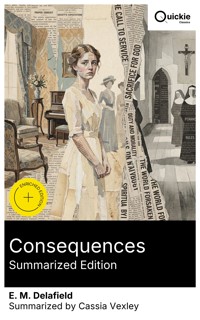
Consequences (1919) follows Alex Clare, a well-bred Edwardian girl whose refusal of an eligible proposal exposes the ruthless calculus allotted to women: marriage or marginality. Delafield tracks Alex from drawing rooms and debutante rites to the rigors of a convent, rendering the tug between piety, desire, and duty with unsparing psychological acuity. The prose blends cool social comedy with an increasingly austere clarity, interrogating the religious and domestic ideologies that shape a life. Situated between late Victorian social critique and interwar psychological fiction, the novel's study of female formation shades, inexorably, toward tragedy. E. M. Delafield (1890–1943), daughter of novelist Mrs. Henry de la Pasture, briefly entered a religious community in 1911 before leaving, and later served as a VAD in the Great War. That experience, coupled with intimate knowledge of upper-middle-class manners, gives the book its authority; satire and sympathy continually test each other. Readers of feminist social fiction, Edwardian cultural history, or the moral psychology of vocation will find Consequences both elegant and unsettling. It rewards close attention with sharp observation, ethical seriousness, and a haunting question about a self denied room to become. Quickie Classics summarizes timeless works with precision, preserving the author's voice and keeping the prose clear, fast, and readable—distilled, never diluted. Enriched Edition extras: Introduction · Synopsis · Historical Context · Brief Analysis · 4 Reflection Q&As · Editorial Footnotes.
Das E-Book können Sie in Legimi-Apps oder einer beliebigen App lesen, die das folgende Format unterstützen:
Veröffentlichungsjahr: 2026
Ähnliche



















Consequences (Summarized Edition)
Table of Contents
Introduction
In Consequences, E. M. Delafield traces the perilous space between the rules that promise a place in the world and the inward hunger that refuses to be pacified, showing how a well-brought-up girl, trained to please, to be good, and to be useful, is left to navigate a maze where every correct step narrows her path, while every falter exposes her to judgment, so that belonging itself becomes a test she can neither pass nor renounce, and the small decisions of daily life accumulate into a quiet reckoning about who is allowed to exist on her own terms.
First published in 1919, this is a work of literary fiction with a distinctly psychological bent, set within the drawing rooms, schools, and pious institutions of early twentieth-century England. Delafield writes from the immediate aftermath of the First World War, yet her focus is domestic, attentive to the fabric of class expectations and the social education of girls who are taught to treat marriage or service as the only acceptable horizons. The novel’s world is recognizably upper-middle-class, managed by propriety and small sanctions, and its concerns align with the era’s social novel, while anticipating the cool, incisive ironies of Delafield’s later work.
A young daughter of a comfortable English household grows from nursery games to the brittle poise of adolescence, absorbing the lesson that charm, obedience, and usefulness confer security. When she falters at this curriculum—whether at school, in friendships, or under the gaze of relations—she is steered toward sanctioned roles that promise safety at the price of self-forgetting. Delafield’s narration is measured and exact, cool on the surface and deeply compassionate beneath, with a keen ear for conversational evasions and the small shames that train a character. The reading experience is quiet, immersive, and cumulative, tracing interior weather rather than outward spectacle.
The novel’s abiding themes include the education of girls into self-effacement, the narrow calculus of class respectability, and the fraught search for vocation—whether social, emotional, or spiritual—when no vocabulary is provided for authentic desire. Delafield examines how kindness can shade into control, how guardianship can become a discipline of invisibility, and how ideals of goodness may leave a young person stranded between longing and duty. The title gestures toward the accumulation of outcomes that follow seemingly minor choices, asking what happens when each accommodation, harmless alone, adds to a pattern that fixes a life more firmly than any single decision.
For readers now, the book’s questions remain urgent: how do young people, especially young women, form selves under relentless scrutiny; which institutions offer care, and which merely offer containment; what becomes of those who cannot translate inner need into acceptable goals. Delafield’s clarity about ambivalence and loneliness feels strikingly contemporary, illuminating the subtle mechanisms by which families and communities define normality and punish deviation while believing they act for the best. The novel invites reflection on mental well‑being, agency, and the ethics of support, prompting readers to consider the difference between being helped to choose and being chosen for.
Formally, Delafield favors unshowy precision: scenes of conversation, household routine, and social instruction carry the weight of a psychological novel, with time marked by birthdays, visits, and the rites of a well-ordered life. Her irony is unsentimental but never cruel, and her restraint allows the reader to feel pressure building through implication rather than proclamation. Dialogue is deft, revealing character through half-answers and the polite refusal to notice distress; description is economical, attentive to rooms and gestures. The result is a narrative that seems simple on the surface and grows, chapter by chapter, into a study of invisible compulsion.
Approached on its own terms, Consequences offers both a portrait of its moment and a mirror for ours, a novel of manners that unfolds into a subtle inquiry about freedom and responsibility. It asks readers to attend to the slow work of formation: how habits are planted, how praise and blame steer choices, how hope persists even when it has no language. Without resorting to melodrama, Delafield makes domestic life consequential, and the quiet page can feel as charged as any public crisis. To read it now is to honor forgotten lives and to weigh the costs of well-meant certainties.
Synopsis
Consequences, first published in 1919 by E. M. Delafield, follows the life of Alex Clare from girlhood into early adulthood, tracing how a sensitive temperament confronts the narrow choices available to a well-bred young woman in early twentieth-century Britain. The novel observes Alex’s world with calm detachment, recording the subtle pressures of family expectation and social ritual. Delafield presents a study of character rather than event-driven melodrama, showing how a yearning for approval and belonging shapes a sequence of decisions. The title signals a quiet accumulation of outcomes, where small, seemingly harmless choices acquire weight in a constricting social order.
As a child, Alex is affectionate, impressionable, and keenly observant, yet uncertain about her own value. Family life offers comfort but little explicit guidance, and ordinary episodes of play and discipline leave her vigilant for cues of acceptance. The education arranged for her emphasizes propriety and self-control. At a convent school on the Continent, Alex encounters a form of devotion that appears to promise clarity, order, and unconditional purpose. Her ardor fixes on exemplary figures who seem to embody certainty. Delafield carefully charts the beginnings of Alex’s self-effacing idealism and the way external standards become internal commandments.
Returning home, Alex enters the social round expected of a young woman of her class. The rituals of introductions, dances, and visits proceed with exacting rules that she struggles to interpret. Her openness and hunger for significance risk misreading polite gestures as intimacy, while the approved pathway—an advantageous marriage—feels both essential and elusive. Familial goodwill is mixed with impatience, and social life reveals its quiet cruelties. Delafield’s narrative remains measured, letting awkward encounters speak for themselves. The season becomes a test of Alex’s ability to perform adulthood according to script, and a reckoning with how much of herself that performance requires.
After disappointments and misunderstandings, Alex evaluates alternatives to the marriage market and turns toward religious life as an arena where sacrifice might be meaningful. The convent offers rhythm and rule, a counterpoint to worldly contingency. Early fervor sits alongside a sincere wish to submit, to be guided into usefulness. Within the community, she finds models of discipline and compassion that confirm her hopes. Delafield presents these developments without caricature, allowing the appeal of renunciation—its simplicity, its promise of wholeness—to appear genuinely persuasive to a temperament like Alex’s, even as the narrative maintains a wary eye on the costs of such surrender.
Over time, the apparently stable refuge reveals its own fluctuations. Personnel change, assignments shift, and spiritual consolation does not always answer to effort. Scruple and conscience intensify, and the same structures that sheltered Alex can magnify her inner tensions. Delafield renders this with psychological precision: the drift from zeal to vigilance, from vigilance to self-reproach. The novel’s tone never turns polemical; it shows an institution neither idealized nor condemned, while keeping focus on the individual who seeks certainties it cannot always supply. Alex measures herself against standards she can describe yet struggles to inhabit, and the strain quietly accumulates.
Parallel to Alex’s spiritual course, the outer world advances. Family members pursue marriages, careers, and practical arrangements, illustrating a spectrum of possibilities that confirm how limited Alex’s options have become once she steps away from the conventional path. Occasional visits and letters underscore disjunctions of sympathy and understanding. Chance meetings and modest turning points suggest other lives she might have led, without offering easy exits. Delafield’s restraint allows the reader to perceive the narrowing of prospects without overt dramatization. The question becomes not simply what Alex will choose, but what can be chosen after certain avenues are closed by time, temperament, and circumstance.
Consequences endures as a lucid portrait of the pressures shaping women’s lives in its period, and as a compassionate study of dependence, duty, and the longing to be necessary. Without sensational revelation, Delafield shows how ideals—romantic, familial, or religious—can support and endanger a person who invests in them without reserve. The novel’s closing movement is sober and unsentimental, but its power lies less in events than in the accumulation of insight. It remains resonant for readers interested in how institutions, expectations, and self-conception intersect, and in how the desire to do right can lead, step by step, to unforeseen ends.
Historical Context
Consequences, published in 1919 by the English novelist E. M. Delafield, is set primarily in late Edwardian Britain, with scenes that extend to a Catholic convent on the Continent. The story’s social geography runs from country houses and schoolrooms to drawing rooms and the London Season, the annual round of balls, calls, and presentations at Court that organized elite social life. Its religious geography reflects the continued presence of Roman Catholic institutions accessible to British women abroad, including Belgium. These settings anchor the narrative in recognizable pre-war structures, framing a young woman’s limited avenues within the intertwined hierarchies of family, society, and church.
Upper- and upper-middle-class girls in late Victorian and Edwardian Britain were commonly educated at home by governesses, sent to girls’ boarding schools, or finished abroad, then launched into society under strict chaperonage. The London Season culminated in presentation at Court to the monarch, a ceremony that signaled eligibility for marriage and entry into elite networks. Formal accomplishments—music, languages, and deportment—were prized over vocational training. Social custom and inheritance practices steered many families to prioritize suitable marriages for daughters, while paid work for genteel women remained limited and often stigmatized. These expectations form the social lattice against which Delafield’s protagonist makes choices.
Roman Catholic convents formed an alternative institutional world that English women could enter, though Catholicism remained a minority faith in Britain. After France’s 1905 law separating Church and State, many French religious orders operated schools and houses in Belgium and elsewhere, drawing British girls as pupils and, in some cases, as postulants. Convent life followed a structured progression—postulancy, novitiate, and vows—and varied by order in its degree of enclosure, silence, and austerity. The disciplined spirituality, clear rules, and communal routine offered a stark contrast to the ambiguities of secular society, making the convent a historically recognizable setting for a crisis of vocation.
E. M. Delafield (born Edmée de la Pasture in 1890) drew on closely observed social milieus throughout her career. In 1911 she briefly entered a convent in Belgium, an experience she soon abandoned and later acknowledged as formative. During the First World War she served in the Voluntary Aid Detachment and worked in a military hospital; her novel The War Workers appeared in 1918. Consequences followed in 1919, written by an author who had firsthand familiarity with both religious life and wartime service. These biographical facts clarify the novel’s confident portrayal of convent discipline and its acute attention to women’s institutional experiences.
Religious questions were volatile in pre-war Britain and Ireland. Pope Pius X’s 1908 decree Ne Temere, regulating the validity of marriages involving Catholics and the religious upbringing of children, sparked widespread controversy and press debate in the United Kingdom. Anti-Catholic sentiment persisted in some circles, and convents—largely private and enclosed—could appear opaque to outsiders. At the same time, Catholic schools and orders had a recognized educational role, especially on the Continent. By placing an Englishwoman within a Roman Catholic house, the novel situates personal faith and discipline within a public context of denominational tension, cultural curiosity, and the politics of mixed confessional society.
The novel appeared just as women’s roles were changing. Before 1914, the suffrage movement ranged from nonviolent campaigning by the National Union of Women’s Suffrage Societies to militancy by the Women’s Social and Political Union. War work from 1914 expanded women’s employment in nursing, administration, and munitions. In 1918 Parliament enfranchised many women over 30 and allowed women to stand for Commons; the 1919 Sex Disqualification (Removal) Act opened professions and juries. Against this backdrop, Delafield’s pre-war setting underscores how recently upper-class girls were trained for marriage or piety rather than vocation, inviting readers in 1919 to reassess those assumptions.
Demography sharpened anxieties about marriage and women’s futures. The 1911 census recorded roughly one million more females than males in England and Wales, a disparity widely discussed as the problem of “surplus women.” After wartime losses, the 1921 census showed about 1.7 million more females than males. Well before those figures, however, the pre-war marriage market was competitive among the gentry, and families invested in finishing schools, language study, and the Season to improve daughters’ prospects. Against this statistical and cultural backdrop, turning to religious life or unpaid “useful work” appeared to many families as the remaining respectable alternatives to marriage.
Consequences belongs to early twentieth-century British fiction that probes women’s inner lives and the social mechanisms constraining them. Eschewing melodrama, Delafield uses closely observed realism to depict how etiquette, parental authority, and religious aspiration can shape a young woman’s course. The novel’s attention to convent routine and to the rituals of elite sociability reflects institutions that defined the Edwardian lifecycle. Its critique is implicit rather than didactic: by showing the costs of conformity and the hunger for meaningful vocation, the book mirrors its era’s debates about duty, freedom, and identity, and it questions the adequacy of the roles offered to women.




