


0,49 €
Mehr erfahren.
- Herausgeber: Booksell-Verlag
- Kategorie: Geisteswissenschaft
- Sprache: Englisch
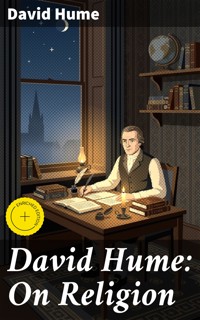
In "David Hume: On Religion," renowned philosopher David Hume presents a critical examination of religious belief through his signature empirical lens. The book engages with major theological concepts, unsettling dogmatic doctrines while advocating for a rational approach to understanding faith. Employing a rich blend of philosophical essay, polemic, and intellectual inquiry, Hume's literary style is characterized by its clarity and eloquence, making complex ideas accessible. Positioned within the Enlightenment tradition, this work grapples with the tension between human reason and religious belief, challenging contemporary thought and laying the groundwork for future philosophical discourse. Hume, a central figure of the Scottish Enlightenment, was profoundly influenced by the empirical methods of observation and skepticism toward established norms. His own experiences and the intellectual climate of 18th-century Scotland, marked by burgeoning ideas of personal liberty and human rationality, inspired his critical stance on religion. Straddling the delicate interplay of faith and reason, Hume'Äôs inquiries reflect both a personal and philosophical struggle with the nature of belief. "David Hume: On Religion" is a must-read for anyone interested in philosophy, theology, or the historical context of religious thought. Hume's incisive reasoning and engaging prose invite readers to ponder their convictions while cultivating a deeper understanding of the human condition. In this enriched edition, we have carefully created added value for your reading experience: - A succinct Introduction situates the work's timeless appeal and themes. - The Synopsis outlines the central plot, highlighting key developments without spoiling critical twists. - A detailed Historical Context immerses you in the era's events and influences that shaped the writing. - An Author Biography reveals milestones in the author's life, illuminating the personal insights behind the text. - A thorough Analysis dissects symbols, motifs, and character arcs to unearth underlying meanings. - Reflection questions prompt you to engage personally with the work's messages, connecting them to modern life. - Hand‐picked Memorable Quotes shine a spotlight on moments of literary brilliance.
Das E-Book können Sie in Legimi-Apps oder einer beliebigen App lesen, die das folgende Format unterstützen:
Veröffentlichungsjahr: 2023
Ähnliche



![Ensayos morales [Selección] - David Hume - E-Book](https://legimifiles.blob.core.windows.net/images/33abc671d35f985787e83435514da62b/w200_u90.jpg)





David Hume: On Religion
Table of Contents
Introduction
This volume gathers two of David Hume’s most influential works on religion, The Natural History of Religion and Dialogues Concerning Natural Religion, to present in one place the central lines of his philosophical engagement with religious belief. Read together, these texts show Hume approaching the subject from complementary angles: one tracing religion as a phenomenon of human life and society, the other testing arguments about the divine through structured conversation. The purpose of collecting them is not to merge distinct projects, but to allow readers to follow the continuity of questions, methods, and critical standards that animate Hume’s treatment of religion across different forms of writing.
The scope of the collection is deliberately focused rather than comprehensive. It does not aim to reproduce Hume’s entire corpus or to serve as a general introduction to his philosophy, but to concentrate on his mature reflections on religion as they appear in these two standalone works. In bringing them together, the collection makes it easier to compare Hume’s explanatory ambitions in one text with his argumentative scrutiny in the other, and to see how each work illuminates the other’s strengths and limitations. The result is a compact set of readings that foreground the coherence of Hume’s concerns while preserving the independence of each work’s design.
The Natural History of Religion is a philosophical essay that treats religion as a subject for inquiry into human nature and social life. Its guiding premise is that religious practices and beliefs can be investigated by attending to the tendencies, fears, hopes, and habits that characterize ordinary human experience, and by considering how such tendencies may shape communal life over time. Hume’s interest is not in providing a devotional account, but in asking how religious forms arise and why they persist. The essay’s orientation is explanatory and comparative in spirit, inviting the reader to examine religion as an object of historical and psychological reflection.
Dialogues Concerning Natural Religion, by contrast, belongs to the tradition of philosophical dialogue. Instead of advancing a single continuous argument in the author’s own voice, it explores questions about natural religion by staging a conversation among interlocutors who represent differing philosophical temperaments and positions. This form allows Hume to present arguments and objections in close proximity, to test their force, and to show how philosophical disagreement can persist even when the parties share standards of reasoning. The work is not a narrative in the manner of a novel, but a carefully constructed exchange designed to examine what can be established by reasoned inquiry about the divine.
Taken together, these two works display the range of genres through which Hume addressed religion: the essay and the dialogue. Both genres are suited to philosophical investigation, but they invite different modes of reading. The essay encourages the reader to follow a sustained line of explanation and evaluation, attending to how general claims are supported by reflections on human conduct and social patterns. The dialogue encourages the reader to weigh competing considerations, to notice how conclusions depend on assumptions, and to observe how argumentation changes when it must answer a live opponent. The collection thus shows Hume as both analyst and dramatist of reasoning.
A unifying theme across the volume is the demand that claims about religion be assessed with the same care that governs inquiry elsewhere. Hume repeatedly turns attention to the sources of belief, the strength of evidence, and the limits of what can be inferred from experience. He asks not only what people believe, but why they believe it and what justifications are offered in its support. This orientation ties the two works together: the natural history examines religious belief as a human phenomenon with discernible causes, while the dialogues examine whether philosophical arguments can secure conclusions about a divine reality by reasoning from the world as we experience it.
Another shared concern is the relation between philosophical reflection and ordinary human life. Hume’s analyses proceed from observations about common sentiments and patterns of thought, and they keep in view the way abstract reasoning interacts with imagination, emotion, and custom. Without reducing religion to a single motive or outcome, the works invite readers to consider how intellectual arguments and practical concerns intertwine. The collection thereby presents religion not as an isolated domain, but as a field in which metaphysical questions, ethical sensibilities, and social practices meet. That breadth of perspective helps explain why these texts remain central to discussions of religion in modern philosophy.
Stylistically, the volume exhibits Hume’s characteristic clarity and measured control. His prose aims for precision without needless technicality, and he frequently guides the reader by careful distinctions and orderly transitions. In the essay, this produces an economical argumentative flow that moves between general considerations and illustrative reflections. In the dialogue, it produces a disciplined contest of ideas that remains readable even when the issues are difficult. Across both works, Hume’s restraint is significant: rather than relying on rhetorical excess, he presses questions by insisting on intelligible standards of reasoning, and by letting implications emerge through sustained examination.
The dialogue form also highlights another hallmark of Hume’s approach: the use of philosophical drama to reveal the strengths and vulnerabilities of different viewpoints. By giving space to contrasting interlocutors, the Dialogues make room for arguments that might otherwise be dismissed too quickly, and for doubts that might otherwise remain unspoken. The reader is prompted to engage in active evaluation rather than passive assent, since no single speaker can be treated as a simple mouthpiece for final answers. This method aligns with the collection’s broader purpose: to cultivate critical reflection on religious reasoning, and to demonstrate how philosophical inquiry proceeds amid disagreement.
The lasting significance of these works lies in their influence on how religion is studied and debated. The Natural History of Religion helped establish a way of treating religious belief as a subject that can be examined in relation to human psychology and social development, without presupposing the truth of particular doctrines. The Dialogues Concerning Natural Religion stands as a major contribution to philosophical theology and the critique of it, because it tests prominent strategies for arguing about God by appealing to experience and reason. Together, the texts have shaped subsequent conversations in philosophy of religion, moral psychology, and the history of ideas.
At the same time, this collection is valuable as an introduction to Hume’s broader intellectual sensibility. Readers encounter his concern for the limits of human understanding, his insistence that arguments be proportioned to the evidence available, and his interest in the interplay between reason and sentiment. Even when the immediate topic is religion, the underlying questions are methodological: what kinds of explanations are appropriate, what counts as a good inference, and how should one respond when evidence underdetermines conclusion. In that way, the volume provides access to a general Humean stance toward inquiry, one that has continued to attract both defenders and critics.
This edition invites readers to approach the works in their own terms while attending to their mutual resonance. The Natural History of Religion sets a broad explanatory frame for thinking about religious belief as a feature of human life, while Dialogues Concerning Natural Religion focuses the reader’s attention on the structure of arguments about divine attributes and design. Placed side by side, they allow a more complete view of Hume’s engagement with religion than either work can supply alone. The collection’s purpose is therefore scholarly and reflective: to make available, in a single volume, two complementary masterpieces of philosophical prose that continue to define the field’s questions and standards.
Author Biography
David Hume (1711–1776) was a Scottish philosopher, historian, and essayist whose work became central to the Enlightenment and to later debates in epistemology, moral philosophy, and the philosophy of religion. He is widely associated with empiricism and with a skeptical method that tests the limits of human understanding by examining experience, habit, and the workings of the mind. Hume wrote in a lucid, carefully argued prose intended for educated readers beyond academic specialists. His enduring significance lies in the way he reshaped discussions of evidence, causation, and religious belief.
Hume was educated in Scotland and studied at the University of Edinburgh. He was formed by the intellectual environment of the Scottish Enlightenment and by earlier British and continental thinkers who emphasized observation and critical inquiry. Rather than presenting philosophy as a set of inherited doctrines, he approached it as an investigation into human nature—how people actually think and judge—while remaining attentive to the social and historical contexts in which beliefs arise. This general orientation would shape his later treatment of religion, where he examines belief as a human phenomenon open to naturalistic explanation and scrutiny.
In early adulthood Hume pursued a life of letters, refining a philosophical project that sought to place the study of the mind on a more systematic footing. He also established himself as a public intellectual through essays and, later, major historical writing, gaining a broad readership. His work often met resistance from religiously conservative audiences, yet it circulated widely and influenced contemporaries and successors. Across his genres—philosophical inquiry, essays, and history—Hume’s method remained consistent: careful analysis of evidence, attention to psychological mechanisms, and a preference for explanations grounded in human experience.
Hume’s approach to religion is especially evident in The Natural History of Religion, where he investigates religious belief as an outcome of ordinary human passions and social circumstances rather than as a direct product of rational demonstration. He is concerned with how fears, hopes, and uncertainties can prompt people to infer invisible powers behind events, and how these interpretations can become organized into shared practices. The work reflects his broader interest in explaining complex cultural phenomena by appeal to general features of human psychology and to the dynamics of community life, without relying on theological premises.
Dialogues Concerning Natural Religion presents Hume’s examination of arguments about God through a philosophical conversation among characters who represent different positions. The dialogue form allows him to weigh competing claims—especially those that infer a designer from the apparent order of nature—while highlighting questions about what kinds of conclusions the available evidence can support. Without depending on dogmatic assertion, the work probes the strength and limits of analogical reasoning, the problem of inferring attributes of a cause from effects, and the difficulties of moving from observations of the world to confident theological doctrines.
Hume’s writings on religion were controversial in his lifetime, in part because they challenged the idea that traditional theological claims could be established by reason alone. Yet his influence grew through the very rigor and restraint of his skeptical method, which forced later thinkers to refine their accounts of proof, inference, and the justification of belief. His style helped make philosophical discussion accessible and pointed, and his willingness to analyze religion with the same critical tools used elsewhere contributed to the development of modern philosophy of religion and to broader secular approaches in the study of culture.
In his later years Hume remained an important figure in British intellectual life and continued to be read as both a philosopher and a man of letters. After his death in 1776, his work continued to shape debates about knowledge, scientific reasoning, and the rational assessment of religious claims. The Natural History of Religion and Dialogues Concerning Natural Religion remain especially influential for their combination of psychological insight and argumentative discipline. Hume’s legacy endures wherever thinkers ask how far evidence can take us, how beliefs form and persist, and what intellectual humility demands in the face of uncertainty.
Historical Context
David Hume’s writings on religion belong to the European Enlightenment of the eighteenth century, when learned debate increasingly emphasized experience, historical inquiry, and the limits of traditional authority. In Britain, the 1688–89 Revolution settlement and subsequent party politics were intertwined with confessional questions, while universities, churches, and law courts still enforced boundaries of orthodoxy. Hume’s career unfolded amid expanding print culture, coffeehouse discussion, and the growth of polite letters, all of which encouraged public scrutiny of theology. The works gathered in “David Hume: On Religion” reflect this setting by treating religion as a subject for philosophical analysis and historical explanation rather than solely devotion or ecclesiastical instruction.
David Hume (1711–1776) was educated in Scotland, a society shaped by the 1707 Acts of Union and by Presbyterian institutions that strongly influenced public life. The Scottish Enlightenment—associated with figures such as Francis Hutcheson and later Adam Smith—developed ambitious programs for moral philosophy, political economy, and “conjectural history” of social development. These currents favored explanations grounded in human nature and social causes, a method Hume applied to religion in The Natural History of Religion (first published in 1757). At the same time, Scotland’s ecclesiastical courts and university appointments could be hostile to unorthodox ideas, a pressure that contributed to Hume’s careful publication strategies and his preference for indirect argument in Dialogues Concerning Natural Religion (published posthumously in 1779).
The intellectual background includes the Scientific Revolution’s legacy and the prestige of Isaac Newton’s physics. By the early eighteenth century, Newtonianism had become a model for reasoning about nature, and many theologians developed “natural theology,” arguing that order in the world supports belief in a designing deity. Debates about miracles, providence, and the rationality of religious belief were intensified by the spread of experimental philosophy and new standards of evidence. Hume’s earlier philosophical work, especially A Treatise of Human Nature (1739–40) and later the Enquiry concerning Human Understanding (1748), shaped his approach by emphasizing skepticism about causal inference and the limits of human reason. The religion essays in this collection extend those epistemological concerns into the public controversies of his time.
Britain’s confessional landscape remained contested after the Reformation, and the later seventeenth and early eighteenth centuries saw recurring tensions between established churches, dissenting Protestants, and Catholics. Laws restricting Catholics and some dissenters remained in force, even as the Toleration Act of 1689 allowed certain Protestant groups to worship outside the Church of England. The memory of civil wars and religious violence made arguments about enthusiasm, superstition, and clerical power politically charged. Hume’s religious writings repeatedly draw on the theme that religion can influence social stability and political authority, a theme also developed in his multi-volume History of England (published 1754–62). The Natural History of Religion, in particular, treats religious forms as historically variable, implying that no single confession can claim an uncontested monopoly on truth or social utility.
The Enlightenment’s “republic of letters” widened the audience for controversial discussion. Periodicals, pamphlets, and improved distribution networks helped ideas circulate among educated readers beyond clerical and academic settings. Booksellers and printers, however, faced censorship risks, and authors sometimes used anonymity, delayed publication, or dialogical forms to manage the dangers. Hume’s Dialogues Concerning Natural Religion exemplify this environment: the conversational structure allows competing positions to be aired without an explicit authorial declaration, a device with precedents in classical dialogues and early modern philosophical debates. The Natural History of Religion, though more direct in method, still adopts a tone of philosophical inquiry rather than doctrinal refutation, aligning with the era’s conventions of “polite” skepticism and learned critique.
European intellectual life also included the impact of the Dutch and French traditions of critical scholarship and religious skepticism. Spinoza’s seventeenth-century biblical criticism and Pierre Bayle’s late-seventeenth-century skeptical erudition influenced how educated readers approached claims about revelation and church history. In France, debates among philosophes about superstition, toleration, and the social role of religion were prominent by mid-century, with works such as Voltaire’s writings pressing for civil reform. Hume traveled and served in diplomatic-related roles in France in the 1760s, entering a milieu where skepticism and religious critique were more openly discussed in elite circles than in Britain. His writings on religion participate in this transnational conversation, while remaining shaped by the distinctive legal and ecclesiastical constraints of the British context.
A major stimulus for eighteenth-century reflection on religion was expanding knowledge of global cultures through travel literature, missionary reports, and colonial administration. Accounts of indigenous religions in the Americas, Africa, and Asia provided comparative material that challenged the assumption that European Christianity was the default human condition. Scholars and philosophers drew on such sources to propose naturalistic explanations of religious origins and diversity. The Natural History of Religion reflects this comparative impulse by treating polytheism, superstition, and “refined” theism as developments influenced by human psychology and social circumstances. Hume’s use of historical and cross-cultural examples fits broader Enlightenment efforts to create universal histories of society and belief, though it also depends on the uneven reliability and bias of contemporary sources.
Hume wrote at a time when “natural religion” was widely debated among Anglicans, dissenters, and deists. Deist writers in the late seventeenth and early eighteenth centuries argued that reason and nature, rather than revelation, are sufficient for core religious truths, provoking rebuttals from church apologists. Thinkers such as Samuel Clarke offered influential arguments for God’s existence, including versions of cosmological reasoning, while others emphasized design in nature. The Dialogues engage this intellectual world by examining the strengths and limitations of design-based reasoning and by exploring how far analogical inference can legitimately go. Hume’s treatment mirrors the period’s disputes over whether theology could be made to meet the evidential standards increasingly demanded in philosophy and science, without depending on sectarian premises.
The mid-eighteenth century also saw intense discussion of religious emotion and mass movements, including concerns about “enthusiasm” associated with revivalism. In Britain and North America, Methodist and evangelical revivals (from the 1730s onward) drew large crowds and emphasized conversion experiences, which some critics saw as socially disruptive or intellectually suspect. This context made the psychological sources of belief a live question, not merely an abstract philosophical issue. The Natural History of Religion responds by emphasizing fear, hope, and the pressures of uncertainty as drivers of religious imagination, offering a framework that could be applied to both ancient polytheism and contemporary forms of popular piety. By locating religion’s origins in common human passions, Hume aligned with Enlightenment efforts to explain belief through natural causes rather than supernatural intervention.
Hume’s standing in Scotland illustrates the era’s institutional stakes. He sought academic positions, including attempts in the 1740s and early 1750s, but faced opposition connected to suspicions of irreligion. Presbyterian clergy and university authorities could mobilize against appointments perceived as threatening to moral and doctrinal order. These experiences encouraged caution and a preference for arguments that could be framed as philosophical rather than polemical. The publication of The Natural History of Religion in 1757, as part of a set of essays on broader themes, occurred in a climate where explicit denial of central doctrines could bring social and professional penalties. The Dialogues’ delayed publication likewise reflects how authorial risk persisted even for established figures in the literate public sphere.
The year 1757, when The Natural History of Religion appeared, was also marked by the Seven Years’ War (1756–63), a global conflict entangling empire, commerce, and state power. Wartime politics often intensified patriotic uses of Protestant identity in Britain, while also raising questions about providence and national destiny. Hume’s essay does not treat the war directly, but its larger message—that religious forms are historically contingent and rooted in human passions—stood against simple providential readings of events. In the broader eighteenth-century pattern, histories of religion were increasingly written as part of civil history, linking belief to institutions, conflict, and social change. Hume’s approach thus aligned with a historiographical movement that sought to explain religious development without relying on confessional narratives of divine guidance.
Dialogues Concerning Natural Religion was composed over a long period, with Hume working on it by the 1750s and continuing revisions into the 1770s. This prolonged composition reflects both the complexity of the subject and the sensitivity of publishing it during his lifetime. In the later eighteenth century, disputes over skepticism and faith remained intense, and high-profile controversies could have legal and reputational consequences. Hume’s decision to have the Dialogues published after his death, with its eventual appearance in 1779, corresponds to a period when Enlightenment critique and orthodox rebuttal were both well developed. The work’s careful staging of multiple voices allowed it to enter this contentious arena while leaving interpretive space for readers, a strategy shaped by the risks and norms of the time.
Across both texts, Hume’s method reflects broader Enlightenment confidence in studying “human nature” as the basis for morals, politics, and belief. Scottish thinkers developed moral-sense theories and theories of sociability, while also refining approaches to historical explanation that linked institutions to underlying motives. The Natural History of Religion uses this framework to account for why certain kinds of religious ideas arise under conditions of insecurity, ignorance of causes, or social dependency. The Dialogues apply similar methodological caution to metaphysical claims, emphasizing the limits of analogy and the difficulty of inferring divine attributes from finite experience. Together, the works show how Enlightenment philosophy combined psychological explanation with skepticism about speculative systems, in contrast to earlier scholastic or purely doctrinal approaches to theology.
Technological and economic changes also formed part of the background, even when not foregrounded in the arguments. Eighteenth-century Britain experienced growth in commerce, finance, and urban life, alongside improvements in communication and the spread of consumer goods. These developments supported a larger reading public and encouraged “polite” venues for debate, from clubs and salons to expanding libraries. They also altered the social authority of clergy and traditional elites as new professional classes emerged. Hume’s analyses of religion as tied to social passions and institutional power resonated with these shifts, since religion could be examined as one cultural system among others within a changing civil society. The emphasis on historical variation in The Natural History of Religion fits an era increasingly attentive to how economic and social environments shape belief and practice.
Hume’s works also interacted with contemporary legal and moral debates about toleration and civil peace. While Britain did not adopt full religious equality in the eighteenth century, arguments for broader toleration gained ground among some intellectuals and politicians, partly as a response to memories of sectarian conflict. By treating religion as a human phenomenon with diverse manifestations, The Natural History of Religion implicitly undercut claims that any single church’s authority was self-evident or universally binding. The Dialogues, by questioning the reach of natural theology, contributed to disputes about what can be established by reason alone in a plural society. These contributions mattered in a context where public order was often imagined as linked to religious uniformity, yet commercial and imperial realities made diversity increasingly unavoidable.
The reception of Hume’s religious writings was shaped by the prominence of apologetics and by organized responses to skepticism. Clerical writers and philosophers continued to defend design arguments and the credibility of religious belief, and in Britain the culture of sermons, universities, and learned societies sustained a strong apologetic literature. Hume’s arguments about evidence, inference, and the psychology of belief were repeatedly discussed by supporters and critics in the later eighteenth century. The Dialogues, once published, became a focal point for debate because it concentrated many issues of natural theology into a compact, vivid form. The Natural History of Religion, meanwhile, contributed to longer-term developments in the academic study of religion by modeling a program of explanation that emphasized causes, functions, and historical change over doctrinal truth-claims.
In the nineteenth century, readers encountered Hume through new intellectual currents, including German biblical criticism, comparative philology, and anthropology, which offered additional tools for studying religion historically. While these movements developed independently, they found in Hume an early example of analyzing religion without presupposing revelation as the explanatory key. British debates over reform and education also broadened access to philosophical texts, and editions of Hume circulated widely. At the same time, many theologians continued to treat Hume as a central skeptic to be answered, especially on arguments from design and on the limits of reasoning from experience. The collection’s two texts thus sat at an intersection: they were used both as resources for secular scholarship and as challenges within ongoing apologetic traditions, reflecting the enduring ambiguity of Enlightenment critiques in later cultural battles over faith and reason.
Synopsis (Selection)
The Natural History of Religion
Hume offers a naturalistic account of how religious belief arises and changes by tracing it to ordinary human psychology, social pressures, and the uncertainties of life. He contrasts different kinds of religious outlooks and follows how fear, hope, and imagination can push communities toward varied forms of worship and doctrine. The tone is explanatory and diagnostic, treating religion as a human phenomenon to be analyzed rather than a set of revealed truths to be defended.
Dialogues Concerning Natural Religion
In a structured conversation among sharply opposed interlocutors, Hume tests the strongest philosophical arguments for and against claims about God drawn from nature, especially reasoning from design and the order of the world. As the discussion shifts, each position is pressed on its assumptions, limits of analogy, and what—if anything—human reason can legitimately infer about divine attributes. The tone is probing and ironic, emphasizing intellectual humility, the fragility of metaphysical certainty, and the tension between speculative theology and empirical standards of evidence.
Recurring Themes Across the Collection
Across both works, Hume treats religion as continuous with human cognitive habits, asking how belief is formed, justified, and sustained under the constraints of limited experience and fallible inference. He favors careful scrutiny of evidence and highlights how emotion, custom, and imagination can outpace what reason can securely establish. The collection moves from a broad explanatory “genealogy” of religious belief to a tightly staged philosophical stress-test of natural theology, showcasing his skeptical method in both historical and dialogic forms.




