


5,49 €
Mehr erfahren.
- Herausgeber: Rock Rooster Books
- Kategorie: Religion und Spiritualität
- Serie: Dear Theophilus
- Sprache: Englisch
Explore the Gospel of Luke like never before.
Have you ever wondered what it would be like to walk alongside Jesus during his time on earth? In this insightful Bible study, you will discover the heart of Christ and the profound impact he had on those around him.
Embark on a transformative 40-day journey through the book of Luke with DEAR THEOPHILUS, a captivating Bible study by Peter DeHaan.
Through 40 key passages, delve deep into the life of Jesus, gaining fresh perspectives and practical insights that will shape your faith and transform your daily walk with God.
From the moment of Jesus's arrival to his ultimate victory over death, each chapter of DEAR THEOPHILUS offers a thought-provoking exploration of Luke’s biography of Jesus. You'll witness the miracles, teachings, and profound moments of Jesus's life in a whole new light.
Whether you're seeking to deepen your understanding of the Bible or longing for a closer relationship with Jesus, this Bible study is a must-read.
Embark on a spiritual journey that will renew your hope, strengthen your faith, and draw you closer to the heart of God.
Discover the certainty of Christ's love and sacrifice for you as you immerse yourself in DEAR THEOPHILUS. Get ready to experience the timeless truths of the Gospel of Luke in a way that will leave you forever changed.
This Bible study is perfect for both personal reflection and group study. Bonus sections enhance your understanding of key themes and passages in the book of Luke.
Start your journey of discovery and embrace the life-transforming power of Jesus.
Get your copy of DEAR THEOPHILUS today.
[This book has also been published as That You May Know.]
Das E-Book können Sie in Legimi-Apps oder einer beliebigen App lesen, die das folgende Format unterstützen:
Seitenzahl: 132
Veröffentlichungsjahr: 2019
Ähnliche





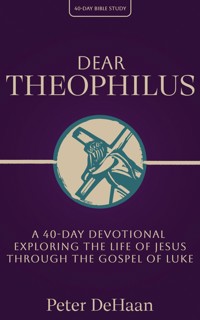
DEAR THEOPHILUS
A 40-DAY DEVOTIONAL EXPLORING THE LIFE OF JESUS THROUGH THE GOSPEL OF LUKE
40-DAY BIBLE STUDY SERIES
BOOK 1
PETER DEHAAN
DearTheophilus: A 40-DayDevotionalExploring the Life of Jesus through the Gospel of Luke © 2018, 2025 by PeterDeHaan.
SecondEdition
Book 1 in the 40-DayBibleStudySeries.
All rights reserved: No part of this book may be reproduced, disseminated, or transmitted in any form, by any means, or for any purpose without the express written consent of the author or his legal representatives. The only exception is short excerpts and the cover image for reviews or academic research.
Scriptures are taken from the HolyBible, NewInternationalVersion®, NIV®. Copyright © 1973, 1978, 1984, 2011 by Biblica, Inc.™ Used by permission of Zondervan. All rights reserved worldwide. www.zondervan.com The “NIV” and “NewInternationalVersion” are trademarks registered in the UnitedStatesPatent and TrademarkOffice by Biblica, Inc.™
ISBN:
Published by RockRoosterBooks
Credits:
ToLauraAlexander
CONTENTS
Who Is Luke?
Day 1: So That You May Know
Part 1 Jesus Arrives
Day 2: John Points People to Jesus
Day 3: The Messiah is Coming
Bonus Content: Mary’s Road Trip
Day 4: Celebrate Jesus
Bonus Content: Two More Witnesses
Day 5: Tween Jesus
Day 6: The Real Message of John the Baptist
Day 7: The Mystery of Jesus’s Baptism
Day 8: Strike Three
Part 2: Jesus Serves
Day 9: People Try to Kill Jesus
Day 10: Jesus’s First Miracles
Bonus Content: The Miracles of Jesus
Day 11: Fishing for People
Day 12: To Forgive and to Heal
Day 13: The Sermon on the Plain
Bonus Content: Sabbath or Sunday?
Day 14: Faith or Grace?
Day 15: Jesus Assures John the Baptist
Day 16: Anointing Jesus
Bonus Content: The Women Who Anoint Jesus
Day 17: The Parable of the Sower
Day 18: Are You My Family?
Day 19: Who Is Jesus?
Bonus Content: A Transfer of Authority and Power
Day 20: See the Kingdom of God
Day 21: Love Your Neighbor
Day 22: Priorities Matter
Day 23: The Lord’s Prayer
Day 24: The Antidote to Worry
Day 25: A Narrow Door and a Huge Feast
Bonus Content: The Parables of Jesus
Day 26: Count the Cost
Day 27: Lost and Found
Day 28: Eternal Consequences
Day 29: Ten Lepers
Day 30: Jesus Warns of His Death
Part 3: Jesus Overcomes Death
Day 31: Like a Rock Star
Day 32: Our Cornerstone
Bonus Content: The Old Testament Cited in Luke
Day 33: Be Ready
Day 34: Judas Sells Out
Day 35: The Last Supper Is the First Communion
Day 36: Two Failures and Two Responses
Bonus Content: Two Swords and One Ear
Day 37: Jesus’s Prayer
Day 38: Two Responses to Punishment
Bonus Content: Agenda Versus Justice
Day 39: Jesus’s Death and Burial
Day 40: Eyewitnesses to Resurrected Jesus
Epilogue: A Special Gift
The 40-Day Bible Study Series
For Small Groups, Sunday School, and Classrooms
If You’re New to the Bible
About the Author
Books by Peter DeHaan
Series by PeterDeHaan
40-DayBibleStudySeriestakes a fresh and practical look into Scripture, book by book.
BibleCharacterSketchesSeriescelebrates people in Scripture, from the well-known to the obscure.
HolidayCelebrationBibleStudySeriesrejoices in the holidays with Jesus.
VisitingChurchesSeries takes an in-person look at church practices and traditions to inform and inspire today’s followers of Jesus.
Be the first to hear about Peter’s new books and receive updates at PeterDeHaan.com/updates.
WHO IS LUKE?
Paul is the most prolific writer in the NewTestament. Who’s second? That would be Dr. Luke.
Luke wrote a biography of Jesus, called “TheGospelAccording to Luke” (or simply “Luke”). Later he reported on the activities of the early church in “TheActs of the Apostles” (or just “Acts”). These two books account for about 25 percent of the content in the NewTestament and give us valuable historical information about Jesus and his followers. Luke’s writing provides a compelling two-book set that can inform our faith and enlighten the practices of our church community.
Luke was a doctor and the only non-Jewish writer in the NewTestament. As such, his words are that of an outsider, which may more readily connect with those on the outside, that is, non-Jews. This includes me, and it may include you. Luke wrote with simple, yet captivating language. He also gives us details not found in the other three biblical biographies of Jesus (Matthew, Mark, and John).
However, despite having penned two major books in the Bible—and the longest two in the NewTestament—we don’t know much about Luke. He’s only mentioned three times in the Bible.
This is what we know:
First, we learn that Luke is a dear friend of Paul; second, he’s a doctor (Colossians 4:14). Third, he’s esteemed by Paul as a fellow worker (Philemon 1:24). Last, in one of his darker hours, Paul laments that everyone is gone, and only Luke has stayed with him (2 Timothy 4:11). As such, we see Luke as a faithful, persevering friend. Luke emerges as a man of noble character.
We also know that Luke is a firsthand observer in many of the events he records in the book of Acts. We see this through his first-person narratives in some passages when he uses the pronoun “we.” (Read more about Luke and the book of Acts in this book’s sequel, DearTheophilus, Acts: 40 DevotionalInsights for Today’sChurch.)
AlthoughLuke wasn’t a church leader or an apostle, his contribution to our faith and our understanding of Jesus and his church is significant. Dr. Luke’s ministry function wasn’t leading or preaching. Instead, he played a silent and almost unnoticed supporting role.
Though his work was quiet, his legacy lives on, loudly influencing Jesus’s followers two millennia later.
Do we sometimes feel like an outsider? What can we do to leave a faith legacy that will influence others after we die?
[DiscoverLuke’s first-person accounts in Acts 16:10–17, 20:4–15, 21:1–18, 27:1–29, 27:37, and 28:1–16.]
DAY 1: SO THAT YOU MAY KNOW
Luke 1:1–4
. . . so that you may know the certainty of the things you have been taught. (Luke 1:4)
It’s easy to miss the first four verses in the book of Luke. In many Bibles, this passage carries the heading of “Introduction.” Most people skip introductions. I know. I usually do.
Even if we read these first four verses, we typically read them fast. We want to get to the good stuff about John the Baptist that starts in verse five, so we can get to the really good stuff about Jesus that starts in chapter two.
We need to slow down.
Luke starts his book admitting that many others have undertaken the task of writing about the life of Jesus. We don’t know if they finished their works or what happened to their writings, but we do know Luke wants to write his own account—one thoroughly researched and backed by eyewitnesses to what Jesus said and did.
As a non-Jew, Luke carries with him the detached perspective of a religious outsider. And as a doctor he possesses the training to note details and create an accurate record. He confirms that he carefully investigated everything to write an orderly account about Jesus.
Why?
ForTheophilus.
Who?
TheBible tells us nothing about Theophilus, but Luke addresses both his books to this mysterious person. The reason is significant. Luke wants Theophilus to know—for certain—the things he was taught.
Think about that.
People told Theophilus about Jesus. PerhapsTheophilus believes, but maybe he still isn’t convinced. He might carry a tinge of doubt about this Jesus, the man who changed religion into a relationship. It’s so countercultural that it’s revolutionary. Regardless, Luke feels it’s worth his time to help Theophilus know Jesus—for sure.
If you’ve ever had doubts—and, if we’re being honest, we all have at one time or another—wouldn’t it be amazing to know for sure? Who wouldn’t want to chase away lingering worries about our faith and replace them with confident conviction? That’sLuke’s goal. And that’s precisely why we should read the book of Luke.
This is a grand undertaking that Luke made. Not only did he spend time writing a book, but even more so, he did the required research.
Luke’s biography of Jesus is the longest book in the NewTestament, at just under 20,000 words. His sequel, “TheBook of Acts,” is the second longest. Together they’re almost the length of a short novel. That’s a lot of words, a lot of writing, and a lot of research.
ThoughLuke writes this book with one person in mind, Theophilus, it’s available for us two thousand years later. LikeTheophilus, we too can read Luke’s account of Jesus so that we can know for certain the things we’ve been taught.
Would we be willing to research and write a book for just one person? What other things can we do to help others be sure of their faith?
[Discover more about Theophilus in Acts 1:1–2.]
PART 1 JESUS ARRIVES
Luke 1:5 to 4:13
DAY 2: JOHN POINTS PEOPLE TO JESUS
Luke 1:5–25
Both of them were righteous in the sight of God. (Luke 1:6)
Zechariah and his wife Elizabeth have no kids. They’re old. Seriously old. Their chance to have a baby has passed. From a human perspective it’s ridiculous, yet they pray for the improbable.
They’re a righteous pair, Zechariah and Elizabeth. They obey all God’s commands and fully follow his rules—all of them. They’re both descendants of Aaron. In addition, Zechariah’s a priest. He works for God.
Did you catch all that?
They’re good people. They’re obedient and do the right things. They have the ideal heritage, and Zechariah lives to serve God.
For all this devotion, doesn’t God owe them something in return? A kind of thank you gift? A reward? After all, they live right. In fact, Luke says they’re blameless. I’m sure this is a bit of an exaggeration, a little hyperbole to make his point, but we do get what he means.
Yet year after year passes and still no baby. Despite not receiving what they yearn for, they don’t waver. They pray on.
Then something incredible happens.
One day the angel Gabriel shows up at Zechariah’s work, right when he’s supposed to burn the incense for the worship service. Talk about bad timing. The people are waiting for Zechariah to kick off their religious ceremony. Couldn’tGabriel have waited a few minutes?
ButGabriel has good news. Zechariah and Elizabeth’s years of prayers are about to be answered. They’ll finally have a baby, a son, in fact. And he won’t be just any kid, but a special one. They’re to call him John.
Gabriel says baby John will bring them much joy, and others will celebrate his birth. They must set him apart for service to God. He’ll do amazing things. TheHolySpirit will empower him, and he’ll spark a nationwide revival. In the mold of Elijah, he’ll be super amazing. This baby boy will grow up to pave the way for the Messiah, the long-awaited Savior.
That’s a lot to take in. God’s people have waited for this for centuries.
And how does Zechariah respond? He says, “Really? My wife and I are too old.”
Frankly, if I were in that situation, I’d say that too.
Gabriel takes this as a sign of unbelief. To emphasize his news, he removes Zechariah’s ability to talk, which makes it difficult for the poor guy to lead the people in worship. In what may be the world’s first game of charades, Zechariah makes gestures to let the people know he has seen a vision from God.
When his stint in the temple is over, Zechariah goes home. Take time to imagine what happens when he arrives, what he communicates, and what they do. Elizabeth gets pregnant. She’s overjoyed with God’s blessing and his favor for taking away her shame over her childless condition.
God is good.
How long are we willing to wait for God to answer our prayers and give us what we yearn for? Do we have faith to believe in the improbable? The impossible?
[Discover more in the prophesies about John the Baptist in Isaiah 40:3-5, Malachi 3:1, and Malachi 4:5–6 (see Matthew 11:13–14).]
DAY 3: THE MESSIAH IS COMING
Luke 1:26–80
“You will conceive and give birth to a son, and you are to call him Jesus.” (Luke 1:31)
Six months later the angel, Gabriel, makes a return visit to earth. This time it’s to see Mary, a young girl, a virgin. Luke makes sure we don’t miss her purity. He mentions her virgin status three times. Though engaged, she’s waiting until she’s married.
The exchange between Gabriel and Mary unfolds much like what happened between him and Zechariah. Gabriel’s arrival startles Mary—as it would any of us. Then he tells her not to freak out—yeah, like that’s possible when an angel shows up. Again, he shares news of a pregnancy, the name to give the baby, and all the remarkable things this child will grow up to do.
The virgin Mary will have a baby. This son, Jesus, is God’sSon too. A descendant of Judah, he’ll continue the rule of KingDavid in a never-ending kingdom. This is what everyone’s been waiting for, what the OldTestament prophets talked about for centuries.
What’sMary’s response? It’s almost the same as Zechariah’s. Whereas he says, “How? We’re old.” Mary says, “How? I’m a virgin.”
Gabriel saw Zechariah’s understandable question as a sign of doubt and struck him mute to teach him a lesson. However, Gabriel reacts differently to Mary. He explains: “TheHolySpirit will supernaturally impregnate you.” The result of this spiritual union will produce a virgin birth. It’s the spiritual superseding the physical—what is unseen controlling what is seen.
Then he drops some more shocking news. ElderlyElizabeth, as in Elizabeth-too-old-to-have-a-baby, is pregnant. IfGod can work a miracle in Elizabeth’s aging body, he can certainly make a miracle in Mary’s pure body.
Frankly, Gabriel’s explanation of a supernatural conception and virgin birth doesn’t help a lot. Mary, like us, knows what it takes to make a baby. Never before—and never since—has a supernatural conception like this taken place.
Personally, I’d have more questions. But not Mary. With grace and faith, she accepts Gabriel’s astounding declaration as fact. She simply responds, “May it be so.”
WhenGod throws us a curveball, how do we respond? Does logic or faith guide our reaction? Can it sometimes be both?
[Discover more in these prophesies about Jesus in Psalm 145:13 and Isaiah 9:7.]




