


1,82 €
Mehr erfahren.
- Herausgeber: Delphi Classics Ltd
- Kategorie: Für Kinder und Jugendliche
- Serie: Delphi Ancient Classics
- Sprache: Englisch
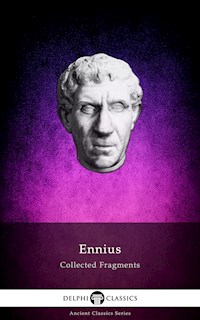
The father of Roman literature, Quintus Ennius (239–169 BC) was instrumental in creating a new Roman literary identity. Though later overshadowed by Virgil’s ‘The Aeneid’, Ennius was revered by his contemporaries for producing the first true Latin epic poem. ‘The Annals’ covered Roman history from the fall of Troy to the censorship of Cato the Elder. Sadly, Ennius’ works survive only in fragments, recorded by later writers and painstakingly collected over the centuries by classical scholars, who have analysed the positioning and understanding of these precious remnants. In spite of their fragmentary form, they afford us a rare understanding of the importance of Rome’s first epic poet. Delphi’s Ancient Classics series provides eReaders with the wisdom of the Classical world, with both English translations and the original Latin and Greek texts. This comprehensive eBook presents Ennius’ complete extant works, with illustrations, informative introductions and the usual Delphi bonus material. (Version 1)
* Beautifully illustrated with images relating to Ennius’ life and works
* Features the collected fragments of Ennius, in both English translation and the original Latin
* Concise introduction to the text
* Includes E. H. Warmington’s translations, previously appearing in the Loeb Classical Library edition of Ennius
* Rare fragments of plays and other works, first time in digital print
* Excellent formatting of the texts
* Easily locate the sections you want to read with individual contents tables
* Provides a special dual English and Latin text of the fragments of ‘The Annals’, allowing readers to compare the sections paragraph by paragraph — ideal for students
* Features a bonus biography — discover Ennius’ ancient world
* Scholarly ordering of texts into chronological order and literary genres
Please visit www.delphiclassics.com to explore our range of Ancient Classics titles or buy the entire series as a Super Set
CONTENTS:
The Translations
THE COLLECTED FRAGMENTS
The Latin Texts
THE LATIN FRAGMENTS
The Dual Text
DUAL LATIN AND ENGLISH TEXT
The Biography
LIFE OF ENNIUS by E. H. Warmington
Please visit www.delphiclassics.com to browse through our range of exciting titles
Das E-Book können Sie in Legimi-Apps oder einer beliebigen App lesen, die das folgende Format unterstützen:
Seitenzahl: 535
Veröffentlichungsjahr: 2018
Ähnliche













![Tintenherz [Tintenwelt-Reihe, Band 1 (Ungekürzt)] - Cornelia Funke - Hörbuch](https://legimifiles.blob.core.windows.net/images/2830629ec0fd3fd8c1f122134ba4a884/w200_u90.jpg)






Collected Fragments of
ENNIUS
(c. 239–c. 169 BC)
Contents
The Translations
THE COLLECTED FRAGMENTS
The Latin Texts
THE LATIN FRAGMENTS
The Dual Text
DUAL LATIN AND ENGLISH TEXT
The Biography
LIFE OF ENNIUS by E. H. Warmington
The Delphi Classics Catalogue
© Delphi Classics 2018
Version 1
Browse Ancient Classics
Collected Fragments of
QUINTUS ENNIUS
By Delphi Classics, 2018
COPYRIGHT
Collected Fragments of Ennius
First published in the United Kingdom in 2018 by Delphi Classics.
© Delphi Classics, 2018.
All rights reserved. No part of this publication may be reproduced, stored in a retrieval system, or transmitted, in any form or by any means, without the prior permission in writing of the publisher, nor be otherwise circulated in any form other than that in which it is published.
ISBN: 978 1 78656 405 4
Delphi Classics
is an imprint of
Delphi Publishing Ltd
Hastings, East Sussex
United Kingdom
Contact: [email protected]
www.delphiclassics.com
The Translations
Archaelogical remains at Rudiae — Quintus Ennius was born at Rudiae, formerly a small town located near modern Lecce in the heel of Italy, ancient Calabria.
The amphitheatre at Rudiae
THE COLLECTED FRAGMENTS
Translated by E. H. Warmington for the Loeb Classical Library
Widely regarded as the father of Roman literature, Quintus Ennius (239–169 BC) was instrumental in creating a new Roman literary identity, his works going on to inspire major developments in Roman religion, social organisation and popular culture. In 204 BC he was brought to Rome in the entourage of Cato and he took up residence on the Aventine Hill, where he soon found work. Fluent in his native Oscan as well as Greek and Latin, Ennius became one of the first teachers to introduce Greek learning to the Roman upper classes through public readings of important Greek texts.
Though largely overshadowed today by Virgil’s later epic The Aeneid, Ennius was revered by his contemporaries for producing the first true Latin epic poem. Composed in fifteen books, later expanded to eighteen, The Annals covered Roman history from the fall of Troy in 1184 BC down to the censorship of Cato the Elder in 184 BC. It was the first Latin poem to adopt the dactylic hexameter metre used in Greek epic and didactic poetry, leading it to become the standard metre for these genres in Latin poetry. The epic also became a school text for Roman schoolchildren, eventually supplanted by The Aeneid.
The Annals gave Roman epic its canonical shape and pioneered many of its most characteristic features, inspiring the later works of Virgil, Ovid and Statius. Though only 600 lines survive today, Ennius is recognised for domesticating Greek epic and drama, elevating Roman literature to the same sphere as his Greek models. Ennius also pursued a wide range of literary endeavours and was successful in almost all of his literary forms. His tragedies were long regarded as classics of the genre, while other major texts included philosophical works in prose and verse, epigrams, didactic poems, dramas on Roman themes and occasional poetry that later influenced the development of satire by Horace and Juvenal.
Ennius’ works only survive in fragments, recorded by later writers and painstakingly collected over the centuries by classical scholars, who have conjectured and agonised over the positioning and understanding of the precious remnants of Rome’s first epic poet. In spite of their fragmentary form, the preserved texts afford us a rare understanding of the importance of Ennius’ work and its immeasurable impact on the history of Latin literature.
Double herm featuring a portrait believed by some to be of Ennius, Ny Carlsberg Glyptothek
CONTENTS
The Annals
Book I. Prelude. From the Sack of Troy to the Death of Romulus
Book II. The Reigns of Numa Pompilius, Tullus Hostilius and Ancus Marcius
Book III. The Reigns of Tarquinius Priscus, Servius Tullius, and Tarquinius Superbus; Establishment of the Republic
Book IV. The Early Republic, probably to the Gallic Invasion of 390 or 387 BC
Book V. Samnite Wars and the Rise of Pyrrhus, to BC 295
Book VI. The War with Pyrrhus, 281–271 BC
Book VII. Events leading to the Second Punic War
210–27
Book VIII. The Second Punic War to the Departure of Scipio for Africa
Book IX. Scipio’s campaigns in Africa; Peace, 201 BC
Book X. Wars with Macedon to the settlement with Philip, 196 BC, after the Battle of Cynoscephalae
Book XI. From the Peace made in 196 to the Opening of the War with Antiochus III (192 — 1); Cato in Rome and in Spain
Book XII.
Book XIII. The War with Antiochus perhaps to the departure of Lucius Scipio and Publius Scipio Africanus for the East in 190 BC
Book XIV. From the Departure of the Scipios to the settlement of Asia after the Battle of Magnesia
Book XV. The Aetolian War, 189 BC, and the Achievement of M. fulvius nobilior, whom ennius celebrated elsewhere in a separate work (p ff.). The original conclusion of the Annals
Book XVI. From 188 BC to the end of the Istrian War
Book XVII. Probably from the end of the Istrian War to the Defeat of P. Licinius Crassus at Callinicus, 171 BC, during the third Macedonian War
Book XVIII. Further Events of the year 171?
Other Fragments of the Annals not assigned to any Book
Tragedies
Achilles or Achilles After Aristarchus
Ajax
Alcmaeon
Alexander
Andromache or Andromache Captive
Andromeda
Athamas
Cresphontes
Erechtheus
Eumenides
The Ransom of Hector
Hecuba
Iphigenia
Medea or Medea Banished
Melanippa
Nemea
Phoenix
Telamon
Telephus
Thyestes
Other Plays
Ambracia
The Sabine Women
The Little Hostess
The All-Round Champion
Unassigned Fragments of Plays
From Tragedies
From Comedies
Either Tragedies or Comedies
Satires
Book I
Book II
Book III
Book IV
Unplaced Fragments from the Satires
Scipio
Epigrams (Epitaphs)
Other Poems
Sotas
Delikatessen
Epicharmus
Euhemerus or Sacred History
Fragments Not Assigned to Any Work
From the Annals?
From the Satires?
Various Fragments
Spurious Fragments
The Patrician Torlonia bust thought to be of Cato the Elder
A first-century AD bust of the orator Cicero in the Capitoline Museums, Rome — Cicero highly regarded Ennius’ works and is one of the key authors to have preserved many of his famous quotations.
The Annals
Book I. Prelude. From the Sack of Troy to the Death of Romulus
1
The first line; invocation of the Muses:
Varro: In Ennius there is... —
Muses, who with your feet beat mighty Olympus; by Olympus the Greeks mean the sky.
2–3
Exhortation to readers:
Probus: As for the neuter gender the syllable is short.... Ennius in the first book —
for my subject and my poem shall have renown among the peoples of Italy.
Homer, seen by Ennius on Mount Helicon in a dream, was the source of inspiration:
Fronto: Homer’s instructress was Calliope; Ennius’ instructors were Homer and Sleep.
Marcus Aurelius to Fronto: And now I pass to our poet Ennius, who you say began to write after sleeping and dreaming. But surely if he had not been roused out of his sleep he would never have told the tale of his dream.
4
Fronto writes to Marcus Aurelius: If ever, —
Fettered in soft calm sleep
as the poet says, I see you in dreams, there is no time when I do not embrace you and fondly kiss you... this is one proof of my love, which I take from the Annals, a poetic and dreamy one indeed.
5
Homer appears:
Cicero: When Ennius had dreamed, this is what he told of it —
Homer the poet appeared at my side.
6
Opening of Homer’s speech:
Cicero: Unless indeed we choose to believe that Ennius, merely because he dreamed it, did not hear the whole of that famous speech —
‘O loving kindness of thy heart....
as well as he would have heard it if he had been awake.
7–10
Homer explains to Ennius some principles of life:
Varro These two, sky and earth, correspond with life and body. The wet and cold masses form the earth, whether we assume that —
<In somnis mihi> visus Colonna, Merula coll. Aen. II, 270, fortasse recte.
‘The feather-furbished tribe is wont to be delivered of eggs, not of life,
according to the words of Ennius —
‘and after that time life itself comes to the chicks by a god’s will;
or, according to Zenon of Cition, that the seed of living things is fire and this is their life and soul.
11–12
Varro: Right therefore is the statement of... Ennius —
‘And earth who herself bestowed the body takes it back and wastes not a whit.
13
Homer tells how his soul transmigrated from a peacock into Ennius’ body:
Donatus: ‘I remember seeing’ instead of ‘having seen’: Ennius —
‘I remember becoming a peacock.
A scholiast: Persius alludes to Ennius, who states that in a dream he saw a vision of Homer on Parnassus (mistake for Helicon); Homer said that his soul was in Ennius’ body.
14
Romans must remember the place where Ennius dreamed: Persius: —
‘Take note, ye citizens, of Luna’s harbour — it is worth while.
Thus commanded Ennius in his senses after he had snored out his dream that he was the Man of Maeonia — Quintus at last out of a Pythagorean peacock.
A scholiast on this passage: This line he took from the poems of Ennius to put into his own poem. It is well then that he says,’ thus commanded Ennius in his senses after he had snored out.’ That is what Ennius says in the beginning of his Annals where he states that in the course of a dream he saw a vision of Homer who said that he was once a peacock and from it, according to a rule laid down by the philosopher Pythagoras, his soul had been conveyed into Ennius.
15
Beginning of the narrative. The fall of Troy:
Priscianus: ‘Veterrimus’ is as it were derived from a positive ‘veter.’... Ennius has —
When aged Priam was laid low beneath the warring Pelasgian,
16–17
The lineage of Aeneas: Assaracus, Capys, and Anchises:
Servius (supplemented): Assaracus was grandfather of Anchises.... Ennius —
From Assaracus sprang Capys best of men: and he was from his loins begetter of Anchises the loyal.
18–19
Anchises:
Probus: Ennius pictures to himself Anchises as having some power of soothsaying by bird-lore, and, through this, something of the prophet in him: thus — and shrewd Anchises to whom Venus, loveliest of goddesses, granted power to foretell, yea to have a godly heart of prophecy.
20
An approach of Venus:
Servius (supplemented): ‘To float’ instead of ‘to fly,’ as in a passage of E. in the first book —
Along she floated swiftly through thin wafts of mistiness.
21
Venus appears to Aeneas and his companions:
Festus: ‘Sos’ for ‘eos’; for example Ennius in Book I —
Thereupon she, hallowed among the holy goddesses, took her stand close to them.
22–3
She tries to persuade Aeneas to obey Anchises and retire to Mount Ida:
Festus: That the ancients used the term ‘to plead’ for ‘to deal.’ Ennius also was a witness when he wrote in the first book of the Annals —
‘But be sure to do what your father pleads for in prayers with you.’
24
Italy and the Latins:
Macrobius: ‘There is a region which the Greeks call by name “Western Land.”’ Ennius in the first book —
There is a region which mortals used to call ‘Western Land,’
25
Varro: That ‘cascus’ means ‘old’ is shown by Ennius where he says — which the ancient Latin folk of eld did hold.
26
The early connexion of Latium with Saturn:
Varro says of the Capitoline Hill: Men have recorded that once upon a time this hill was called ‘Saturn’s’ and hence Latium has been called —
Saturn’s Land as Ennius among others calls Latium.
27–8
The fortunes of Saturn:
Nonius: ‘Caelum’ neuter. In a masculine form... Ennius —
To Saturn whom Sky begat.
29
Why he fled to Italy:
Nonius: ‘Obsidio’... neuter in Ennius —
When great Titan was afflicting him with cruel duress.
30
Aeneas and his followers arrive at Laurentum in Latium:
Priscianus: ‘Laurentis’ for ‘Laurens.’ Ennius in the Annals —
These men one day Laurentum’s land received.
31
Concourse of Aeneas and the King of Alba:
Atilius: The longest line has 17 syllables... the shortest has 12 like this of Ennius —
To him answer made the King of Alba Longa.
Aeneas is deified:
Servius: According to Ennius, he (Romulus) will be reckoned with Aeneas among the gods.
The story of Ilia:
Servius goes on: He says that Ilia was a daughter of Aeneas.
32–48
The dream of Ilia, daughter of Aeneas, after his death:
Cicero: in Ennius the famous vestal tells her story —
When the old woman roused up, had with limbs a-tremble brought a light, then the maid frightened out of sleep, spoke thus in tears:— ‘O daughter of Eurydica, you whom our father loved, now strength and life too leave all my body. For a man of beautiful looks seemed to hurry me away among pleasant sallow-thickets and banks and places strange; so, my own sister, after that did I seem to wander alone, and slow-footed to track and search for you, but to be unable to catch you in my senses: no path made sure my footing. Then it was father who seemed to lift up his voice and speak to me in these words:— “O daughter, first there are hardships to be borne by you; but after that, your fortunes will rise again from a river.” With these words, my own sister, did father suddenly withdraw, and no longer gave himself to my gaze though my heart longed for him; no, even though many a time and with tears did I keep holding out my hands towards the blue precincts of the sky, and called and called him with caressing voice. Then did sleep scarcely leave me all sick at heart.
Ilia, loved by Mars, gives birth to Romulus and Remus:
Ovid:
If a woman should take the Annals (there’s no poem shaggier than they) she will perforce read how Ilia became a mother.
Servius (supplemented): Naevius and Ennius record that the founder of the city was Romulus, grandson of Aeneas through his daughter.
49–50
Ilia, arraigned for her fault, appeals to Venus:
Nonius: ‘Parumper,’ speedily and quickly.... Ennius in the first book of the Annals —
‘Thee, hallowed Venus, thee now the mother of my father, I pray look down on me from heaven a little while, my kinswoman.’
51
Ilia appeals also to Tiber:
Macrobius: ‘And thou, sire Thybris with thy hallowed stream’; Ennius in the first book —
‘And thee, Father of the Tiber, with thy hallowed stream,
52
Venus answers Ilia’s prayer:
Charisius: The grammarians would have it that the form ‘neptis’ should not be used... and Ennius is appealed to because he wrote ‘nepos’ as a feminine, thus —
‘Ilia, godly granddaughter, the hardships you have borne...
53–4
Servius (supplemented), on ‘cetera’ in Virgil: ‘Cetera that is, ‘in ceterum’; and it is an Ennian usage —
‘For the rest, take you no care for the boys to whom you gave birth.
55
Amulius orders Ilia to be thrown into the Tiber:
Nonius: ‘Facessere’ means ‘to do.’... —
Thus he spake out; and then the hireling warriors sprang to carry out his word.
Porphyrio: According to Ennius’ account Ilia was thrown headlong into the river Tiber by order of Amulius, King of the Albans; but before this she was joined in marriage to the Anio.
56
Ilia is married to Tiber:
Servius (supplemented) on ‘reddita’ in Virgil: ‘reddita’ must, as an archaic usage, be taken to mean ‘data’; Ennius in the Annals —
But Ilia, rendered into wedlock,
57
The gods assemble to decide the fate of Romulus:
Tertullian: Ennius the poet spoke simply of — most mighty dining-halls of heaven either on account of their lofty position or because in a passage of Homer he had read of Jupiter feasting there.
58
Servius, on ‘bipatentibus’ in Virgil: —
with twin openings
This mode of expression is Ennian, and is drawn from the use of doors which we unclose both to right and left.
59
The assembled gods; Jupiter:
Macrobius: (Atlas) ‘whirls on his shoulders the sky dotted’ with blazing stars. Ennius in the first book —
who spins round the sky dotted with shining stars.
60–1
Martianus Capella: The colleagues of Jupiter himself amount to twice six in number, including the Thunderer just mentioned; whose names are contained in a pair of lines in Ennius —
Juno Vesta Minerva Ceres Diana Venus Mars Mercury Jupiter Neptune Vulcan Apollo
62
Speech of Juno; she agrees to the deification of Romulus:
Servius, on ‘sancte deorum’ in Virgil: We must either put a comma after ‘sancte’ or else he used the phrase ‘sancte deorum’ after Ennius —
Juno, hallowed among goddesses, daughter of Saturn, made answer.
63–4
Jupiter foretells to Mars that only one of his sons shall be deified:
Varro: In this book I shall speak of words which find a place in the poets.... I will begin with this —
‘One there will be whom thou shalt raise up to the blue precincts of the sky.
65
The Tiber overflows; the effects:
Festus: ‘Remanant,’ they fill. E. in the first book —
The waters leave the streams and overtrickle the plains.
66–9
Jupiter orders Tiber to subside:
Fronto: ‘It was done.’ This same verb is used by Ennius... —
the broken places to be dammed up;
he says —
it was done... the Tiber
... and a noteworthy act. ‘Tiberis’ is in Tuscan dialect ‘Tiber,’ which you order to be dammed up. The river Tiber is lord and ruler of all flowing waters round those parts. Ennius —
After the river which is chief over all settled down... for whose sake Ilia did sink beneath
70
The trough holding Ilia’s twins Romulus and Remus is cast up by a fig-tree which was later called the ‘Fig-Tree of the Paps.’
Charisius: ‘Fici.’ Ennius —
sweet-bearing figs, dripping milk from the whole udder.
71
The she-wolf:
Serviusn (supplemented): The noun ‘lupus’ was in old writers certainly common to both genders, as in Ennius — Suddenly a she-wolf big with young
She suckles Romulus and Remus:
Servius: The whole of this passage (Aen., VIII, 630–4) is certainly modelled on Ennius.
72–4
The wolf sees the shepherds and flees:
Nonius: ‘Parumper,’ speedily and quickly... —
Thereupon the she-wolf gazed and saw them all; then she, passing over the plain with quick lope, hurriedly betook herself into a wood.
75–6
Romulus and Remus sport with the shepherds:
Nonius: ‘Licitari,’ to engage in battle, to fight. E. —
Some hurled stones in play and justled one with another.
77
Romulus as a hunter:
Festus: ‘Ratus sum’ means ‘I thought’ but apart from this ‘ratus’ and ‘ratum’ are put for ‘firm,’ ‘sure.’ Ennius —
They were cut down when Romulus the Resolved won his quarry.
78
Romulus is reconciled with Numitor:
Macrobius quoting Virgil: ‘Give and take you plighted troth: there are within us hearts brave in war.’ Ennius in the first book —
‘Give and take you plighted troth and make a treaty truly firm.
79
Romulus and Remus are about to take the auspices for founding a city; they wait for daybreak:
Macrobius: ‘And the dead of night held hid the moon in a black mist.’ Ennius in the first book —
When the dead of night held hid the light above,
80–100
Romulus and Remus take the auspices at dawn; Romulus stands on the north-west of the Aventine, Remus on the southeast:
Cicero: And thus Romulus, as augur with his brother, likewise as augur, as takes place in a passage of Ennius —
Careful with a great care, each also in eagerness for royal rule, they are intent on the watching and soothsaying of birds... [on a hill.]... Remus devotes himself to watching and apart looks out for a favourable bird. But handsome Romulus makes his search on high Aventine and so looks out for the soaring breed. Whether they should call the city Roma or Remora — this was their contest. Anxiety filled all the men as to which of the two should be ruler. As, when the consul means to give the signal, all men look eagerly at the barrier’s bounds to see how soon he will send the chariots forth from the painted mouths — so they waited Thus were the people waiting, and held their tongues, wondering to which of the two the victory of right royal rule should be given by the event. Meanwhile the white sun withdrew into depths of night. Then clear shot forth, struck out in rays, a light: just when, winging to the left, there flew from the height a bird, the luckiest far of flying prophets, just then all golden there came out the sun. Thrice four hallowed forms of birds moved down from the sky, and betook themselves to places lucky and of happy omen. From this saw Romulus that to him, to be his own, were duly given the chair and throne of royalty, established firm by the watching of birds.
Romulus founds the city of Rome:
An excerpt from a glossary: Of Rome, there is no known founder common to tradition.... Ennius and others say it was founded by Romulus.
101
Remus scoffs at Romulus and his wall on the Palatine:
Festus: ‘Quamde,’ for quam... —
‘Jupiter! Yes, truly relies he more on a wall than the might of his arm!’
102–3
Romulus threatens Remus with death:
Macrobius, quoting Virgil: Meanwhile you shall none the less pay full recompense to me with your life-blood. Ennius in the first book —
‘Neither you nor any man alive shall do this unpunished: no, you shall give recompense to me with your life-blood.’
104
A mediator seeks to heal a quarrel:
Nonius: ‘Torviter’... —
‘But he whom you just now so fiercely noised at
105
Festus: ‘Sum’ for ‘eum’... —
‘But by stratagem, not brute force, should he seek to save this state
106
Festus: ‘Stolidus,’ Billy... —
‘for to fight out a quarrel by blind force — it is a thing of blockhead boars beloved.
107
The war with the Sabines. Having built temples after the defeat of the Sabines, Romulus celebrates public games and dances:
A grammarian: When Romulus had built a temple to Jupiter Feretrius, he caused greased hides to be spread out and held games in such a manner that men fought with gauntlets and competed in running races; Ennius bears witness to this fact in the Annals.
Servius (supplemented) on ‘lentandus’ in Virgil: And some think that ‘lentandus’ is a coined word of Virgil’s; but in the Annals we read —
Rubbed down with oil, suppled and ready for taking arms.
Paulus: ‘Noise o’ War’ was a term the Romans were wont to use of dancing when they danced with weapons; this was an institution of Romulus so that he should not suffer the like of what he himself did when he dragged off the maidens of the Sabines at their public games.
108
Rape of the Sabine women. A Sabine speaks:
Festus: ‘Sas.’ Verrius believes it means ‘eas,’ his witness being Ennius on the ground that he says in the first book —
‘maidens; for the Romans have each their own at home.
where it seems rather to mean ‘suas.’
109
Rage of the Romans against Titus Tatius:
Priscian: In the nominative... authors are wont to add the short syllable te instead of met.... Ennius —
‘Thyself to thyself, Titus Tatius the tyrant, thou tookest those terrible troubles.’
110
Charisius: ‘Concorditer’... —
‘Both of you, while away your days in friendliness for ever.’
111
Hersilia’s prayer:
Gellius: Ennius also in the first book of Annals —
‘Nerio, consort of Mars, and Here likewise’
if he has preserved the metre (which is certainly not always the case with him), has lengthened the first syllable and shortened the third.
112–13
Romulus to Titus Tatius after the establishment of double kingship?:
Nonius: ‘Fortunatim,’ prosperously... —
‘And may this, I pray, turn out in fortune prosperous and fair for me, our task, our plighted troth, our kingdom, and for you, my citizens.
The Sabines form a new tribe at Rome:
Varro: According to Ennius, the Titienses were so called from Tatius, the Ramnenses from Romulus; the Luceres, according to Junius, from Lucumo.
Romulus is deified:
Servius: According to Ennius, Romulus will be reckoned with Aeneas among the gods.
114–15
Proculus tells the people of his vision of Romulus:
Servius: ‘Aevum’ properly means eternity, which comes to none but gods. Ennius —
‘Romulus lives from age to age in heaven with the gods that gave him birth.’
116
Romulus and Hersilia are worshipped by the Romans:
Nonius says:’ Hora,’ goddess of youth.... —
‘Thee I worship, sire Quirinus, and thee, Hora, consort of Quirinus.’
Book II. The Reigns of Numa Pompilius, Tullus Hostilius and Ancus Marcius
117–20
The people mourn Romulus:
Cicero: Indeed when a people is bereaved of a just king, then even as Ennius says, after the passing of the best of kings, for many days longing filled their breasts —
And at the same time they talked thus among themselves— ‘O Romulus, godly Romulus, what a guardian of your country did the gods beget you! O father, O begetter, O blood sprung from the gods!
They used to call those whom they had lawfully obeyed not lords and masters, nor yet again kings, but guardians of their country, yes and fathers and gods. Nor was this without reason. For what do they say next? —
‘You it was who brought us forth into the world of light!
122
Festus: ‘Speres.’ The archaic writers used this plural form, for example Ennius in the second book —
‘And so soon as he fled away, our hopes he thus utterly...
123
Question of a successor to Romulus:
Festus: ‘Square Rome,’ a name given to a site on the Palatine in front of the temple of Apollo.... Ennius has this place in mind when he says —
And how hopes he that he will be king at Square Home?
124
The reign of Numa Pompilius. Intercourse of Numa and Egeria:
Varro: In a passage of Ennius —
To him replied Egeria with sweet sound,
The word ‘olli’ has the force of ‘illi,’ dative to the feminine ‘olla’ and to the masculine ‘ollus.’
125–6
The religious institutions of Numa:
Varro: In a passage of Ennius —
He established the Tables, he also the Shields...
‘ancilia’ is a word derived from ‘ambicisus,’ because those arms were indented on either edge like those of Thracians; — ... and the Pancakes, the Bakers, the Rush-Dummies, and the Priests with conical top-knots.
‘Liba’ are so called because they are made to be used at libations. The ‘fictores’ are so called ‘a fingendis libis’; the term Argei is derived from Argos.... ‘tutulati’ is a term used for those who at sacrifices are accustomed to wear a kind of cone on their heads.
127–9
He institutes the flamines:
Varro: Ennius states that Pompilius also established the ‘special priests’; while all are surnamed from individual gods... there are special priests whose surnames remain obscure in origin... as is the case with most of the following which are enumerated in these verses —
He likewise established the priests of Volturnus, of Palatua, of Furina, of Flora, of Falacer, and of Pomona.
130
Numa desires that his institutions be maintained:
Festus: The ancients used to say ‘me’ instead of ‘mihi,’ as does Ennius when he says in the second book —
‘If something of man’s fate should happen to me, do you keep my ordinances.
The reign of Tullus Hostilius. War between Rome and Alba, which agree to settle their quarrels by a combat between two sets of triplet brothers.
Propertius:
And I had already put puny lips to mighty fountains, whence once father Ennius did slake his thirst and sang of the brothers Curii and of the Horatii and their spears....
131
The triplets are ready to fight:
Priscianus: In this way, therefore, ἐμοῦ and οὗ correspond to mei tui and sui, ἐμοῦς, σοῦς, οὗς to mis tis sis.... Ennius —
A great and strong anxiety is mine to do equal deeds with my heartfellows.
132
The fight: the surviving Horatius escapes a thrust:
Festus: ‘Occasus,’ a passing away of the sun, for example, when it drops down from the heights to regions beneath the earth; Ennius used this noun for ‘occasio’ in the second book —
At this point chance was given him, but renowned Horatius with a leap...
133
Horatius justifies himself to his sister, who loved one of the Curiatii:
Priscianus: We find very ancient writers who even lengthened the penultimate (sc. of perfects in -ui)...— ‘He agreed that he would join issue with me by the sword.
134
Horatius’ sister heaps reproaches on him?:
Festus: ‘Tolerare,’ to bear patiently... —
He would fain suffer slaughter by the sword rather than by words such as these.
135
She cares more for her dead Curiatius than for all the Romans:
Festus: ‘Quamde’... for ‘qaam’... —
‘than for all your legions and commoners.
136
Horatius’ father pleads for his son at his trial for killing his sister; he pictures the mother’s grief?:
Festus: ‘Sum’ for ‘eum’... —
‘But she, who had brought him forth, (killed) herself.
137
The prosecutor(or one of the two judges? ) accuses Horatius:
Festus: ‘Ningulus,’ no one... —
‘Who are one to threaten with the sword, while against you no one...’
138
Progress of the trial:
Festus: ‘Tuditantes’ means ‘tundentes,’ that is, conducting an affair... —
They spent the whole day threshing out this trial among themselves.
139
The punishment of Mettius Fufettius by Tullus for refusing to help Rome:
Quintilian: Tinga of Placentia... by writing ‘precula’ for ‘pergula’ was guilty of two barbarisms in one noun.... But Ennius arraigned on a like charge of a double mistake by saying —
Mettoeoque Fufetioeo
is defended on the plea of poet’s licence.
140
He is torn apart by horses:
Macrobius: ‘Tractare’ is the iterative of ‘trahere’... Ennius —
Dragged over the smooth flat plain
141–2
and birds devour his corpse:
Priscianus: The oldest writers declined ‘homo,’ gen. ‘homonis.’ Ennius —
A vulture did craunch the poor man in the forest. Ah! In what a cruel tomb buried he his limbs!
143
The destruction of Alba Longa by Tullus:
Servius, on ‘clangor’ in Virgil: States are generally overthrown to the sound of a trumpet, in the way in which Tullus Hostilius ordered Alba to be overthrown.
Priscianus: In ‘nominationes,’ that is in onomatopoeias whether nouns or verbs, of unusual structure, we must not look for all the turns of inflexion... ‘taratantara.’ Ennius —
And the trumpet in terrible tones taratantara blared.
Servius on Virg., Aen., II, 486: ‘And the dwelling within.’ This passage (II, 486 ff.) is taken from the Sack of Alba.
144
The reign of Ancus Marcius. His accession:
Servius (supplemented), on ‘reddita’ in Virgl: ‘Reddita’ must, as an archaic usage, be taken to mean ‘data’... — and that day when Ancus Marcius received the kingship,
Here ‘recepit’ stands for ‘accepit.’
145
The foundation of Ostia: fortifications and other works:
Macrobius: A most happy express’ on of Virgil’s is ‘belches forth a flood,’ and archaic too, for Ennius says — and belches the river Tiber into the salt sea,
146–7
Festus: ‘Quaesere’ is put by archaic writers instead of ‘quaerere’... —
Ostia was fortified. He likewise made the channel clear for tall ships and for sailors seeking a livelihood on the sea.
148
Servius (supplemented): Some say that ‘texamus’ is the right term to use because the places in which ships are made are called in Greek ναυπήγια, in Latin ‘textrina.) Ennius —
that same plain holds a workshop for their long ships.
149
The Caelian:
Festus: Ennius seems to have made a joke... and in the second book —
the blue-dark meadows
Book III. The Reigns of Tarquinius Priscus, Servius Tullius, and Tarquinius Superbus; Establishment of the Republic
150
Jupiter’s omen to Priscus on his way to Rome:
Nonius: ‘Laevum.’ The old critics believe this word to take its meaning as it were from ‘levare.’... Ennius in the third book of Annals —
The All-glorious sent down one day from the sky a favourable sign.
151–2
The omen:
Probus, on ‘anima’ in Virgil: ‘Air’ is here taken, by inductive reasoning, to mean ‘winds’; in proof of this we have taken an example of Ennius from the third book of the Annals —
and there came flying on thick-set wings an eagle, battling with the breeze which the Greek nation calls in its tongue ‘aer’
153
Taqnaquil(?) accepts the omen as favourable:
A scholiast; ‘Laeva,’ prosperous... as Ennius says —
on the left hand and duly taken as good.
154
The death of Ancus Marcius:
Festus: ‘Sos’... now and then writers put it for suos... Ennius —
After good Ancus quitted the light with his eyes,
aquila <in> Keil a.<hinc> L
trib. lib. III St.
155
Tarquinius Priscus is made King:
Festus: ‘Solum,’ earth. Ennius in the third book — gave to Tarquin both sway and soil of the kingdom.
156
War of Priscus with the Latins (or Etruscans?):
Festus: ‘Sos’ for ‘eos.’... E. in the third book —
The clans of might and wealth which are around them.
157
Tanaquil decks dead Priscus:
Servius, on ‘And they wash and anoint his body in the chill of death’ in Virgil: a line from Ennius, who says —
The good woman washed and anointed Tarquin.
158
The funeral of Priscus:
Festus: ‘Prodinunt,’ the same as ‘prodeunt’... —
The thralls moved on: then beamed bright lights.
159
The reign of Servius Tullius; wars with Etruria. Speech of an Etruscan (?) general before battle?:
Macrobius: We must notice that he used even ‘qua noctu.’ And this he put in the seventh book of the Annals, in the third book of which he wrote the same sort of thing more clearly —
‘On this night all Etruria’s fate will hang by a thread.
160–61
A battle in Servius’ Etruscan wars:
Macrobius: ‘The unruly husbandmen engage with javelins on all sides.’ Ennius in the third book —
After they were tired out from standing and spattering each other with loop-handled lances, they engaged with javelins on all sides.
162
Tarquinius Superbus. Lucretia outraged:
Macrobius: (Atlas) ‘whirls on his shoulder the sky dotted with blazing stars’... —
She looked up at the sky dotted with shining stars.
163
Lucretia prepares for death:
Gellius: We used to investigate the question whether ‘superesse’ in the archaic writers was a term used for ‘remain and be lacking for the completion of a thing’... we find in the third book of Ennius’ Annals this line —
Then she says that for herself one labour still waits over:
‘superesse,’ ’is left’ and ‘remains’ undone; this being the meaning, it must be spoken as two words.
stare et V stando Pontanus stantes Scriver. stant et cdd.
prospexit Macrob. suspexit V
Book IV. The Early Republic, probably to the Gallic Invasion of 390 or 387 BC
164
The siege of Anxur by the Romans:
Macrobius: ‘They strain with all their might and main’ (Virgil). Ennius in the fourth book —
The Romans on their ladders strain with all their might and main
165
Anxur is stormed, 406 b. c.:
Paulus: The town which is now spoken of as Tarracina, belonging to the Volscian tribe, used to be called Anxur, as Ennius’ words show —
The wretched Volscians lost Anxur.
166
Eclipse of the sun, 21st of June, 400 BC:
Cicero, on the true cause of solar eclipses:
In later times this did not escape the notice even of our Ennius, who writes that, about three hundred and fifty years after the foundation of Rome —
On June’s fifth day the moon blocked out the sun in darkness.
Book V. Samnite Wars and the Rise of Pyrrhus, to BC 295
167
A single combat; Manlius and a Gaul?:
Festus: ‘Occasus.’... E. used it for ‘occasio’... in the fifth book —
Vexation drives him on, the chance holds him to it, the fact helps him.
168
Defence of Fregellae against the Romans?:
Nonius: ‘Ansatae,’ missiles with loop-handles... —
They send down loop-handled lances from the towers.
169
Appeal of women at Fregellae at its capture, 313 BC:
Priscianus: ‘Misereo’... was used by the oldest writers... —
They caused even the enemy to have pity on them shedding tears.
170
A battle between the Romans and the Samnites?:
Aero: At one time the Romans fought with Samnite enemies until nightfall; whence Ennius also says —
The dead of night wrested from them a drawn battle.
171
The River Liris at Interamna Lirenas, where the fields were laid waste in 294 BC:
Macrobius: It is not inelegant to put ‘agmen’ in the sense of a certain ‘actus’ and ‘ductus’; for example, ‘Thybris flows with gentle train.’ Indeed it is also an antique usage; for Ennius in the fifth book says —
because the river flows with gentle train through the pleasant town.
172
Rise of Pyrrhus:
Nonius: ‘Stirps’... Ennius has it in the masculine in the fifth book of the Annals —
by name Burrus, a man they say of highest stock.
VI and VII
Book VI. The War with Pyrrhus, 281–271 BC
NOTE ON BOOKS VI AND VII
There can be no doubt that Ennius did not include the First Punic War in the detailed narrative of his Annals; the statement of Cicero (see pp. 82–83) is explicit, and it is unreasonable to believe that we know better than he did. He tells us that Ennius did not desire to rival Naevius, who had already written a poem about this war (see Remains of Old Latin, Vol. II); it is further probable (see St., pp. 163–4) that Ennius had before him other poems covering the same ground. It is quite possible that in Book VII Ennius gave a mere sketch, or enumerated only the chief events of this war; but I have no hesitation in following Miss Steuart in her refusal to attribute to it a number of fragments on which she offers attractive suggestions (St., pp. 149 ff.). Cf. also Norden, Enn. u. Verg., 63 ff., 143 ff., 170. For the old view, which goes back to Merula, see V., CLXXIX ff.; Müller. Q. Enn., 166 and C. Q. XIII, 113 ff.; Skutsch, Pauly, s.v. Ennius, 2607, etc.
On the other hand, I cannot believe that Ennius allowed his history of Pyrrhus to extend into the seventh book so that at the beginning of that book it was interrupted by three things: (i) the elaborate prologue to the book; (ii) an account of the origin of Carthage; (iii) an apology for not describing the First Punic War. I suggest that the war with Pyrrhus was contained wholly in Book VI, which was thus devoted to a man whom Ennius, it is clear, admired; and that Book VII, after a prologue and an apology, sketched the origins of Carthage, brushed aside, as it were, the First Punic War with a short outline, and narrated the winning of Sardinia and Corsica by Rome, her reduction of the piratic Illyrians to submission (here we may put some of the disputed fragments), and the conquest of Cisalpine Gaul. It is possible that the achievements of Hamilcar, Hasdrubal, and Hannibal in Spain were also sketched. Thus Book VIII began with the outbreak of the Second Punic War and carried events down to the departure of Scipio Africanus for Africa in 204 BC This left Ennius free to devote all Book IX to the crowning achievement of his friend Scipio.
173
Prologue:
Servius, on ‘Unroll ye this great war from end to end,’ in Virgil: that is... Tell ye not only the beginnings, but also the conclusions of these wars; for by ‘orae’ is meant ‘extremities.’ An augmenter of Servius adds: It is further an expression of Ennius —
Who can unroll this great war from end to end?
174–6
Pyrrhus receives an oracle of Apollo:
Cicero: Why should I take Herodotus to be more truthful than Ennius? Surely he was quite as capable of inventing stories about Croesus as Ennius was about Pyrrhus. For who is there who could believe that Apollo’s oracle gave this answer to Pyrrhus? —
‘I say that you, O man sprung from Aeacus, The Romans can defeat.’
In the first place, Latin is a tongue in which Apollo never spoke; again, that particular reply is not known among the Greeks; and, moreover, in the time of Pyrrhus Apollo had already ceased to make verses; and lastly, although it has always held good, as we find in Ennius, that— ‘That tribe of blockheads, stock of Aeacus Are war-strong more than wisdom-strong’;
still, Pyrrhus would have had the sense to see that the double meaning of the line ‘you the Romans... defeat’ applied equally to himself and to the Romans.
177
Pyrrhus’ stormy crossing to Italy; his ship:
Valla: ‘Stlataria.’ Probus expounds: ‘alluring:’ Ennius —
and a better ship than such as carries foreign fripperies.
178
Pyrrhus was at first welcomed in Tarentum, 281 BC:
Festus: ‘Navus,’ swift and active.... E. in the sixth book —
A man of deeds was found, a Greek son of a Greek father, a king.
179
but he shewed himself a stern master:
Festus: ‘Summussi’ is a term which was applied to murmurers.... Ennius in the sixth book... —
Within (the people?) grumbled in secret.
180
A sudden raid near Tarentum by Lucius Aemilius Barbula?:
Macrobius, quoting Virgil: ‘Through the dust the horsemen raged; all cried for weapons.’... —
He harried the bleating sheep; all cried for weapons.
181–5
Preparations for burning the dead after the battle of Heraclea, 280 BC:
Macrobius, quoting Virgil:
They went into an old forest, deep dens of the wild; forward fell pitch-pines, clattered holms under hatchet-blows, clattered beams of ash-trees against wedges; splitting oakwood too they cleft, and rolled along lofty rowans of the mountains.
Ennius in the sixth book —
Then strode they through tall timber-trees and hewed With hatchets; mighty oaks they overset; Down crashed the holm and shivered ash outhacked; Felled was the lofty fir; they wrenched right down Tall towering pines; and every woody tree In frondent forest rang and roared and rustled.
Homer has:
And they went holding in their hands hatchets for cutting wood, and ropes well twisted, while mules walked on in front of them. And oft strode they uphill and downhill and sideways and crossing. But when they came nigh unto the shoulders of Ida which is full of fountains, then straightway they hewed leafy-topped oaks, pressing on with the long edge of bronze; and the trees crashing mightily fell; whereon these the Achaeans split up and hung from the mules, and these tore up the ground with their feet through thick underwood, eager for the plain.
186–93
Pyrrhus replies to Fabricius, who came to ransom prisoners taken at Heraclea:
Cicero: And of Pyrrhus too there is that illustrious speech on the restoration of prisoners —
‘Gold for myself I ask not; no, to me ye shall not pay a price. Not chaffering war but waging war,
not with gold but with iron — thus let us of both sides make trial for our lives. To see what Mistress Chance may bring, whether it be you or I she wishes to be king — let it be by bravery that we make the test. And withal hear this word of mine: of those warriors to whose bravery war’s fortune has been kind, to the freedom of those same have I too planned to be kind. I give them to you, take them home — and with them I give you the blessing of the great gods.’
194–5
Fruitless embassy of Cineas to Rome. Appius Claudius Caecus protests against any acceptance of Cineas’ offers (cf. B. Luiselli,in Annali d. Facolta di lettere. Cagliari Univ. XXVIII. 1960):
Cicero: To Appius Claudius’ old age was added the infirmity of blindness; nevertheless, when the opinion of the Senate was inclined towards peace and alliance with Pyrrhus he did not hesitate to utter those famous thoughts which Ennius set forth in poetry —
‘Whither on your road have senseless turned your senses which hitherto were wont to stand upright?
196
Donatus on ‘in animo parare’ in Terence: the addition of ‘animo’ is graceful. Ennius in the sixth book —
‘But wherefore do I grieve now in my heart?
197
Cineas reports to Pyrrhus his failure at Rome:
Varro: In a passage of Ennius —
The spokesman came back without a peace, and brought the news to the king, ‘spokesman’ is a term derived from speech.
libertati me L m.l. cdd.
viai Lambinus via cdd.
198–9
The courage of the Romans?:
A scholiast, on ‘Here the conqueror towering in pride of soul’ in Virgil: Ennius in the sixth book —
‘Or they mount high in pride, and the rough beginnings... of war they spurn.
200–2
The battle of Ausculum, 279 BC Deems Mus devotes himself to the ‘di manes’:
Nonius: ‘Prognariter,’ actively, valiantly and steadfastly. (Non. is wrong. O. Skutsch, C.Q., Nov. 1960, 190, 193 ff.)... —
‘Ye gods, hear this my prayer a little while: just as from my body I breathe my last for the Roman people’s sake, with foreknowledge and awareness, in arms and in battle,
203
Pyrrhus’ mahouts cut the traces of the Roman chariot-horses in the battle of Ausculum?:
Festus: ‘Scitae’ is a term applied by poets sometimes to women of good looks, sometimes to women who are of good accomplishments.... Ennius in the sixth (?) book —
The skilled driver...... the beasts.
204
Operations of Pyrrhus against the Carthaginians in Sicily, 277–276 BC:
Macrobius, quoting Virgil: ‘The four-footed beat of the hoofs shook the crumbling plain.’ Ennius in the sixth book —
The Numidians went scouting; their hoofs shook the whole ground.
205
The battle of Beneventum, 275 BC; Pyrrhus moves to attack the Roman camp by night?;
Macrobius, quoting Virgil: ‘Meanwhile round rolls the sky and night sets in from the Ocean.’ Ennius in the sixth book —
Meanwhile the sky rolls round with its vast constellations.
206
[and dawn reveals his approach:
Achilles Statius: ‘He scanned the white ether’... Ennius on the sun... in the sixth book... —
When for the first time darkness was cast away and the day was whitening, ]
207–8
A soliloquy of Jupiter (during the battle of Beneventum?):
Macrobius, quoting Virgil: ‘and the father of the gods and king of men called a council.’ Ennius in the sixth book —
Then with all his heart the father of the gods and king of men spoke forth.
209
Triumph (275?) or death (270) of Manius Curius Dentatus:
Cicero: From such a life (i.e. of a statesman) men of the highest rank are honoured, as for example Manius Curius —
whom none could overcome with iron or gold.
Book VII. Events leading to the Second Punic War
NOTE ON THE CLASH BETWEEN ROME AND CARTHAGE.
On this book see pp. 64–5. Steuart includes in it the end of the war with Pyrrhus. Norden, pp. 143–52 has devoted special attention to a reconstruction of the book; he would carry the narrative at least as far as the battle at the Trebia.
Vahlen, CLXXIX ff., believes that Ennius did include a fairly detailed narrative of the First Punic War. O. Skutsch, C.Q., XLIII, 1948, 94 ff.; W. Friedrich, Herm., LXXVI, 1941,113 ff.
210–27
Prologue:
Gellius: There is a very clever and graphic description and definition by Ennius in the seventh book of the Annuls (in a sketch of Geminus Servilius, a man of noble birth), of what temper and cheerfulness and modesty... it is seemly a man should show who is a friend of another his superior in birth and fortunes —
So saying he called to one with whom he shared willingly and cheerfully and right often his table, his talks, and his affairs, when, tired out, he had spent long hours of the day in managing the greatest affairs, by counsel given in the wide forum and sacred senate-house; one to whom care-free he would often speak out boldly matters great and small, and joke the while, and blurt out words good and bad to say, if so he wished at all, and store them in loyal keeping; one with whom he could share many a pleasure and many a joy both openly and secretly; whose nature no thought of mind led to do a bad deed lightly or with wrong intent; a learned, trusty, winsome man and a fine talker, content with his own, happy and shrewd; one who spoke the right thing at the right time, and obliging; of few words; keeping many old-time ways of which a bygone age long buried is the maker, and manners old and new; keeping also to the modes of many a one of our elders, and the laws too of gods and men; one who could prudently speak out hearsay or keep it to himself. Him did Servilius, in the midst of battles, thus address.
They say that Lucius Aelius Stilo used to state that Quintus Ennius wrote this about none other than himself, and that the passage given here is a picture of the manners and temper of Quintus Ennius himself.
228
Prologue, continued?
Festus: ‘Quianam’ for ‘quare’ and ‘cur’... —
For why has your intent been turned by my words?
229–30
Prologue continued: Ennius alludes to his tale of his dream in the first book:
Festus: ‘Sas.’.. In the seventh book of the same poet it must be confessed that ‘earn’ is meant when he says — nor has any man seen in his dreams Wisdom (a name given to knowledge) before he has begun to learn her secrets.
231–2
The first Punic War; Ennius chooses to omit a detailed narrative of the war because Naevius and others have already sung about it:
Cicero: Nevertheless, the Punic War of this poet, whom Ennius counts among the seers and Fauns, gives delight as though it were a work of Myron. I grant you, to be sure, that Ennius is the more perfect poet as he certainly is; but if he really scorned Naevius, as he pretends, he would not, in working through all our wars, have left undone the famous First Punic War, a most bitter one. But in his own words he tells us why he does it. He says —
Others have written of the matter in verses
And nobly indeed they wrote, even though they did it in less finished fashion than you did; nor indeed ought it to appear otherwise to you who took many points from Naevius, if you confess it; or if you deny it, filched them.
232–4
Cicero: Well? Our old verses, where are they? In his own words he speaks of himself (nor lies in his boasting) — which once upon a time the Fauns and Seers used to sing, when no one had surmounted the rough rocks of the Muses... nor was anyone mindful of style before this man...
83
235
Cicero: Therefore since it was allowed to Ennius, when he scorned the old poetry, to say ‘in verses which once upon a time the Fauns and seers used to sing,’ must I be forbidden to speak of archaic writers in the same fashion? Especially since I am not going to say ‘before me’ as he does, nor what follows —
’Twas I durst unbar...
236
The origins of Cartilage. The Carthaginian stock; the worship of Moloch:
Probus, on ‘that he may sleep on shell-dye of Sarra’ in Virgil: By shell-dye of ‘Sana’ he wishes us to understand Tyrian purple. For that Tyre was called Sana we are informed by Homer; Ennius also follows him as an authority when he says —
Phoenicians sprung from Sarra
237
Festus: ‘Puelli’ is a word derived in a diminutive form from ‘pueri.’ Thus Ennius says —
Phoenicians accustomed to offer up to the gods their own little sons
238
How the Romans and the Carthaginians first came into conflict?; Appius Claudius Caudex enters Sicily, 264 BC:
Cicero: ‘History’ means public events remote from the recollection of our own age; such as —
Appius proclaimed war against the Carthaginians.
239–40
Events between the First and Second Punic Wars. Rome obtains Corsica (239 BC) and Sardinia (238):
Servius (supplemented): By ‘box’ Virgil meant the wood and not the tree, although in using the neuter gender he could have meant even the tree after the example of Ennius; for that poet has it thus in the seventh book —
and tapering cypresses with crenelled leaves, and the box too, with bitter body, stand straight.
241
Charisius: ‘Frus.’ Fern, gender because it is thus inflected by E. in the seventh book of the Annals —
the leaves turn ruddy
242–3
Rome obtains Sardinia (238 BC):
Nonius: ‘Rumor,’ favour, aid.... —
The Roman army attacked the ruins; and next made away with the dwellings, cheered on by the crowd.
244
War with the Illyrian pirates, 230–228 BC Complaints of the Greeks about half-hearted measures?:
Festus: ‘Sos’ for ‘eos’... —
While they were minded to startle them with threats, therewith they encouraged them.
245–6
Advance of the Roman fleet under Cn. Fulvius and L. Postumius:
Festus: ‘Tonsa.’ By this word Ennius, when he says in the seventh book —
‘Lean ye right backward and beat ye your breasts with the trimmers’; means an oar, because as it were ‘tondetur,’ it is trimmed, with a knife; again —
Backward they reach, then again pull the trimmers to their breasts.
247
A sea-fight; Illyrians hard-pressed:
Festus: ‘Nare.’ Cornificius states that this word is derived from ‘navis’... —
The one wishes to float in flight; the other is ready to fight.
248
An Illyrian ship is driven ashore:
Priscianus: ‘Mulgeo’ likewise takes ‘mulsi’ for its perfect tense... —
Hither the sea had gently washed a ship buffeted by the billows.
249
The Illyrians resist stoutly:
Paulus: ‘Sibyna,’ a name given by the Illyrians to a javelin resembling a hunting-spear. Ennius —
The Illyrians stood fast and stabbed with curving knives and hunting-spears.
250
War of the Boii and other Cisalpine and Transalpine Celts against Borne, 226–222 BC Preparations of the Gauls?:
Nonius: ‘Gracilentum’ for ‘graoilos.’... — They beat out handy swords like slender thread.
251–2
The Gauls near Clusium, 225 BC; terror at Rome; reminiscence of the invasion of 390 (? 387) BC:
Macrobius: — on that night the Gauls with stealth attacked the wall-tops of the citadel in the sleep-time, and on a sudden brought bloodshed on the sentinels.
In this passage we must notice that Ennius not only used ‘noctu’ and ‘concubia’ but also ‘qua noctu’; he puts this expression in the seventh book of the Annals....
253
Defeat of the Gauls at Telamon? 225 BC Speech of Gaius Atilius or of Lucius Aemilius:
Macrobius, quoting Virgil: ‘Let there be no delay to my commands. Jupiter stands on our side.’ Ennius in the seventh book —
Not always does Jupiter upset your plans; now he stands on our side.
254
Macrobius, quoting Virgil: ‘Fortune favours the daring.’ E. in the seventh book —
To men of fortitude is fortune granted.
255
The Via Flaminia is completed by Flaminius as far as Ariminum (220 BC); works built at the crossing of the river Nar between Narnia and Carsulae?:
Priscianus: But ‘Nar’ has kept the a long even in oblique cases.... —
He built blow-holes by Nar’s sulphury waters.
Second Illyrian War, 219 BC; suppression of Demetrius of Pharos by L. Aemilius Paullus:
Propertius says:
And he sang... of the royal trophies carried by Aemilius chip.
256–7
Second Punic War begins; Hannibal advances from ‘New Carthage,’ spring 218 BC:
Servius (supplemented): Here by ‘equitem’ Virgil means ‘equmn.’... Ennius in the seventh book of the Annals —
Lastly, with mighty rush the horseman at a four-footed gallop and the elephants too hurl themselves onwards.
Some great men of whom Ennius wrote in Books VIII-XV
Cicero: Our poet Ennius was a dear friend of the elder Africanus, and that is why a marble statue of him, it is thought, was set up in the tomb of the Scipios. But his verses of praise are surely an adornment not only for him who is praised but also for the name of the Roman people. Cato, ancestor of Cato here, is extolled to the skies; this carries with it great honour for the history of the Roman people. In short, all those great names — the Maximi, Marcelli, Fulvii — are honoured by praise which is shared by all of us. Hence it was that he who had done all this, a native of Rudiae, was received by our ancestors into their citizenship.
Book VIII. The Second Punic War to the Departure of Scipio for Africa
258–9
Outbreak of Discord:
Horace: You would not find the limbs of a poet even when dismembered, as you would if you were to break up the following —
After foul Discord broke open the ironclad doors and doorposts of war,
Porphyrio on this passage: The sense is: If you analyse my verses or Lucilius’, you will not find the same sort of ‘limbs’ as you would in Ennius verses, which are to be sure composed with mighty inspiration, with the use of a loftier diction as these are: ‘After...
260–1
Probus: Air surely is the thing which gives us supplies of the breath of life. ‘Spiritus’ is the name given to it by Ennius also in the Annals —
<Discord,> of hellish body daughter bred, woman of war in warrior’s cloak, for whom water and fire and breath and heavy earth are equal.
262–8
The people in time of war:
Gellius says: ‘Ex iure manum consertum’ are words drawn from ancient cases at law.... Ennius used these words... Then I myself recited from memory these lines from the eighth book of the Annals... —
When news of battles is proclaimed, away from view is Wisdom thrust, with violence is action done, scorned is the spokesman of good counsel, dear is the rude warrior. Not with learned speeches do men strive, but with evil speaking fall foul one of another, brewing unfriendliness. They rush to make joint seizure — not by law; rather by the sword do they seek a due return and aim at the first place, and move on with pack and press.
269
Rome thinks lightly of the Carthaginians?:
Priscianus: Dido, Didonis.... E. in the eighth book —
Phoenicians sprung from Dido
270
Gellius: Quintus Ennius does not appear to have spoken of the Carthaginians as —
petticoated lads without scorn.
271
The Romans were unaware of Hannibal’s character:
Over a passage of Orosius, in a codex Sangallensis, referring to Hamilcar Rhodanus, Ekkehart wrote the following: Ennius has —
what kind of man he was in counsels, and how great his prowess in arms.
272–3
Over another passage of Orosius, in the same codex, referring to Hannibal, Ekkehart (?) wrote the following: On Hannibal Ennius has —
But not such a double-faced foe was Burrus sprung from Aeacus.
Election in 217 BC of Quintus Fabius Maximus (Cunctator) as dictator: Battle of Cannae, 216 BC; crisis of the war:
Propertius: And he sang... of Fabius’ delays that were fraught with victory: and of the ill-starred fight of Cannae; and how the gods were turned to hear our heartfelt prayers.
274
The Battle of Cannae. Aemilius Paullus, on the eve of Cannae, tries to persuade Terentius Varro not to accept battle:
Nonius: ‘Praecox’ and ‘praecoca’... —
‘Time is unripe for fighting.
275
Fears of Paullus:




