


2,99 €
Mehr erfahren.
- Herausgeber: 22 Lions Bookstore
- Kategorie: Geisteswissenschaft
- Sprache: Englisch
Planet Earth is going through many transitions — social, economical, and spiritual —, and a better understanding is needed of how to differentiate the paths that are being presented in order to make the rights decisions.
Discernment is the main ability that one needs when wanting to know himself better, in order to conquer higher goals in life and go through the many challenges with the conviction that he is on the right path.
Many speak of oneness and faith, but few dare to speak about discernment, because you can only discern that which you can see, and once you can see things as they are, nobody can control you.
That state requires a perception of the potentialities in you, as the more you can see, the more of the new world will be revealed to you as well.
As you ascend to a higher state of perception, you don't cease being who you are, but instead, become more practical and faster in your decisions.
Such a capacity will make you more confident and less doubtful or fearful when having to let go of something or someone. And a bright future awaits those who have the courage to accept it and are not afraid of the consequences of their decisions.
Das E-Book können Sie in Legimi-Apps oder einer beliebigen App lesen, die das folgende Format unterstützen:
Veröffentlichungsjahr: 2021
Ähnliche



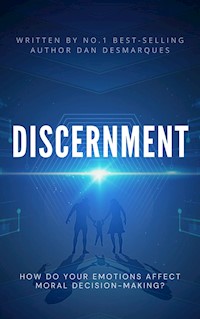
Discernment: How Do Your Emotions Affect Moral Decision-Making?
Dan Desmarques
Published by 22 Lions, 2021.
Table of Contents
Title Page
Copyright Page
About
Introduction
Chapter 1 - Understanding the Social Chaos
Chapter 2 - The Problem with Social Expectations
Chapter 3 - How Stereotypes Create Fools
Chapter 4 - When People Rationalize Their Insanity
Chapter 5 - Dealing with the Incongruences of Society
Chapter 6 - Evil Always Argues with Hypocrisy
Chapter 7 - Love Can’t Be Unconditional
Chapter 8 - How Karma Forms Our Experiences
Chapter 9 - How People Create Their Karma
Chapter 10 - Karma is Not Interchangeable
Chapter 11 - Trusting God Above the World
Chapter 12 - Civilization is Not Civilized
Chapter 13 - Most People Can’t Love Anyone
Chapter 14 - The Alchemical Elements in a Culture
Chapter 15 - Healthy and Unhealthy Spiritual Practices
Chapter 16 - How to Transmute the Energy in You
Chapter 17 - How to Be Spiritual Among Others
Chapter 18 - Faith Doesn’t Require Logic
Chapter 19 - Learning to Accept Oneself
Chapter 20 - How to Practice Unconditional Love
Chapter 21 - Learning to Forgive and Forget
Chapter 22 - Those Who Read but Can’t Understand
Chapter 23 - How to Differentiate Opinions
Chapter 24 - How to Deal with Discrimination
Chapter 25 - Choosing in What to Believe
Chapter 26 - How Leaders Manipulate the Masses
Chapter 27 - The Truth Isn’t Relative to Emotions
Chapter 28 - Why Many Women Are Single and Lonely
Chapter 29 - How an Ascension Occurs on Earth
Chapter 30 - Why You Should’t Fear Being Different
Chapter 31 - Discovering and Accepting the Unknown
Chapter 32 - How Cultures Determine Individual Thoughts
Chapter 33 - The Alignment of Faith with Life
Chapter 34 - The Correlation Between Power and Influence
Chapter 35 - We Observe According to What We Know
Chapter 36 - The Deception Caused by Dichotomies
Chapter 37 - Darkness and Ignorance
Book Review Request
Books Written By The Author
About the Publisher
Copyright Page
Discernment: How Do Your Emotions Affect Moral Decision-Making?
By Dan Desmarques
Copyright © Dan Desmarques, 2021 (1st Ed.) All Rights Reserved.
About
Publisher & Bookstore: 22Lions.com
Author: Biolinky.co/dandesmarques
Introduction
Planet Earth is going through many transitions — social, economical, and spiritual —, and a better understanding is needed of how to differentiate the paths that are being presented in order to make the rights decisions.
Discernment is the main ability that one needs when wanting to know himself better, in order to conquer higher goals in life and go through the many challenges with the conviction that he is on the right path.
Many speak of oneness and faith, but few dare to speak about discernment, because you can only discern that which you can see, and once you can see things as they are, nobody can control you.
That state requires a perception of the potentialities in you, as the more you can see, the more of the new world will be revealed to you as well.
As you ascend to a higher state of perception, you don't cease being who you are, but instead, become more practical and faster in your decisions.
Such a capacity will make you more confident and less doubtful or fearful when having to let go of something or someone. And a bright future awaits those who have the courage to accept it and are not afraid of the consequences of their decisions.
Chapter 1 - Understanding the Social Chaos
It takes a while for us to know others but also to know ourselves.
We often think that we will get to know ourselves through others, but all that this process does is convince us that we are what others see. And such a conclusion neglects the eternity of our spirit.
Truly, it is easier to know oneself than it is to know others. And yet, we can hardly know ourselves, except through others.
This said, it is not as important what we think of ourselves, as how we perceive ourselves through the eyes and discernment of others.
Nobody likes to be disrespected, humiliated, or insulted in any way, because we inherently believe in our immortality as a soul, and we need our dignity to evolve. This is what makes us a big family. We all need each other. Nobody is better than anyone else.
The prophet needs his followers to get his message delivered and absorbed by the culture of the society, and society needs its artists and scholars to help in the transition from the very high to the very low.
We call that methodology education but it is actually the art of indoctrinating in the forms and repetitions that we may never understand.
The books that we create and use to communicate those higher truths are the tools of transition, from the foolishness to the clarity of mind and actions — the efficiency that leads us, like a boat in a storm of ignorance, to where we want and need to go.
In this path that takes us through terra incognita, some cultures prove themselves more fertile than others, to help us grow and become more who we are destined to be. But my journeys through the world have shown me that not always are the best places to be those we could expect, for historical or geographical reasons.
The Balkan peninsula has surprised me in a very positive manner, for the politeness of its people, and the relaxing feeling one gets from the culture. And this, despite all the wars they faced throughout their history.
In recent times, after experiencing living in the city center of many famous countries, I came to the conclusion that areas that are near parks and far from the busy centers are better for my mind and emotional stability.
I may not experience so much chaos as those in the city centers, but quite a lot of this chaos is actually a void of self-centered minds that tend to replicate their own expectations.
We often attract more easily what others expect for themselves when among many people. In this sense, highly populated city centers, are great for promiscuity, mistakes, insults, crime, and anger. You know, everything people absorb from movies, because they rarely think for themselves, and care more about entertainment, even when it comes in the form of brainwashing propaganda.
This is why you can't really know yourself in the middle of social chaos. If anything, it is better to allow oneself to surrender to nature because nature brings us closer to our spiritual self.
When I sit in front of a lake, relaxing, I get more results than I would in a whole day looking at people passing by, or even if I talked to most of them. I also feel happier.
Talking to most people these days depresses me so much, that I often lose the motivation and capacity to write.
You see, whatsoever you want to do, requires certain mental patterns, and those mental patterns are the software you use to create the program — the active work.
Work shapes our thinking but so do our interactions. If what you do creates a wider gap with society, pushing yourself into society will cause patterns — needed to do something that society isn't interested in doing, such as creating something useful and outside the norms —, to break apart in you.
Many may disagree and say that it depends on whom we meet and interact with. But to them, I say: Good luck in finding someone that doesn't match the rest of society in the middle of society.
Chapter 2 - The Problem with Social Expectations
The greatest challenge of the artist is to bridge that which is unrelated to society with society itself, and then bring the very high to the very low, by merging two opposing realities. This is why artists are so important in the world.
A writer that can’t do this is a very bad writer.
I have met many of such writers. They think they are very important because nobody understands them and nobody is interested in what they write. They think that makes them superior.
What should I then conclude of them, when they meet me? I wrote more than four hundred books, and many of them wrote one, but assume they are more important than me.
What should we call that? Delusion? Insanity? Intellectual stupidity?
You see, a person may have a Ph.D. or Masters Degree, or some other fancy academic title, and be very proficient in debating art and literature, but that doesn’t make him or her a genius or an interesting person.
I remember when once I attended a meeting for writers, and they asked me:
— “What are you writing lately?”
It is like asking a lion: “What are you hunting lately?”
Could someone be more of a writer than I am? Would I be more visible to them if I wrote a thousand books? Probably, I would be more transparent than I was that day.
Most people are blind, and they think that being experts in the darkness, makes them enlightened.
The ignorant one in the dark is as ignorant as the intellectual sharing the same space. Both are in the dark.
Isn’t the schizophrenic that can’t read, as mentally ill as the one who was once a professor? Aren’t they both equally sick? So why do we think that the intellectual ignorant is better than the non-intellectual ignorant? Aren’t they both ignorant?
Most people can’t see the difference because they are focused on appearances, but they see only what they think they know and they know very little to nothing.
I could have taught a lot to those writers but because they could not see anything, they could not hear either. They lost a great opportunity to learn how to write better and faster.
Instead, they focused on non-sense, and then proceeded to tell me about the exercises they do in the group to write better.
I never talked to any of them again, and never again attended those meetings.
That’s what happens when you disrespect the opportunities life gives you. The opportunities leave you to join someone else that deserves them.
When I talk about opportunities, as you can see here, I am referring to everything you attract — in the form of people, ideas, knowledge, money, love, and anything else you can think or imagine.
God loves those who are mindful of him;
Love comes to those who respect it;
Money is attracted by those who want it;
Knowledge is abundant in the mind of the ones who want to learn.
But what do most people do?
They force their religious ideas on God and expect Him to fulfill them;
They put love before their selfish needs;
They ignore money;
They read with the expectation that the book will show what they believe, and reject the author when he proves them wrong.
What is the result of all that?
People love their religion but can’t understand why God ignores their prayers;
They behave in their marriage as if their house is a battlefield and say the opposite gender is the enemy;
They complain they work a lot but can’t get out of scarcity;
They read plenty but change nothing in their life, and say that their favorite authors are the ones who confirm that what they think is true.
Imagine if, instead of prolific writer arriving at a meeting with unsuccessful writers, you had God in human form coming to a religious congregation, willing to fulfill the desires of everyone and answer any of their questions. Do you think they would listen?
They wouldn’t, even if he could levitate. They would say it’s a demon.
That’s what happens to me when I speak too much. I’m either labeled psychotic or demonically possessed.
Chapter 3 - How Stereotypes Create Fools
Many of our best opportunities in life come unexpectedly but that doesn’t make them less important than the ones we work hard to find.
Among such opportunities, the most interesting are related to those who find my books by chance, read them, learn a lot, but then search for me, and assume that I am a being of a low vibration.
They actually think, after learning from me, that I am inferior to them.
If the person who elevates them with a book is inferior to them, what does that say about their state of mind?
Would you say that the mechanic that fixes your car is less qualified than you? And if yes, why don’t you fix it yourself?
Would you say that the expert that fixes your computer knows less than you about computers? If the answer is yes, why do you ask him to fix it?
Quite a lot of people, read my books, learn a lot from my writing, and then tell me:
— “I don’t think you apply what you write.”
— “I don’t think you are spiritually evolved.”
— “I don’t think you can write those books.”




