


4,00 €
Mehr erfahren.
- Herausgeber: Edizioni Aurora Boreale
- Kategorie: Poesie und Drama
- Sprache: Englisch
Matthew Arnold (1822-1888) was an English poet, writer and cultural critic. He has been characterised as a sage writer, a type of writer who chastises and instructs the reader on contemporary social issues. He was also an inspector of schools for thirty-five years, and supported the concept of state-regulated secondary education.
In 1883 and 1884, Arnold toured the United States and Canada delivering lectures on education, democracy and Ralph Waldo Emerson. He was elected a Foreign Honorary Member of the American Academy of Arts and Sciences in 1883. In 1886, he retired from school inspection and made another trip to America.
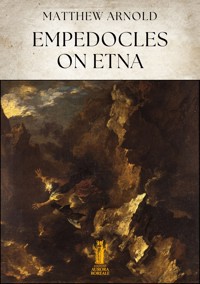
Empedocles on Etna is Matthew Arnold’s most famous poem. It is a dramatic poem or closet drama in two acts, first published, anonymously, in 1852. It describes the philosophic contemplations and suicidal ravings of the ancient Greek philosopher Empedocles (c. 494 - c. 434 BC) and his legendary death in the fires of Mount Etna on Sicily.
Das E-Book können Sie in Legimi-Apps oder einer beliebigen App lesen, die das folgende Format unterstützen:
Veröffentlichungsjahr: 2025
Ähnliche



SYMBOLS & MYTHS
MATTHEW ARNOLD
EMPEDOCLES ON ETNA
Edizioni Aurora Boreale
Title: Empedocles on Etna
Author: Matthew Arnold
Publishing series: Symbols & Myths
Editing by Nicola Bizzi
ISBN: 979-12-5504-901-2
Cover image: Salvator Rosa, The Death of Empedocles, c. 1665-1670
(Private collection)
Edizioni Aurora Boreale
© 2025 Edizioni Aurora Boreale
Via del Fiordaliso 14 - 59100 Prato - Italia
www.auroraboreale-edizioni.com
INTRODUCTION BY THE PUBLISHER
Matthew Arnold (1822-1888) was an English poet and cultural critic. He has been characterised as a sage writer, a type of writer who chastises and instructs the reader on contemporary social issues. He was also an inspector of schools for thirty-five years, and supported the concept of state-regulated secondary education.
The eldest son of Thomas Arnold and his wife Mary Penrose Arnold, he was born on 24 December 1822 at Laleham-on-Thames, Middlesex.
In 1828, Thomas Arnold was appointed Headmaster of Rugby School, where the family took up residence, that year. From 1831, the young Matthew Arnold was tutored by his clerical uncle, John Buckland, in Laleham. In 1834, the Arnolds occupied a holiday home, Fox How, in the Lake District. There William Wordsworth was a neighbour and close friend.
In 1836, Arnold was sent to Winchester College, but in 1837 he returned to Rugby School. He moved to the sixth form in 1838 and so came under the direct tutelage of his father. He wrote verse for a family magazine, and won school prizes. His prize poem, Alaric at Rome, was printed at Rugby.
In November 1840, aged 17, Arnold matriculated at Balliol College, Oxford, where in 1841 he won an open scholarship, graduating B.A. in 1844. During his student years at Oxford, his friendship became stronger with Arthur Hugh Clough, a Rugby pupil who had been one of his father's favourites. He attended John Henry Newman's sermons at the University Church of St Mary the Virgin but did not join the Oxford Movement. After his father's death in 1842, Fox How became the family's permanent residence. His poem Cromwell won the 1843 Newdigate prize. He graduated in the following year with second class honours in Literae Humaniores.
In 1845, after a short interlude of teaching at Rugby, Arnold was elected Fellow of Oriel College, Oxford. In 1847, he became Private Secretary to Lord Lansdowne, Lord President of the Council. In 1849, he published his first book of poetry, The Strayed Reveller. In 1850 Wordsworth died; Arnold published his "Memorial Verses" on the older poet in Fraser's Magazine.
Wishing to marry but unable to support a family on the wages of a private secretary, Arnold sought the position of and was appointed in April 1851 one of Her Majesty's Inspectors of Schools. Two months later, he married Frances Lucy, daughter of Sir William Wightman, Justice of the Queen's Bench.
Arnold often described his duties as a school inspector as "drudgery" although "at other times he acknowledged the benefit of regular work". The inspectorship required him, at least at first, to travel constantly and across much of England. As narrated by Stefan Collini in his 1988 book on Arnold: «Initially, Arnold was responsible for inspecting Nonconformist schools across a broad swath of central England. He spent many dreary hours during the 1850s in railway waiting rooms and small-town hotels, and longer hours still listening to children reciting their lessons and parents reciting their grievances. But that also meant that he, among the first generation of the railway age, travelled across more of England than any man of letters had ever done. Although his duties were later confined to a smaller area, Arnold knew the society of provincial England better than most of the metropolitan authors and politicians of the day».
In 1852, Arnold published his second volume of poems, Empedocles on Etna, and Other Poems. In 1853, he published Poems: A New Edition, a selection from the two earlier volumes famously excluding Empedocles on Etna, but adding new poems, Sohrab and Rustum and The Scholar Gipsy. In 1854, Poems: Second Series appeared; also a selection, it included the new poem Balder Dead.
Arnold was elected Professor of Poetry at Oxford in 1857, and he was the first in this position to deliver his lectures in English rather than in Latin. He was re-elected in 1862. On Translating Homer (1861) and the initial thoughts that Arnold would transform into Culture and Anarchy were among the fruits of the Oxford lectures. In 1859, he conducted the first of three trips to the continent at the behest of parliament to study European educational practices. He self-published The Popular Education of France (1861), the introduction to which was later published under the title Democracy (1879).
In 1865, Arnold published Essays in Criticism: First Series. Essays in Criticism: Second Series would not appear until November 1888, shortly after his death. In 1866, he published Thyrsis, his elegy to Clough who had died in 1861. Culture and Anarchy, Arnold's major work in social criticism was published in 1869. Literature and Dogma, Arnold's major work in religious criticism appeared in 1873.
In 1883 and 1884, Arnold toured the United States and Canada delivering lectures on education, democracy and Ralph Waldo Emerson. He was elected a Foreign Honorary Member of the American Academy of Arts and Sciences in 1883. In 1886, he retired from school inspection and made another trip to America. An edition of Poems by Matthew Arnold, with an introduction by Arthur Christopher Benson and illustrations by Henry Ospovat, was published in 1900 by John Lane.
Arnold died suddenly in 1888 of heart failure whilst running to meet a tram that would have taken him to the Liverpool Landing Stage to see his daughter, who was visiting from the United States where she had moved after marrying an American. His wife died in June 1901.




