


3,49 €
Mehr erfahren.
- Herausgeber: Rana Books UK
- Kategorie: Ratgeber
- Sprache: Englisch
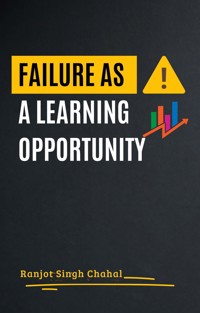
In "Failure as a Learning Opportunity," you'll uncover the profound potential hidden in setbacks. Explore the significance of learning, overcome obstacles, and harness the power of reflection. This book offers insights for lifelong personal growth and success, emphasizing the transformative nature of embracing failure as a stepping stone toward greatness. Don't miss your chance to unlock your full potential through the art of learning from failure .
Das E-Book können Sie in Legimi-Apps oder einer beliebigen App lesen, die das folgende Format unterstützen:
Veröffentlichungsjahr: 2023
Ähnliche

















Ranjot Singh Chahal
Failure as a Learning Opportunity
First published by Rana Books ( UK, India ) 2023
Copyright © 2023 by Ranjot Singh Chahal
All rights reserved. No part of this publication may be reproduced, stored or transmitted in any form or by any means, electronic, mechanical, photocopying, recording, scanning, or otherwise without written permission from the publisher. It is illegal to copy this book, post it to a website, or distribute it by any other means without permission.
First edition
ISBN: 978-81-19786-43-5
Contents
1. Introduction
2. The Psychology of Learning and Memory
3. The Educational System and Learning Disabilities
4. Social Factors Affecting Learning
5. Embracing Failure as an Opportunity for Growth
6. Overcoming Obstacles to Learning
7. Learning Styles and Individual Differences
8. Learning for Lifelong Success
1
Introduction
1. Introduction: Understanding the Importance of Learning and the Consequences of Failure
Learning is a fundamental and continuous process that helps individuals acquire knowledge develop skills and adapt to new situations. It is an essential aspect of human growth and development enabling us to enhance our understanding make informed decisions and navigate the complexities of life.
When individuals fail to engage in learning or experience difficulties in the learning process it can have significant consequences that impact various aspects of their lives. Whether it relates to education career advancement personal growth or social interactions the failure to learn can limit opportunities and hinder progress. This article aims to delve deeper into the importance of learning and the far-reaching consequences that arise from the failure to learn.
1.1 Definition of Learning and its Significance
Learning can be defined as the process of acquiring knowledge skills attitudes or values through study experience or teaching. It involves a cognitive emotional and behavioral transformation that enables individuals to interpret and understand the world around them. Learning is not limited to classroom settings; it occurs throughout our lives encompassing formal education informal learning and experiential learning.
The significance of learning cannot be overstated. It forms the foundation of personal and professional development enabling individuals to adapt and thrive in a rapidly changing and interconnected world. Learning enhances critical thinking problem-solving abilities creativity and decision-making skills. It also plays a crucial role in fostering personal growth building self-confidence and fostering a sense of accomplishment and fulfillment.
In educational contexts learning is central to academic success. It equips students with the necessary knowledge skills and competencies to meet the challenges of their chosen fields of study. For professionals learning is essential for career advancement as it allows them to stay updated with industry trends acquire new skills and embrace innovation. From a societal perspective learning is vital for the progress and development of communities as it equips individuals with the tools to contribute to their respective fields and foster positive change.
1.2 Exploring the Negative Impact of Failure to Learn
When individuals fail to engage in the learning process or face significant difficulties in acquiring and applying knowledge and skills it can have profound consequences that extend beyond their immediate circumstances. These consequences encompass different areas of life including education career opportunities personal development and social interactions. Understanding these consequences sheds light on the far-reaching impact of the failure to learn.
a) Educational Consequences:
Failure to learn can have serious implications in educational settings. In schools and higher education institutions the primary purpose is to impart knowledge and facilitate learning. When students struggle to grasp concepts fail to acquire essential skills or lack motivation to engage in the learning process their academic performance suffers. Poor academic performance can lead to lower grades failure to graduate or an inability to pursue higher education opportunities.
Beyond academic consequences failure to learn can also impact students’ self-esteem confidence and motivation. Students who consistently struggle with learning may develop negative attitudes towards education and perceive themselves as incapable of success. This mindset can create a vicious cycle as the lack of self-belief and motivation can further impede learning and academic performance.
b) Career Consequences:
Learning is crucial for career advancement and professional success. Individuals who fail to learn or neglect opportunities for skill development are more likely to face difficulties in the job market. In today’s dynamic work environment where new technologies industries and job roles emerge rapidly individuals must be adaptable and continuously upskill themselves to remain competitive.
Without a commitment to learning and skill development individuals risk becoming obsolete or falling behind their peers. This lack of competitiveness can limit career growth opportunities result in stagnant wages or lead to unemployment. Additionally failure to learn may hinder individuals’ ability to adapt to changes in their job roles or industries creating further career challenges.
c) Personal Development Consequences:
Learning plays a vital role in personal development shaping individuals’ perspectives values and understanding of the world. When individuals fail to engage in learning or resist acquiring new knowledge they limit their personal growth potential. The failure to learn can hinder the development of critical thinking skills problem-solving abilities and creativity which are essential for personal and intellectual growth.
Furthermore individuals who do not actively pursue learning may miss out on opportunities to broaden their horizons expand their knowledge base and explore new interests. Learning enhances individuals’ ability to understand diverse perspectives appreciate different cultures and engage critically with complex issues. The failure to learn can limit individuals’ capacity for empathy creativity and adaptability hindering their personal growth and fulfillment.
d) Social Consequences:
Human interactions and social relationships are pervasive elements of our lives and learning plays a vital role in fostering positive social connections. Failure to learn can impact individuals’ ability to effectively communicate collaborate and empathize with others. Inability or unwillingness to learn can lead to misunderstandings conflicts and strained relationships with family members friends colleagues or community members.
The failure to learn can also impede individuals’ capacity to engage in civic activities contribute to community well-being and be informed and responsible citizens. Learning is essential for understanding social issues engaging in constructive dialogue and working towards collective solutions. Without a commitment to learning individuals may become disconnected from the social fabric leading to isolation marginalization or an inability to contribute meaningfully to their communities.
Overall the failure to learn can have far-reaching consequences that impact various aspects of an individual’s life. From educational to career opportunities personal growth and social interactions the inability or reluctance to engage in learning can hinder progress limit opportunities and lead to broader personal and societal challenges.
To demonstrate the consequences of the failure to learn let’s explore a few examples:
Example 1: Educational Consequences - Sarah a high school student consistently neglects her studies fails to attend classes regularly and lacks motivation to engage in learning activities. As a result her academic performance suffers leading to low grades and potential failure to graduate. Sarah’s lack of commitment to learning hampers her chances of pursuing higher education opportunities or entering desired career paths.
2
The Psychology of Learning and Memory
2.1 Understanding How We Learn:
Learning is a complex psychological process that involves acquiring retaining and applying knowledge or skills. It is a fundamental aspect of human development and plays a critical role in our daily lives. Understanding how we learn can provide valuable insights into effective learning strategies and techniques.
One of the key theories in the psychology of learning is classical conditioning proposed by Ivan Pavlov. Classical conditioning is based on the idea that behaviors can be learned through repeated association between a stimulus and a response. Pavlov famously demonstrated this with his experiments on dogs where he conditioned them to salivate at the sound of a bell by repeatedly pairing the sound with the presentation of food.
Another important theory is operant conditioning introduced by B.F. Skinner. Operant conditioning focuses on how behaviors are shaped through consequences or reinforcement. Skinner’s experiments with rats in boxes (known as Skinner boxes) showed that behaviors that are reinforced are more likely to be repeated while behaviors that are punished or ignored are less likely to occur.




