


4,99 €
Mehr erfahren.
- Herausgeber: Olympia Press
- Kategorie: Für Kinder und Jugendliche
- Sprache: Englisch
The myths, legends, fairy tales, fables and old novels have, in translation, lost nothing of their immediacy and robust humor, and will alternately shock, delight and amuse the general reader. As folklore, they are indispensable for those who wish to know and understand Korean culture, history, religion, philosophy and even politics and economics.
Das E-Book können Sie in Legimi-Apps oder einer beliebigen App lesen, die das folgende Format unterstützen:
Veröffentlichungsjahr: 2016
Ähnliche













![Tintenherz [Tintenwelt-Reihe, Band 1 (Ungekürzt)] - Cornelia Funke - Hörbuch](https://legimifiles.blob.core.windows.net/images/2830629ec0fd3fd8c1f122134ba4a884/w200_u90.jpg)






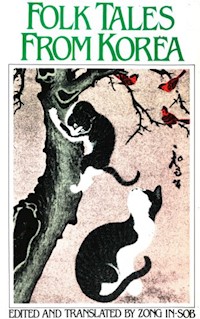
Folk Tales from Korea
Edited and Translated by Zong In-Sob
This page copyright © 2007 Silk Pagoda.
http://www.silkpagoda.com
The myths, legends, fairy tales, fables and old novels have, in translation, lost nothing of their immediacy and robust humor, and will alternately shock, delight and amuse the general reader. As folklore, they are indispensable for those who wish to know and understand Korean culture, history, religion, philosophy and even politics and economics.
A scholar himself, Professor Zong In-Sob has been careful to put on record a source for each of the 99 tales. Since most are based on oral tradition, they make excellent primary source material for folklore studies, but they are told first and foremost to be enjoyed.
Acknowledgements
I would like to take this opportunity of expressing my heartfelt thanks to W. Simon, Dr.Phil., D.Lit., Professor of Chinese in the University of London and Acting Head of the Far East Department of School of Oriental and African Studies, University of London, who suggested to me the preparation of this work and kindly wrote the Foreword of this book.
I am especially indebted also to Mr. W. B. Eggington, B.A., who read my manuscript and helped me with valuable suggestions.
Zong In-Sob
PART ONE. MYTHS
1. Dan-Gun, First King of Korea
THERE WAS once a wise and brave Prince, Hwan-Ung by name, son of the Heavenly King. The Prince asked his father to grant him the Beautiful Peninsula of Korea to govern. The King granted his wish, and he was dispatched to the Earth, bearing three Heavenly Seals, and accompanied by three thousand followers.
The Heavenly Prince arrived under the sacred sandalwood tree on the Tebeg Mountains, and ascended the throne. There he established the Sacred City. There were three ministers to carry out his orders, Pung-Beg (Earl Wind), U-Sa (Chancellor Rain), and Un-Sa (Chancellor Cloud), who were charged with the supervision of about three hundred and sixty officials, who controlled all things, such as grain, life, sickness, the determination of good and evil.
At that time a bear and a tiger were living in a big cave near the sandalwood tree. They wished ardently that they could become human beings. Every day they prayed so earnestly before the tree that the Heavenly Prince, who was now the ruler of the land, was moved by their sincerity, and, giving them twenty bulbs of garlic and a bundle of mugwort, he said to them, 'Eat these, and confine yourselves deep in your cave for one hundred days, and then you will become human.'
So the bear and the tiger took the garlic and the mugwort and went into their cave. They prayed earnestly that their wish might be granted. The bear patiently endured weariness and hunger, and after twenty-one days became a beautiful woman, but the tiger ran away, for it could not tolerate long days sitting quietly in the cave.
The woman was overjoyed, and visiting the sandalwood again she prayed that she might become the mother of a child. Her ardent wish was appreciated, and before long she became Queen, and gave birth to a prince, who was given the royal name Dan-Gun, or the Sandalwood King.
The people of the country rejoiced at the birth of the prince, Dan-Gun, who reigned afterwards as the first human king of the peninsula. When he came to the throne he established a new capital at Pyongyang, and gave the kingdom the name of Zoson (Choson—Land of Morning Calm). This was four thousand two hundred and eighty-three years ago. As the King's real name was Wang-Gum, the capital was also known as the Castle of Wang-Gum.
He later removed the capital to Mount Asadal (now Mt. Guwol in Hwang-He Province), where there is now a shrine called Sam-song (Three Saints, Hwan-In, the Heavenly King, Hwan-Ung, the Heavenly Prince, and Dan-Gun, the first human King). It is said that when Dan-Gun abdicated and left his throne to the next king he became a San-sin (Mountain God).
In the Tebeg Mountains, now called Myohyang-San, where the Heavenly Prince descended and the first King was born, there is even to this day a cave, known as the cave of Dan-Gun. There are historical relics of Dan-Gun on Mt. Mai, in Island Ganghwa, near Seoul, also.
From Samguk Yusa and Ondoru Yawa.
2. Go Zu-Mong, King of Goguryo
IN ANCIENT times there was a kingdom called Buyo whose territory included the Korean peninsula and the whole of Manchuria. The King of this land, Heburu, by name, though he had reached an advanced age, was yet without an heir. He therefore prayed constantly to the gods of the mountains and rivers that he might be granted a son. He was out riding one day, and when he came to a pool called Gonyon, his horse stopped, and neighed mournfully at a big stone. He ordered his attendant to turn the stone over, when, lo and behold, there appeared beneath it a little boy in the form of a golden frog. The King was overjoyed to find the boy, and, thinking that he must be a gift from a god, he adopted him as Prince. And he called him Gum-Wa (Golden Frog).
One day one of the King's ministers, Aranbul by name, came to the King and told him that a god had appeared to him in a dream and advised him that they should move to a more fertile land, called Gayobwon, near the Eastern Sea. So the King moved his kingdom thither, and renamed it Dong-Buyo (East Buyo). And after his death the Prince, Gum-Wa, succeeded him, but in his former territory a pretender called Hemosu took the throne, claiming that he was of divine ancestry.
One day the new King was travelling in the land of Ubalsu, south of Mount Tebeg, when he happened to meet a woman, by name Yuhwa, daughter of Habeg (Lord of the River). The King asked her about herself, and she answered, 'I once met a man called Hemosu. He said he was the son of a god. We stayed one night together in a house by the Yalu River, near Mount Ungsim, but after that he never came back. And for this illicit liaison my parents cast me out.'
On hearing her story the King was deeply moved, and he took her and confined her in a room. Sunbeams came streaming in towards her. Though she tried to avoid them she could not, they still fell directly upon her. She soon became pregnant, and in the end she gave birth to an enormous egg, as big as five dwoe (a unit of dry measure).
The King was most displeased by the birth of an egg, and threw it to the dogs and the pigs, but they would not eat it. He cast it out on the streets, but the cows and horses avoided it. He had it taken out into the fields, but the birds tended it under their wings. So he took it back and tried to break it, but it was not to be broken, and so finally he returned it to the mother. She wrapped it in soft cloth and placed it in a warm part of the room. Before long it hatched, and a boy was born from it. He appeared from birth to be very strong and healthy. His mother was very happy, and tended him with great care.
When the boy was six years old he could already shoot with the bow, and soon became so skilful that he outstripped all rivals. He was thereupon given the name of Zu-Mong, because from the earliest times the champion archer had been called so.
The King had seven sons. The eldest, Deso, was jealous of Zu-Mong, and said to his father, 'Zu-Mong was born from an egg. I think he is a dangerous character. I advise you to get rid of him at once, for if you do not he may sow seeds of trouble.' But the King ignored this suggestion, and appointed Zu-Mong to the care of his horses. Zu-Mong fed the better horse sparingly, in order that it might become thin and weak, and on the other hand he fed the other lavishly that it might become fat and appear to be strong. This he did because he already suspected the malice of others toward himself, and wished to be prepared for what might happen in the future.
One day the King decided to go hunting, and, riding the fat horse himself, bade Zu-Mong ride the thin one. In the field the King was hindered in his hunting by the slowness of his horse, whereas Zu-Mong was most successful even with the poor bow and arrows that he had, since the horse he rode was really the better one.
Now the King was anxious about possible dangers, and, influenced by the malicious designs of the Princes and his ministers, was inclined to have Zu-Mong killed. His mother Yuhwa guessed this evil intention, and earnestly advised her son to escape. He fled with three followers, Zoi, Mari, and Hyobbu, and came to the river Omczesu. But there was no bridge, and they were hotly pursued by the King's men. So Zu-Mong prayed to the River God, 'I am the son of a god, and of the daughter of Habeg. I am beset by the gravest of dangers. Save me, oh, please save me!'
Then marvellous to relate, there came swimming in the river a great crowd of fish and tortoises, and they formed a bridge with their backs. So they crossed the river with ease, but their pursuers could not follow, for the fish and tortoises immediately swam away.
Zu-Mong and his followers went on their way and came to the valley of Modun, where they met three wise men, Zesa, Mugol, and Muggo. He asked them to assist him in founding a new kingdom. The three wise men agreed and followed him, and he bestowed on them the family names of Gugsi, Zungsil, and Sosil respectively.
So Zu-Mong went to Zolbonczon with his three followers and the three wise men, and founded a new capital there, for it was a fertile spot, surrounded by steep mountains and traversed by a beautiful river. Until such time as he might be able to build himself a palace he built temporary dwellings of thatched houses on the banks of the Bullyu River. His kingdom he called Goguryo, and took as his family name the first syllable Go.
Thus Go Zu-Mong became the first king of Goguryo, two thousand three hundred and two years ago.
From Samguk Sagi, Vol. 13.
3. The Sun and the Moon
LONG, LONG AGO there lived an old woman who had two children, a son and a daughter. One day she went to a neighbouring village to work in a rich man's house. When she left to come back home, she was given a big wooden box containing buckwheat puddings. She carried it on her head, and hastened back to her waiting children. But on the way, as she passed a hill, she met a big tiger.
The tiger blocked her path, and opening its great red mouth asked, 'Old woman, old woman! What is that you are carrying on your head?' The old woman replied fearlessly, 'Do you mean this, Tiger? It is a box of buckwheat puddings that I was given at the rich man's house where I worked to-day.' Then the tiger said, 'Old woman, give me one. If you don't, I will eat you up.' So she gave the tiger a buckwheat pudding, and it let her pass the hill.
When she came to the next hill the tiger appeared before her and asked her the same question, 'Old woman, old woman, what have you got in that box you are carrying on your head?' And, thinking it was another tiger, she gave the same answer, 'These are buckwheat puddings I was given at the rich man's house where I worked to-day.' The tiger asked for one in the same way. And the old woman gave it a pudding from her box, and it went off into the forest.
The tiger then appeared several more times and made the same demand, and each time she gave it a pudding, until there were no more left in the box. So now she carried the empty box on her head, and she walked along swinging her arms at her sides. Then the tiger appeared again, and demanded a pudding. She explained that she had none left, saying, 'Your friends ate all my buckwheat puddings. There is nothing at all left in my box.' Thereupon she threw the box away. Then the tiger said, 'What are those things swinging at your sides?' 'This is my left arm, and this is my right arm,' she replied. 'Unless you give me one of them, I will eat you up,' roared the tiger. So she gave it one of her arms, and it walked off with it. But not long afterwards it appeared in front of her again, and repeated its threats. So she gave it her other arm.
Now the old woman had lost all her puddings, her box, and even both her arms, but she still walked along the mountain road on her two legs. The greedy tiger barred her way once more and asked, 'What is that, moving under your body?' She answered, 'My legs, of course.' The tiger then said, in a rather strange tone, 'Oh, in that case, give me one of your legs, or I will eat you up.' The old woman got very angry, and complained, 'You greedy animal! Your friends ate all my puddings, and both my arms as well. Now you want my legs. However will I be able to get back to my home?' But the tiger would not listen to her, and persisted in its demand. 'If you give me your left leg, you can still hop on your right leg, can't you?' So she had to take off her left leg, and throw it to the tiger, and then she set off homewards, hopping on her other leg. The tiger ran ahead of her, and barred her way again. 'Old woman, old woman! Why are you hopping like that?' it asked. She shouted furiously, 'You devil! You ate all my puddings, both my arms, and one of my legs. However can I go home if I lose my right leg too?' The tiger answered, 'You can roll, can't you?' So she cut off her right leg, and gave it to the tiger. She set out to roll over and over along the road. Then the tiger rushed after her, and swallowed what was left of her in a single gulp.
Back at the old woman's home her two children waited till nightfall for her to return. Then they went inside and locked the door, and lay down hungry on the floor, for they did not know that a tiger had eaten their mother on her way home.
The cunning tiger dressed in the old woman's clothes, and put a white handkerchief on its head. Then, standing erect on its hind legs, it walked to the old woman's house and knocked at the door. It called to the two children, 'My dears, you must be very hungry. Open the door. I have brought you some buckwheat puddings.' But the children remembered the advice their mother had given them when she went out in the morning, 'There are tigers about. Be very careful.' They noticed that the voice sounded rather strange, and so they did not open the door, and said, 'Mother, your voice sounds rather strange. What has happened to you?' So the tiger disguised its voice and said, 'Don't be alarmed. Mother is back. I have spent the day spreading barley to dry on mats, and the sparrows kept flying down to eat it, so that I had to shout loudly at them all day long to drive them away. So I have got rather hoarse.' The children were not convinced, and asked again, 'Then, Mother, please put your arm in through the hole in the door, and let us see it.' The tiger put one of its forepaws in the hole in the door. The children touched it and said, 'Mother, why is your arm so rough and hairy?' So the tiger explained, 'I was washing clothes, and I starched them with rice paste. That must have made my arm rough.' But the children peeped out through the hole in the door, and were surprised to see a tiger there in the darkness. So they slipped quietly out the back door, and climbed a tall tree and hid among the branches.
The tiger waited for a while, but as it got no further reply from inside, it broke into the house, and searched in vain for the children. It came out in a furious temper, and rushed round the house with terrible roars, till it came to an old well underneath the tree. It looked down at the water, and there saw the reflections of the two children. So it forced a smile and tried to scoop up the reflections, and said in a gentle voice, 'Oh, my poor children. You have fallen into the well. I haven't got a bamboo basket, or even a grass one. How can I save you?' The children watched the tiger's antics from above, and could not help bursting out laughing. Hearing their laughter it looked up, and saw them high in the tree. It asked in a kindly voice, 'How did you get up there? That's very dangerous. You might fall into the well. I must get you down. Tell me how you got up so high.' The children replied, 'Go to the neighbours and get some sesame oil. Smear it on the trunk and climb up.'
So the stupid tiger went to the house next door and got some sesame oil and smeared it thickly on the trunk and tried to climb up. But of course the oil made the tree very slippery. So the tiger asked again, 'My dear children. You are very clever, aren't you? However did you get up there so easily, right to the top? Tell me the truth.' This time they answered innocently, 'Go and borrow an axe from the neighbours. Then you can cut footholds on the trunk. 'So the tiger went and borrowed an axe from the house next door, and, cutting steps in the tree, began to climb up.
The children now thought that they would not be able to escape from the tiger, and in great terror prayed to the God of Heaven. 'Oh God, please save us. If you are willing, please send us the Heavenly Iron Chain. But if you mean us to die, send down the Rotten Straw Rope!' At once a strong Iron Chain came gently down from Heaven to them, so that they could climb up without difficulty.
When the tiger reached the top of the tree the children were gone. It wanted to follow them, so it too began to pray, but in opposite terms, because it was very afraid that it might be punished for its misdeeds. 'Oh God of Heaven, if you would save me, send down the Rotten Straw Rope, I beg of you. But if you mean me to die, please send down the Heavenly Iron Chain.' By praying in this way, it hoped that the Iron Chain would come down, and not the Straw Rope, for it expected that as a punishment it would receive the opposite of what it had prayed for. But the gods are straightforward, and always willing to save lives by answering prayers directly, and so it was the Rotten Straw Rope that came down after all. The tiger seized the rope, and began to climb up it, for in the darkness it could not see that it was not the chain. When it got a little way up the rope broke, and so it fell down to the ground. It crashed down in a field of broom-corn, where it died crushed and broken, its body pierced through by the sharp stems of the corn. From that day, it is said, the leaves of broom-corn have been covered with blood red spots.
The two children lived peacefully in the Heavenly Kingdom, until one day the Heavenly King said to them, 'We do not allow anyone to sit here and idle away the time. So I have decided on duties for you. The boy shall be the Sun, to light the world of men, and the girl shall be the moon, to shine by night.' Then the girl answered, 'Oh King, I am not familiar with the night. It would be better for me not to be the moon.' So the King made her the Sun instead, and made her brother the moon.
It is said that when she became the Sun people used to gaze up at her in the sky. But she was a modest girl, and greatly embarrassed by this. So she shone brighter and brighter, so that it was impossible to look at her directly. And that is why the sun is so bright, that her womanly modesty might be for ever respected.
Ondoru Yawa, told by O Hwa-Su; Onyang (1911).
4. The Fire Dogs
THERE ARE MANY countries in Heaven, just as there are in the world below. One of them is called Gamag Nara, the Land of Darkness, and its inhabitants keep many horrible dogs. They are known as Fire Dogs. The King of that land is greatly concerned before all else that his realm is so dark. So from time to time he sends his dogs to the world of men to try to steal the Sun or the Moon.
Once upon a time the King summoned the fiercest of his Fire Dogs and ordered it to go and steal the Sun and bring it to him. So the Fire Dog went off, and tried to seize the Sun in its mouth, but it was too hot. It snapped at it again and again, but in the end it had to give up, and returned without its prey. The King was very angry, and reprimanded the dog severely for its failure. Then he turned to the next fiercest dog, and sent it to try to steal the Moon, for he thought that it might not be so hot as the Sun. The Moon would not give him as much light as the Sun of course, but he thought it would be better than nothing. But when the dog tried to bite the Moon, it was so cold that it froze its mouth. It tried repeatedly to grasp it with its teeth, but in the end was obliged to spit it out. And so the second Fire Dog too had to return without the prize.
Despite these failures the King of the Land of Darkness never gave up hope, and to this day he often sends out his Fire Dogs, but they always fail in the end.
It is said that eclipses of the Sun and Moon are caused in this way by Fire Dogs from the Land of Darkness. It is the parts of the Sun or Moon that they bite which show dark during an eclipse.
We cannot watch an eclipse of the sun directly because it is so dazzlingly bright, but it can easily be seen in the reflection of the sun in a basin of water in which a little black ink has been dissolved. An eclipse of the moon can also be watched in the same way. We can easily see on the inky surface of the water the Fire Dog biting the sun and then spitting it out again.
Told by Zong Teg-Ha; Onyang (1912).
5. The Seven Stars of the North
ONCE UPON A time there lived a widow, who had seven most filial sons. Every winter they used to cut wood in the mountains so that they could keep a fire burning constantly under the floor of their house and make it warm enough for their aged mother to sleep warm at night. But she always looked very cold and sad. However much wood they burnt, she always felt the cold. In fact, she always complained of the cold, even in the hottest midsummer months.
One night the eldest son woke up, and saw that his mother was not in the room. He waited in great anxiety for her to return, though he pretended to be asleep. Just before dawn she came creeping stealthily back, so that her sons should not notice her.
When she went out the next night her eldest son followed her secretly. When she reached a stream on the outskirts of the village she girded up her skirts and waded across, muttering to herself, 'Oh, how cold it is,'—for it was winter—and went to a poor thatched cottage on the other side. She stood before the house and called, 'Father, are you at home?' An old man came out and welcomed her, saying, 'Come in, Mother.' He was a poor widower who earned a living by weaving straw sandals.
The eldest son now understood what was in his mother's heart. So he hurried home and woke his brothers, and told them what he had seen. Then they all went out together and set stepping stones in the stream. They went back home and slept as if nothing had happened.
When their mother came to the stream on her way home she was very surprised to see the stepping stones which had not been there before. Of course she did not know that her sons had put them there. She was deeply grateful to whoever had set them in the stream, and prayed to Heaven, 'May those who put these stepping stones in the stream become the Seven Stars of the North.'
So when the seven filial sons died they were set in Heaven as the Seven Stars of the North, just as their mother had prayed. And they formed the constellation that is known in the West as the Great Bear.
Told by Son Zin-Te; Gupo (1926).
6. The Three Stars
LONG AGO THERE lived a rich man who had one daughter. One year he went up to the capital to take a Government post, and left his daughter in charge of the house in his absence.
One day a Buddhist monk came begging alms. The daughter told the maid to give him a little rice. But the monk asked her to fill the bowl right up, and so she told the maid to do so. Yet however much she put into the bowl it could not be filled. She fetched all the rice from the storeroom, and even unhulled rice and millet, and yet the bowl could not be filled. The maid was very puzzled, and she asked, 'How can it be filled?' The monk answered, 'If the daughter of the house comes and tries herself, she will be able to fill it without difficulty.' So the daughter of the house came to the monk and tried to fill the bowl, but even she could not fill it completely. Then the monk said, 'If you pick up each grain separately nine times with silver chopsticks you will fill it.' So she did as he suggested, but still without success. 'If you take off your undergarments in a pit, and then try, you will succeed,' said the monk. So she did so, but even so the bowl was not filled.
Meanwhile the sun had set, and the monk earnestly begged her to give him lodging for one night. She refused his request, with the excuse that there was no guest room in the house, but he still persisted in his request, and would not leave the house. He said that he would be satisfied to sleep in the stable, and this she allowed him to do. About midnight he came and said, 'It is too cold in the stable, will you not let me sleep in the corner of the kitchen?' She took pity on him, and let him move into the kitchen. But a little later he came and said, 'I cannot stand the cold here either, let me come and sleep in the annexe of your room.' This too she allowed him to do. Very soon, however, he came and said, 'It is too cold here too. Please let me sleep behind the screen in your room.' Even this she allowed him to do. And so it came about that the monk slept in the same room.
When she awoke next morning the monk had gone. On her father's return, some time later, all the servants went out to welcome him, but she could not go, for she was with child. On hearing this her father was very angry, and determined to kill her. She was taken into the garden and bound, and a servant was ordered to cut off her head. But when he lifted the axe, the handle broke in two, and it fell behind him. He took a sword, and tried to kill her with that, but when he flourished it over her head the blade snapped in half. Her father then had an underground cell made, and she was cast into it. He kept the key himself, and gave orders that no food should be taken to her, so that she might starve to death.
From that time the monk appeared in the underground cell every night. No one knew whence he came, or how he was able to get into the cell. He took food to the girl, and in due course she gave birth to triplets.
Some years later her father ordered the cell to be opened. He expected he would find only a skeleton. Great was his amazement to find his daughter alive, with three children sitting reading beside her. So he asked her how it had come about and she told him the whole story. So he sent for the monk, and when he came he asked him, 'Are these three children yours?' 'Yes,' replied the monk, 'and I will prove, it.' He lifted up the sleeve of his robe. 'If these three children pass through my sleeve without touching it, that will prove that they are indeed my sons.' Then the children passed through his sleeve without touching it. The monk said again, 'Let them put on wooden sandals and walk on white sand. They will leave no trace whatever on the sand.' This they did, and walked on sand without marking it. So the truth was proved, and the father recognized the marriage of the monk with his daughter. And the monk was seen to be a miracle-working Buddhist.
When they died his three children were set in Heaven as the three stars of the constellation Vega. They rise in a vertical line, and set in a horizontal line, just as the children were born one after the other downwards from the womb, and were buried in three graves side by side.
Told by Son Zin-Te; Gupo (1926).
7. The Mountain and the Rivers
LONG, LONG AGO, when food ripened on the Food Tree, and clothes ripened on the Clothes Tree, there lived a giant. He was so big that even his ears were six hundred feet long. He could not wear clothes, because there was not cloth enough in the whole land to cover his body. So he went almost naked the whole year long, and in winter he suffered bitterly from the cold weather.
The King in those days—it was, of course, even before the time of Dan-Gun—was very sorry indeed for the poor giant, and had as much cloth as could be found collected from all the provinces, and ordered all the tailors to make a robe for him. After many months they finished the robe, but even so it was too short. Nothing more could be done as there was no more cloth, and so it was bestowed upon the giant as a gift from the King.
The giant gladly put on the robe, and danced for joy on the lofty mountain pass of Seze. Suddenly the whole land was darkened, for as he danced his robe cut off the sunbeams. All the crops failed in the darkness, and the people appealed to the King to send the giant away. The King was very angry, and ordered his army to expel the giant beyond the borders of the land. A party of the mightiest warriors set out to carry the royal message to him. When they reached the summit of the mountain pass where he was standing they all shouted together in a loud voice, but the giant could not hear them, his ears were so far from his feet. So they climbed up his legs, and after many months they reached his navel. Once more they shouted, 'HO, GIANT! Your robe cuts off the sunlight, and the crops do not ripen. His Majesty has ordered that you be expelled beyond the borders of the land.'
So the giant was driven out into the barren fields of Manchuria. Soon he became very hungry and thirsty, and ate the soil of the fields, and drank the water of the sea. Then his stomach began to roar like a mighty flood, and instantly his bowels were loosened. And his excrement became a range of mountains, the highest mountain in Korea, Begdu-San (White Head Mountain). And when he made water two mighty channels were cut, one before him, and one behind. These are the two greatest rivers of the northern frontier of Korea. One is the Amnog-Gang (Yalu River), the longest river in Korea, and the other great river is the Duman-Gang (Tumun River). There is a great lake on top of the mountain where both these rivers rise, called Czonzi (Heaven Lake) or Yong-Dam (Dragon Pool). This lake was formed by the giant making water there. Ondoru Yawa, told by Bang Zong-Hwan; Seoul (1925).
8. The Great Flood
ONCE UPON A time there stood a big laurel tree. A fairy often used to come down from Heaven and rest there. She bore a son, whose father was the tree, and when he was seven years old she went up again to Heaven.
One day there was a great storm, and the rain continued for many months, so that the whole Earth was flooded as if by a raging sea. The flood even began to drown the great laurel. So the tree said to its son, 'My boy, you are my son. I am afraid I shall fall, so then you must ride on my back. In that way only can you be saved.' Soon afterwards the tree was uprooted by the waves, so the boy climbed on to the back of his father the tree, and the tree remained floating on the water for many days.
One day a great crowd of ants came drifting by. They shouted, 'Oh, Son of the Tree! Save us, please save us!' So the Son of the Tree asked his father, 'Father, may I save them?' And the tree replied, 'Indeed you may.' The son called to them, 'Get on to the tree.' So the ants gladly climbed on to the branches and leaves of the laurel. Then a group of mosquitoes came past, and wearied with much flying, appealed to the boy, 'Oh, Son of the Tree! Please save us, we implore you!' So the Son of the Tree asked his father if he might save them. It gave its consent, and the mosquitoes alighted on the branches of the tree. Then a boy of his own age, who was floating on the water, shouted, 'Oh, my friend! Save me, please save me!' So the son asked his father the tree for permission to help the boy, but the tree said, 'No!' The boy shouted desperately in his distress, and the son asked his father again, but the answer was the same. Now the boy was screaming for help, for he was near to drowning, so the son asked his father a third time, 'Father, do let me save the boy.' This time the tree replied, 'Do as you like,' and so the son shouted to the poor boy, 'Get on to this tree!' And so the boy was saved too.
At last the great laurel tree, carrying the two boys, the ants and the mosquitoes, came to an island. It was the summit of a lofty mountain, as high as Mt. Begdu. The ants and the mosquitoes then went away, after bidding farewell to the boy, and expressing their gratitude, 'Thank you, Son of the Tree. You saved our lives, and we are deeply indebted to you. Good-bye!'
The two boys, who were very hungry, went and found a house, where there lived an old woman and her two daughters. One of them was her own daughter, and the other a foster-child. She received the two boys kindly, and gave them work in the farmyard. There was no one else left alive, as all the other people had been drowned in the flood.
Now the rain stopped, the waters subsided, and they started farming again. The old woman thought it would be advisable to arrange marriages between the young people, and decided to match her own daughter with the cleverer boy, and her foster-daughter with the other.
The second boy detected the old woman's plan, and decided to take advantage of his opportunity. He said to the old woman maliciously, 'The Son of the Tree is a most unusually clever boy. Though you scatter a great bag of millet grains on the sand he can pick it all up within half an hour. Let him try it, and you will see for yourself.'
So to test his skill the old woman scattered a great bag of millet on the sand, and bade the son of the tree collect it again. He refused at first, but she repeated her demand, and in the end he had to agree. He tried to pick the grains up one by one, but he was so slow that it seemed unlikely that he could finish in half a year to say nothing of half a day. So with his head bowed in despair he wondered miserably what he could do.
Then he felt something biting his heel. It was a big ant, and it said to him, 'I am one of the ants you saved from the flood. Why are you so sad?' The boy told it what a difficult task he had been set, and then the ant brought thousands of its friends and picked up all the grains, so that the bag was filled in a few minutes. But the other boy was jealous, and watched the scene from a distance. He went and told the old woman that the task had not been done by the Son of the Tree himself.
So the old woman could not decide which of the boys she favoured, and said to them, 'I love both of you equally, and so I cannot decide which of you should marry my daughter, and which my foster-daughter. Now I have a plan. You shall choose your own destiny. There will be no moon to-night, for it is the last day of the month. You must go and wait outside the gate in the dark, and I will put one of the girls in the east room and one in the west room. Then I shall call you, and you may enter whichever of the rooms you may choose. Thus you shall make your own choice, and you will not be able to complain at the result.'
After supper the two boys went and waited outside. After a while the old woman called them to come in. In the summer night the Son of the Tree stood wondering which room he should enter. Just then he heard a big mosquito flying near his head. It came and whispered in his ear, 'Son of the Tree! Go to the east room, the east room!' So he went to the east room, and there he found the old woman's beautiful daughter. And the other boy found her foster-daughter in the west room.
It is said that these two couples had many children, and that they are the ancestors of the whole human race to-day.
Told by Kim Gi-Teg; Tong-Yong (1913).
9. The Jewel of the Fox's Tongue
THERE WAS A big school in a country village long ago. There were a hundred pupils at this school, and they used to study at night, reading aloud at the top of their voices. Sometimes, when it was too late for them to go to their homes, they used to sleep together in a big room.
Late one night they were all sleeping soundly, except the youngest boy, who was just seven years old. He heard strange footsteps outside, and pricked up his ears. Amid the loud snores of his friends he could hear faintly, yet clearly, the voice of a woman counting the shoes outside—one, two, three, four... and so on up to one hundred pairs. Then a beautiful girl quietly opened the window and crept stealthily into the room. The youngest boy was very frightened, and crept silently to the furthest corner of the room. He saw the girl begin to count the pupils, starting from the doorway. She kissed each of them on the lips, and then, strange to say, each of them stopped breathing and died as soon as she kissed him. When she came near the corner where the youngest boy was hiding he crept over to the opposit [...]




