


9,99 €
Mehr erfahren.
- Herausgeber: Alessio Mangoni
- Kategorie: Wissenschaft und neue Technologien
- Sprache: Englisch
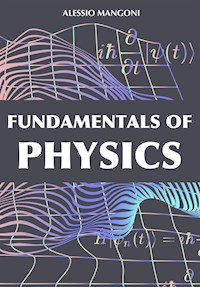
This book aims to provide solid bases for the study of physics for the university and it is divided into four parts, each dedicated to a fundamental branch of physics: quantum mechanics, theoretical physics, particle physics and condensed matter physics. In the first part we start with the concept of wave function, until the Heisenberg uncertainty principle. In the second part, after recalling the basic concepts of relativity, we treat the elementary particles and the hadrons, arriving to the notions of scattering and cross section. The third part is dedicated to the theoretical physics, where we analyze the field theory and the concepts of Lagrangian and Hamiltonian, introducing the quantum electrodynamics (QED), passing through the Klein-Gordon, Dirac and Maxwell fields. In the last part of the book we expose the basics of the condensed matter physics, including diffusion and Brownian motion, Drude and Sommerfeld models, the calculation of specific heat and the principal mechanical properties of solids, with references to lattice defects and semiconductors.
Das E-Book können Sie in Legimi-Apps oder einer beliebigen App lesen, die das folgende Format unterstützen:
Veröffentlichungsjahr: 2020
Ähnliche
















Contents
Contents
Introduction
Part I
Quantum Mechanics
Introduction
The wave function
The Schrödinger equation
Free particle equation
General equation
Continuity equation
Wave packets
Normalization
Fourier transform
Interval of length 2pi
Interval of length L
Infinite interval
Coordinate and momentum space
Expectation value
Operators
Position operator
Momentum operator
Energy operator
Angular momentum operator
Spherical coordinates
Commutation relations
Uncertainty principle
Eigenvalue equations
Position operator
Momentum operator
The third component of angular momentum operator
Part II
Particle Physics
Introduction
Natural units
Bases of relativity
Four-vectors
Lorentz transformations
Relativistic kinematics
Invariant mass
Particles
Elementary particles
Quarks
Leptons
Quark model
Fundamental interactions
Hadrons
Mesons
The Yukawa meson
Baryons
Nucleons
Cosmic rays
The pion
The muon
Particles with strangeness
Kaons
Hyperons
Energy loss
Ionization energy loss
Electron energy loss
Photon energy loss
Hadron energy loss
Quantum numbers and symmetries
The strangeness
The parity
Parity of the photon
Parity of a two-particle system
Charge conjugation
Charge conjugation of the photon
Charge conjugation of the pion
Time reversal
CPT theorem
Baryon number
Lepton number
Isospin
Hypercharge
The Gell-Mann-Nishijima formula
G-parity
Helicity
Chirality
Scattering and decays
Reference frames
The invariant quantity s
Mandelstam variables
Two‐body elastic scattering
Fermi's golden rule
Cross section
Beam intensity reduction
Luminosity
Two-body cross section
Decays
Part III
Theoretical Physics
Introduction
Lagrangian and Hamiltonian
Lagrangian field theory
Hamiltonian field theory
Symmetries and gauge invariance
Symmetries and conservation laws
Gauge invariance
Campo di Klein-Gordon
The Klein-Gordon field
Klein-Gordon Lagrangian
Klein-Gordon Hamiltonian
The electromagnetic field
Maxwell's equations
Gauge invariance
Maxwell Lagrangian
The Dirac field
Dirac equation
Properties of gamma matrices
Dirac Lagrangian
Dirac Hamiltonian
Free particle solutions
Quantum electrodynamics
Interaction Lagrangian
Interaction Hamiltonian
Field operators
The S matrix
Part IV
Condensed Matter Physics
Introduction
Brownian motion and diffusion
Introduction
Einstein relation
Fick's laws
Random walker
Langevin equation
Fokker-Planck equation
Boltzmann equation
Drude model
Introduction
Electric conductivity
Hall effect
Thermal conductivity
Seebeck effect
Sommerfeld model
Quantum treatment
Internal energy
Sommerfeld expansion
Mechanical properties of solids
Introduction
Young's modulus
Poisson's ratio
Lattice defects
Introduction
Point defects
Color centers
Dislocations
Semiconductors
Intrinsic semiconductor
Extrinsic semiconductor
Wave packets
We have seen that the general solution of the Schrödinger equation for a free particle (i.e. where V=0) is given by an overlap of plane waves, each with a certain wave number k. A free particle with a well-defined k (or, equivalently, a well-defined momentum p) has the following wave function




