


Erhalten Sie Zugang zu diesem und mehr als 300000 Büchern ab EUR 5,99 monatlich.
- Herausgeber: Steffen Schönherr
- Kategorie: Für Kinder und Jugendliche
- Sprache: Englisch
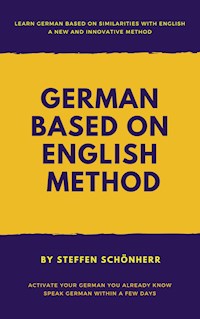
Is it possible to learn German for beginners quick and easy? The answer is: yes! Simply because German and English are not so different from each other. In fact, you know a lot of German already! Both languages share thousands of similar words and have similar sentence structures. This is how anyone who knows English can actually pick up basic German easily - and speak it right away! And the best thing is that you don't need to study a lot of grammar or words. It just needs a teaching method to point out the similarities and some practice...GboE method is right for you if you:- plan a trip to Germany, Austria or Switzerland- want an easy to learn approach to German- want to be able to speak German within a few days- want to avoid complicated German grammar rules- want to start speaking German right away with what you already know from English- want to hear and pronounce German the native way correctly- want to learn some of the 100 most frequently used German words (with an easy to remember technique)- want to learn 1699 German words which are similar to English (and therefore easy to remember)- struggle picking up German with "normal/ classic/ traditional" methods which most other language courses use- want a real German "boost" because you are planning to take a German class in High School, College or at a regular language school and you want to start in a "pole position" to impress your teacher and classmatesWhat you get with the Basic package:- learn 1699 German words- 5 lessons- access to pronunciation audio files- access to speaking video lessonsContent:Lesson 1: Arrival - Germany/ Austria/ SwitzerlandSituation: Arrival at a German, Swiss or Austrian airport, transfer to the hotelWhat you learn: Say what you need, what you look for and what (public transportation) you take, the German Akkusativ (accusative), more Top 100 Words (most frequent German words)Words: 187 new wordsPronunciation audio files: 32:03 minutesSpeaking video lessons: 41:40 minutesLesson 2: At the hotelSituation: At the hotelWhat you learn: Say who you are, what you would like, what you have, how you like things, persons and situations, more Top 100 Words (most frequent German words)Words: 240 new wordsPronunciation audio files: 39:43 minutesSpeaking video lessons: 77:04 minutesLesson 3: Move around at the new placeSituation: You get around in a city, you ask for directionsWhat you learn: How to ask questions, say and ask for directions, more Top 100 Words (most frequent German words)Words: 425 new wordsLesson 4: Spend more time at the hotelSituation: You are in a hotel, at the hotel reception, you ask for a free room, you have a drink at the hotel barWhat you learn: Say what you like, what is yours, what you do, how you pay, numbers, prices, more Top 100 Words (most frequent German words)Words: 533 new wordsLesson 5: At the train stationSituation: You buy tickets for a train, you ask for train departures and arrivalsWhat you learn: Say where you come from, what you see, where your sit, ask for a (free) seat, buy a train/ bus ticket, ask for bus/ train departure and arrival, say and ask the time, colours, the German he/ she/ it, more Top 100 Words (most frequent German words)Words: 314 new words
Sie lesen das E-Book in den Legimi-Apps auf:
Seitenzahl: 114
Veröffentlichungsjahr: 2019
Das E-Book (TTS) können Sie hören im Abo „Legimi Premium” in Legimi-Apps auf:
Ähnliche







![Tintenherz [Tintenwelt-Reihe, Band 1 (Ungekürzt)] - Cornelia Funke - Hörbuch](https://legimifiles.blob.core.windows.net/images/2830629ec0fd3fd8c1f122134ba4a884/w200_u90.jpg)




Table of Contents
Lesson number 1: Arrival - Germany/ Austria/ Switzerland
Lesson number 2: At the hotel
Lektion Nummer 3: Move around at the new place
Lektion Nummer 4: Spend more time at the hotel
Lektion Nummer 5: At the train station
Learn more German (Lern mehr Deutsch)
German based on English [GboE method]
Learn German based on English words and structures. Activate your German you already know.
© 2019 Steffen Schönherr
All rights reserved.
Steffen Schönherr
Contact: [email protected]
Visit us on: https://germanbasedonenglish.com/
Vorwort
Foreword
This German course based on similarities with English will teach you how to create and speak German by using words and structures which you already are familiar with from English. Find out how easy and similar many German words and structures are. There are thousands of identical words in modern English and modern German due to its same Germanic heritage. Also, both languages share many words that have Latin (e.g. French) roots.
In addition, you will learn (lernen) a useful selection of the 100 most frequently used words of the German language. Some of these “Top 100 Words” have little or no similarities with English, however by using effective memorization techniques you will notice that these words are easy for you to remember as well. Furthermore, the German vocabulary and sentence structures will be repeated in exercises throughout this course, so you'll find yourself learning them without even trying.
You might ask yourself: Is that possible? Will I even learn a German I can use with German speakers if this course teaches a German which is mainly based on what I know as an English speaker? The answer is: yes. The similarities to English exist to an extent which allows you to communicate the basics of the German language. This course is different from the traditional German courses because it focuses almost exclusively on similarities with English in order to reach the most possible communication outcome. With thousands of similar words and simple structures this communication goal is possible! It is about breaking down German to its essentials with only one goal: basic communication without having to study much.
In contrast, “traditional” German courses teach you words and grammar that have no or little connection to English – which is of course part of the German language reality but not necessary if you want to build up basic communication skills or if you want to start out learning German by activating what you already know.
This course is designed for you to keep German as simple as possible with a quick learning effect!
Content
Lesson 1: Arrival - Germany/ Austria/ Switzerland
Situation: Arrival at a German, Swiss or Austrian airport, transfer to the hotel
What you learn: Say what you need, what you look for and what (public transportation) you take, the German “Akkusativ” (accusative), more Top 100 Words (most frequent German words)
Words: 187 new words
Pronunciation audio files: 32:03 minutes
Speaking video lessons: 41:40 minutes
Lesson 2: At the hotel
Situation: At the hotel
What you learn: Say who you are, what you would like, what you have, how you like things, persons and situations, more Top 100 Words (most frequent German words)
Words: 240 new words
Pronunciation audio files: 39:43 minutes
Speaking video lessons: 77:04 minutes
Lesson 3: Move around at the new place
Situation: You get around in a city, you ask for directions
What you learn: How to ask questions, say and ask for directions, more Top 100 Words (most frequent German words)
Words: 425 new words
Lesson 4: Spend more time at the hotel
Situation: You are in a hotel, at the hotel reception, you ask for a free room, you have a drink at the hotel bar
What you learn: Say what you like, what is yours, what you do, how you pay, numbers, prices, more Top 100 Words (most frequent German words)
Words: 533 new words
Lesson 5: At the train station
Situation: You buy tickets for a train, you ask for train departures and arrivals
What you learn: Say where you come from, what you see, where your sit, ask for a (free) seat, buy a train/ bus ticket, ask for bus/ train departure and arrival, say and ask the time, colours, the German “he/ she/ it”, more Top 100 Words (most frequent German words)
Words: 314 new words
Three simple steps: How to learn
1. Study this document
Do the exercises for each lesson by simply following the instructions. You learn all the new words and sentences to communicate!
2. Pronounce the words with audio files
Even though English and German have the same Germanic roots, sounds can sound entirely different from English. However, it is not as difficult to pronounce German as you might think! With a little practice you'll soon become familiar with the sounds of German and even the most difficult words will be easy once you’re used to them.
Therefore, this language course includes some pronunciation audio files. I recommend you to listen to the words and repeat them loudly after each lesson or step by step after each exercise or word list – whatever you prefer! This will be the best way for you become familiar with the beautiful German sounds!
3. Practice speaking with the videos
Each lesson has its own videos to practice speaking. You repeat words and structures by speaking words and phrases and you even create whole sentences yourself!
Glossar
Glossary
Umlaut
The so called “Umlaut” are two dots on the vocals: ä, ö, ü. If your device does not easily let you write the “Umlaut” it is as well possible to write these letters as follows:
Also:
Nomen (noun):
A word that refers to a thing, person, substance, place, event, or quality.
→ Doktor (doctor), Kohle (coal), Region (region) and (Kuh) cow are all Nomen (nouns).
Rule: The first letter of a noun in German always starts with a capital letter!
Verb (verb):
A word that describes an action, experience or condition.
→ rennen (to run), fühlen (to feel), finden (to find) are all Verben (verbs)
Adjektiv (adjective):
A word that describes a noun or pronoun.
→ gut (good), laut (loud), intelligent (intelligent) are all Adjektive (adjectives)
Nomen (nouns) and its genders
As you might have heard, the German language has three different genders for nouns.
→ maskulin (masculine), feminin (feminine) and Neutrum (neuter)
The abbreviations in this language course are as follows:
→ maskulin (m.)
→ feminin (f.)
→ Neutrum (n.)
In contrast, the English language has only one gender: neuter (a, the)
Cognates
Words of languages that have the same roots, are related or in some way similar.
“Full Cognates”
A word creation to refer to cognates which are 100% the same words in German and English (spelled exactly the same way, but might have a slightly different pronunciation).
“Half Cognates”
A word creation to refer to cognates which are around 50% the same words in German and English (you will be able to recognise them and it will still be fairly easy to remember them).
“Top 100 Word”
A word from the list of the 100 most frequently used words in the German language.
“Power Word”/ “Power Verb”
A word which is very powerful in terms of being very useful for communication in the German language.
Lesson number 1: Arrival - Germany/ Austria/ Switzerland
Instant vocabulary (Full Cognates)
Here are 32 identical German nouns for you to use right away.
Audio file: https://vimeo.com/312076668
Alphabet n.
Auto n.
Bank f.
Bar f.
Bus m.
Café n.
Computer m.
Club m.
Euro m.
Fastfood n.
Festival n.
Gate n.
Hospital m.
Hotel n.
Hostel n.
Kiosk m.
Laptop m.
Lounge f.
Name m.
Person f.
Potential n.
Restaurant n.
Safe m.
Service m.
Supermarkt m.
Ticket n.
Terminal m./ n.
Theater n.
Tram f.
Transporter m.
Tutor m.
Van m.
Neue Wörter
New words
Audio file: https://vimeo.com/312076691
Top 100 Word/ Power Verb
The ich is similar to English, you only need to add a -ch to the i. Note that the letter i looks like a cobra snake – it indeed makes a cobra sound combined with the -ch.
Top 100 Word/ Power Verb
The German word for I need is ich brauche.
Imagine the funny image of a bra und Che Guevara – I need to laugh. ;-)
The German word for you need is Sie brauchen.
Top 100 Word/ Power Verb/ Half Cognate
The German word for I search (I look for) is ich suche.
Imagine a zoo is looking for a zookeeper. I search a zookeeper, ich suche.
The German word for you search is Sie suchen.
Top 100 Word/ Power verb
The German word for I take is ich nehme.
The German word for you take is Sie nehmen.
Imagine a friend is single and happy about it and you say: “you don't takeno men”.
Top 100 Word/ Half cognate
The German word for a/an is ein or eine.
Ein sounds similar to an and is used for masculine and neuter nouns, eine is used for feminine nouns.
Power Word
The German word for a train is Bahn (f.).
Imagine the word barn, there are usually a lot of animals in it. In a Bahn you share your space as well, but usually with human passengers.
Top 100 Word / Half cognate
The German word for and is und.
You only need to replace the letter a with u.
Top 100 Word/ Half Cognate
The German word for for is für.
You only need to replace the letter o with ü.
Power Words/ Half Cognates
To learn simple greetings is essential. Also, here you can find similarities with English. Please fill in the English translations.
06:00h – 11:00h
11:00h - 18:00h
18:00h - …
Before you go to bed
24 hours
Deutsch
Guten Morgen!
Guten Tag!
Guten Abend!
Gute Nacht!
Hallo!
Englisch
Power Word
The German word for (good)bye is tschüs.
Imagine you are saying the Italian ciao with a slightly different ending.
Deutsch klar und präzise
German clear and precise
The German language distinguishes between formal “Sie” (formal you - which is used in situations in which you want to address one person or several people formally, i.e. persons you don't know/ which you meet for the first time) and informal “du” (informal you - which is used in informal situations with persons you know/ who are friends). As an adult you also use the informal “du” for kids and teenagers you know or don't know. On the other hand kids and teenagers will speak to adults using the formal “Sie” if they don't know the adult very well. Kids addressing each other use the informal “du”. In this language course we will stick to the formal “Sie” which you will need more when dealing with German speaking people you meet for the first time. The informal “du” (and the other personal pronouns: he/she/it, we, etc.) will be introduced with the GboE method.
Lerntipp für Nomen
Learn/ study tip for nouns
To remember well each noun with its gender write down each noun, for example next to the instant vocabulary word list above. If you do it you are more likely to remember each noun with its corresponding article (ein, eine) in the long term.
Example:
Auto m.einAuto
Bank f.eineBank
Computer n.einComputer
Übung 1A
Exercise 1A
See how well you remembered your new German words. Match the words.
[ ] ich
[ ] ich brauche
[ ] eine (feminin)
[ ] ein (maskulin, Neutrum)
[ ] Sie (formell)
a) I
b) you (formal)
c) a/an (masculine, neuter)
d) a/an (feminine)
e) I need
[ ] ich nehme
[ ] eine Bahn
[ ] und
[ ] Sie suchen
f) and
g) you search
h) I take
i) a train
[ ] ich suche
[ ] Sie nehmen
[ ] für
[ ] tschüs
[ ] Sie brauchen
j) (good)bye
k) you need
l) I search (I look for)
m) you take
n) for
[ ] guten Abend
[ ] hallo
[ ] guten Morgen
[ ] guten Tag
o) good morning
p) good day
q) good evening
r) hello
Antworten zu Übung 1A
Answers to exercise 1A
1. ich; 2. Sie (formell); 3. ein (maskulin, Neutrum); 4. eine (feminin); 5. ich brauche; 6. und; 7. Sie suchen; 8. eine Bahn; 9. ich nehme; 10. tschüs; 11. Sie brauchen; 12. ich suche; 13. Sie nehmen; 14. für
Cognates-Kategorie 1: c/k
You can make these English cognate words (nouns and adjectives) into German by changing c to k.
Differences: c/k
Words: 34
Audio file: https://vimeo.com/312076557/571fc4bef5
America: Amerika n.
architect: Architekt m.
Atlantic: Atlantik m.
boycott: Boykott m.
cactus: Kaktus m.
camel: Kamel n.
camera: Kamera f.
combination: Kombination f.
decadent: dekadent
dialect: Dialekt m.
direct: direkt
doctor: Doktor m.
document: Dokument n.
effect: Effekt m.
exact: exakt
fact: Fakt n./ m.
factor: Faktor m.
focus: Fokus m.
helicopter: Helikopter m.
incompetent: inkompetent
instinct: Instinkt m.
local: lokal
logic: Logik f.
music: Musik f.
nectar: Nektar m.
object: Objekt n.
panic: Panik f.
perfect: perfekt
perspective: Perspektive f.
reaction: Reaktion f.
scandal: Skandal m.
transaction: Transaktion f.
vacuum: Vakuum n.
zinc: Zink n.
Cognates-Kategorie 2: sh/sch
In German the English sh sound is spelled sch by adding the letter c.
Differences: sh/sch
Words: 14
Audio file: https://vimeo.com/312076593
Bangladesh: Bangladesch
bush: Busch m.
English: englisch, Englisch n.
fetish: Fetisch m.
Finnish: finnisch, Finnischn.
fish: Fisch m.
harsh: harsch
Irish: irisch, Irisch n.
marsh: Marsch f.
shimmer: Schimmer m.
shock: Schock m.
shrill: schrill
Spanish: spanisch, Spanisch n.
stockfish: Stockfisch m.
Cognates-Kategorie 3: ph/f
In German and English the f sound is sometimes spelled with f or ph. This does not follow a pattern neither in English nor in German, you just need to try to remember the spelling.
Differences: ph/ f
Words: 2
Audio file: https://vimeo.com/312076624
photo: Foto n.
elephant: Elefant m.
Cognates-Kategorie 4: add an -e




