


Erhalten Sie Zugang zu diesem und mehr als 300000 Büchern ab EUR 5,99 monatlich.
- Herausgeber: Pushkin Children's Books
- Kategorie: Für Kinder und Jugendliche
- Sprache: Englisch
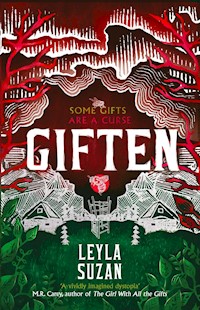
'Gripping, haunting and compelling... Definitely one for fans of Black Mirror or John Wyndham' Liz Hyder, author of Bearmouth One girl takes on an oppressive system in this electrifying teen dystopia, set in a post-apocalyptic world sapped of natural resources 'A vividly imagined dystopia furnished with memorable characters and urgent, believable conflicts' M.R. Carey, author of The Girl With All the Gifts A BLIGHTED LAND Ever since The Darkening, survival has been a struggle. The people of the Field toil on parched earth, trying to forge a life amid dwindling resources. A GIFT As one of the Giften, Ruthie is a saviour to her isolated community: her hands hold the rare ability to raise food from dead soil. But she is also its greatest danger. A SINISTER REGIME In the City lurks a dark army, intent on hunting Giften to harnass their power. With the threat growing ever stronger, Ruthie and her friends must leave behind all they have ever known and embark on a quest that will pitch them towards the City, and unknowable danger One way or another, a battle is coming. READER REVIEWS OF GIFTEN 'Giften will appeal to readers of The Maze Runner and The Hunger Games''A fantastic story about survival''An exciting and thought-provoking read''A unique & very creative YA story''Addictive'
Sie lesen das E-Book in den Legimi-Apps auf:
Seitenzahl: 335
Veröffentlichungsjahr: 2021
Das E-Book (TTS) können Sie hören im Abo „Legimi Premium” in Legimi-Apps auf:
Ähnliche












![Tintenherz [Tintenwelt-Reihe, Band 1 (Ungekürzt)] - Cornelia Funke - Hörbuch](https://legimifiles.blob.core.windows.net/images/2830629ec0fd3fd8c1f122134ba4a884/w200_u90.jpg)





2
5
For E.B.
7
The dusty bowls and dishes lie
on tables oak and brown
But where did all the people go?
No children’s merry sounds
I ask the winter, call the snow
to bring my mammy home
To fill the dishes on the table
with soft sweet-smelling loam
anonymous
Contents
My First Testimonial
I touch the pencil to my tongue as I have seen our Recorder do so many times, and begin to write down Logan’s words, committing them to the rough paper sheets, to be read by people I will probably never meet.
It is impossible to feel anything but joy on a day like today. The Field, in the late summer sunshine, sparkles. I watch our friends bend to the task of repairing their cabins in time for the winter frost and the young ones collecting fat windfall from swollen apple trees, their mouths stained purple from gorging on blackberries. Their laughter trills through the Woods, even now, when you feel that your world is about to end.
My own story is a simple one, Ruthie.
My mother recorded the voices of our northern land and that job, on her death, fell to me. My own death, and yours, will not silence our stories. I record them for all who come after, so they will know we rejoiced as much as we suffered. 10Do not forget they are the words of real people whose hands worked the earth and raised their children, whose voices hold within them every word of wisdom you will ever need, every comfort.
Is it lonely work? Tiring? Of course. But I ask for help and help is often given: willing hands keep the wheels of my old yellow solar turning; the papermakers are generous and there is a woman who crafts charcoal into sturdy pencils just for me.
I put away the idea of a One and Only a long time ago, when I was little more than a child. When your head is full of the lives of others, what can you offer of yourself? It might be different for you.
From the Lakes to the Hebrides, from the smallest communities to the vast; from inland, to the coasts and even to the City, and in all weather, I follow paths, tracks and cratered roads to gather stories as if they were pigment to paint a picture of our world. So much strength and resolve, so much despair and searing pain—all this will make a fine canvas of lives lived in constant renewal.
I’m not impartial. How can you record the resilience of our people and remain detached? Ever since the Darkening the challenges have been great. And I’m only human.
My ancestors witnessed the destitution of our land and also, its slow revival. While I rejoice in our growth, it is with grief that I have had to record the hunting of the Giften all these years and the tales of those who would protect them. 11
You have come to a fork in the road, Ruthie, and you will take the new path. You will see new things. And meet new people.
You listen well; maybe the life of a Recorder will suit you. Let this be your first record.
Logan—the Recorder
Prologue
Joshie was fourteen when the MAGs took him.
He was my favourite older boy when I was a smallie, we all wanted to play with him and he never chased us away. We laughed at his bad jokes and helped him with his chores when he would let us. His hair, the colour of wheat, had a way of flopping down over his eyes when he laughed. His smile revealed a dimple in one cheek.
In the weeks after, my dreams were strange, violent things. I’d wake up with lingering shouts of defiance ringing in my ears, still panting from dream-running through thick woodland, chasing after my friend who was being dragged away by men with guns.
But I didn’t chase after him. I didn’t do anything. No one did.
The edges of the thick forest circling our land were ankle deep with autumn leaves that day. Stace and I were playing, in the reds, yellows and golds, the sun glinting off everything it touched. She thought we were too old to play at eleven, but Joshie changed her mind about that 14when he nudged us into a game, chasing us further into the Woods. Hide and seek turned into catch-me-if-you-can, and soon enough we were all running around the Hollow Oak.
Stace caught me, tripped me up and she and Joshie began to pile on the leaves. I held still, because this was also part of the game. If you’re caught, you get buried and then, you get to burst out like a thunderstorm. The smell of autumn leaves, the feel of the earth at my back, the sun on my skin—all of it as real as the moments that followed.
I was still under this crunchy blanket when I felt Stace’s kick.
“Ruthie! Our mums are calling.”
I scrambled, but she and Joshie were already running out of the Woods and into the Field. And there was Mum, shouting my name.
The sun was setting over the row of cabins, the sky full of pink. Wood smoke trailed out of our chimneys, curling, white. Stace was already halfway across the Field, bare legs paddling to keep up with her mum, but Joshie was waiting for me, one foot in the Woods, the other in the Field.
“What’s going on?” I panted, bent double, hands on my knees. But Mum’s eyes were on Joshie, not me.
“Run!” she shouted at him. “Get out of here!”
“What?” he said, taking a step.
“Joshie!” Amy, his mum, her face as red as the autumn leaves, streamed past Mum, folding him into her arms, her mouth at Joshie’s ear, whispering urgent words. Mum’s 15hand was tight around my arm as she started to run for the cabins.
“They’ve come for the Offering,” she panted. “You need to get inside.”
The MAGs were here.
Mum slowed down, dropping my arm as we passed the MAGs, their black solars parked outside Dev’s cabin, next to ours.
Three MAGs; giant insects, in their uniforms of black. Their holstered guns and hard bodies made my heart bang harder. The adults were gathered around the solars; the MAGs were shouting, pointing at the hessian sacks of fresh veg, earthen containers of dried fruit and cloth-wrapped packets of smoked deer meat. The Offering—our food. But that summer had been especially good to us, the harvest was plenty enough to see us through the bad weather and to make the Offering. They should be happy, I thought, bitterly, but something else was going on here, something bad enough to make the mums call us home.
As I climbed the porch steps, Mum at my back nudging me to go faster, the voices grew louder. A very tall MAG stepped up to Dad, shouted into his face. I caught the word Giften.
“Stay inside!” Mum hissed and then she was gone.
From my bedroom window I watched the MAG aim his gun at the sun and fire. I covered my ears as everyone scattered. The crack bounced off the trees and the high peal of a baby’s scream ripped through the air. Baby 16Amaya was thrust above the heads of the small crowd by strong arms, MAG arms. She writhed and shrieked. The giant MAG swept his gun across the frightened faces of my community.
Joshie and his mum raced up their porch steps and slammed the door. The baby carried on squirming, screaming while Daisy, her mum, clawed at the MAG’s arms.
“Let her go. Please!”
Everyone but the baby fell silent when the back door of a MAG solar swung open and from behind darkened windows a woman emerged.
I had never seen her before, but we all knew who she was. My heart had been thumping hard, but now it felt like it had stopped.
The first thing that struck me about her was how clean she was. Her clothes weren’t made from other clothes sewn together like ours. She wore a pale blue shirt, a copper brooch pinned to a crisp collar; grey trousers with a sharp crease. Her red boots shone in the low afternoon sun. Even though she looked quite old, she had a young girl’s hair, long, straight and yellow, which fell down her back, untroubled by the breeze.
“Let’s all take a moment, shall we?” she said. Her voice was sweet, soothing. She gestured for the baby, holding out her arms.
“What’s your name then?” she asked, cradling Amaya. The adults were silent. Dad’s arm circled Mum’s shoulders, drawing her close. 17
“Amaya. She’s my daughter,” Daisy said, through her sobs.
“And I’m Saige Corentin,” she said. “Oh, come now. You don’t have to be like that.”
Defiant, unsmiling faces stared back at her.
Amaya had stopped crying; something about Saige Corentin had transfixed her.
“We came for the Offering, which you have given us. I wanted to meet you, you and the other communities, and to tell you that you needn’t fear us.” She glared at the tall MAG. “Put that away,” she snapped.
He holstered the gun but kept his hand on the grip.
“Your Offering is sizable this season, my men tell me.” Saige held Amaya aloft and Amaya giggled. “It’s too big for such a small community.” She smiled at Amaya’s mum. “Daisy, is there a Giften in the Field?”
Daisy shrank back, her eyes flicking to the faces of the small crowd.
“Do you need some incentive, my dear?” Saige’s voice was low, but still loud enough for me to hear its sickly sweet tone.
Daisy grabbed her arm as she made to climb back into the car with Amaya. The MAGs moved in.
“Stand down!” Saige snapped. Amaya was on her hip now, playing with the long strands of her blonde hair. “Yes?” she said, her head inclined towards Daisy, who swallowed hard, before she leaned in to speak into Saige’s ear, her arms outstretched for her baby. 18
The heads of every adult in the community turned towards Joshie’s house.
I didn’t understand what was happening, but it had something to do with my friend. Amy’s red face, her urgency, Mum telling him to run.
As I raced down the porch steps, the MAGs were shoving my friends, my family, aside. One ran ahead to Joshie’s cabin, kicking open the door, while the others held the community back with raised weapons. I reached Dad just as Joshie was pushed out of the cabin. Amy hung on to him as the giant MAG started to drag him away. She tripped on the porch steps, got up again, shouting, “No, please,” until the butt of a gun cracked against her skull. She went down and stayed down.
“Joshie!” I screamed as he was hauled off the ground and dragged towards the solars. All of us were yelling, cursing the MAGs, cursing their guns.
The sky was even pinker now; the Field looked impossibly beautiful in this light; our faces bathed in the glow of a perfect evening.
“You have nothing to be scared of.” Saige Corentin’s voice cut through our pleas. “I am rebuilding the City. And I have people to feed. Your Offerings and your Giften make that possible.”
A MAG appeared at her side, opening the back door of her solar.
“Any Circle here?” she said to him, her eyes sweeping over our faces. 19
Dad flinched, his grip on my arm suddenly painful.
The MAG shook his head. “We should go, doctor,” he said. “We’ve got everything we need.”
The sun glinted off the brooch on her collar, the embossed image of an open palm. “No members of the Circle here? Your revolutionary zeal is disappointing, I have to say.” She laughed and climbed into the car. “We will forfeit the next Offering from the Field,” she said, before pulling her door shut and disappearing once more behind the black glass.
Joshie, on the backseat of the second solar, struggled with the giant MAG.
When the cars pulled away, Dev started to run after them. I screamed, trying to wrench free from Dad, but he wouldn’t let me go.
A MAG leaned out of the window and fired a gun into the sky and Dev stopped dead. His chest heaving, he turned around and screamed his rage into our faces; they had taken his best friend and we had done nothing to stop them.
* * *
And then it was dark and I was in bed. Dad loomed over me, arms folded tight across his chest, while Mum cried next door.
“Why did you let them take him?” I whispered. I could barely see him in the gloom. A single yellow candle 20sputtered on my nightstand, threatening to go out any second.
“I didn’t let them.” His voice broke.
“I didn’t know he was Giften.”
“No one should have known,” he sighed.
We both jumped as the wind thumped against my window. It was black outside, not even the pointy silhouette of the treetops showed against the moonless sky.
I sank back into my bed as Dad shook out my crumpled blanket and covered me.
“It was the food; we gave them too much. It was our own stupid fault; we made them suspicious.” He was talking to himself now. I thought of the screaming baby—swapped for the Giften boy. “Something needs to change. We need to change.” He headed for the door.
“Dad,” I said, “if we had Circle here, would they have stopped her?” I watched his head fall to his chest. His voice was husky, low.
“Maybe.”
PART ONE
The Field
My hands have worked the land since I was a girl. Look at them, lined, rough, and calloused. Not much good for needlework or writing. But they tell my story just the same. And it’s a great yarn, Logan. It’s about raising food to feed the smallies, chopping wood to keep them warm, holding them close when they’re ill. In this world, you need two things to survive, one is love and the other is a strong pair of hands.
Gracie, Moorlands Valley
1
It’s hard to imagine what these lands were once like. Full of people, full of cars, full of greed. We pumped out poison and it suffocated us, the land dried to a crisp or became a sodden wasteland. Whatever they did to change their ways, it wasn’t enough, or it was too late. Greedy people never really change, they just find different ways to get what they want. And here we are, decades and decades after the Darkening, small communities living in isolated pockets, trying to feed ourselves off the mistakes of the insatiable.
Finian, Invers Keep
Two years ago, Dad and his friend, Owen, went on a Supply Run, but only Owen came back.
Two long summers have come and gone since Dad disappeared. Two winters when he wasn’t here to chop up firewood, and two autumns when he didn’t give the Field Day speech. He’s missed my fourteenth and fifteenth birthdays, and I guess I’ve missed a couple of his. Some days a careless spark of hope drives me to glance out of a window, or look up from my chores 24outside, thinking I might see him in the distance; he’ll be shielding his eyes from the sun, or frowning at the state of our porch steps. Or he’ll spy me at my window, wave, yell, Hello, chicken.
Mum tried, for a while, to pretend, as the weeks turned into months, that he might find his way back to us, but that was for my sake. It was easier for her to listen to my hopes and wipe away my tears, than to tell me Dad was dead and I would never see him again.
But we saw much more of Owen. He had sat down in Dad’s chair at our table that day, saying the same words over and over; they had been ambushed by MAGs, he ran into some woodland, believing Dad was right behind him, but when he stopped running, when he turned around and came out of the woods, Dad was gone.
It feels like Owen took Dad’s chair and decided he liked it enough to stay.
* * *
Owen and his son, Seb, lived in another community before they joined us; they arrived when I was just a smallie. Their last community had collapsed when the food ran out and Seb’s mother had died on the road. I don’t remember a time when they weren’t here. I once heard Old Pete tell Mum that because Owen was not born and bred Field stock, it took him longer to find his place, but hasn’t he come to love this land as much as we do? Wasn’t it Owen, after 25all, who had almost single-handedly rebuilt the Shed after the Big Storm five years back?
For a long time, his presence was the black hole into which Dad had disappeared. The single word answers I gave him infuriated Mum, I could tell, and so whenever he came over, she’d send me off to Stace’s because she needed to talk to Owen in peace. But sometimes I’d just climb back in through my bedroom window and listen. I never heard anything very interesting though, just him apologizing and saying how guilty he felt and Mum telling him it wasn’t his fault. That’s when I really hated him. He shouldn’t be asking her to forgive him. I wished he’d been taken instead.
Finally, I caught something worth hearing. He was saying that he wanted to take care of her, of us, and he wanted to be more than a good friend.
I heard chairs scraping, and then no more words. I opened my bedroom door a crack and peeked. Owen was holding Mum so tight I wanted to scream, his fingers pressing into the soft flesh of her arms, his mouth covering hers, but then Mum’s fingers were pulling at Owen’s shirt, dragging it over his broad shoulders, exposing his back. And then she caught sight of me. I was no longer hiding, but standing in full view.
Things moved fast after that, and however hard I tried to slow them down, Mum pushed back. Move on, Ruthie. Six months later she was pregnant with Ant, and Owen and Seb had moved in. Owen, who had rebuilt the Shed 26almost single-handedly, wasted no time in adding another room to our cabin for my two new brothers.
But Owen is not my father. And when I tell Mum that he can’t be bossing me, or pretending to be Dad, she tells me that he doesn’t boss me and he loved Dad. Sometimes I see Owen looking at me funny and I know he’s wishing I wasn’t here, believing that he and Seb and baby Ant are enough for Mum. Stace says that’s wrong, that it’s sadness in his eyes, not hate, that all he wants is for me to stop blaming him.
There have been fewer Supply Runs since Dad disappeared. Even the MAGs have been stopping by less, we don’t seem to get the random invasions that we used to.
Owen’s been on pretty much every Supply Run since he joined the Field according to Old Pete, that’s how much he cares for the community. He usually takes Seb, now that he’s eighteen, or Dev. They bring back the herbs Doc Pam needs for doctoring, salvage for repairing the solars and the cabins, and whatever rusty tools or old books have resurfaced from the days before the Darkening. But now Owen says he doesn’t need the company; there are more MAGs out than ever before, why risk more lives? When I asked Mum who put Owen in charge of the Supply Runs, she said he’s looking out for us and I should be grateful.
In recent months he’s started to patrol the outer perimeter of the Woods, sometimes he’s gone for days; she says this is to keep us safe too. But the only people who come 27uninvited into the Woods are MAGs, and we have no guns to stop them.
* * *
The Field sparkles in the heat today, and the shirts of the men and women harvesting the wheat stick to their backs. Sweat drips off their red faces as they work. Yesterday, when I took my turn with the scythe, a cool wind made the job just about bearable.
In just three months the Field will be under snow. And when you think it can’t get any colder, it does, and none of us go outside much, except to check the traps or fetch more wood and food from the Shed. Maybe a bit of hunting if it’s clear skies. But right now, at this moment, it’s hard to believe in winter at all.
“Hey,” I say to Stace. She is sprawled on the dry grass around the Well. Dev, dark skinned with cropped black hair, lies beside her. He’s only three years older than us, but he’s taller and stronger than most of the men here. Stace squints up at me.
“Hey,” she says and shuts her eyes again.
Dev lifts a lazy hand in a wave. Seb sits a little way off, his back against the stone wall of the Well, whittling arrow heads from silver birch to a sharp point.
“Why don’t you sit down?” Seb asks, glancing up. It’s not midday heat, the sun is already dipping in the sky, but I’m still damp under my thin shirt. His white hair is the 28opposite of Owen’s thick black waves. Owen says his mum had the same colour hair, but Seb was only three when she died on the way to the Field, so he doesn’t remember her at all. “I have an extra knife if you want to whittle,” he says.
“Too hot,” I say.
Stace squints at me again and when I don’t move, she sits up slowly.
“What’s wrong?” She shields her eyes from the sun.
“I want to talk to you.”
Seb and Dev exchange a look. Seb grabs his arrows, shoves them into a pouch, folds away his knife and stands up.
“You don’t have to go, we’ll go,” I say.
“No. It’s OK.” Seb offers Dev a hand. “We have work to do anyway.” They think we’re going to talk about bleeding.
“Apple picking?” Dev says, pulling himself to his feet. Seb nods. They head into the Woods, unfolding two sacks for windfall.
“So, what’s up?” Stace says, standing up and brushing grass from her skirt. “Let’s go to mine. It’s too hot out here. Dad’s on the roof and Mum’s—”
“At mine. I know.”
We pass today’s harvesters in floppy white hats, stretching and then bending back to it. Old Pete is on his porch making a charcoal drawing on a finely sanded panel of wood; when I follow the direction of his gaze, I see he’s staring into the sky. He is drawing from memory.
“Ladies,” he nods as we pass.
“Do you think his kids will ever come back?” Stace asks 29when we’re out of earshot. Old Pete and Lucia’s children left the Field when I was a smallie. They wanted to see what else was ‘out there’, and either they found it and decided it was better than the Field, or they were dead.
“Who knows?” I hope she can tell by my tone that I don’t want to get into it.
Stace’s cabin is a mess as usual. Bits of wood, tools and salvaged metal are strewn about the main room, the materials her dad, Filip, uses to make toys for the children and fine bows and arrows from yew and furniture from oak for the adults. His wood-turning lathe sits outside in the sun at the foot of the porch, where wood shavings lie in soft blond piles in the grass. Mum is tidy, too tidy Dad thought, and because of her, I guess, I’m also too tidy. I start to stack random blocks of wood and shuffle the tools into a pile, but Stace laughs and knocks the blocks off the table onto the floor.
“Leave it,” she says.
I follow her into her room. Her wardrobe hangs open, empty, because her clothes are scattered around her room. Patchwork dresses are draped over the chair, underwear on the floor, trousers on the bed. There is a sort of order to it, I suppose.
We listen for a moment to Filip on the roof, every time he bangs in a nail a shower of fine dust rains down from the beams.
Stace joins me on the bed after flinging trousers on top of dresses.30
“So?” she asks.
“Owen found traces of someone camping in the Woods,” I tell her.
“What?” She sits up suddenly; her eyes, wide and excited, gaze into mine. “Where?”
“At the Blazes,” I say. My voice catches. “Yesterday.”
“The Blazes?” she says slowly.
“I know,” I say. “He found tire tracks from a solar… and apple cores.”
“Shall we go take a look?” She is suddenly on her feet.
I sit up slowly. This isn’t going how I planned. “I don’t think so. He’s telling everyone to stay out of the deep Woods.”
I love Stace like a twin, but she isn’t one for standing still. She stares at me, her hands on her hips.
“Do you think it’s MAGs?” I whisper.
“Of course not!” she says quickly, sitting down on the bed. “Is that what you’re worried about, that MAGs—”
“I don’t know, Stace,” I say, as she reaches for a curl of my hair and twists it between her fingers.
“Come on, Ruthie, let’s go see. It’s probably someone who just needs help.” She takes my hand and pulls me off the bed and over to the window, where she parts the muslins. The sun is setting behind the trees and flashes of red and gold sparkle through the branches. The wind has picked up. I’m glad for the workers. Old Pete chases his hat across the wilting spinach.
“I don’t want to,” I say. “And Owen said to stay away.” 31
But Stace is already bored of the idea. She’s watching Dev and Seb head for the Shed. They each carry a half-filled sack of apples, shoving each other, laughing.
“Who do you think is better looking—Seb or Dev?”
“What?”
“Seb?”
“Seb?” I say, stupidly.
“You like him, don’t you, Ruthie?” Stace is staring at me again.
“What? I… Don’t be weird, Stace.”
“You can’t see it, can you?” she says, catching my arm before I can lift the latch on her door to leave. Her blue eyes are large in her face, her voice steady. She really wants to know my answer.
“What’s wrong with you?” I say.
“Nothing. I’m an idiot. Just forget it.” Her mouth turns down and her eyes glisten.
“Stace? Are you crying?”
“No.” She’s looking out of the window again. “I’ll see you later, OK? And don’t worry. It’s not MAGs,” she says.
* * *
Stace and I are the same age, roughly, I’m just ten days older than her. Before we could walk, we crawled all over the Field together, before we could run, we stumbled about in the Woods, hand in hand. I used to think she is the me I’d like to be. Stace is funny and kind; she’s also 32restless. Whenever we’ve walked up to the outer edges of the Woods, to the strip of land bordering the Field and the outside world, I’ve caught her gazing at the dusty track the solars take on Supply Runs. She says she wants to see what’s out there.
This spring Stace and Seb started to go together, and for a while Stace was the happiest she’d ever been, and I thought that maybe one day she and Seb would join and then she’d be my real sort-of sister. But they broke up, and she’s miserable. Seb isn’t though. Whenever I tried to talk to her about what happened, she just shook her head and looked away. So now I don’t bother.
Sometimes I find myself watching Seb when I have no business to. I like the way he blows his snow-white hair out of his eyes on a hot day.
I know what Stace was hinting at, of course I do.
* * *
On the way home from Stace’s I think about the Field Day celebrations in two days’ time. A moment to pause from all the chores is the saying. In the Clearing, in the Woods, we share the best of our food and the community takes a day off. Of course, there is the Speech we have to sit through which stings since Dad isn’t here to make it. Even though I’d heard him recite the story of the Field every year of my life, something new revealed itself with each telling. 33
The Speech is partly the story of the Darkening, when our land was once too parched to live off, or drowned by flood water or split by earthquakes. We were broken by the Darkening, cut down by greed, by a lack of care. But Dad’s speeches always ended by telling us that something good came out of the ruins—we found ourselves again; we, who inherited this broken world, made the Field and the other communities. All we’re greedy for now, is life, and having less has made us value our small, everyday victories.
Last year, Owen gave the Speech. He complained about how hard we have to work for so little, how one bad harvest can lead to winter starvation. Maybe we should think about moving further south, towards the Border. He even mentioned my illness and the fever, my near-death he called it, and how thankful he was I wasn’t contagious. Everyone was waiting for him to say that it was all worth it, that living here, in the Field, surviving on the food we grow as a community, is rewarding, but that part never came. Instead of claps and cheers at the end of his speech, there was silence. Old Pete’s mouth hung open, Mum looked puzzled and Seb was staring at his own father as if he didn’t know him.
“That’s bullshit!” Dev was on his feet. “That’s not how you give a Field Day speech.” He was already taller than Owen. His eyes swept the gathering. “Is it? We’re lucky here. We feed ourselves. We’re doing OK.” 34
“Dev’s right,” a quiet voice said. Jacintha, Dev’s grandmother. Her white hair was long and loose around her shoulders. “You should know better, Owen.”
“And Ruthie was really ill,” Dev went on. “We’re thankful she’s alive, that’s what you should be saying instead of all that stuff about being contagious.”
Old Pete got slowly to his feet, waving his hands to hush the muttering that had started up.
“It’s been tough on all of us since Dan was taken. I’m sure that’s what Owen is reacting to.” He turned to Owen. “Is that right?”
Owen nodded slowly.
Mum said that Owen is just worried about the future, about the danger to our lives whenever a black solar drives into the Field. About the MAGs.
The MAGs, the men ordered by Saige Corentin to take our food and our Giften.
Before they were MAGs, before they had guns, they were the Rovers; thugs, bullies and thieves who travelled the land in loose gangs, threatening and looting from the communities, but easy enough to resist. And then, more than two decades ago, almost overnight according to Old Pete, Saige crossed the Border from the South to the North. She armed the Rovers and dressed them in black. They became MAGs: Men and Guns—and Giften hunters.
They say the Offerings and the Giften feed the people of the City, where the land is rotten, but why should we 35believe the words of men who kill with an easy twitch of the finger?
But we have no army to fight them.
After Joshie was taken, Dev started to talk about the Circle, how they wanted things to change, how they ambushed MAGs and fought for the communities. But Old Pete and Jacintha and Owen and Mum and nearly everyone else were scared. We weren’t fighters. We couldn’t risk the little we had.
Owen has asked to give the Speech again this year; Old Pete and the others decided he should have one more chance. Mum says there’ll be no surprises this time.
2
The only laws we have are those we make ourselves. In this community, we ration food, we share the work, we punish thieves and no one challenges these rules. I remember a time, when I was a much younger woman, the communities bartered more, shared more, talked more, but the MAGs have put a stop to all that, they’ve isolated us, made us scared of each other. The rewards for informing on Giften or reporting on the Circle are tempting to those who have very little.
Alice, Catland Hills
Dad had been gone a year when I got the gift.
And just like Joshie, I became a saviour and a danger to the Field. Today, the MAGs would only have to take a walk through the Woods to the patch of burned forest we call the Blazes to know there was another Giften in the Field, someone who could use their hands to raise food from dead earth.
One morning, a month before my fourteenth birthday, I woke up hot and confused. For a few days I’d been 37watching Mum and Owen; they seemed happy, too happy. A small idea took root and grew; not only had Mum forgotten Dad, but she was glad he was gone. She had wanted Owen all along.
On a hot day in July, while the sun punched its way into every inch of the Field and it was impossible to find even a scrap of shade that wasn’t suffocating, I shared these thoughts with Stace and Dev.
We were sitting in the Clearing, our backs against the wide trunk of the Giant Oak. Sticky and sweating, I gulped air, incoherent ideas spilling from my mouth; maybe Owen had killed Dad; maybe Mum knew, maybe they had planned it together. The branches of the Oak seemed to be nodding, even though there was no wind. No words came from the stunned mouths of my friends until Stace reached out and touched my forehead.
“You’re burning up, Ruthie. We need to get you to Doc Pam.”
“You’re not making sense, you’re ill,” Dev said, rising to his feet, holding out a hand to me.
But I ran away from them, deeper into the Woods. I lay on my back by the stream, taking deep breaths; I couldn’t get enough air in. The sun broke through the branches and there, in the middle of the light was Dad, speaking softly.
“Ruthie, it’s OK. I’m here. I’m right here. Open your eyes.”
But my eyes were open. I blinked rapidly. The face hovering over mine wasn’t Dad’s, but Mum’s, and I 38wasn’t in the Woods but at Doc Pam’s. I sat up slowly, waving Mum away. My head swam and I fell back onto the cushions of Doc Pam’s lumpy sofa.
“Dev brought you straight here,” said Mum. “You’d passed out. I need to get you home.”
“You’ve a fever.” Owen loomed into view holding out a mug. “Drink some water,” he said. I stared into his eyes and saw resentment.
“You drink it!” I shouted, knocking the mug from his hand. Every black hair on his face glinted in the sunshine pouring in through the Doc’s kitchen window.
“Let me take you home,” he said. His voice was kind, but I could see he was putting it on for Mum. I opened my mouth to tell him I wasn’t a fool, when he stepped past Mum and scooped me up off the sofa. By then I had no strength to struggle, so I gave up and lay still as he carried me home to my own bed.
Waking up hot and muddled in the days that followed, my dreams were all about Dad. Mum wasn’t in them, or if she was, she was hanging back, standing in the shadows, a giant silhouette beside her. Seb and Stace and Dev were there all the time, sitting by my bed, or standing over me, coaxing me to get better.
And then when I got too ill to even dream, Mum was like the old Mum again. Whether she was stroking sticky, damp hair off my face, or sponging cool well water over my steaming skin, her eyes were full of the old love. 39
“Ruthie, I’m here. I’m right here,” she whispered over and over. Fat tears fell down her cheeks. My fingers itched to catch the drops but it hurt to even raise my arms.
Finally, on one of those hot, hot nights, when the air felt thick and dry, when our small cabin felt more like the inside of the stove than a refuge from the heat, a tingling started at my toes and moved up my body, into my arms and hands. I fell asleep and woke to Mum shouting into my face and shaking me. My body hurt bad. This is how that week passed; deep sleep, thirst, deep sleep and Mum shaking me awake. I don’t remember the sky changing from day to night, it was always daytime. I fell asleep in sunshine and woke up in it, washing me in its heat as fast as Mum wiped the sweat from my skin.
Hot sun baked the Field while I baked in my bed. No covers, just sheets that had to be changed so often that Mum gave up and just moved me to the old mattress on the floor till they dried and then moved me back. Stace came every day and just held my hand. She told me funny stories of the Field, the time we thought the chickens had been taken by foxes in the night, but then we found them wandering about the Woods, free of their pen, splashing in the stream. Dev, impossibly tall, sat on my bed and told me that I’d have to work extra hard when I was better to make up for all my chores he had covered.
“Your hair,” I whispered. Usually long, hanging in messy waves to his shoulders, it was now cropped close to his head. He looked strange, older. 40
“Too hot,” he sighed. “Have you seen outside?”
He helped me sit up, and pulled aside the muslins at my window. The weight of the heat stooped the shoulders of my friends in the Field as they went about their work. The land was burned yellow, not a single leaf on any tree in the distant Woods twisted in the wind, because there wasn’t any wind. It was so still, so beautiful. But that golden glow across the land wasn’t beautiful, it meant the crops were going to fail.




