


Erhalten Sie Zugang zu diesem und mehr als 300000 Büchern ab EUR 5,99 monatlich.
- Herausgeber: ProBooks
- Kategorie: Wissenschaft und neue Technologien
- Sprache: Englisch
Created to provide an experience closer to drawing and modeling with real objects, SketchUp has won over a host of loyal users year after year. SketchUp stands out for its speed and ease when creating volumetric objects and studies, being used to produce from simple to highly complex designs. The ability to exchange information between various programs in the CAD industry and other innovations such as integration with Google Earth, Google Street View and the availability of inumerous free libraries, through the Google 3D Warehouse make SketchUp stand out. This book aims to provide a high quality learning experience. All the described procedures are illustrated; at the end of each chapter there is a summary of the main topics addressed and exercises.
Sie lesen das E-Book in den Legimi-Apps auf:
Seitenzahl: 150
Veröffentlichungsjahr: 2017
Das E-Book (TTS) können Sie hören im Abo „Legimi Premium” in Legimi-Apps auf:
Ähnliche














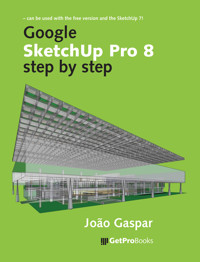
Google SketchUp Pro 8 step by step
By João Gaspar
1st Edition
VectorPro
São Paulo
2012
Gaspar, João
Google SketchUp Pro 8 step by step / João Alberto da Motta Gaspar - São Paulo : VectorPro, 2012.
ISBN 978-85-61453-09-1
1. Computer Graphics 2. SketchUp I. Title.
CDD006.0000
text and coordination
João Gaspar
cover
Ari Miaciro and Alexandre Villares
final revision
João Gaspar and Alexandre Villares
translation
Kevin Thompson
layout
Erick Costa
electronic version
Erick Costa
Michelle Marucci
Ronaldo Luidi
Sabrina Cury
contribution
Julio Britto
Artur Cordeiro
Bruno Cunha
João Carlos Kuhn
Natália Lorenzo
Caio Mamede
Ari Miaciro
Vitor Nagoya
Tobias de São Pedro
Diego Quattrone
Carolina Scatolini
Fernando Setoguchi
Mariana Suzuki
Lia Takata
Fábio Tutibachi
Copyright ©2012 GetPro Books
No part of this book may be reproduced without the author's permission in any way whatsoever – photocopy, photograph, or electronic or digital storage and data transmission – in accordance with the Brazilian Federal Act No. 9610 of February 19th, 1998.
No warranties, expressed or implied, are made in this book. Thus, neither the Author nor the Publisher may be held responsible for any problem or damage that may be directly or indirectly caused or assumed to be caused by this book.
All product and company names cited herein are proprietary to their respective owners, having no commercial links with the Publisher.
To Mr. Gaspar, Ms. Maria, Malu, Gabriel, and all my family
To Alexandre and all those who are a part of or have been a part of VectorPro Network
To all my friends
Introduction
Created to provide an experience closer to drawing and modeling with real objects, SketchUp has won over a host of loyal users year after year.
SketchUp stands out for its speed and ease when creating volumetric objects and studies.
The unique presentation quality that strays from the standards normally used and the ability to exchange information between various programs in the CAD industry are also important distinctions.
The program also brings other innovations such as integration with Google Earth and the availability of various free libraries, through the 3D Warehouse.
The book, Google SketchUp Pro 8 step by step, aims to provide a high quality learning experience. All the descrited procedures are illustrated; at the end of each chapter is a summary of the main topics addressed and exercises to be downloaded at www.thesketchupbook.com. The site also has a discussion forum for the book and program with participation of the author.
Where to get help
Below is a list with some recommended sites and other publications that can help to improve your knowledge of the program:
1. For more information on using SketchUp, visit sketchup.google.com/support.
2. To download ready-made-use objects on SketchUp, visitsketchup.google.comandsketchup.google.com/3dwarehouse.
3. To see video tutorials, in addition to work done using SketchUp, accesswww.youtube.com and type SketchUp in the search box.
SketchUp was created for those wanting to produce 3D objects in a fast, easy, and intuitive way.
The program comes with a totally unusual interface, in which the creation, manipulation, and editing of elements is done in a way that is different from any other software. Given its unique characteristics, it doesn’t fall into the category of CAD software (like Vectorworks, ArchiCAD, or AutoCAD for example), or in that of traditional 3D software (3D Studio, Maya, Cinema 4D, and others); and that is what makes it such a special program.
What you’ll read in this chapter
1.1 Setup, new document, open, save, and close
1.2 Units, location, template
1.3 Basic viewing
1.4 Types of selection
1.5 Basic drawing
1.6 Draw with measurements
1.7 How to create and alter basic figures
1.8 How to delete objects
1.1 Setup, new document, open, save, and close
When you open SketchUp for the first time, a window will appear. In it, you’ll make some adjustments to the program that will be used from that moment.
how to run SketchUp for the first time
1. After installation, SketchUp should have placed a program icon on your desktop. Double click on it.
2. Click onLearn(a) if you want to learn more about SketchUp; click onAdd License(b) to enter your license number; click onChoose Template(c) to choose a template to be used as a reference for creating new documents.
3. After clickingChoose Template(item2c) click again to choose oe of the options (use the click wheel to see all):
a.Simple Template–Feet and Inches: Displays the basic settings for styles and colors, with units in feet and inches;
b.Simple Template– Meters: Displays the basic settings of styles and colors, with units in meters;
c.Architectural Design– Feet and inches: Configured for architecture, in feet and inches;
d.Architectural Design– Millimeters: Configured for architecture, in millimeters;
e.Google Earth Modeling– Feet and Inches: Adjusted for use with Google Earth, in feet and inches;
f.Google Earth Modeling– Meters: Adjusted for use with Google Earth, in meters;
g.Engineering– Feet: Configured for engineering, units in feet;
h.Engineering– Meters: Configured for engineering, units in meters;
i.Product Design and Woodworking– Inches: Adjusted for woodworking and product design, in inches;
j.Product Design and Woodworking– Millimeters: Adjusted for woodworking and product design, in millimeters;
k.Plan View– Feet and Inches: Simple configuration for plan view, in feet and inches;
l.Plan View– Meters: Simple configuration for plan view, in meters.
4. Click onStart using SketchUpand the program will start, using the selection made on the previous item.
to create a new document
1. ChooseFile/New(Ctrl+N).
2. SketchUp will open a new drawing area. Your configurations (units, location, palette, etc.) are based on theselected template file, which can be found inWindow/Preferences/Template.
to open a document
1. ChooseFile/Open(Ctrl+O), and select the document to be opened.
NOTESketchUp for Windows does not allow opening more than one document during the same session of the program. If you want to open two or more document (to copy and paste objects between them, for example) you need to open other sessions of SketchUp, clicking twice on the program icon (just as if starting the program again). On a Macintosh, SketchUp allows using more than one document during the same session. To toggle between files on a Mac, just use the Window menu.
to save a document
1. ChooseFile/Save(Ctrl+S).
2. If it is the first time the document will be saved, SketchUp will ask for a name and location on the computer.
3. If it’s not the first time, the document will be saved under the same name with which it was created and in the same place.
4. To save a document with another name and/or place it in another location on the computer, chooseFile/Save As....
to close a document and end the program
1. ChooseFile/Exit (Ctrl+Q). If the document has not been saved, SketchUp will ask if you want to save it. The program will never close your document without saving (unless that is your intention).
1.2 Units, location, template
The items listed above are the main configurations among various that exist in SketchUp. The idea of this topic is to show how to alter these parameters and create a new template that serves as your starting point in SketchUp.
to configure units
1. ChooseWindow/Model Infoand select theUnitsoption.
2. In theFormatfield, selectArchitectural(a). If you’d like, alter thePrecisionfield (b) to 1/2"or 0,01m (two decimal places).
to choose a location for your project
1. ChooseWindow/Model Infoand select theGeo-locationoption.
2. Click onAdd Location....
3. Next, click on the indicated field and type the name of your project’s location (a). Next, click onSearch(b).
4. SketchUp will display the indicated location in the window. You can use the left button on your mouse and the click wheel to adjust the position according to the exact location of your project.
5. Click onSelect Region(a) to select the portion of the image that you want. Next, click and drag the indicated controls (b) to define the area to be used. To confirm, click onGrab(c).
6. Notice that the image was inserted into your drawing and theGeo-Locationpanel now displays the correct geographic information (including the correctly displayed solar north).
viewing option
Importing from Google Earth to SketchUp always brings two objects: one is the flat image, without topographic information, and the other is a group comprised of the topography and the applied image.
1. To alternate between the terrain image without topography and the group, with topography, chooseGooglepalette and click onToggle Terrain.
to manually configure the location of the project
1. ChooseWindow/Model Infoand select theGeo-locationoption.
2. Click onSet Manual Location....
3. Adjust the items in the box:
a.Country: Type the name of the country where the project is;
b.Location: Write the name of the location of your project;
c.Latitude: Enter the latitude of your project;
d.Longitude: Enter the longitude of your project.
4. Click onOKto confirm.
to create a template
1. Configure the file (units, location, and any other type of information, including drawings, if needed) and save it using theFile/Save As Template...menu option.
2. Configure the items in the box:
a.Name: Name the template;
b.Description: Write a short text that summarizes the template characteristics;
c.File Name: Name the file that contains the template;
d.Set as default template: Click this box if you want the template to be used automatically each time SketchUp is started.
3. Click onSaveto save the template.
to set project north manually
1. ChooseWindow/Preferences.
2. In the window that opens, click onExtensions(a); then activateSolar North Toolbar,the palette for manually adjusting north (b). Click onOK(c) to confirm.
3. ChooseView/Toolbars/Solar North.
4. Click on the indicated button to activate the north indicator in the drawing area.
5. Click this button if you want to indicate north using the compass (a). Click on any point (b) and drag the mouse in the direction you want to mark north; release the button to confirm (c).
6. Click this button to type a value for north in the box (a). ClickOKto confirm (b).
to choose a template
1. ChooseWindow/Preferences.
2. In the box that opens, chooseTemplate(a); then select a template from the list (b).
3. Click onOK. This template will be used as a reference the next time you start SketchUp.
1.3 Basic viewing
You can control the most important view commands directly from the mouse. However, there are some more complex movements that can only be done using the menus and toolbars.
to zoom in and out
1. On theCameratoolbar, choose theZoomtool.
2. Place the cursor in the center of the screen, then click and drag up (zoom in) and down (zoom out).
NOTETo zoom in or out with the mouse, roll the click wheel.
to orbit a project
1. On theCameratoolbar, choose theOrbittool.
2. Place the cursor in the center of the screen; click and drag to orbit. If you holdShiftwhile clicking and dragging the cursor, SketchUp will move in a panoramic mode.
NOTETo orbit with the mouse, click and drag the click wheel.
to magnify a particular area
1. On theCameratoolbar, choose theZoom Windowtool.
2. Click once to indicate where the area to be magnified starts (a). Drag the cursor and release it where you want the zoom window to end (b).
NOTEIf you are too zoomed out on a project, go to theCameratoolbar and choose theZoom Extentsbutton for SketchUp to frame the project in the screen.
to view as a Panoramic (Pan)
1. On theCameratoolbar, choose thePanoramic(Pan) tool.
2. Place the cursor in the center of the screen, click and drag to either side to move the viewer.
NOTETo view as aPanoramic(Pan) with the mouse, click and drag the click wheel, and without releasing it, click and drag with the left button.
how to place the viewer inside the project
1. ChooseCamera/Standard Views/Top.
2. On theViewtoolbar, choose thePosition Cameratool.
3. Click where you want to position the viewer and hold the mouse button (a). Release the button in the direction the viewer will be looking (b).
4. In theMeasurementstoolbar, type the height of the viewer; next, pressEnter.
5. Next, SketchUp will automatically open theLook Aroundtool. Click and drag to move the viewer without moving it out of place.
1.4 Types of selection
All the objects in SketchUp are built with lines and faces. One face only exists when it is completely surrounded by at least three lines on the same plane. You can select several lines and faces, therefore transforming the set into a group or component.
how to select a line
1. On thePrincipaltoolbar, choose theSelecttool.
2. Click once directly on the line you want.
how to select a face
1. On thePrincipaltoolbar, choose theSelecttool.
2. Click once directly on the face you want.
how to select an object
1. On thePrincipaltoolbar, choose theSelecttool.
2. Click three times on any element of the object to select all the lines and faces connected to it.
to select more than one object
1. On thePrincipaltoolbar, choose theSelecttool.
2. Triple-click on the first object to be selected.
3. Press and hold theShiftkey, and triple-click on the other objects to select them.
4. If you click three times on an object that has already been selected, it will be released from the selection.
other interesting options
1. By double-clicking a line, the line and all the faces connected to it will be selected.
2. By double-clicking a face, the face and all the lines connected to it will be selected.
3. Some options for editing objects only appear when you click the right mouse button. In this case, SketchUp shows the context menu. The information on this menu (which varies according to the object selected) is mentioned, always when necessary, throughout the book.
1.5 Basic drawing
In SketchUp you draw directly in 3D, and the basic shapes (even arcs and circles) are actually built with lines. These tools are the foundation for building volumes, as we’ll see later.
line
1. On theDrawingtoolbar, choose thePenciltool.
2. Click and drag the cursor in the direction the line will be created. Release it where you want to stop.
NOTEIf you click and release, instead of clicking and dragging, SketchUp will start another line at the end of the current line.
irregular polygon
1. On theDrawingtoolbar, choose thePenciltool.
2. Click and release the cursor in the direction the line will be created. Click to confirm the end of the first line.
3. Notice that SketchUp already begins to trace a new line. Click for each segment, and click on the original point to finish.
NOTETo stop drawing the polygon, pressESC.
rectangle
1. On theDrawingtoolbar, choose theRectangletool.
2. Click and release the cursor on the rectangle starting point.
3. Move the cursor diagonally and click where you want to place the opposite vertex.
circle
1. On theDrawingtoolbar, choose theCircletool.
2. Click and release the cursor on the starting point for the circle.
3. Move the cursor to determine the radius and click to finish.
arc
1. On theDrawingtoolbar, choose theArctool.
2. Click and release the cursor on the starting point of the arc.
3. Move the cursor to determine the end of the arc and click again.
4. Move the cursor to choose the size of the bow and click again to finish.
regular polygon
1. On theDrawingtoolbar, choose thepolygontool.
2. In theMeasurementstoolbar, type the number of sides of the polygon.
3. Click and release the cursor to start drawing the polygon.
4. Move the cursor and click when you reach the desired distance.
freehand
1. On theDrawingtoolbar, choose theFreehandtool.
2. Click and drag the cursor to draw however you want. To stop, just release the button.
1.6 Drawing with measurements
SketchUp also allows entering exact measurements at the time an object is created. To do this, use theMeasurementstoolbar in the lower right portion of the SketchUp window.
to draw a line or polygon with measurements
1. On theDrawingtoolbar, choose thePenciltool.
2. Click where you want to start the line and move in the desired direction.
3. In theMeasurementstoolbar, type the dimension and pressEnter. The line was drawn in the indicated direction.
4. At this point, SketchUp will start a new line at the end of the current one. PressESCif you want to stop drawing.
5. Move the cursor in the direction of the next segment and type a number in theMeasurementstoolbar. PressEnter.
6. Repeat items4and5to create new lines. To stop, click again on the starting point (to close the polygon, creating a face) or pressESC(keep the polygon open).
how to draw a rectangle with measurements
1. On theDrawing toolbar, choose theRectangletool.
2. Click where you want to start the rectangle (a) and move the cursor in the desired direction (b).
3. In theMeasurementstoolbar, type the rectangle dimensons inX,Y (or X;Y,in some countries)format. PressEnterto complete the rectangle.
how to draw a circle or regular polygon with measurements
1. On theDrawing toolbar, choose theCircle




