


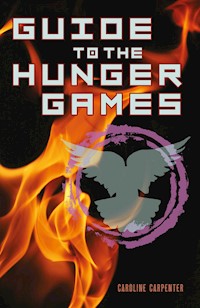
7,99 €
Mehr erfahren.
- Herausgeber: Plexus Publishing Ltd.
- Kategorie: Für Kinder und Jugendliche
- Sprache: Englisch
Guide to the Hunger Games offers a new way to interact with the enthralling world of the young adult publishing phenomenon that is Suzanne Collins's Hunger Games trilogy. This companion guide provides deeper insight into the inspiration behind the thrilling adventure series, as well as the contemporary social and political themes at its root. The book comes at the perfect time for Hunger Games fans, with Lionsgate Entertainment's announcement that they will release a highly anticipated blockbuster film adaptation of the first book in 2012. Covering all the aspects of the series that fans love, and including an exclusive guide to winning The Hunger Games, this companion guide brings the world of Panem to life and is a must-have for all aspiring Tributes.
Das E-Book können Sie in Legimi-Apps oder einer beliebigen App lesen, die das folgende Format unterstützen:
Veröffentlichungsjahr: 2015
Ähnliche









![Tintenherz [Tintenwelt-Reihe, Band 1 (Ungekürzt)] - Cornelia Funke - Hörbuch](https://legimifiles.blob.core.windows.net/images/2830629ec0fd3fd8c1f122134ba4a884/w200_u90.jpg)


CONTENTS
Introduction
BOOK 1: THE HUNGER GAMES
Welcome to Panem
Main Players
The 74th Hunger Games
Tribute Test
Muttations
BOOK 2: CATCHING FIRE
Navigating the Capitol
Growing Inferno
Quarter Quell
Cinna’s Creations
BOOK 3: MOCKINGJAY
District 13
Old Order versus New Order
Gale or Peeta?
Panem Personal Ads
Becoming the Mockingjay
War of the Words
How to Survive the Hunger Games
Quiz
Personal Review
INTRODUCTION
With The Hunger Games trilogy, Suzanne Collins has created something truly special. So, just what’s the inspiration behind her string of wildly successful books? Collins says that the idea came to her one night when she was channel-surfing between a reality TV competition and actual war footage. ‘The lines began to blur in this very unsettling way,’ recalls Collins. And, from here, the seed of her creation was sown; which shouldn’t come as a surprise. So many elements of the story – the surgically enhanced people of the Capitol and their obsession with reality TV – mirror the Western world (albeit a very extreme version). The Hunger Games is clearly very much a product of our own troubled times.
However, Collins’ writing is shaped by more than just current affairs, drawing on a rich array of classical references besides. The timeless story of Theseus and the Minotaur is particularly important for the development of Collins’ protagonist, Katniss. Mentioned by Collins on numerous occasions, this Greek myth recounts how, in a bid to stop King Minos of Crete from attacking his land, King Aegeus of Athens agreed to a deal whereby, every nine years, seven Athenian boys and seven Athenian girls would be sent to Crete to be eaten by the Minotaur, a monstrous half-man, half-bull kept by Minos in a maze on the island. However, after this ritual had taken place a couple of times, King Aegeus’ son Theseus volunteered to be one of the youths sacrificed to the Minotaur, with the intention of killing the beast and ending the atrocity once and for all. When he arrived in Crete, King Minos’ daughter Ariadne fell in love with him. Desperate to help him overcome the Minotaur, she provided him with string and a sword. As he wandered deeper into the labyrinth, Theseus unravelled the string to leave a trail behind him. Using the sword given to him by his sweetheart, he somehow managed to slay the monster. Then it was simply a question of following the thread he’d laid to find his way back to Ariadne.
Theseus’ story had a profound impact upon Suzanne Collins as a child. She was deeply affected by the ruthless way that the children’s deaths were used as a form of punishment. The parallels between this myth and The Hunger Games – a tale of young people chosen to die, within a society that is powerless to stop it – are immediately evident. Both stories are centred on the terrible bargains made to appease an all-powerful, dominant force. In the ancient myth, the human sacrifice stops the Cretans unleashing further destruction on the Athenians; in The Hunger Games, the tradition is payback for a much earlier failed rebellion against the ruling power. But perhaps the clearest comparison to be drawn is between the heroes at the heart of each narrative. Theseus proves he is admirably fearless and selfless when he volunteers to face the Minotaur; likewise, Katniss stands out when she puts herself forward to take part in the dangerous Hunger Games in place of her younger sister. This element of self-sacrifice is fundamental to both characters and, while Katniss does not set out to overthrow the practice that threatens the children of her nation (the Hunger Games) in the same way that Theseus does, her actions ultimately lead to the same conclusion.
Another source of classical inspiration within Collins’ books is that of the Roman Empire. She has said herself that, ‘the world of Panem, particularly the Capitol, is loaded with Roman references’. Not only are many words in the book derived from Latin (the name of the nation itself, Panem; Avox; tessera), but several of the Capitol-dwelling characters have traditionally Roman names, such as Octavia, Seneca, Venia, Flavius and Portia. Even more significant is the use of gladiatorial games as a form of entertainment. When the Roman Empire was at its height, these games – in which fighters battled to the death in an arena, often with dangerous animals thrown in – were incredibly popular and watched by huge audiences. The Hunger Games are essentially an updated form of these events – an assortment of kids forced to fight to the death by a sadistic government, in the name of an exciting ‘show’. A marked difference is that the Hunger Games are not watched by a live audience, but through television screens (in an eerie echo of the hugely popular reality TV shows that dominate the airwaves today). Nevertheless, the reaction of the crowd remains paramount. With the makers of the games constantly seeking new ways to keep things ‘interesting’, the viewers’ response can play a vital role in how the action unfolds, for tributes and gladiators alike.
As well as ancient history, Collins drew ideas from her own upbringing. Her father – a military specialist, historian and doctor of political science – was also an Air Force officer who fought in the Vietnam War for an entire year of her childhood, meaning that, from a young age, she was taught the consequences of war, poverty and starvation. Her father’s absence (echoed by that of Katniss’ dead father years later) meant that stories such as Theseus and the Minotaur, telling of families torn apart by destructive forces beyond their control, hit young Suzanne especially hard. However, her father never shielded her from the harsh realities of war and tried to explain things in a way that was appropriate for her age, whilst also trusting that his daughter could cope with a certain amount of truth – in much the same way that Collins herself would come to write about serious and complex issues for her young audience.
Mr Collins also provided some of the background to the survival techniques employed by Katniss and Gale. He grew up during the Depression – a time when his family had to resort to hunting for food – and even as an adult he would forage in the woods for edible mushrooms. Again, we can see a parallel here with Mr Everdeen, who taught Katniss how to hunt and distinguish between edible and poisonous plants.
Despite the range of factors behind Collins’ creation of Panem and the Hunger Games – from the strikingly apparent to the deeply personal – some people have been quick to draw comparisons between The Hunger Games and a number of seemingly similar texts. Battle Royale, for example, is a Japanese novel, Manga series and film depicting a totalitarian state that forces high-school students to participate in an annual program in which they must kill each other, with the purpose of scaring the wider population so badly that they do not rebel against their oppressors. On the surface, the two stories seem almost identical, yet they are very different. What is it about Collins’ story, referencing familiar ideas and age-old fears, that makes it so fresh and appealing to the teenagers (and adults) of today?
First and foremost, it is almost unnecessary to say that the books are fantastic adventure stories. They are fast-paced, filled with action and Collins constantly builds up suspense with infuriatingly intriguing chapter endings that practically force you to read on. Yet, despite the focus on a thrilling narrative, characterisation is not lost. All of the characters are vividly portrayed (in the first book, Gale isn’t given more than a few pages’ space, but somehow this is enough to completely convey the essence of who he is) and they are nearly all made to feel ‘real’, rather than two-dimensional. Katniss, for example, is not shown to be a perfect heroine. She can be moody, aggressive and unforgiving as well as brave, compassionate and resourceful. Her mother is not a caring angel, but neither is she a cruel witch. She is someone who has had her heart broken and become selfish as a result, but is still forever trying to be stronger for her family – in short, she is human. And so are the rest of the characters in Collins’ books – similarly complex creations with fully-formed personalities that we can truly ‘believe’ in.
Equally important as this personal connection with the characters are the universal themes that Collins touches upon. Inequality, corruption, exploitation and morality are always going to be important concerns and they are dealt with so cleverly within The Hunger Games trilogy. Rather than telling us what to think, Collins shows many different perspectives on these complicated topics (most clearly shown in the distance that grows between Gale and Katniss in Mockingkay because of their different outlooks on how the war should be won). Through the characters, we see the effects of their struggle for equality . . . a struggle we can believe in because Panem reflects the flawed world around us.
Despite the obvious distinctions to be made between our own society and that of Panem, there are enough similarities to resonate with readers everywhere. We too seem to have a strange obsession with reality TV programmes that see people put in ever more awkward and sometimes unpleasant situations in the name of entertainment. We enjoy luxury goods shipped in from other countries without ever really considering the working environments of people who produced them. Though we’re not quite on the same level as the vacuous citizens of the Capitol just yet, alongside the fantastical elements of Panem (with its shocking developments in cosmetic enhancement, genetic engineering and lethal weaponry), there is enough truth in the stories to make them feel real and relevant.
Another aspect of the books that feels real is the inner turmoil experienced by Katniss. As well as an action hero, she’s also a fairly typical adolescent girl. Though the Hunger Games arena provides an extreme backdrop to say the least, virtually everyone can relate to the worries experienced by Katniss whilst she’s in there – apart from her main concern of fighting to stay alive, of course! Constantly stressing over the impression that you’re making and whether or not you’re being judged are standard adolescent anxieties experienced by almost everyone at some point in their lives – whether you happen to be facing a pack of ruthless teen tributes, or just another day at high school. As Katniss must do later in the series, we have all grappled with trying to define who we really are, if only we could know ourselves a little better. For Katniss, this is of course made all the more complicated by the presence of the two boys in her life.
While by no means the main storyline, the love triangle between Katniss, Peeta and Gale is highly intriguing. Suspense is increased by the fact that Katniss seems no clearer about who she should be with than the reader. Collins certainly hasn’t given her (or the reader) an easy choice. Gale, the ruggedly handsome best friend, would surely have been Katniss’ first choice if she hadn’t been thrown into the Hunger Games arena and forced to pair up with the charming, selfless Peeta. Wanting to find out who she’ll choose in the end is just another reason why we all keep turning the pages.
However, The Hunger Games never strays too far into the territory of soppy romance. There’s plenty of blood, action and gore to balance the love story out. In fact, it’s morbidly fascinating to find out how the tributes will defeat each other and to see which devices and creatures the Capitol will unleash on its subjects next. Though few readers would be rushing to volunteer on reaping day, you can’t help but wonder as you read what kind of tribute you’d be and the strategy you’d adopt to stay alive. Through the character of Katniss, we all get to feel like an action hero for a little while and it’s a thrilling experience!
Ultimately, to try to pin the addictive appeal of these novels down to any single aspect is a pointless exercise. It’s Collins’ expert combination of genres and issues that makes them so unique and enthralling. Elements of our modern society are amplified and mixed with Ancient Roman practices in a way that makes the story feel timeless. Adolescent angst and the struggle to stay true to your own self are contextualised within age-old tales of heroes overcoming evil and wider social issues, so that everyone can find something to relate to within this epic and varied trilogy. Panem is a dark and mystical place pulled from the depths of Collins’ wonderful imagination, but it bears enough resemblance to our world for the story to make a genuine impact on audiences in this century (and any other). Suspense and adventure run throughout the series, however there are also softer moments where the pace slows and relationships between the characters can truly develop. For every romantic or humorous moment, there is one filled with tragedy or danger. In short, there’s something for everyone in The Hunger Games.
That is also what I hope you will find in this book. Offering comprehensive profiles of each of the main characters, detailed descriptions of the main settings, complete coverage of the 74th and 75th Hunger Games and much more, it provides an in-depth introduction for anyone who’s yet to discover the trilogy. For those who are already fully-fledged tributes, I hope it’ll be an opportunity to revisit all your favourite characters and moments from the books, offering a fresh new perspective on Collins’ richly imaginative universe. With extra information about the inspiration, context and parallels with our own society, I hope to illuminate some of the complex issues surrounding The Hunger Games, engaging with Collins’ world in exciting new ways with the aid of quizzes, guides and illustrations. Whether you want to learn about the true-life histories that influenced Collins’ writing, get to grips with a particular species of muttation, or pick up strategic tips for surviving the Hunger Games, it’s all here. I hope you enjoy reading this guidebook as much as I enjoyed writing it!
WELCOME TO PANEM
To understand The Hunger Games, you need to understand the world in which the action unfolds. Like many great writers before her, Suzanne Collins has created a whole universe in her books – a nightmarish dystopian vision of what our society could become in the future.
Part of what makes Panem feel so real is the fact that it shares some similarities with our own world. However, there are still a lot of things in Collins’ imaginary state that are different and new to discover.
The Capitol doesn’t let people speak their mind about what life is really like in Panem (as the poor Avoxes would tell you, if only they could), but they can’t keep everyone silent. Luckily, we’ve found an old resident of District 12 who’s willing to share their knowledge of Panem – as long as you promise to keep it confidential and check there are no jabberjays around to report back!
DYSTOPIA DEFINED
A dystopia is a fictional society that is very controlled and repressed. It is the opposite of a utopia – an ideal society with perfect legal, social and political systems. The Hunger Games comes from a long tradition of dystopian novels, such as Aldous Huxley’s Brave New World and George Orwell’s Nineteen Eighty-Four. While Huxley’s imaginary state is divided into strict social castes, Orwell’s citizens – or ‘Proles’ – are ruled over by Big Brother, an all-powerful leader who keeps them under constant surveillance. Panem has many characteristics of a typical dystopia (see the next page). Like other writers, Collins has exaggerated elements of the real world to create her own vision of what the future could bring if our culture were to collapse. For example, climate change, the use of plastic surgery, the inequality of wealth and resources in the world and the popularity of reality TV are all very real concerns indeed. According to Collins, it could only take between 100 and 999 years for our world to become Panem!
Lesen Sie weiter in der vollständigen Ausgabe!
Lesen Sie weiter in der vollständigen Ausgabe!
Lesen Sie weiter in der vollständigen Ausgabe!
Lesen Sie weiter in der vollständigen Ausgabe!
Lesen Sie weiter in der vollständigen Ausgabe!
Lesen Sie weiter in der vollständigen Ausgabe!
Lesen Sie weiter in der vollständigen Ausgabe!
Lesen Sie weiter in der vollständigen Ausgabe!
Lesen Sie weiter in der vollständigen Ausgabe!
Lesen Sie weiter in der vollständigen Ausgabe!
Lesen Sie weiter in der vollständigen Ausgabe!
Lesen Sie weiter in der vollständigen Ausgabe!
Lesen Sie weiter in der vollständigen Ausgabe!
Lesen Sie weiter in der vollständigen Ausgabe!
Lesen Sie weiter in der vollständigen Ausgabe!
Lesen Sie weiter in der vollständigen Ausgabe!
Lesen Sie weiter in der vollständigen Ausgabe!
Lesen Sie weiter in der vollständigen Ausgabe!
Lesen Sie weiter in der vollständigen Ausgabe!




