


Erhalten Sie Zugang zu diesem und mehr als 300000 Büchern ab EUR 5,99 monatlich.
- Herausgeber: No Exit Press
- Kategorie: Abenteuer, Thriller, Horror
- Sprache: Englisch
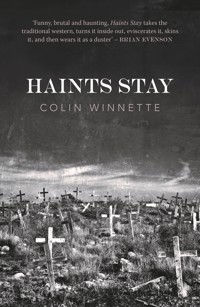
Slate: Underrated Books of the Year Flavorwire: Best Independent Press Books of 2015 LitReactor: Best Books of 2015 Brooke and Sugar are contract killers without a contract. Bird is the 13-year-old who appears in their camp one night, with no memory and palms as smooth as stones. Driven from town after a bathhouse brawl, it's only a matter of time before the sheriffs will find them. Before the cannibals and stampedes and marauders will find them. Before the past will clamber up from where they buried it, covered in animal skins and teeth. In Haints Stay, Colin Winnette breaks down the classic Western and builds a bloody lean-to from the scraps. Brutal, surreal, and darkly funny, this bold new novel follows an ever-expanding cast of characters - each in the pursuit of their own brand of justice and belonging.
Sie lesen das E-Book in den Legimi-Apps auf:
Seitenzahl: 307
Veröffentlichungsjahr: 2016
Das E-Book (TTS) können Sie hören im Abo „Legimi Premium” in Legimi-Apps auf:
Ähnliche
















HAINTS STAY
Slate: Underrated Books of the Year
Flavorwire: Best Independent Press Books of 2015
Brooke and Sugar are contract killers without a contract. Bird is the 13-year-old who appears in their camp one night, with no memory and palms as smooth as stones. Driven from town after a bathhouse brawl, it’s only a matter of time before the sheriffs will find them. Before the cannibals and stampedes and marauders will find them. Before the past will clamber up from where they buried it, covered in animal skinsand teeth.
In Haints Stay, Colin Winnette breaks down the classic Western and builds a bloody lean-to from the scraps. Brutal, surreal, and darkly funny, this bold new novel follows an ever-expanding cast of characters – each in the pursuit of their own brand of justice andbelonging.
Aboutthe Author
Colin Winnetteis from Denton, Texas.
He is the author of Revelation, Animal Collection, Fondly, Coyote (also published by No Exit Press) and Haints Stay. His work has been translated into Italian and French.
Coyote won Les Figues Press’s NOS Book Contest, was on the Small Press Distribution bestseller list for four months and was listed as a 2015 ‘Best Book of the Year’ byFlavorwireand theWashington Independent Review of Books.Haints Staywas listed as a 2015 ‘Best Book of the Year’ byFlavorwire,Litreactor,Largehearted Boy, andSlateand featured inVicemagazine’s ‘2015 was the Year the Literary Versus Genre War Ended’ bestbook list.
Colin was a runner-up for the Cleveland State University Poetry Center’s First Book Award, and a finalist for Gulf Coast Magazine’s Donald Barthelme Prize for Short Prose, as well as the 1913 Press First Book Award. He was the winner of the Sonora Review’s 2012 Short Short Fiction Contest and Heavy Feather Review’s Featured Chapbook Contest in 2014.
His writing has appeared in numerous journals and anthologies. He lives in SanFrancisco.
CRITICAL ACCLAIM FORHAINTS STAY
‘In his astonishing portrait of Americanviolence,Haints Stay, Colin Winnette makes use of the Western genre to stunning effect’ –LA Times
‘Haints Stayturns the Western on its ear’ –Washington Post
‘Haints Stayputs to mind the very best contemporary novels of the old West... But Colin Winnette has his own dark and delightful and surprising agenda. Bewary. He might be the new lawin town’ – Sam Lipsyte, author of The Fun Parts andThe Ask
‘Winnette portrays his serial killers with anodd grace and punctuates his circular narrative with murders, revenge killings, a shooting spree, and a heroic arc for wannabe gunslinger Bird that is broadly, darklyhumorous’ –Kirkus Reviews
‘Funny, brutal and haunting,Haints Staytakes the traditional Western, turns it inside out, eviscerates it, skins it, and then wears it as aduster...’ – Brian Evenson, author of The Open Curtain
‘I loved it. Loved it!Haints Stayhad me from the very first line – the visceral ante upped and crescendoing nearly every page. Humor, gore, that wonderful unsettling feeling you get when you’re reading a book that excites you and kind of scares you as well? Yes, please’ – Lindsay Hunter, author of Ugly Girls and Don’t Kiss Me
‘[One of the] 50 Best Independent Press Books of 2015’ – Flavor Wire
‘[One of] LitReactor’s favorite reads of 2015’ – Lit Reactor
‘[One of their] Favourite novelsof 2015’ – Large Hearted Boy
‘Read it soon’ – Fourth andSycamore
‘[One of the best] Overlooked Booksof 2015’ – Slate
‘A gritty, modern acidwestern’ –Book Riot
‘Winnette gives his characters fascinating depth and masterfully pushes the novel far outside the genre’s boundaries’ – River City Reading
‘Damn good read’ – Numero Cinq
‘From dialogue to action, Winnette does many things right in this novel’ – TheCollagist
‘The cinematic quality to this work is undeniable’ – Portland Mercury
‘Winnette’s Western world still resonateswith the trope-filled works of the genre’s greats’ – Heavy Feather Reviews
‘Great book [that helped prove] 2015 Wasthe Year the Literary Versus Genre War Ended’ – Vice
‘One of those novels that challenges you to find a good moment to put it down’ – MidnightBreakfast
‘Kind of refreshing, bizarre, remorseless story the Western genre needs’– Ask Men
‘Raw and cut throat and still capable of reducing you to helplesssnickers’ – Full Stop
‘The novel is both haunting and haunted’ – The Oyster Review
‘Dark, riveting drama’ – Alibi
‘Striking andpowerful’ – Electric Literature
‘A journey into a hallucinatory West’ – Vol. 1Brooklyn
‘Packed with action’ – Cultured Vultures
This book is for bug
Brooke and Sugarwere on a bridge between a field and a crowded wood. They had lost their horses days ago and had been walking for miles on end. The bridge was where they decided to break. Out in the open. A kind of celebration.
Sugar unpacked a few slices of bread and a brick of old cheese. He tore chunks loose with his nails and set them on the open face of the bread at his side. Brooke spat between his knees and took pleasure in the smacking sound as his saliva met the water below.
They had finished a job. They were emptied of bullets and powder. They were satisfied men. They were on their way to collect the next few months’ security. To be cleaned and taken care of. They would be treated well again, their shoulders and their genitals rubbed. They would smoke and bathe at the same time. Sugar would buy dinners and drinks and comb his hair with scented oils. Brooke would gamble and win and lose, but no one would be after him. He would buy a new knife. They were victorious and cheerful as ever they could be.
It was another day or two before they reached the town. They camped out in the open, unsheltered. Sugar smoked on his back with a strip of fabric covering his eyes. Each night, Brooke counted the stars until he fell asleep and woke blinded by the one.
***
As they neared the town, they smelled smoke. Not the welcoming kind, the tin-chimney and clay-pot kind, but an acrid, overwhelming kind of smoke. They continued. It was only a few minutes before they noticed the thin gray funnels rising up and opening out to the clouds above them.
In essence the town remained, but its landscape had changed. Jenny’s had been razed. People moved past the bar as if it were nothing to see at all. And there wasn’t much. What remained of the walls was blackened and halved. A streaked set of spiraling stairs near the center of the lot wound upward to nothing. The pole at the banister’s base supported the charred head of an eagle.
The bathhouse stood fine as it ever had, only a man now hunched at the doorway. They didn’t know him. He had the clean, fat look of an out-of-towner. He wore a thin-brimmed hat and a charcoal vest.
“I’m Brooke,” said Brooke, “and this is my brother Sugar.”
Sugar nodded, put out his hand.
The clean, fat stranger nodded and opened the door to them.
Sugar lowered his hand, slid it into his pocket. They were used to disrespect. They did not take it personally.
Brooke followed his brother into the lobby of the bathhouse. It was cleaner than usual and bustling. They positioned themselves in line behind an elderly man hunched against a thin cane. He smiled at them and Sugar smiled brightly back.
“Good afternoon,” he said. “Was there an accident at the bar?”
The elderly man shook his head. He stuck out a nub where his tongue should have been. He turned from them and arranged himself against the cane again.
Sugar tapped Brooke’s elbow, stuck out his tongue, and pointed at what the elderly man had been missing. Brooke nodded. He saw what Sugar saw, just the same as Sugar saw it, but Sugar insisted on telling it back to him.
“You’re the two boys without a father,” said a very thin man, suddenly at their side. He too wore a vest and a thin-brimmed hat.
They nodded. It was how people chose to see them. The truth was they had plenty of fathers, but that wasn’t what people meant when they said father. They had that kind of father too, the kind that gave Sugar his thick hair and Brooke his crooked nose. There was a single man responsible for the husks of both brothers, only no one knew which man he was or had been and Brooke and Sugar did not care for them to.
“Come with me, then,” said the man at their side.
They followed. With the bar gone and their payment delayed, at the very least, they were willing to investigate whatever new opportunities were presented them. Things changed in town. They changed often. There was no use fighting it. What they did was, they found a way and worked it until they found a new one.
They were seated before an oak desk and the tiny man behind it.
“You see the bar?” said the tiny man. “Do you know who burned it?”
Brooke and Sugar watched the tiny man smile and lean back in his desk chair.
“Me,” said the tiny man, “and the women inside and the men inside. Your man inside. Your woman inside.”
The tiny man pointed at Sugar. He had soft eyes, the tiny man behind the desk. Soft and black, like pencil lead.
Sugar shifted in his seat. He brought a strip of fabric out from the front pocket of his tattered suit and wiped his brow theatrically. A signal to the man that he meant no harm, that he was willing to appear intimidated. It wasn’t their show, and they knew it.
Brooke examined the desk: a jar of pens, an ivory letter opener atop a stack of papers, an ashtray containing one smoldering cigarillo.
“You think I’ve got ideas I don’t,” said the tiny man. “I know this won’t stick. I’m not here to stay. I’m a link in a chain of things I’ve got no idea how to stop or predict.”
He barely occupied his chair. He was like a cat in the lap of a giant. He was sweating too, and Sugar thought to pass the fabric to him in a gesture of brotherly goodwill.
“But I’m here for now,” said the tiny man. “And you’re the first problem I can see coming.”
“Because we’re owed by the bar,” said Brooke.
“There isn’t a bar,” said the tiny man. “Not anymore.” He laughed and tilted back in his chair and laughed some more, his hand at his belly. Darkness and rot freckled the inside of his mouth. His teeth and gums were lit by the room’s light as he laughed and held his mouth open like an offering.
Sugar smiled. Brooke examined a nearby shelf, the spines of the books there and the dust that had long ago settled on them. The dust of another man’s body, another man’s toil and time.
After a moment the tiny man regained his composure and opened the drawer to his left. He slid the letter opener from the exposed desktop down into the drawer.
“Money,” said the tiny man, “or some other thing that will make you resentful of the bar going down. Maybe you two like to drink. Maybe you two like women. Maybe you’re sentimental. I can’t have two thorns wandering the streets, looking for a reason to stick in my side.”
The tiny man seemed to relax then.
“So,” he said, settling back into the enormous-looking chair and letting his thin arms dangle from either side, “how can I trust you two to keep your heads about you?”
“Do you read history?” said Sugar.
“Yes and no,” said the tiny man, a smile creeping back into his lips. “I don’t read much, but I know a few things. History, as you put it, it’s slippery.”
“Well I’m a student of history,” said Sugar, “and any observant man can see that power is like a gold coin. Some men squander it, throw it away on nothing worth noticing. Others simply lose it to a world that’s much hungrier for it than they are. Others still dedicate their lives to holding onto it. And some die, coin in hand, surrendering it only to the men who bury them.”
The tiny man inched forward in his seat, eyed Sugar for a point.
“My brother and I,” said Sugar, “it makes no difference to us what the world does with its money.”
“You’re too… uh, historically read, huh,” said the tiny man, “to get hung up on something like an unpaid debt? Or an ignorant, rot-mouthed cunt taking the reins?”
“No,” said Brooke, “but we’d settle for a modest homecoming of sorts. We’d like a bath each. We’d like the promise of a bed or two with a window, at least temporarily. The peace of mind to rest. We’ve been traveling for days. We lost our beloved horses with many miles still between us and here. Give us the opportunity to get fresh, to adjust. We’ll keep our pampered heads about us.”
Sugar placed the fabric back into his front pocket. He crossed his legs and eyed the tiny man, who looked at Brooke as if he were still speaking. Finally, the tiny man nodded and a hand set itself on Brooke’s shoulder.
Brooke had the ashtray from the desk in his hand then and was already withdrawing the blow he’d spent on the broken-nosed thug behind him. Blood spilled from the thug’s nose. He clutched his face as if trying to collect the blood that gathered there.
Brooke set the ashtray back on the desk and Sugar settled himself into his chair.
“Okay,” said the tiny man, with a grin. “A bath it is.”
The baths were crowded. Men of indeterminate age, but none of them young, lined the edges. A mix of tobacco smoke and steam crowded the air. Sagging wooden guardrails led down a row of steps into the water of the communal bath. The floor and walls wore a yellowing tile.
The heat pressed against Brooke’s and Sugar’s lungs as they moved along the bath’s perimeter to hang their towels from a row of silver hooks lining the far wall.
Someone whistled. Others coughed, shifted, and began to whisper.
“I think they like you,” said Brooke.
Sugar smiled and Brooke stepped into the water. The blood on his left hand lifted and dispersed. He bent at the knees and submerged himself up to his shoulders. He shut his eyes, listened to the sounds of the other men as they examined his brother.
“You don’t even smell like a woman,” said a longhaired man sitting alone in the corner of the large square, now shared by nearly twenty men.
Sugar had seated himself on the bench lining the edge of the bath. He crossed his legs, then thought again and uncrossed them. He parted his knees just slightly. He nodded at the longhaired man sitting a foot or so from him.
“It’s because I’m not a woman,” said Sugar. He snapped his fingers at a passing boy in white. The boy paused and removed a thin cigarette from a pack on the silver tray he carried before him. Sugar gripped it with his lip and the boy lit it with a smile.
“Your charge number, sir?”
“It’s on your man,” said Sugar, and the boy nodded. He made a mark in a small notebook beside the cigarette pack on the tray and began again to circle the bath’s perimeter.
“You’ve got the finer parts,” said the longhaired man. “I don’t mean at all to pry or stare. I just haven’t seen a woman’s parts… in years, and… well you don’t expect to come across them in a place like this.”
“Is he bothering you, Sugar?” Brooke rose from the water before them. He was lean and cruel looking. He looked as if he should have been covered in scars, but all of the wounds he bore were fresh. His muscles were mottled with age and effort.
“No,” said Sugar. He let the smoke drift between his vaguely parted lips. “He’s just admiring my parts.”
The longhaired man smiled and shifted and put his hands up. “No,” he said, “I’m just noticing is all. I don’t mean either of you any discomfort or trouble.” He slunk away to a far corner of the bath and settled between two older men who were leaning against the bath’s edge, eyes closed, either sleeping or dead.
Brooke took his spot there in the corner near his brother.
“You should cross your knees,” he said. “In a place like this.”
“You should avoid giving advice,” said Sugar. “You haven’t got the face for it.”
“Did you notice our friend?” said Brooke. He ran his palms along the surface of the water, examined the edges of his scabs as they softened.
“How long do you think we’ve got?” said Sugar.
“Get your hair wet,” said Brooke. “Then we should go.”
The broke-nosed thug was bleeding between two gangly men in the bath adjacent to Brooke and Sugar. His eyes had not lifted from their movements.
Sugar crab-walked out from the bench and lowered himself under the water. He ran his hands back and forth through his hair and could feel the grit coming away in sleeves. He opened his eyes to see the water had yellowed around him. He picked at the pieces that clung directly to his scalp. He felt a shiver in his shoulders, the rare delight of a long-awaited bath. He admired his brother’s legs through the chalky water. The pressure in Sugar’s lungs grew more intense with each passing moment. He exhaled and Brooke’s legs lifted suddenly up and out of the bath. Sugar kicked himself toward the far edge of the bath and rose up and out as well.
Brooke was on top of the naked, broke-nosed thug, pounding his chest and stomach and face. The sound was that of a cow collapsing into mud, again and again and again.
Brooke broke the skin of the broke-nosed thug in various patches about his body. Brooke rose only when the reach of the blood surpassed his wrists. He rose naked and bloody and examined the room. Some looked angry, put out. Others were frightened and without a plan. The longhaired man who had been talking to Sugar sank between the two old men at either side of him, until the water reached his ears. He eyed the brothers across the surface of the water, bubbling air from his slender nose.
Sugar gathered their towels from the hooks and Brooke backed slowly into his as Sugar opened it to greet him.
They left the bath together, dressed hurriedly in the adjoining room where they had left their clothes, and sped toward the front door with the air of practiced men.
They were back in the woods only a few minutes later. They had slid out of town, uninterrupted. It wasn’t a hard thing to do, to disappear when they needed to. It just wasn’t what they’d been hoping for.
“I can’t do another night of this,” said Sugar. He was standing, pacing, looking between the trees.
“At least we got the bath.” Brooke set his head on a small rock at the base of a tree. It was sundown. The woods were cooling around them.
No one was after them. They’d been given no chase. They were gone and that was all that mattered. In a place like that, in a time like this, people had more immediate concerns. All the better if he’d killed the pummeled thug. He was the only one who might have taken the whole thing personally.
“Have we got another plan?” said Sugar.
Brooke set his hands palm down where his ribs met his belly. “Perhaps we’ll live and die in the woods,” he said.
Finally, Sugar sat. The night grew dark. They talked on as their eyes adjusted. They got along well when there were empty hours ahead. They’d been out for so long already, it was almost easier for them to talk like they still were, like they’d never been back. Only things were soured now. They hadn’t the same tolerance they’d had when headed home.
“We’ll just wait a few days,” said Brooke. “No one’s going to care in a week.”
“So we’ll wait a week, or a few days?” said Sugar.
“We’ll just wait,” said Brooke, “until it feels right.”
“Here’s what’s eating me,” said Sugar. “The man you nearly killed. What was he hoping to get out of approaching us in the bath?”
“What do you mean?” Brooke rolled on to his side to examine his bedded-down brother.
“I mean, was he after you for breaking his nose, or to finish what he’d started?”
“The difference being?”
“The difference being, one agenda is personal. The other was a task assigned him by the same tiny man who sent us to enjoy his newly acquired facilities, only moments after you broke the nose of a man in his employ.”
“Okay,” said Brooke, “it’s a question that warrants asking. And yet I don’t think the answer makes much of a difference. Either way we’ll be in the woods tonight. We’ll listen for the approach of a man, and if we don’t hear it, we’ll wait a day or two and then go home. We’ll find a bed and a private shower. We’ll stay out of anyone’s hair until they need us or come looking.”
“And what if they no longer need us?”
“We’ve never been without work.”
“Times are lean. You saw the people back there. Not a lot of children. Not a lot of fat.”
“You’ve got a quality perceptive mind, Sugar. I could listen to you for days on end.”
“What purpose do killers serve in a town that’s already dying?”
“And poetic too.”
“People aren’t living like they used to, Brooke.” Sugar sat up to face his brother.
“They never have,” said Brooke. Then, “The door man.”
“The door man,” said Sugar.
“He was fat.”
“He was muscular, maybe, but…”
“No, fat. He was fat, Sugar.”
“Okay. And he was in the tiny man’s employ. So he’s keeping the town slim and fattening up his men. An army of giants to protect a child.”
“I miss Henry.”
“We’ll find a new Henry.”
“Henry was special.”
“Henry was a horse.”
“He was a special horse, Sugar.”
“You’re the only one who lost a horse?”
“I miss Buck too.”
“Well, I miss Buck and Henry too.”
They were silent then. Sugar tilted his body as if to suggest he was listening for the broke-nosed thug. Brooke opened his eyes and stared into the brilliant dark. He pressed his fingers into the dirt on either side of him and felt the stones and teeth buried there.
“How old are we, Brooke?”
“Why would I know that?”
“You seem to know so much about our life and how we should live it. I thought you could answer one honest question.”
“We’ll get two new horses. They will be stronger and livelier than the old ones.”
“Henry and Buck.”
“Than Henry and Buck, yes, and they’ll serve us well and we’ll love them as we loved Henry and Buck, and then they’ll die and we’ll get more horses. And on and on, Sugar. Now sleep.”
Brooke’s hand was occupied by a foreign object. He felt it before opening his eyes to greet the day, which had rose up around them like a warm fog. Here they were, back in the woods again and holding one another as they had always done on cold nights. But Sugar felt different to him that morning. Smaller, thinner. Cleaner. Brooke felt a bone protruding, sharper than those he knew to be Sugar’s. He spoke a few casual sounds and received no answer and opened his eyes to reveal a young boy, hardly a hair on his body, sleeping between Brooke and his brother as heavily as a dead horse.
“Sugar.”
His brother did not stir.
“Sugar, there’s a boy here.”
Sugar rolled slightly but did not rise.
“Sugar,” said Brooke, and this time the boy was rocked casually in place before opening his eyes to discover the two men at his flank.
“Who are you?” said the boy.
“I’d like to ask the same question, and add a ‘How did you get here and between us?’” said Brooke. He rose and dusted himself, examined the woods around them for a set of eyes or ears or a broken nose. The woods were silent but for the small birds plunging into the pine needles gathered at the base of each enormous tree. They were utterly alone, the two brothers and their stranger.
“I don’t know,” said the boy. He said it plainly and without fright. He seemed as comfortable as the leaves around them.
“You don’t know which?” said Brooke. He kicked Sugar, finally, to wake him.
“It’s horse shit,” said Sugar, unsteadily, his eyes still shut.
“It’s an escape,” said Brooke. “You’re hiding out?”
Again, the boy said, “I don’t know.”
“Well,” said Sugar, “who are you?” He was up finally, watching the boy, puzzling out how slow he might actually be, or how capable a liar.
“Who are you?” said the boy. He put his hands to his face, rubbed, coughed. He brought his hands down and examined the two men. “You’re going to hurt me?”
“Let’s assume no one is going to hurt anyone,” said Brooke. “I’m Brooke. This is my brother Sugar. We’re killers by trade and we’re hiding in the woods after a rout of sorts.”
“You’re…”
“Killers,” said Sugar, “hiding out.” He was waking up, pacing again and looking between the trees.
The boy seemed weak, a little slow. Incapable of harm, or at least uninterested.
“Who… who did you kill?”
“Which time?” said Sugar.
“Stop it, Sugar.” Brooke poured something black from a leather pouch into a tin cup. He handed it to the boy, “My brother is trying to scare you.”
“Why?” asked the boy.
“Because you’re wrong not to be frightened of two men sleeping in the woods,” said Sugar. “Especially these two men.”
“When you say you don’t know where you came from or who you are,” said Brooke, “what exactly do you mean? Where were you yesterday? Where were you an hour ago?”
“I don’t know.”
“Everyone comes from somewhere,” said Sugar. “Where are your clothes? What have you got in your pockets?”
“I don’t have anything,” said the boy. He was nude and empty-handed. There was nothing in the piles about them that did not belong to Sugar and Brooke, that they had not bedded down with the night before. The boy had nothing to him but his person.
“There’s meat on your bones,” said Sugar. He cracked the bones in his fingers, one by one, then his neck and back. He rose and stood before the boy. “You’ve eaten recently enough. You don’t look ill or wounded.”
The boy nodded slowly. “I don’t feel ill or wounded.”
“Hm,” said Sugar. He leaned forward slightly and set his hand to his waist. He turned and walked into the woods around them and after a few moments his figure disappeared into the mist. They could hear him crushing leaves and cracking twigs with his boots. They could hear faintly the sound of his breathing.
“What’s he doing?” said the boy. “Where’s he gone?”
“Don’t mind it,” said Brooke.
“Are you going to hurt me?”
“I don’t think so,” said Brooke. “If you tell us why you’re here. If you can tell us why we shouldn’t. You can tell the truth, boy. Are you a scout? A young gunslinger trying an impoverished angle? Did you grow up on a perfectly normal farm with perfectly simple parents who were very casual people and did not bother much with towns or neighbors? Were you looking to get out and see the world? Or did your people torture you and send you running into the night?”
“I haven’t done anything,” said the boy. He was crying without whimpering or whining, letting the tears roll from the corners of his eyes in crooked lines down to his mouth. “What’s he doing?”
“Don’t worry about him,” said Brooke.
“Where’s he gone?”
“He’s ill,” said Brooke. “We’re not doctors. We don’t like them. It will stop eventually.”
“I don’t understand.”
“Neither do I. He’s my brother. It’s always been this way.”
“What’s your name?”
“Brooke. Now yours.”
The boy examined his palms.
“I don’t know,” said the boy. “I don’t know anything.”
“Where were you before?”
“I don’t know.”
“What do you remember?”
“What do you mean?”
“What do you remember about where you were before? What do you picture in your head when you think about elsewhere?”
“I picture you and… Sugar?”
“Sugar.”
“You and Sugar. That’s all I know. And some voices.”
“What are they saying?”
“I can’t tell. It’s just sounds. From a distance.”
“You don’t remember anything else?”
The boy shook his head.
“Your mother? Your father? What you had for breakfast yesterday?”
The boy was silent a moment. He examined his palms.
“Can I… can I see your hands?” said the boy.
“Where are these words coming from then? What you’re saying? Who taught you to speak and speak like us?”
The boy shrugged. He was crying again.
Brooke put out his palms. They were caked in dirt, a little blood in the deeper wrinkles, which had run from a small crack in the skin between his knuckles. The boy slid his hands under his legs, palms down and pressing into the dirt.
Sugar approached.
“What’d you get?” said Brooke.
“What business is it of yours?”
“Are you sick?” said the boy.
“No,” said Sugar.
“Are you hurt?”
“You’re a curious little egg, aren’t you? We’re done with this. You need to get along anyhow. Back to nowhere.”
“Sugar,” said Brooke.
“And if someone comes looking for us tonight, tomorrow, or any day after this, for that matter,” Sugar leaned in, “we’re going to know where he came from. Whether or not you actually said something, we’ve got to act on what we know, pursue reason and statistical likelihood above all else—so we’re going to find you and the people who matter most to you. Did we explain what it is we do for a living, son? Did we make it clear enough? We’ll go right to work on you, and anyone who knows your name.”
“Sugar,” said Brooke.
“We’ll erase you. Any trace of you.”
“Sugar,” said Brooke.
The boy was crying openly, his palms still buried beneath his thighs. He was flexing his fingers and digging into the leaves beneath him, loosing small rocks and the end of a buried twig.
“I’m telling the truth,” said Sugar.
“You’ve scared him, Sugar. Now leave him alone,” said Brooke.
Finally the boy brought his hands to his face, tried to turn away from them. Sugar snapped him up by the wrists and held out his arms as if the boy were pleading. The boy stared up at him but said nothing.
“Sugar, let him go,” said Brooke, and Sugar held out the boy’s palms to Brooke and pointed with his chin. The palms were blank, staring back at them. Smooth as stones.
“Have you ever caught anything before?” said Brooke.
The boy was on his belly at Brooke’s side and they were watching two deer hoof their way crosswise up a steep and sudden incline only a mile or so from where the men had been camped that morning.
“I don’t know,” said the boy.
“Let’s say you haven’t,” said Brooke. “You’re going to feel a certain kind of pride, a sense of accomplishment. But you’re also going to feel uneasy with that, as if there’s something wrong with it. There isn’t. It’s as natural as breathing. That guilt is all fear, anyway. Fear that one day you’re going to be on the receiving end of a blow, and the sudden wish that no one had to do that kind of thing ever. You can rid yourself of all that if you just accept what’s coming to you in the general sense, and work to prevent it in the immediate sense. No matter what you let live you’re going to die and it’s just as likely it will be of a rock falling on your head or getting a bad cough as it is that someone will decide they want you gone. So accept it now and move on.”
“Okay,” said the boy.
“Are you ready?” said Brooke.
“I think so,” said the boy.
“We’ll wait then,” said Brooke.
The deer worked their way up the steep incline without struggle. As they neared the top, the boy said, “I don’t think your brother likes me.”
“He doesn’t trust you,” said Brooke.
“Why?”
“He’s no reason to.”
“Okay,” said the boy.
Brooke watched him a moment. Then the boy said, “I’m ready,” and they rose up and loosed their stones from their slings.
The boy missed entirely, but Brooke’s stone made contact with the larger of the two and when the creature stumbled, stunned, a few feet down the incline, Brooke took off. He collapsed onto the stunned animal, gripped its jaw, its shoulder, twisted and snapped some hidden, necessary part. Everything about the deer went still, then it kicked, shuddered, and went still again.
“We’ll eat,” said Brooke.
“I won’t eat it,” said the boy.
Brooke was sawing the skin from the kill, its legs spread and tied to two separate trees. Brooke shrugged and placed the knife beneath a long length of flesh.
“Then you’ll die,” said Brooke.
***
That night they heard men on the road. Voices in the dark. The boy woke first. He trembled and rubbed his body beneath the shirt Brooke had given him, which the boy hadn’t put on, but chose instead to lay over himself as a blanket.
He heard laughter from several men and a single struggling voice. Grunting and squealing just a little, breathing in spurts.
“I think someone’s found us,” said the boy.
Brooke and Sugar did not stir.
“Brooke,” said the boy. “Sugar. I think someone’s—”
And Brooke was up. He was quiet, moving, sifting through his bag. His hand withdrew clutching a piece of metal that shone silver in the moonlight. Brooke disappeared then, into the trees. Sugar, the boy suddenly noticed, had vanished too.
As the voices approached, the boy scrambled toward a large dark tree and crouched down on the side opposite their apparent approach.
A limping body scrambled into their campsite, knocking their empty cans with its feet and tripping into the bundles of their supplies. It struggled to lift itself with two skinny arms but four men were suddenly upon it. They dragged it from amongst the supplies and blankets, out to an open spot of grass, faintly lit from the light above. There, they proceeded to kick and strike at the body without a word between them. One stepped back to grab a slick bundle of deer meat from the food pile and bring it down upon the struggling body with something like a laugh, cough, or wheeze. The bundle burst and the boy could hear the meat spilling out and into the grass, then their kicking and stepping on it as they moved about.
“It’s meat,” said a voice.
“Did we kill him?” said another.
“It’s animal meat,” said a third.
“Is he dead then?”
The body was no longer struggling, but the boy could make out the chest’s movement from several feet away. It breathed like a man asleep, long, deep breaths punctuated by only a moment of stillness.
“He’s not dead.”
“It’s a campsite.”
“Who’s here?”
“No one.”
“The blankets are warm.”
One man held Sugar’s blanket to his face, smelling and then rubbing it against his cheeks.
“It’s a woman,” he said.
“Let me,” said another voice, grabbing the blanket and pressing it to his face.
“Where is she?”
“Got to be near.”
The beaten man began to rise again, lifting himself on two skinny arms then pushing off from the dirt and setting out to run while bent at the waist, clutching his gut as the loose bits of deer fell from him and back into the grass.
“He’s up,” said a voice, and pursued him.
The one holding the blanket wrapped it around his waist and tied a knot.
“It’s mine,” said a voice.
“Get after him,” said the one with the blanket, and within moments, they set upon their pursued.
They had him down again, pressed against the earth. This time, a knife was drawn. One of the shadows set to sawing at the howling body, and it writhed for a moment before settling back into the ground like a dark, dull piece of landscape.
The boy was shivering, watching them remove pieces of their kill and set them in what must have been pockets or pouches he could not see. They disassembled their kill, much like Brooke had disassembled the deer—hungrily, without hesitation, but with pride.




