


Erhalten Sie Zugang zu diesem und mehr als 300000 Büchern ab EUR 5,99 monatlich.
- Herausgeber: No Exit Press
- Kategorie: Krimi
- Sprache: Englisch
Flavorwire: One Of the Best Independent Press Books of 2015 Washington Independent Review of Books: 13 Best Novels of 2015 Winner of Les Figues Press' NOS Book Contest Small Press Distribution: Best of the Press A daughter disappears in the middle of the night. What happens in the aftermath of this tragedy-after the search is abandoned, after the TV crews move on to cover the latest horrific incident-is the story of Coyote. There is a marriage and a detective. There is a storm, a talk show host, and a roasted boar. People are murdered and things are hidden. Coyotes skulk in the woods, a man stands by the fence, and a tale emerges within this familiar landscape of the violent unknown.
Sie lesen das E-Book in den Legimi-Apps auf:
Seitenzahl: 79
Veröffentlichungsjahr: 2015
Das E-Book (TTS) können Sie hören im Abo „Legimi Premium” in Legimi-Apps auf:
Ähnliche


















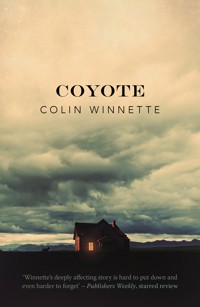
COYOTE
A daughter disappears in the middle of the night. What happens in the aftermath of this tragedy – after the search is abandoned, after the TV crews move on to cover the latest horrific incident – is the story of Coyote. There is a marriage and a detective. There is a storm, a talk show host, and a roasted boar. People are murdered and things are hidden. Coyotes skulk in the woods, a man stands by the fence, and a tale emerges within this familiar landscape of the violent unknown.
About the Author
Colin Winnette is the author of several books. His writing has appeared in the Los Angeles Review of Books, the Believer, Lucky Peach, and numerous other publications. He lives in San Francisco.
colinwinnette.net
Praise for Coyote
‘Coyote has a strong and inviting voice and that voice wraps around a dark story, a contemporary story, and one that has its own velocity and fragmentation built in. I found myself swept along in it and impacted by its delicate/bleak movement’ – Aimee Bender
‘Like a modern-day Poe, Winnette has fashioned a narrator whose pull on the reader’s sympathy gradually fades as she recounts the aftermath of her daughter’s mysterious disappearance…Winnette’s deeply affecting story is hard to put down and even harder to forget’ – Publishers Weekly, starred review
‘While there’s a contemporary urgency to Winnette’s novel, it’s the small details (and how they are revealed) that give this story its considerable sting’ – Kirkus Reviews
For any always elsewhere.
CONTENTS
Coyote
About the Author
Praise for Coyote
Dedication
Coyote Story
Acknowledgments
Copyright
WE WERE ON THE porch most of the night before she vanished. Just grilling and eating things like hot dogs and potatoes. Her Dad grilled the buns so they got all sweet and burnt-tasting on the edges. We drank beers and watched her pick at the heads of nails sticking up out of the splintering blue wood. Her Dad played guitar a little, songs I didn’t know other than when he played them.
I didn’t like to drink in front of her. I never got comfortable with it, not really. But that night I just gave into it and drank and she seemed happy enough and even her Dad seemed a little happy. Or at least that’s how I remember it.
It was getting dark but we sat out a little longer while the bugs gathered up to the house lights. They were in her long hair, getting tangled. She got a bite or something that made her come over and get up in my lap. Coyotes used to come by all the time back then, but I can’t remember if they did that night or not. We’d hear them circling and sounding off like maniacs, real high-pitched wailing like some hysterical woman lost out in the woods.
One time one came right up onto the porch and her Dad got him with a shovel while I watched from the kitchen. He cracked it once and then a few more times for good measure. He wanted to eat the thing, brought it inside wrapped in a t-shirt from the thrift bag, but there was no way she or I was going to get involved with that. So he buried it in the yard with the dog, two cats, and a hamster from before. The roads near us aren’t busy, but they’re busy enough. They’re constantly littered with all kinds of dead or dying. Everything that escapes winds up out there eventually. That’s the way it seems at least. Her Dad has brought every escapee back to us in a tarp.
I’VE TOLD THE SAME story over and over again, to the police, to the reporters, to the prep-interviewers and interviewers and celebrity guests and you name it. I tell the same story every time: we put her to bed, and when we woke up she was gone.
THE FIRST TIME I thought being a mother might have deranged me, I was watching her play in the yard. This was back when Spot was alive, our first dog. All black with a white spot on his chest. Creative people, we aren’t really. She was throwing sticks and he was chasing them. I only went inside for a second, to fill my glass, but I heard Spot cry out and then he was there at the back porch. I couldn’t tell where the blood was coming from at first. It hid in streams of long black hair, pooling in the white diamond at his chest, dyeing the whole thing red as a new car.
Before I brought him in I scanned the yard for her, but I didn’t see her so I went looking. Spot stayed on the porch, whimpering a little and wanting some help, I’m sure, but I was getting a little worried, wondering where she might have gone to. Your mind starts filling with so many ideas about what could have happened.
I pictured someone cutting her and Spot, someone hurting them, someone taking her, running away with her. I even pictured her as a monster, just a little bit. Not that I didn’t forgive her immediately. She wouldn’t have known what she was doing. I’d done things as a kid that were hurtful, dangerous, just not knowing. I killed a few animals through sheer curiosity and aggressive ignorance. Drowned a hamster, suffocated a cat beneath a mattress. I never meant any harm. I pictured her experimenting with Spot. The ways she might have hurt him without understanding the cruelty of what she’d done. And it was right when those images were at the peak of intensity that I found her in the bushes, just crying and curled up there, innocent as Eve.
Spot started hurting, she told me later.
I had carried her into the house, crying there in my arms, and set her on the counter by the sink. I wiped at her face with a rag but every tear I wiped away was immediately replaced with a new one.
How did he start hurting?
He just did, she said. She was open-mouthed crying then, like a wail, like she did when she was a baby.
So I let it drop.
I didn’t care what happened anymore. I just wanted her to stop crying. I held her as close to my heart as possible. I don’t know why, but I get the feeling it’s warmest there. She balled up in my arms and I held her while she cried and I bounced her. I swayed a little, watched the window. It was just a normal afternoon, with that sharp afternoon light on the curtains. I watched that until she seemed weightless in my arms. Until she grew quiet and her sounds were replaced by Spot’s there at the door. It could have been a human being, begging, and it wouldn’t have mattered to me. I only wanted her to quiet down and curl up.
HER DAD AND I don’t sleep anymore, but we still get into bed. We shut our eyes from time to time, until our eyelids get sore or just seem to open up on their own. We’ll be quiet for hours. Not tossing, not turning. Just there on our backs with our arms at our sides or folded in our laps. I ask him, What was our daughter like?, and he can only say one hundred percent true things that can’t be argued.
She was without visible flaws, he says.
She had tiny hands, like a puppy that is never going to get any bigger.
She had thin brown hair.
She ate what we worried might be too much ketchup, liked it on tacos.
She preferred her water warm.
She wasn’t scared of anything, even the coyotes.
She really only cried when she could tell we thought she might. She was an opportunist.
She reminded me of the scarred-up girls in high school. Quiet, funny, solitary, like the best thing I could do for her was to stay out of her way.
She worried about the characters in books from the very first page. Is he sad? she would ask. Over and over.
ALL OF HER TOYS were put away. The bed was made, as if we’d never placed her in it. The back door was open, but the screen was closed. That’s the way we did it during the fall. The way we’d done it for years. The screen door slams, and we’ve been meaning to fix it. It’s loud enough for us to notice. But neither of us did. If she went out, if someone came in, we should have heard it. But we didn’t hear anything.
Her Dad and I fought the next night. He took it upon himself to burn all the pictures. What got into him? Beer, I guess. Something strong, maybe. He spends nearly all his home time in a folding chair on the porch or on his back in bed. He was there and I came out and said, Where are all the pictures?
After a moment, he told me he’d burned them. Dug a hole in the yard and burned them and most of the toys and kid diapers and a bunch of things he couldn’t remember. Then he buried it all.




