


4,49 €
Mehr erfahren.
- Herausgeber: Emily Whiteman
- Kategorie: Sachliteratur, Reportagen, Biografien
- Sprache: Englisch
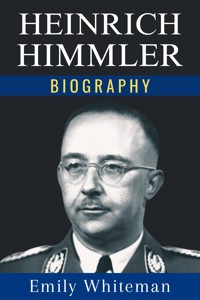
The Biography of Heinrich Himmler: Himmler's Role in the Holocaust
Ever wondered what drives a man to orchestrate unspeakable atrocities? Delve into the shadows of history and unravel the enigma that was Heinrich Himmler, a key figure behind the Nazi reign of terror.
Witness Himmler's journey from a seemingly ordinary life to becoming the architect of one of history's darkest chapters.
Peer into the ideological struggles that plagued Himmler, shaping him into the ruthless leader of the SS and the chief instigator of the Holocaust.
Discover the human side of Himmler, who struggled with insecurities and a desire for approval, which led him down a path of cruelty and dominance.
Gain a deeper understanding of the forces that can lead a man down the path of evil, serving as a stark reminder of the importance of vigilance and compassion in our world today.
Click the buy button and immerse yourself in this gripping biography, a journey through the twisted corridors of one man's life and the consequences that echo through history.
Enjoy the profound insights and knowledge this biography offers.
Das E-Book können Sie in Legimi-Apps oder einer beliebigen App lesen, die das folgende Format unterstützen:
Veröffentlichungsjahr: 2023
Ähnliche

















Heinrich Himmler
Biography
Unmasking the Architect of Evil
Emily Whiteman
Table of Contents
Introduction
Chapter 1
Chapter 2
Chapter 3
Chapter 4
Chapter 5
Chapter 6
Chapter 7
Chapter 8
Chapter 9
Chapter 10
Chapter 11
Chapter 12
Chapter 13
Chapter 14
Conclusion
Copyright Notice
All rights reserved. No part of this book may be reproduced, stored in a retrieval system, or transmitted in any form or by any means, electronic, mechanical, photocopying, recording, or otherwise, without the prior written permission of the publisher.
Copyright © 2023 by Emily Whiteman
Introduction
Heinrich Luitpold Himmler, a name synonymous with the darkest chapter in human history, was a man of immense power and influence within Nazi Germany. As the Reichsführer of the Schutzstaffel (SS) and a key figure in the Nazi Party, he played a pivotal role in shaping the course of World War II and, most notably, orchestrating the Holocaust. Himmler was born on October 7, 1900, and tragically passed away on May 23, 1945. His life was characterized by both calculated ambition and horrific atrocities.
Although he served in a reserve battalion during the First World War without experiencing active combat, Himmler's true journey began when he joined the ranks of the burgeoning Nazi Party in 1923 and the SS in 1925. Under Adolf Hitler's guidance, he rapidly rose through the ranks, ultimately becoming Reichsführer-SS in 1929. Over the next sixteen years, Himmler transformed the SS from a modest battalion of 290 men into a fearsome paramilitary force of over a million.
Himmler's keen organizational skills and ability to discern capable subordinates, exemplified by his selection of Reinhard Heydrich in 1931, contributed significantly to the SS's might. As of 1943, he held dual positions as Chief of the Kriminalpolizei (Criminal Police) and Minister of the Interior, effectively controlling all internal and external police and security forces, including the infamous Gestapo. Additionally, he wielded authority over the Waffen-SS, the military branch of the SS.
However, it was Himmler's personal interests in occultism and Völkisch ideologies that left an indelible mark on Nazi Germany's racial policies. Incorporating esoteric symbolism and rituals into the SS, he was the driving force behind the genocidal programs, forming the Einsatzgruppen and overseeing the operation of extermination camps. The devastating result was the annihilation of approximately six million Jews, along with hundreds of thousands of Romani and countless other victims. In total, the Nazi regime's brutality led to the deaths of an estimated 11 to 14 million civilians, mainly Polish and Soviet citizens.
As the Second World War reached its catastrophic conclusion, Hitler entrusted Himmler with military command and later designated him as the General Plenipotentiary for the administration of the entire Third Reich. However, Himmler's inability to fulfill his assigned objectives led to his dismissal and eventual disgrace. Fearing the impending defeat, he secretly sought to negotiate peace with the western Allies without Hitler's knowledge. But when this came to light, the furious dictator stripped Himmler of all his posts in April 1945 and ordered his arrest.
In the twilight days of the war, as the British forces closed in, Himmler attempted to conceal his identity by going into hiding. Unfortunately for him, he was captured and detained by British authorities. Facing the grim consequences of his actions and fearing the fate that awaited him, Heinrich Himmler chose to end his life by suicide on May 23, 1945, forever escaping judgment from a world that would forever remember his name in infamy.
Chapter 1
A Childhood Molded by Ideology
Heinrich Himmler was born on October 7, 1900, in Munich, into a family that belonged to the conservative middle class. During his upbringing, Heinrich Himmler was exposed to the powerful currents of German ideology. His mother, Anna Himmler, was a devout Roman Catholic, and his father, Gebhard Himmler, was a teacher. Both of his parents instilled in him a sense of discipline and responsibility. As a result of the fact that Himmler's father was a member of the German National People's Party and as a result of the fact that Himmler's mother had firm views on the supremacy of their people, the Himmler household resounded with the passion of German nationalism.
Young Himmler's schooling took a turn toward bolstering nationalist feelings as a result of the ideological environment in which he was raised. Because he attended a Catholic school, he was exposed to teachings that emphasized the relevance of German pride and the superiority of the Aryan race. His membership in a student fraternity that was devoted to German nationalism only served to further solidify his racist and nationalist ideas.
Himmler's path took an unexpected turn in 1918 when he joined the German army during the last months of World War I. This was all part of the fabric that fate weaved for Himmler's life. While serving in the Bavarian Infantry Regiment 11, he witnessed the chaotic aftermath of a nation that had been ripped apart by war. After the war, he attended the Technical University to continue studies in agriculture; however, he never accomplished the requirements for his degree.
When Himmler finally joined the Nazi Party in 1922, it was like the jigsaw puzzle had been completed. After climbing the ranks of the organization with lightning speed, he was appointed Reichsführer-SS in 1929. It was his idea, and he saw it through to its fruition as a strong organization that formed the fundamental foundation of the Nazi state.
However, Himmler's deeply ingrained worldview was the driving force behind his rise to power. He had a strong faith in the supremacy of the German race, and he had a strong desire to construct a new global order in which the Aryan people would reign supreme. This horrific vision pushed Himmler in the direction of a path that was littered with unspeakable crimes, with the Holocaust being a witness to his evil convictions that will be written in history forever.
When one considers the formative years of Heinrich Himmler, it is impossible to overlook the influence that his father's harsh discipline had on him. This may have been a factor in the rigidity and authoritarian characteristics that came to define Himmler. The fact that Himmler had a difficult time making friends as a kid undoubtedly made him more vulnerable to the alluring appeal of radical beliefs. Himmler was an introverted and timid child.
However, it was his interest in mystical practices and the occult that gave his persona an air of mystery that was much deeper than it already was. Himmler's views, which led him to believe that he had a special mission in life, may have contributed to a further warping of his sense of reality and led him down a road that was paved with unspeakable brutality.
Chapter 2
The Rise of National Socialism
Heinrich Himmler's life coincided with a period of dramatic upheaval in Germany, a country that was recovering from the devastation of World War I and struggling with economic and political turmoil at the time. In the middle of all of this upheaval, a new political movement developed, riding the waves of anger, and it came to be known as the National Socialist German Workers' Party, more commonly referred to as the Nazi Party.
The Nazi Party's emphasis on German pride and racial superiority deeply moved Himmler. He was driven by a fervent conviction in the inherent greatness of the German people and a conviction that the Treaty of Versailles was a terrible injustice that required immediate correction. Himmler was resolute in his goal of assisting Nazi Germany in regaining its former greatness, and he set his eyes on this objective.
In 1922, he decided to throw in his lot with the Nazi Party and started on a path that would take him to stratospheric heights within the organization's echelons. His rise through the ranks was meteoric, culminating in 1929 with his appointment as Reichsführer-SS. It was under his direction that the SS rapidly developed into a powerful force that was positioned to become the backbone of the developing Nazi state.




