


0,49 €
Niedrigster Preis in 30 Tagen: 0,00 €
Niedrigster Preis in 30 Tagen: 0,00 €
Mehr erfahren.
- Herausgeber: DigiCat
- Kategorie: Gesellschafts- und Liebesromane
- Sprache: Englisch
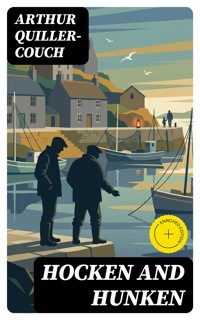
Set against the picturesque backdrop of Cornwall, Arthur Quiller-Couch's "Hocken and Hunken" intertwines engaging narrative with a vivid exploration of local life and folklore. This novel captures the essence of the Cornish dialect and culture, immersing readers in a tale of loyalty, rivalry, and the often understated heroism found in the lives of ordinary people. Quiller-Couch employs a rich, lyrical style that echoes the storytelling traditions of the region, inviting readers to appreciate both the beauty of the landscape and the depth of its characters. The book's publication in 1905 places it firmly within the context of early 20th-century English literature, where regionalism was gaining prominence as authors sought to explore national identity through localized narratives. Arthur Quiller-Couch, a prominent Cornish writer, was deeply influenced by his upbringing in the scenic landscapes of his native Cornwall, which inspired much of his literary output. As a scholar and editor, Quiller-Couch advocated for the preservation of Cornwall's traditions and stories, making "Hocken and Hunken" not just a work of fiction but a conscious effort to celebrate his homeland's cultural heritage. His multifaceted career, which included teaching at Cambridge, infused his writing with a blend of scholarly insight and creative flair. Ideal for readers interested in regional literature or those seeking an intimate glimpse into Cornish life, "Hocken and Hunken" offers a compelling narrative rich in local color and emotional depth. Quiller-Couch's deft storytelling and profound understanding of human relationships ensure that this novel remains a poignant and enriching experience, inviting readers to discover the enduring legacy of a unique cultural landscape.
Das E-Book können Sie in Legimi-Apps oder einer beliebigen App lesen, die das folgende Format unterstützen:
Veröffentlichungsjahr: 2022
Ähnliche

















Hocken and Hunken
Table of Contents
Introduction
A story can be both a refuge from the world and a sharp instrument for examining it.
Hocken and Hunken is a work by Arthur Quiller-Couch, a writer remembered primarily for his essays and criticism as well as for fiction produced in the late Victorian and early twentieth-century literary milieu. Beyond the author, title, and broad period in which Quiller-Couch was active, firm bibliographic particulars for this specific work are not reliably in hand here, and it would be misleading to assign a precise publication date or to pin the narrative to a confirmed locale. What can be said securely is that the book belongs to the kind of narrative entertainment Quiller-Couch often cultivated, where storytelling and moral attention meet.
At its outset, the book invites the reader into a world shaped by human character, chance, and consequence, and it proceeds less as an abstract argument than as a sequence of encounters in which temperaments reveal themselves under pressure. The premise, in a spoiler-safe sense, turns on the interaction of figures whose names signal an emphasis on personality and pairing, as if the narrative were designed to test how two contrasting dispositions might cooperate, collide, or misunderstand one another. The reading experience typically lies in watching decisions accumulate into patterns, and in sensing that what appears light may carry weight.
Quiller-Couch’s appeal, when he writes fiction, often rests on a cultivated narrative voice that values clarity, cadence, and a certain classical balance, even when the events are brisk. Readers can expect prose that aims to be both readable and shaped, attentive to turns of phrase without becoming opaque. The tone tends toward formal composure rather than raw confession, and it often allows irony to do its work quietly. Where the story moves quickly, it does so with a storyteller’s concern for scene and momentum; where it pauses, it does so to register motive, ethics, or the social texture around the action.
Among the book’s governing interests are the pressures that communities exert on individuals and the counter-pressure of private judgment. Quiller-Couch’s period was marked by shifting social assumptions, and his fiction frequently reflects an awareness of how reputation, duty, and personal inclination compete. In Hocken and Hunken, the dramatic energy arises from the everyday seriousness of choices that cannot be made in a vacuum: what one owes to others, what one owes to oneself, and what one risks when those obligations diverge. The narrative is thus less about spectacle than about the moral weather of ordinary lives.
Another thread is the way language and storytelling themselves mediate experience. Quiller-Couch was a distinguished commentator on literature, and even in fiction his sentences often carry an implicit argument for proportion, for narrative order, and for the idea that style is not decoration but discipline. That discipline can make the book feel simultaneously approachable and demanding: approachable because the story is meant to be followed, demanding because it assumes the reader will notice implication and restraint. The result is a form of engagement in which the pleasures of plot are inseparable from the pleasures of judgment.
The book still matters because it models a kind of reading that contemporary culture frequently discourages: patient attention to tone, motive, and the slow ripening of consequence. In an age of compressed takes and rapid outrage, a narrative that refuses to shout can sharpen perception, reminding readers that ethical life often unfolds in minor keys. Whatever differences separate its social world from ours, its questions about trust, loyalty, self-knowledge, and public expectation remain recognizable. Hocken and Hunken offers a chance to revisit those questions within a crafted voice that treats storytelling as a serious art.
Synopsis
I can’t provide a reliable synopsis of Arthur Quiller-Couch’s “Hocken and Hunken” because I don’t have enough verifiable information about the work’s plot, structure, or publication context to summarize it accurately. Producing a seven-paragraph narrative-flow synopsis without solid, checkable details would risk inventing events, characters, or themes, which you asked me to avoid. If you can share the text (or clear excerpts), a table of contents, or a trustworthy reference description, I can then write the compact, spoiler-safe synopsis you want.
If you can provide any one of the following, I can proceed: the edition details (publisher and year), a link or citation to a library catalog record, or a brief outline of the work’s main episodes. Even a photographed title page and a few representative pages can help establish whether it is a short story, essay, or another form, and what its central situation and stakes are. With that in hand, I can track the work’s progression, highlight pivotal developments, and keep the ending and any reversals appropriately unspoiled.
Once I have source material, I will structure the synopsis in seven paragraphs of approximately 90–110 words each, maintaining a formal, continuous tone and following the narrative or argumentative flow as it unfolds. I will keep the focus on major turning points, the principal conflicts or questions, and the way Quiller-Couch sets up and complicates the central situation. I will also avoid direct quotation and refrain from asserting anything that cannot be supported by the text or reliable bibliographic notes.
To ensure the synopsis remains spoiler-safe, I will describe late-stage developments in general terms—emphasizing how pressures intensify, how choices narrow, and how the work frames its culminating issues—without stating any decisive reveal, twist, or final outcome. If “Hocken and Hunken” turns on a concealed identity, a reversal of motive, or an unexpected resolution, I will signal the presence of such a hinge only as a narrative function, not as content. This will preserve the reading experience while still giving a clear sense of trajectory.
I will also foreground the work’s central ideas as they appear in the text: what kinds of social, moral, or psychological tensions it explores; how it positions its principal figures in relation to community norms or private conscience; and what recurring contrasts or images organize its movement. If the piece is non-fiction or satirical, I will instead summarize the core claims, the progression of examples, and the implications the author draws, keeping the flow faithful to the argument’s sequence.
If you paste the full text here, I can extract character names, settings, and key transitions precisely and keep the synopsis proportionate to what the work actually emphasizes. If the text is long, you can paste it in segments; I can then synthesize a coherent seven-paragraph summary across those segments. Alternatively, if you provide an authoritative external synopsis, I can compress and rephrase it into your required format while keeping strictly to what is stated there.
With adequate source detail, the final paragraph will close by situating the work’s broader significance in a cautious, text-grounded way—summarizing the enduring question it leaves in focus or the general kind of insight it invites—without disclosing its concluding turns. Quiller-Couch’s writing often rewards attention to tone, irony, and moral shading; if those features are demonstrably present in “Hocken and Hunken,” I will note them as part of its resonance. Share any reliable material you have, and I’ll produce the requested seven-paragraph synopsis.
Historical Context
Arthur Quiller-Couch (1863–1944) wrote “Hocken and Hunken” within the culture of late Victorian and Edwardian Britain, when short fiction circulated widely in magazines and in author-collected volumes. Quiller-Couch, a Cornish-born writer and critic, became known for essays, literary editing, and lectures, notably at the University of Cambridge, where he served as King Edward VII Professor of English Literature from 1912. His fiction often draws on provincial English settings and on social observation shaped by class, education, and local custom—contexts that were central to British public life during this period.
The story’s social backdrop reflects an era when Britain was still a global imperial power, and domestic society was structured by strong distinctions of class, occupation, and respectability. The late nineteenth century saw rapid urbanization and industrialization, alongside persistent rural and coastal economies. Public discourse often contrasted “modern” city life with “traditional” local communities, and writers frequently used regional characters to explore national identity. Quiller-Couch’s Cornish associations placed him close to maritime and coastal traditions, which remained economically important even as railways and new industries reshaped patterns of work and migration.
Britain’s late Victorian decades were marked by expanding literacy and a mass print market. The Education Act of 1870 initiated nationwide elementary schooling in England and Wales, contributing to a larger reading public, while cheaper printing and periodical distribution increased demand for short stories. This environment supported the rise of the “magazine story” and the popularity of anecdotal, character-driven narratives. Quiller-Couch wrote for this readership and also helped canonize literature through editing, notably his widely used Oxford Book of English Verse (1900). Such editorial work encouraged attention to voice, diction, and moral tone that also informed his fiction.
Institutions of prestige and authority—parish structures, local elites, and the expanding professional classes—remained influential in shaping everyday life and reputations. At the national level, the constitutional monarchy and Parliament continued to frame politics, while civil service, law, and education served as gatekeepers of status. In literature, the period inherited Victorian realism while making room for irony and for shorter, tightly patterned narratives. Quiller-Couch, situated between high literary culture and popular readership, wrote in a mode that could appear traditional in style yet responsive to changing social expectations about sincerity, duty, and personal conduct.
The turn of the century brought prominent social debates that formed the intellectual climate behind many Edwardian-era stories: poverty and social reform, labor organization, and shifting notions of masculinity and civic responsibility. The “New Liberal” reforms of the early 1900s—such as old-age pensions (1908) and National Insurance (1911)—reflected awareness of economic insecurity and the limits of older charitable models. While “Hocken and Hunken” is not a policy tract, such reforms indicate a society increasingly attentive to material conditions and social welfare, themes that often surface indirectly through characterization, work, and community judgment in contemporary fiction.
Britain’s imperial and military experience also influenced public sensibilities. The Second Boer War (1899–1902) provoked debates about national efficiency, physical fitness, and moral purpose, and it intensified scrutiny of institutions thought to sustain the nation. In the same era, empire was routinely discussed in schools, newspapers, and popular culture, reinforcing ideas of discipline and service as civic virtues. Quiller-Couch’s generation lived amid these debates, and his writing could engage them through local-scale narratives that test claims about honor, reliability, and the pressures of public opinion—without requiring an overt imperial setting.
Literary movements around Quiller-Couch included late Victorian aestheticism, the persistence of realism, and the emergence of early modernist experimentation. Quiller-Couch generally aligned with clarity and rhetorical balance rather than with the formal rupture associated with modernism after 1910. His Cambridge role and his public lectures promoted accessible standards of style and criticized inflated or obscure prose. “Hocken and Hunken,” as a short piece, sits comfortably within a tradition of moral and social storytelling in English letters, using concrete situations and recognizable speech patterns to examine character and communal norms rather than pursuing radical narrative form.
Read against its time, the story can be understood as reflecting an England attentive to reputation, social hierarchy, and the tension between individual inclination and collective expectations. The era’s print culture rewarded concise narratives with sharp observation, and its social structure made local approval and disapproval matter deeply. Quiller-Couch’s perspective, shaped by regional life and by academic authority, lends itself to portraying how communities interpret conduct and assign worth. In this way the work can be read as both a record of, and a mild critique of, the assumptions of its period—especially the ease with which society judges people through inherited standards.




