


1,99 €
Mehr erfahren.
- Herausgeber: Booksell-Verlag
- Kategorie: Gesellschafts- und Liebesromane
- Sprache: Englisch
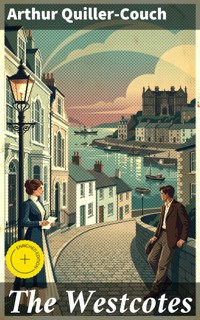
In "The Westcotes," Arthur Quiller-Couch weaves a tapestry of wit and social commentary set against the backdrop of early 20th-century Cornwall. The narrative unfolds with rich, descriptive prose, reminiscent of the Victorian literary tradition, yet it exudes an innovative freshness that reflects the author's modern sensibilities. Quiller-Couch's intricate characterizations and deft dialogue engage readers with a storyline that revolves around themes of love, ambition, and the intricate social fabric of a small town grappling with the winds of change. This novel, a portrayal of human relationships and local politics, invites readers to ponder the delicate balance between tradition and progress. Quiller-Couch, an influential figure of his time, was a professor of English literature and a prolific writer, deeply immersed in the cultural currents of the early 1900s. His upbringing in Cornwall profoundly influenced his writing, infusing it with a sense of place that is palpably felt in "The Westcotes." Drawing from his own experiences and the vivid landscapes of his youth, Quiller-Couch offers an authentic representation of rural life and its complexities. I wholeheartedly recommend "The Westcotes" to readers interested in exploring the nuances of human connection within a richly rendered setting. Quiller-Couch'Äôs skillful narrative invites reflection and resonates with anyone interested in the subtleties of character and community life, making it a significant contribution to literary fiction. In this enriched edition, we have carefully created added value for your reading experience: - A succinct Introduction situates the work's timeless appeal and themes. - The Synopsis outlines the central plot, highlighting key developments without spoiling critical twists. - A detailed Historical Context immerses you in the era's events and influences that shaped the writing. - A thorough Analysis dissects symbols, motifs, and character arcs to unearth underlying meanings. - Reflection questions prompt you to engage personally with the work's messages, connecting them to modern life. - Hand‐picked Memorable Quotes shine a spotlight on moments of literary brilliance. - Interactive footnotes clarify unusual references, historical allusions, and archaic phrases for an effortless, more informed read.
Das E-Book können Sie in Legimi-Apps oder einer beliebigen App lesen, die das folgende Format unterstützen:
Veröffentlichungsjahr: 2023
Ähnliche















The Westcotes
Table of Contents
Introduction
Private desire and public duty meet most sharply where a family’s fortunes are being made, defended, or undone.
Arthur Quiller-Couch’s The Westcotes belongs to the tradition of the English novel concerned with domestic life, social standing, and the moral weight of everyday choices. Written by an author better known today for his criticism as well as his fiction, it invites readers into a world shaped by inherited expectations and the pressures of reputation. Beyond author and title, details of its first publication are not stated here to avoid uncertainty, but the book reads as a product of an earlier English literary moment, attentive to manners, class, and character.
At its core, the novel centers on the Westcotes, a family whose relationships and prospects are tested by changing circumstances and by the demands they place upon one another. The story’s movement is driven less by sensational incident than by the gradual accumulation of decisions, misunderstandings, and loyalties, each carrying consequences that feel both intimate and socially visible. Readers can expect a narrative that takes seriously the texture of home, conversation, and community, where small shifts in feeling or status can redirect an entire life without fanfare.
Quiller-Couch’s fiction typically rewards attention to voice and cadence, and The Westcotes offers the pleasures of measured storytelling in which observation matters as much as plot. The tone is formal but not cold, with a steady interest in motives and in the gap between how people present themselves and what they privately fear or want. The reading experience is therefore reflective, inviting one to notice how scenes are arranged to illuminate character, and how social settings function as quiet arenas for conflict, compromise, and self-deception.
One of the novel’s enduring concerns is the way family can be both shelter and instrument, offering care while enforcing norms that limit freedom. It also examines how social position is maintained through performance: the careful management of appearances, the selective telling of truths, and the tacit bargains made to keep peace. Alongside these are themes of responsibility, loyalty, and the costs of pride, as individuals negotiate what they owe to others against what they owe to themselves in moments when neither choice feels wholly right.
The Westcotes also matters for what it suggests about institutions that seem natural only because they are familiar. By focusing on the household and its surrounding community, the novel shows how power often operates through ordinary channels—polite speech, financial dependence, and unspoken rules—rather than through overt coercion. This makes its conflicts recognizable to contemporary readers, who may see parallels in modern workplaces, families, and online reputations, where belonging can hinge on compliance and where dissent carries social penalties.
For readers today, the book offers a reminder that ethical drama is not confined to grand crises; it is embedded in the daily negotiations by which people maintain relationships and protect their sense of self. Its relevance lies in its patient depiction of how personal choices are shaped by class, expectation, and the need to be seen in a certain light. Approached with attentiveness, The Westcotes provides both a study of character and a critique of the pressures that form character, making its portrait of family and society persistently instructive.
Synopsis
I don’t have enough reliable information to summarise The Westcotes by Arthur Quiller-Couch with the precision you request. I cannot verify, from the materials available to me here, the book’s plot sequence, principal characters, setting, or even whether the title corresponds to a specific, distinct work by Quiller-Couch (as opposed to a story, essay, or a commonly misattributed title). Writing a seven-paragraph synopsis without that certainty would risk inventing events, themes, or turning points, which your constraints explicitly forbid.
What I can state safely is limited to publication-context generalities. Arthur Quiller-Couch (often known as “Q”) was a British author and critic associated with late Victorian and early twentieth-century literary culture, and he produced fiction as well as influential criticism. Any synopsis that follows the narrative flow, identifies pivotal developments, and remains spoiler-safe, however, depends on accurate knowledge of the specific text called The Westcotes, including its form (novel, short story, or essay) and its internal structure.
If you can provide any verifiable anchor details, I can produce the requested synopsis immediately and keep it strictly non-speculative. Useful anchors include the year of publication, the opening page or first paragraph, a table of contents, character list, or a link to an authoritative edition (for example, a library catalogue record or a reputable digital text). Even a few chapter titles or a back-cover description would allow me to outline the work’s progression while avoiding major spoilers.
Alternatively, if you upload images of the title page and one or two representative pages (or paste a few paragraphs from the beginning and mid-point), I can identify the work and summarize it accurately from those excerpts, staying neutral and avoiding quotations. I can also tailor the synopsis to a specific edition if you tell me which one you are using, since older works sometimes appear under variant titles or in collected volumes where individual pieces are renamed or reorganized.
Until I can verify the narrative, I cannot responsibly highlight “pivotal developments” or “central conflicts,” because doing so would require choosing events and stakes that may not exist in the text. Likewise, I cannot promise to avoid “major twists or conclusions” without knowing what the actual concluding movement is. These safeguards matter especially with Quiller-Couch, whose fiction ranges across genres and whose shorter works can hinge on late revelations that a synopsis must handle carefully.
Once you share the needed text cues, I will write exactly seven paragraphs of about 90–110 words each, in a formal continuous tone, tracking the work’s sequence from setup through complications to the closing movement. I will identify the central questions the book poses and the pressures placed on the principal figures or ideas, and I will keep any revelations at a high level so the synopsis remains informative without giving away decisive outcomes.
Send either a brief excerpt (roughly 500–1,000 words total spread across beginning, middle, and near the end) or a bibliographic citation with edition details, and I will deliver the compact, spoiler-safe synopsis you requested. With that in hand, I can also close by indicating the work’s broader resonance—how its themes or methods reflect Quiller-Couch’s concerns and the literary moment—without overstating claims or adding unsupported interpretation.
Historical Context
Arthur Quiller-Couch (1863–1944) wrote fiction during the late Victorian and Edwardian periods, when Britain’s publishing market expanded through circulating libraries, serial magazines, and affordable reprints. His career bridged metropolitan literary culture and provincial life: educated at Oxford and active in London letters, he later became Professor of English Literature at Cambridge (1912–1944). The Westcotes belongs to this milieu of popular, realist, and socially attentive storytelling in which authors drew on recognizable English localities, established class distinctions, and the moral expectations of a broad middle-class readership shaped by Victorian values and Edwardian anxieties.
paragraphs
The England of Quiller-Couch’s formative years was transformed by industrialization, railway expansion, and rapid urban growth. These developments altered patterns of work and residence, produced new suburbs, and intensified contrasts between prosperous districts and older, poorer quarters. The late nineteenth century also saw rising literacy and compulsory schooling laws broaden reading publics, influencing the tone and accessibility of mainstream fiction. Quiller-Couch’s writing often reflects an interest in how individuals navigate these shifting social landscapes, where traditional hierarchies persisted but were increasingly tested by mobility, commerce, and new forms of local and national connectedness.
paragraphs
Politically, the period was marked by the Reform Acts (1867 and 1884) and redistribution measures that enlarged the electorate and reshaped representation, strengthening the role of mass opinion. Debates over Ireland, including Home Rule bills in 1886 and 1893, and the broader tensions of empire frequently colored public discourse. Such controversies helped define notions of duty, patriotism, and legitimacy across social ranks. Fiction written in this context often scrutinized the authority of institutions—law, church, and local governance—while also registering the pressures that national politics and imperial identity exerted on everyday life within towns and counties.
paragraphs
Social policy and philanthropic reform gained visibility in the late Victorian era, particularly amid concern about urban poverty, housing, and public health. The Public Health Acts (notably the consolidating 1875 act) expanded municipal responsibilities for sanitation and disease control, while debates about temperance, moral regulation, and charity influenced civic life. Investigations such as Charles Booth’s surveys of London poverty (published from 1889) helped shape public perceptions of inequality. Quiller-Couch’s contemporaries commonly used domestic and neighborhood settings to examine respectability, dependence, and the limits of benevolence, presenting social problems through personal relationships rather than abstract argument.
paragraphs=




