


9,99 €
Mehr erfahren.
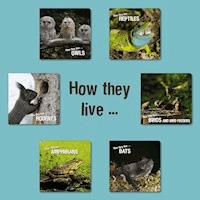
From 6 years oldAll the animals of the "How they live" collection are gathered here in one single book ! Discover their environment, their physical features, what they eat and much more ! The “How they live” collection is a must-have for children and other members of the family who are eager to learn about nature and animals while having fun.EXTRACT The life of amphibians begins in water. This is where they reproduce and live as young, which means that fresh waters are vital for this animal group. As adults they return to water only during the breeding season, though a few species stay there for their whole life. As youngsters they breathe with gills; when they become adults, they use lungs for breathing.ABOUT THE COLLECTIONThe collection "How they live..." is about wild creatures and their relation to our lives and the environment.This book contains all the titles of the "How they live..." series : • How they live... amphibians• How they live... bats• How they live... birds• How they live... owls• How they live... reptiles• How they live... rodentsABOUT THE AUTHORSIvan Esenko presents the world of nature and invites the reader to learn more about the world that we are part of. His camera is his most faithful companion and its lens particularly likes to ‘capture’ those animals that live in close quarters to man. We take them so much for granted that we no longer seem to care for them. Ivan is their voice, he has become their ‘personal’ photographer.David Withrington from Britain has spent most of his professional life working for the official agency, Natural England, where he was initially Author/Editor and latterly Senior Freshwater Adviser. He has a particular interest in birds and butterflies. He has many contacts across Europe through his voluntary work for youth and environmental conservation, including friends in Slovenia, a country which he has visited 34 times.ABOUT THE PUBLISHEROkaši is a Slovenian publisher with a vibrant programme.At every turn, nature reveals its new face and discloses a myriad of secrets. This is why we have devoted a special place to it in our publishing house. We are the creators of books that delight curious children and their parents in their discoveries of nature: in the home garden and the nearby park, but also further afield, in the fields and forests. At Okaši we keep pace with the times which is why have embarked upon several electronic editions of our books. We have added sound to these publications and hence a new dimension to the contents already there.
Das E-Book können Sie in Legimi-Apps oder einer beliebigen App lesen, die das folgende Format unterstützen:
Seitenzahl: 27
Veröffentlichungsjahr: 2015
Ähnliche










The life of amphibians begins in water. This is where they reproduce and live as young, which means that fresh waters are vital for this animal group. As adults they return to water only during the breeding season, though a few species stay there for their whole life. As youngsters they breathe with gills; when they become adults, they use lungs for breathing. Amphibians even breathe through their skin, which is why we should not touch them, as this may damage their skin. They protect their sensitive skin from drying out by hiding in dark, damp places, and avoiding the sun. They are also active during rain, when they leave their hiding places to look for small animals to feed on.
In the spring they make their way to ponds in order to breed. At this time they are vulnerable to road traffic, and toads often end up under the wheels of cars. Many wetlands in the countryside have been drained by man, destroying the amphibians’ traditional breeding areas. So, we can make up for this a little bit by creating ponds in our gardens. Pesticides also kill many amphibians, since they are ground animals and cannot avoid the poisons in agriculture. Amphibians have more or less disappeared from areas of intensive agriculture.
there are still chunks of ice floating in the water when the Common Frog(Rana temporaria)begins to mate in early spring. The males cling to the females who are depositing spawn joined together into jelly balls, in which black dots – the frog embryos – can be seen.
have released a large amount of spawn into this pond in a floodplain forest. However, only a small percentage of the tadpoles will grow into adults. Sometimes the pool will dry up and seal the fate of its inhabitants, and many of the tadpoles and young frogs will be killed by predators.
are this size when they leave their native pond. From now on, they will return to the water only during the mating season. If you have a garden pond, you must be careful on those mid-summer days when the young frogs are leaving, as they are literally crawling through the grass. During this time the lawn should not be mowed, in case the young frogs are killed under the mower. Also, you should wet your hands before touching an amphibian otherwise you could damage its delicate skin.
(Rana esculenta)are loyal to the water year-long. If they live in your garden pond, they will entertain you in the spring and summer with their songs and endearing behaviour. The females are slightly bigger than the males. Edible Frogs spend the winter at the bottom of ponds, covered in mud, so the garden pond should be more than 60 centimetres deep and the bottom should be covered by a layer of mud at least 15 centimetres thick.
(Rana arvalis)




