


2,99 €
Mehr erfahren.
- Herausgeber: 22 Lions Bookstore
- Kategorie: Ratgeber
- Sprache: Englisch
Self-esteem is related to how we understand our personality and the world we live in. And this perception, while not to be altered by force, can be changed naturally, through a new approach to life.
The purpose of this book is exactly that, teaching how we can learn to live better, with more results and more happiness.
It is said that self-esteem and self-respect arise with self-confidence, which cannot be fabricated but rather must be developed through the results we get from our personal experiences. So if we learn to make better decisions, and we learn to create more enriching life experiences, we can actually alter our entire existence and create a future with a stronger purpose.
Faced with such a future, living a life full of personal achievements and fantastic opportunities becomes normal for our new state of being. This new state of being corresponds to a new person, much more aware of himself and his potential.
Das E-Book können Sie in Legimi-Apps oder einer beliebigen App lesen, die das folgende Format unterstützen:
Veröffentlichungsjahr: 2021
Ähnliche









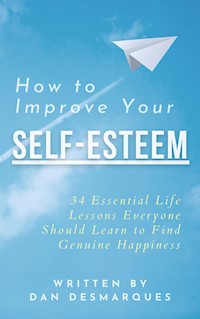
How to Improve Your Self-Esteem: 34 Essential Life Lessons Everyone Should Learn to Find Genuine Happiness
Dan Desmarques
Published by 22 Lions, 2021.
Table of Contents
Title Page
Copyright Page
About the Author
About the Publisher
Introduction
Chapter 1 - The Reasons in Your Emotions
Chapter 2 - Learning to Control Your Imagination
Chapter 3 - The Reasons for Consciousness
Chapter 4 - The Recognition of a Conditioned Reality
Chapter 5 - The Illusion of the Feeling of Freedom
Chapter 6 - The Contextual Causes of Suffering
Chapter 7 - Discovering the True State of the Soul
Chapter 8 - The Importance of Awareness of Forgiveness
Chapter 9 - The Limit of Your Mental Potential
Chapter 10 - Life's Hidden Messages
Chapter 11 - How to Reduce the Strength of Your Difficulties
Chapter 12 - How Emotions Change Your Reality
Chapter 13 - The Awareness of Your Reasons for Living
Chapter 14 - Ethics in Personal Transformation
Chapter 15 - Evolution on a Positive Path
Chapter 16 - The Development of Discernment
Chapter 17 - How to Analyze Your Own Identity
Chapter 18 - Why Many People Are Unhappy
Chapter 19 - The Potential for Personal Transformation
Chapter 20 - The Spirals of Human Existence
Chapter 21 - How We Can Control Thought
Chapter 22 - The Different Levels of Consciousness
Chapter 23 - The Recognition of the Inner Light
Chapter 24 - The Opposite of the Path of Light
Chapter 25 - Personality Formation Through Self-Love
Chapter 26 - The Importance of Your Dreams
Chapter 27 - The Recognition of Personal Values
Chapter 28 - How to Solve Any Problem
Chapter 29 - Your Spiritual Potential in a Material World
Chapter 30 - The Effects of Transformations at the Financial Level
Chapter 31 - Moral Superiority and Personal Recognition
Chapter 32 - The Difference Between Social Recognition and Success
Chapter 33 - The Hidden Cause of Poverty
Chapter 34 - Personality Results from Thought
Chapter 35 — 34 Essential Life Lessons
Book Review Request
34 Books Written By The Author
About the Publisher
Copyright Page
How to Improve Your Self-Esteem: 34 Essential Life Lessons Everyone Should Learn to Find Genuine Happiness
By Dan Desmarques
Copyright © Dan Desmarques, 2021. All Rights Reserved.
About the Author
Facebook: facebook/dandesmarques
Twitter: @dandesmarques
Instagram: @dandesmarques
Blog: dandesmarques.tumblr.com
About the Publisher
This book was published by 22 Lions
More information at www.22Lions.com
Introduction
Self-esteem is related to how we understand our personality and the world we live in. And this perception, while not to be altered by force, can be changed naturally, through a new approach to life.
The purpose of this book is exactly that, teaching how we can learn to live better, with more results and more happiness.
It is said that self-esteem and self-respect arise with self-confidence, which cannot be fabricated but rather must be developed through the results we get from our personal experiences. So if we learn to make better decisions, and we learn to create more enriching life experiences, we can actually alter our entire existence and create a future with a stronger purpose.
Faced with such a future, living a life full of personal achievements and fantastic opportunities becomes normal for our new state of being. This new state of being corresponds to a new person, much more aware of himself and his potential.
Chapter 1 - The Reasons in Your Emotions
If we could characterize the universal order in a single word, we would call it love, since the concept expresses the need for a perfect symbiosis with a view towards the confluence of common energies and interests — which we recognize as empathy.
The word love is often misunderstood as it is confused with affinity, attachment and a feeling of belonging or comfort. And while love can actually be seen as a form of pleasure, or a broader way of explaining pleasure, the love I am referring to here is that of belonging to a universal order, which elevates us and makes us better. So this is the love of the correct discipline of knowing how to live.
Only when we find perfect love, the love of discipline, do we find true love.
This is also the love of truth, love of science, love of mathematics and love of justice.
All of us, in some way, seek this kind of love. It is the imperfections of the soul that distance us from this state and that de-characterize us.
The mischaracterization of self-love and self-knowledge usually occurs through the intellectualization of reality without emotional associations. In other words, it is when we rationalize and justify what happens to us, without visualizing a greater plan of necessary purposes and effects, that we lose the meaning of the acquired knowledge.
This does not mean that all traumas and difficulties bring with them positive lessons, but rather that all experiences teach us more about our personality, namely, what we want to continue to experience or what we should refuse to accept.
The differentiation between emotion and reason places both concepts on opposite planes, however, any rationality that does not start from an objective and personalized analysis is susceptible to errors.
Among these, the most common is the error of associating differentiable concepts, and differentiating similar concepts.
For an analysis to be objective, the meanings covered must be imbued with logic, and this logic must be created by the individual, from his personal experience, and resulting from both life lessons and purposes. Therefore, all identification, selection and differentiation arise from a particular association of meanings that find an answer on the emotional plane and that, nevertheless, are likely to be generalizable.
Emotion, which can be translated into positive or negative, finds its maximum exponent in what is good and beautiful, as only these elements include logic in an infinite plane and, therefore, love and knowledge are inseparable.
There can be no true love without true knowledge, and true knowledge can only be gained with self-love and love of life. Only a truly empathetic person with a passion for life can be willing to gain the truest knowledge, which in turn strengthens his passionate attitude—representing an openness to the universal. And, in this context, it is possible to know self-fulfillment in its purest state.
These are the people who embrace the unknown, in their reality and in the people they meet, because they frame the darkness, the unknown, in their luminosity provided with positive emotions.
Obviously, this requires training, and as noted above, it is training done through the love of true knowledge, self-love, and love of life.
Lesson 1: We must analyze our decisions based on our personality and our emotions, and choose only what allows us to evolve as human beings endowed with intelligence and emotions.
Chapter 2 - Learning to Control Your Imagination
The willingness to put ourselves in an ideal state of mind presupposes several rules:
• Willingness to live without ego;
• Absence of narcissistic perspectives;
• Willingness to love with humility;
• Ability to respect others.
Love, the result of sensations, cannot be manufactured. It is a spiritual state of discovery, intrinsic to a happy existence, and which is present in all the dynamics that unite us to true knowledge and drive us to higher levels of consciousness.
This type of love constitutes an association with universal laws, and as a manifestation of that state, it also represents an association with the present reality. We can only evolve into higher states of self-fulfillment when we learn to love the present life.
Whoever discovers this type of existence can, in a profound way and within the universal laws, easily assimilate what makes them more aware of the interactions inherent to existence.
This is not about an awareness of a metaphysical order, but rather a practical one — in the way you communicate with others, and what you choose to observe in other people.
This person can consciously feel beyond what his eyes show him, predict beyond the information conveyed by the experience of reality, and use his imagination to make important future decisions.
This attitude may require a more creative approach to life, but with time, this attitude becomes natural, especially when the person decides to communicate with anyone, in any way, without assuming expectations about the interaction.
For example, I was recently looking for a house to live in. And the way I chose this house was, first, through the people I communicated with. I was excluding people who didn't seem nice, honest or easy to communicate with. Then, when I had to choose between three houses, I closed my eyes, and in silence, after relaxing my body and mind, I imagined visiting each one of them.
Whenever I approached one of the houses, I knocked on the door and asked to enter. Who opened this door was myself, in the future. In other words, I was imagining a conversation with myself in this future.
The questions I asked my future self were always the same:
— “How do you feel here?" Do you think you made a good choice?
The answers I got were interesting and unexpected, as each of these future selves told me the truth about how they felt at home, and what their lives were like. They also spoke to me, in my mind, about how their life was at that moment, which allowed me to become more aware of how where I live affects my existence, productivity and results.




