


9,99 €
Mehr erfahren.
- Herausgeber: Advanced Reasoning Forum
- Kategorie: Geisteswissenschaft
- Sprache: Englisch
Too often we're guided by what we last heard, by our friends' approval, by impulse—our desires, our fears. Without reflection. Without even stopping to think. In this book you'll learn how to reason and find your way better in life. You'll learn to see the consequences of what you and others say and do. You'll learn to see the assumptions that you and others make. You'll learn how to judge what you should believe. These are the skills we all need to make good decisions. Illustrations using a cast of cartoon characters make the concepts memorable. And many exercises will help you to check your understanding. Truly a book for all—from high school to graduate school, from auto repair to managing a company. "How to Reason" will help you find a way in life that is clearer and not buffetted by the winds of nonsense and fear.
Das E-Book können Sie in Legimi-Apps oder einer beliebigen App lesen, die das folgende Format unterstützen:
Veröffentlichungsjahr: 2019
Ähnliche
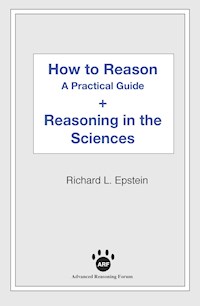






How to ReasonA Practical Guide
Richard L. Epstein
Illustrations by Alex Raffi
Advanced Reasoning Forum
COPYRIGHT © 2019 by Richard L. Epstein.
ALL RIGHTS RESERVED. No part of this work covered by the copyright hereon may be reproduced or used in any form or by any means—graphic, electronic, or mechanical, including photocopying, recording, taping, Web distribution, information storage and retrieval systems, or in any other manner—without the written permission of the author.
The moral rights of the author have been asserted.
Names, characters, and incidents relating to any of the characters in this text are used fictitiously, and any resemblance to actual persons, living or dead, is entirely coincidental.Honi soit qui mal y pense.
For more information about this book and our other publications and research, contact us:
Advanced Reasoning ForumP. O. Box 635Socorro, NM 87801USAwww.AdvancedReasoningForum.org
Visit the Advanced Reasoning Forum on Facebook.
ISBN 978-1-938421-38-9paperback
ISBN 978-1-938421-39-6e-book (pdf)
ISBN 978-1-938421-44-0e-book (epub)
Acknowledgements
I am grateful to Michael Rooney, Peter Adams, Juan Francisco Rizzo, Stipo Sentic, Marley Russell, and Sandy Nelson for their help with this project. I am grateful also to the many others who have helped over the years onThe Pocket Guide to Critical Thinking, on which this book is based.
How to ReasonA Practical Guide
Preface
Claims
1Claims
2Definitions
3Subjective Claims
4Prescriptive Claims
5Concealed Claims
Arguments
6Arguments
7What’s a Good Argument?
8Evaluating Premises
9Common Mistakes in Evaluating Claims
10Repairing Arguments
11Too Much Emotion
12Reasoning with Prescriptive Claims
13Counterarguments
The Form of an Argument
14Compound Claims
15Valid Forms of Arguments using Conditionals
16General Claims
Numbers and Graphs
17Numbers
18Graphs
Reasoning from Experience
19Analogies
20Generalizing
21Cause and Effect
22Cause in Populations
23Inferential Explanations
24Functional Explanations
Making Decisions
25Evaluating Risk
26Making Decisions
Writing Well
Index
Preface
When I first began to teach inmates at the local jail, I was told,
“They aren’t bad people. They just made bad decisions.”
This was always said in a sympathetic tone. But it’s the basis on which to blame the prisoners. They had a choice. They didn’t have to end up in jail. Now they must pay. There’s no empathy for their suffering; it’s justice. But it’s wrong. They didn’t make bad decisions. They didn’t make any decisions. Asked in exasperation, “But what were you thinking?” the only truthful answer they can give is “I wasn’t thinking.”
You, me, we’re the same. We’re guided by what we last heard, by our friends’ approval, by impulse—our desires, our fears. Without reflection. Without even stopping to think
Here you’ll learn how to reason and find your way better in life. You’ll learn to see the consequences of what you and others say and do. You’ll learn to see the assumptions that you and others make. You’ll learn how to judge what you should believe.
Reasoning well requires judgment and the ability to imagine possibilities. The practice you need for that can come from using these ideas every day when you’re studying, watching television, browsing the internet, working at your job, or talking to your friends and family. Plus, there are exercises at the end of most chapters to help you.
Because your thinking can be sharpened, you can understand more, you can avoid being duped. And, we can hope, you’ll reason well with those you love and work with and need to convince, and you’ll make better decisions. But whether you will do so depends not just on method, not just on the tools of reasoning, but on your goals, your ends. And that depends on virtue.
Claims
To reason well, to search for what is true, we need to know how to recognize what in our speech can be true or false— what we call “claims”—and what is so vague that it’s just nonsense. Definitions can help us make clear what we’re talking about.
Whether a sentence is too vague to be a claim depends in part on whether it’s meant as a description of the world outside us or whether it’s about thoughts, beliefs, or feelings. What counts as too vague depends also on whether a sentence is meant to say what is or what should be.
We’ll see, too, how people can mislead us into believing a claim by a clever choice of words.
1Claims
ClaimsAclaimis a declarative sentence used in such a way that it is either true or false, but not both.
To understand this or any definition we need to see examples of what fits the definition, of what doesn’t fit, and what’s on the border line. Only then can we begin to use the idea.
EXAMPLES
•Dogs are mammals.
This is a claim.
This is a claim, a false one.
•Dick is a student.
This is a claim, even if we don’t know if it’s true.
•How can anyone be so dumb to think cats can reason?
This is not a claim. Questions are not claims.
•Never use gasoline to clean a hot stove.
Instructions and commands are not claims.
•I wish I could get a job.
Whether this is a claim depends on how it’s used. If Maria who’s been trying to get a job for three weeks says this to herself, it’s not a claim— we don’t say that a wish is true or false. But if Dick’s parents are berating him for not getting a job, he might say, “It’s not that I’m not trying. I wish I could get a job.” Since he could be lying, in that context it’s a claim.
•There are more bacteria alive now than there were 50 years ago.
This is a claim, though there doesn’t seem to be any way we could know whether it’s true or whether it’s false.
We don’t have to make a judgment about whether a sentence is true or whether it’s false in order to classify it as a claim. We need only judge that it is one or the other. A claim need not be anassertion: a sentence put forward as true by someone.
Vague sentences
Often what people say is too vague to take as a claim. There’s no single obvious way to understand the words.
EXAMPLES
•People who are disabled are just as good as people who aren’t.
Lots of people take this to be true and important. But what does it mean? A deaf person is not as good as a hearing person at letting people know a smoke alarm is going off. This is too vague for us to agree that it’s true or false.
•Susan Shank, J.D., has joined Zia Trust Inc. as Senior Trust Officer. Shank has 20 years’ experience in the financial services industry including 13 years’ experience as a trust officer and seven years’ experience as a wealth strategist.—Albuquerque Journal
April 29, 2010 and the Zia Trust website
“Wealth strategist” looks very impressive. But when I called and asked Ms. Shank what it meant, she said, “It can have many meanings, whatever the person wants it to mean.” This is vagueness used to convince you she’s doing something important.
Still, everything we say is somewhat vague. After all, no two people have identical perceptions, and since the way we understand words depends on our experience, we all understand words a little differently. So it isn’t whether a sentence is vague but whether it’s too vague, given the context, for us to take it as a claim. In a large auditorium lit by a single candle at one end, there’s no place where we can say it stops being light and starts being dark. But that doesn’t mean there’s no difference between light and dark.
Drawing the line fallacyIt’s bad reasoning to argue that if you can’t make the difference precise, then there’s no difference.
Throughout this text we’ll pick out common mistakes in reasoning and label them as afallacies.
EXAMPLES
•If a suspect who is totally uncooperative is hit once by a policeman, that’s not unnecessary force. Nor twice, if he’s resisting. Possibly three times. If he’s still resisting, shouldn’t the policeman have the right to hit him again? It would be dangerous not to allow that. So, you can’t say exactly how many times a policeman has to hit a suspect before it’s unnecessary force. So the policeman did not use unnecessary force.
This argument convinced a jury to acquit the policemen who beat up Rodney King in Los Angeles in the 1990s. But it’s just an example of the drawing the line fallacy.
•Tom: My English composition professor showed up late for class today.
Zoe:What do you mean by late? How do you determine when she showed up? When she walked through the door? When her nose crossed the threshold?
Zoe is asking for more precision than is needed. In ordinary talk, what Tom said is clear enough to be a claim.
•Zoe: Those psychiatrists can’t agree whether Wanda is crazy or not. One says she’s clinically obsessive, and the other says she just likes to eat a lot. This psychiatry business is bunk.
Just because there are borderline cases doesn’t mean there isn’t a clear difference between people who are really insane and those who aren’t.
A sentence isambiguousif it can be understood in two or a very few obviously different ways.
EXAMPLES
•Zoe saw the waiter with the glasses.
Did the waiter have drinking glasses or eyeglasses, or did Zoe use eyeglasses? If we don’t know which is meant, it’s not a claim.
•There is a reason I haven’t talked to Robert [my ex-lover] in seventeen years (beyond the fact that I’ve been married to a very sexy man whom I’ve loved for two-thirds of that time).
—Laura Berman,Ladies’ Home Journal, June 1996
The rest of the time she just put up with him?
•Tom: Saying that having a gun in the home is an accident waiting to happen is like saying that people who buy life insurance are waiting to die. We should be allowed to protect ourselves.
Tom, perhaps without even realizing it, is using two ways to understand “protect”: physically protect vs. emotionally or financially protect.
•Dr. E’s dogs eat over 10 pounds of meat every week.
Is this true or false? It depends on whether it means “Each ofDr. E’s dogs eats over 10 pounds of meat every week” (big dogs!) or “Dr. E’s dogs together eat over 10 pounds of meat every week.” It’s anindividual versus group ambiguity.
We can tolerate some vagueness, but we should never tolerate ambiguity in our reasoning, because then we really don’t know what we’re talking about.
Now you should know what these mean:
•Claim.
•Too vague to be a claim.
•Drawing the line fallacy.
•Ambiguous sentence.
•Individual vs. group ambiguity.
You should be ready to use these, perhaps uncertainly, but as you see them put to use in more examples and with other ideas, you’ll soon be able to make them your own.
Try your hand at these!
Which of the following is a claim?
1.College is really expensive now.
2.Pass the salt, please.
3.Bill Gates founded Apple.
4.Your best friend believes that Bill Gates founded Apple.
5.A friend in need is a friend indeed.
6.The sky is blue.
7.The sky is blue?
8.Whenever Spot barks, Zoe gets mad.
9.The Dodgers aren’t going to win a World Series for at least another 10 years.
10.If you don’t pay your taxes on time, you’ll have to pay more to the government.
11.Suzy: I feel cold today.
12.Public education is not very good in this state.
13.Men are stronger than women.
14.Americans bicycle thousands of miles every year.
15.He gave her cat food.
Answers
1.Not a claim. Too vague.
2.Not a claim. A command.
3.A claim (false).
4.A claim, but not the same as the last one.
5.What the heck does this mean?
6.A claim.
7.Not a claim. A question.
8.A claim.
9.A claim. We just don’t know whether it’s true or false and won’t know for another 10 years.
10.A claim.
11.A claim. Sure it’s vague, but what do you expect when talking about feelings?
12.Not a claim. Too vague.
13.Not a claim,. Too vague. Strong in what way? Can lift more? Can lift more for their body weight? Can survive trauma better?
14.Not a claim. Individual vs. group ambiguity.
15.Not a claim, ambiguous.
2Definitions
There are two ways we can try to make clear what we say.
•Replace the entire sentence by another that is not vague or ambiguous.
•Use a definition to make a specific word or phrase precise.
DefinitionsAdefinitionis an explanation or stipulation of how to use a word or phrase.
A definition is not a claim. A definition is not true or false, but good or bad, right or wrong. Definitions tell us what we’re talking about.
EXAMPLES
•“Exogenous” means “developing from without.”
This is a definition, not a claim. It’s an explanation of how to use the word “exogenous.”
•Puce is the color of a flea, purple-brown or brownish-purple.
This is a definition, not a claim.
•Lee: Maria’s so rich, she can afford to buy you dinner.Tom: What do you mean by “rich”?Lee: She’s got a Mercedes.
This is not a definition—or it’s a very bad one. Some people who have a Mercedes aren’t rich, and some people who are rich don’t own a Mercedes. That Maria has a Mercedes might be some evidence that she’s rich.
•Fasting and very low calorie diets (diets below 500 calories) cause a loss of nitrogen and potassium in the body, a loss which is believed to trigger a mechanism in the body that causes us to hold on to our fat stores and to turn to muscle protein for energy instead.
—Jane Fonda’s New Workout and Weight Loss Program
Definitions aren’t always labeled but are often made in passing, as with this good definition of “very low calorie diet.”
•Intuition is perception via the unconscious.—Carl G. Jung
This is a definition, but a bad one. The words doing the defining are no clearer than what’s being defined.
•Dogs are mammals.
This is not a definition. It’s a claim.
•A car is a vehicle with a motor that can carry people.
This is a bad definition because it’stoo broad: It covers cases that it shouldn’t. For example, a golf cart would be classified as a car. So we can’t use the words doing the defining in place of the word being defined.
•Dogs are domesticated canines that obey humans.
This is a bad definition because it’stoo narrow.: It doesn’t cover cases it should, like feral dogs in India.
Good definitionFor a definition to be good:
•The words doing the defining are clear and better understood than the word or phrase being defined.
•It would be correct to use the words doing the defining in place of the word or phrase being defined. That is, the definition is neither too broad nor too narrow.
•Abortion is the murder of unborn children.
Here what should be debated—whether abortion is murder—is being assumed as if it were a definition.
Persuasive definitionsApersuasive definitionis a contentious claim masquerading as a definition.
•A feminist is someone who thinks that women are better than men.
This is a persuasive definition.
If you call a tail a leg, how many legs has a dog? Five? No, calling a tail a leg don’t make it a leg.
— attributed to Abraham Lincoln
•Absurdity: A statement of belief manifestly inconsistent with one’s own opinion.—Ambrose Bierce,The Devil’s Dictionary
Whether you classify this as persuasive depends on how much faith you have in people.
To make a good definition, we need to look for examples where the definition does or does not apply to make sure it’s not too broad or too narrow.
•Suppose we want to define “school cafeteria.” That’s something a lawmaker might need in order to write a law to disburse funds for a food program. As a first go, we might try “A place in a school where students eat.” But that’s too broad, since that would include a room with no food service where students can take their meals. So we could try “A place in a school where students can buy a meal.” But that’s also too broad, since it would include a room where students could buy a sandwich from a vending machine. How about “A room in a school where students can buy a hot meal that is served on a tray”? But if there’s a fast-food restaurant like Burger King at the school, that would qualify. So it looks like we need “A room in a school where students can buy a hot meal that is served on a tray, and the school is responsible for the preparation and selling of the food.” This looks better, though if adopted as a definition in a law it might keep schools that want money from the legislature from contracting out the preparation of their food. Whether the definition is too narrow will depend on how the lawmakers intend the money to be spent.
Steps in making a good definition
•Show the need for a definition.
•State the definition.
•Make sure the words make sense and are clear.
•Give examples of where the definition applies.
•Give examples of where the definition does not apply.
•If necessary, contrast it with other likely definitions.
•If necessary, revise it.
Now you can recognize and use definitions in your reasoning if you remember these ideas:
•Definition.
•Good definition.
•Persuasive definition.
•How to make a good definition.
Try your hand at these!
Classify each of the following as a definition, a persuasive definition, or neither. If it is a definition, say what word or phrase is being defined.
1.“Dog” means “a canine creature that brings love and warmth to a human family.”
2.Domestic violence is any violent act by a spouse or lover directed against his or her partner within the confines of the home of both.
3.Being rich means you can afford to buy a Mercedes.
4.A real fan has season tickets.
5.A conservative, in politics, is one who believes that we should conserve the political structure and laws as they are as much as possible, avoiding change.
6.A liberal is someone who wants to use your taxes to pay for what he thinks will do others the most good.
7.A killer whale has a sleek, streamlined, fusiform (tapered at both ends) body shape.
Answers
1.Persuasive definition.
2.Definition of “domestic violence.”
3.Perhaps a definition of “rich,” but not a good one. Better to view it as a claim.
4.Not a definition. It’s a condition for someone to be a real fan.
5.Definition of “conservative,” though not a good one now.
6.Persuasive definition.
7.Definition of “fusiform.”
3Subjective Claims
Subjective and objective claimsA claim issubjectiveif whether it’s true or false depends on what someone, or something, or some group thinks, believes, or feels.
A claim that’s not subjective isobjective.
EXAMPLES
•All ravens are black.
This is an objective claim.
•Suzy: My cat Puff is tired.
This is a subjective claim.
•Suzy: It’s cold outside.
This is too vague to be an objective claim. But if Suzy means just that it seems cold to her, it’s a subjective claim. A sentence that’s too vague to be an objective claim might be perfectly all right as a subjective one if that’s what the speaker intended. After all, we don’t have very precise ways to describe our feelings.
•Wanda: I felt sick yesterday, and that’s why I didn’t hand in my work.
Wanda didn’t feel sick yesterday—she left her critical thinking writing assignment to the last minute and couldn’t finish it before class.
This is a false subjective claim.
•Lee: Calculus I is a really hard course.
What standard is Lee using for classifying a course as really hard? If hemeans that Calculus I is difficult for him, then the claim is subjective. If Lee has in mind that about 40% of students fail Calculus I, which is twice as many as in any other course, then the claim is objective. Or Lee might have no criteria in mind, in which case it’s not a claim.
If it’s not clear whether subjective or objective criteria are being invoked, the sentence is too vague to be taken as a claim.
•Inspector: Your restaurant failed this inspection.Restaurant owner: That’s just what you think.
The criteria for passing a restaurant inspection include “There is an accessible sterilizing solution with test strips”, “No drinks without lids are in the food preparation area”, . . . each of which is objective. But despite officials trying to write regulations that are very precise and specific, for an inspector to decide whether each of those is true depends on his or her judgment. What counts as accessible? What are the boundaries of the food preparation area? Different competent inspectors might disagree. So when the restaurant owner says, “That’s just what you think,” he’s wrong if he means that the claim is subjective, but he might be right if he means that he disagrees with the inspector’s judgment about whether certain criteria are satisfied.
•God exists.
Lots of people think this is subjective because there’s so much disagreement about it. But whatever we mean by “God” it’s supposed to be something that exists independently of people. So the example is objective: whether it’s true or false doesn’t depend on what anyone thinks or feels. “God exists”≠“I believe that God exists.”
Subjectivist fallacyIt’s a mistake to argue that because there’s a lot of disagreement about whether a claim is true it follows that the claim is subjective.
•Wanda weighs 215 pounds.
This is an objective claim. Registering a number on a scale is an objective criterion.
•Nurse: Dr. E, tell me on a scale of 1 to 10 how much your back hurts.Dr. E: It’s about a 7.
This is a scale, but one that only Dr. E knows. Dr. E’s claim is subjective.
•Dick: Wanda is fat.
This is a subjective claim. Whether it’s true depends on Dick’s feeling about what is fat. But what if Wanda is so obese that everyone would consider her fat? It’s still subjective, but we can note that agreement.
Intersubjective claimsA subjective claim isintersubjectiveif (almost) everyone agrees that it’s true or (almost) everyone agrees that it’s false.
•There are an even number of stars in the sky.
This claim is objective, but no one knows how to find out whether it’s true or false, and it’s not likely we’ll ever know.
•There is enough oil available for extraction by current means to fulfill the world’s needs for the next 63 years at the current rate of use.
This is objective. People disagree about it because there’s not enough evidence one way or the other.
•Zoe: Tom loves Suzy.Dick: I don’t think so.
Dick and Zoe disagree about whether this subjective claim is true, but it’s not for lack of evidence. There’s plenty; the problem is how to interpret it.
Confusing whether a claim is objective or subjective can lead to pointless disagreements. Dick and Zoe are treating a subjective claim as if it were objective. There’s no sense in arguing about taste.
Often it’s right to question whether a claim is really objective. But sometimes it’s just a confusion. All too often people insist that a claim is subjective (“That’s just your opinion”) when they are unwilling to examine their beliefs or engage in dialogue.
Now you have more tools in your reasoning kit:
•Subjective claim.
•Objective claim.
•Subjectivist fallacy.
•Intersubjective claim.
You can begin to use these if you remember:
•What’s too vague to be an objective claim can still be a subjective claim.
•If it’s not clear whether it’s meant as subjective or objective, don’t take it as a claim.
•Whether a claim is subjective or objective does not depend on:
How many people believe it.
Whether it’s true or false.
Whether anyone can know if it’s true or false.
Try your hand at these!
Which of the following is an objective claim, a subjective claim, or no claim at all?
1.Silk insulates better than rayon.
2.Silk feels better on your skin than rayon.
3.Bald men are more handsome.
4.You intend to finish reading this book.
5.He’s sick! How could someone say something like that?
6.He’s sick; he’s got the flu.
7.Cats enjoy killing birds.
8.(In a court of law, said by the defense attorney) The defendant is insane.
9.Zoe is more intelligent than Dick.
10.Zoe gets better grades in all her courses than Dick.
11.Suzy believes that the moon does not rise and set.
12.Spot ran to his bowl and drooled when Dick got his dog food.
13.Spot is hungry.
14.Fifty-four percent of women responding to a recent Gallup poll said they think that women do not have equal employment opportunities with men.
15.Fifty-four percent of women think that women do not have equal employment opportunities with men.
16.Dog food is more expensive at Smith’s than at Albertson’s
Answers
1.Objective.
2.Subjective.
3.Subjective.
4.Subjective.
5.Subjective.
6.Objective.
7.Subjective.
8.Subjective
9.Subjective.
10.Objective.
11.Subjective.
12.Objective.
13.Subjective.
14.Objective.
15.Subjective.
16.Too vague to be a claim (each kind is more expensive or overall? Individual vs. group ambiguity.)
4Prescriptive Claims
Sometimes we want to say not only what is but what ought to be.
Descriptive and prescriptive claims
A claim isdescriptiveif it says what is.
A claim isprescriptiveif it says what should be.
Prescriptive claims are also called “normative,” and descriptive ones are sometimes called “positive.”
EXAMPLES
•Drunken drivers kill more people than sober drivers.
This is a descriptive claim. It’s objective.
•There should be a law against drunk driving.
This is a prescriptive claim.
•Dick: I’m hot.Zoe: You should take your sweater off.
Dick has made a descriptive claim. Zoe responds with a prescriptive one.
•The government must not legalize marijuana.
This is a prescriptive claim, where “must” indicates a stronger idea than “should.”
•The government ought to lower interest rates.
This is a prescriptive claim.




