


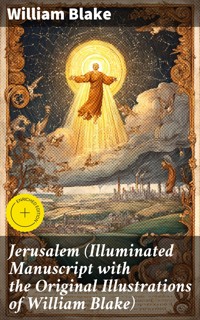
Jerusalem (Illuminated Manuscript with the Original Illustrations of William Blake) E-Book
William Blake
0,49 €
Mehr erfahren.
- Herausgeber: Booksell-Verlag
- Kategorie: Poesie und Drama
- Sprache: Englisch
William Blake's "Jerusalem" is a profound exploration of the relationship between the material and spiritual realms, presented through his distinctive illuminated manuscript style. Written in the late 18th century and characterized by rich symbolism and visionary imagery, the text weaves together themes of redemption, social justice, and the quest for a transformative England. Blake's striking illustrations serve not merely as embellishments but as integral components that deepen the reader's understanding of the poem's intricate philosophical and theological underpinnings. The work reflects the fervent spirit of Romanticism, positioning itself against the backdrop of the Industrial Revolution and the socio-political upheaval of Blake's time. William Blake (1757-1827) was not only a poet but also a painter, engraver, and visionary philosopher, whose unyielding belief in the power of imagination profoundly influenced his artistic endeavors. A figure often ahead of his time, Blake's own experiences with social exclusion and spirituality undoubtedly shaped the themes present in "Jerusalem." His rejection of conventional norms allowed him to create a work that challenged societal structures and championed an idealized vision of human potential. "Jerusalem" is a compelling read for anyone interested in the intersections of art, poetry, and philosophy. Blake's fusion of text and imagery invites readers to forge a deeper connection with their own spiritual journeys while contemplating the urgent social issues of his day. A testament to the power of imagination and creativity, this work is essential for scholars, poets, and lovers of art alike. In this enriched edition, we have carefully created added value for your reading experience: - A succinct Introduction situates the work's timeless appeal and themes. - The Synopsis outlines the central plot, highlighting key developments without spoiling critical twists. - A detailed Historical Context immerses you in the era's events and influences that shaped the writing. - An Author Biography reveals milestones in the author's life, illuminating the personal insights behind the text. - A thorough Analysis dissects symbols, motifs, and character arcs to unearth underlying meanings. - Reflection questions prompt you to engage personally with the work's messages, connecting them to modern life. - Hand‐picked Memorable Quotes shine a spotlight on moments of literary brilliance. - Interactive footnotes clarify unusual references, historical allusions, and archaic phrases for an effortless, more informed read.
Das E-Book können Sie in Legimi-Apps oder einer beliebigen App lesen, die das folgende Format unterstützen:
Veröffentlichungsjahr: 2023
Ähnliche

Jerusalem (Illuminated Manuscript with the Original Illustrations of William Blake)
Table of Contents
Introduction
A fallen giant seeks to awaken the sleeping city within the human soul. William Blake’s Jerusalem presents a visionary landscape where psychological, spiritual, and national histories intertwine, inviting readers into an epic of division and reunion. Composed as an illuminated poem, it fuses language and image to enact the very acts of perception it celebrates. The work’s propulsive energy arises from a struggle between constriction and imaginative liberation, between systems that bind and the creative fires that transfigure. Entering this book is to cross a threshold: Blake bids us to read with the eye and the mind at once, and to measure ourselves against a mythic scale.
Jerusalem is considered a classic because it expands the possibilities of what a poem—and a book—can be. Its audacity lies not only in prophetic scope but in formal invention, where image and text co-create meaning. As a culminating effort of Romantic vision, it helped define a countertradition that values imagination as an active force, not mere ornament. The work’s afterlife is long: poets, painters, and critics have returned to it for models of myth-making, multi-modal artistry, and moral intensity. Its endurance rests on a paradox: though anchored in Blake’s time, it speaks to every era’s conflicts over freedom, community, and the remaking of perception.
The author is William Blake (1757–1827), the English poet, engraver, and painter who devised his own method of relief etching, which he called illuminated printing. Jerusalem was composed and engraved between 1804 and around 1820, and printed in very small numbers during Blake’s lifetime. In this illuminated manuscript, Blake wrote, etched, and hand-colored his pages, integrating words with images so that each impression is both poem and picture. The present edition foregrounds his original illustrations as part of the text’s meaning. The result is a work conceived as a total artwork, where typography, drawing, and color combine to carry—and complicate—the poem’s arguments and emotions.
While avoiding spoilers, one can say that Jerusalem stages a drama of fall and awakening across a mythic Britain. Figures embody energies and mind-states: a vast human form stands for a collective people; a feminine city-persona signals vision and community; a prophetic maker tends the furnaces of creative labor; a lawgiver crystallizes constricting systems. Landscapes shift from city streets to cosmic spaces, as inward experience becomes external terrain. The poem’s plot is less linear quest than widening revelation: separations expose themselves, contraries clash and converse, and an arduous path toward reintegration is sketched. The scale is epic, but the stakes are intimate—how a single perception might alter a world.
Blake’s purpose was both artistic and prophetic. He sought to fashion a national epic not by adopting classical models, but by inventing a personal myth that could diagnose his society and kindle transformation. He wrote and engraved to assert that imagination is an active power capable of reshaping vision and, therefore, action. By binding image to text, he aimed to dramatize how forms of seeing are also forms of thinking. He addresses the pressures of his age—war, industrial change, religious and political coercions—without yielding to mere denunciation, instead modeling a creative alternative. The poem becomes an instrument of moral perception, testing readers’ habits and inviting renewal.
The material form is integral to the reading experience. Blake’s plates carry flowing script, sculpted by his hand into the copper, beside figures that stride, kneel, or weave through architectural vistas and molten interiors. Hand-applied color varies from copy to copy, creating a shifting atmosphere: dawns and furnaces, river-light and shadowed walls. Motifs recur—looms, wheels, gates, and city plans—functioning as visual rhymes that echo the poem’s rhythms. The page borders alternately frame and overflow, enacting the poem’s tension between constraint and enlargement. To attend to the images is to participate in the work’s argument: perception is never merely passive; it is a forge where meaning is made.
In literary history, Jerusalem consolidates Blake’s prophetic project and anticipates later experiments in form and vision. It stands at the edges of Romanticism while pointing toward Symbolist and Modernist practices that would integrate word and image, myth and critique. Nineteenth-century artists and poets helped renew Blake’s reputation, and twentieth-century critics deepened appreciation for his mythic architecture. The book’s influence is discernible in artists’ books, visionary epics, and graphic narratives that refuse to separate seeing from reading. Its insistence on imagination as an active, ethical faculty has resonated with writers seeking alternatives to inherited forms, and with visual artists pursuing a syntax of emblem, diagram, and dream.
Though created with world-changing ambition, Jerusalem initially circulated within a small circle. Its difficulty and the rarity of its impressions limited early readership, even as devoted admirers preserved and discussed it. The later nineteenth century brought renewed interest in Blake, and with it a broader recognition of this work’s singular achievement. A poem in the preface was adapted as a widely known hymn in the twentieth century, further entwining Blake’s visionary language with public culture. Scholarly editions and facsimiles have since made the illuminated plates more accessible, allowing readers to encounter the poem as Blake intended: as a crafted unity of verbal prophecy and pictorial thought.
Approaching Jerusalem benefits from patience and openness. Names and places act as emblems; they carry psychological charge as much as historical reference. Readers may find it helpful to let images and text inform each other, tracing recurring forms, colors, and phrases as they resurface with altered meaning. The poem often proceeds by juxtaposition rather than linear exposition, asking us to feel the pressure between contraries before synthesis emerges. Nothing essential is hidden behind a code: the work teaches its method by practice. Allow its cadences to accumulate, its figures to gather density, and its visual metaphors to become mental instruments for understanding division and reunion.
The book’s abiding themes include the relation between freedom and form, the labor of art, and the possibility of forgiveness. Sleep, chains, and walls symbolize states of mental closure; furnaces, rivers, and gardens suggest creative process and renewal. Urban and national spaces become living bodies whose health depends on recognition and mutuality. Religious, political, and artistic orders are tested not for doctrine, but for their capacity to enlarge life. Throughout, Blake explores how perception can be narrowed into habit or opened into vision, how memory can bind or liberate, and how the language of making—building, weaving, forging—models an ethics of attention and care.
For contemporary readers, Jerusalem remains strikingly relevant. Its critique of dehumanizing systems speaks to ongoing debates about technology, labor, and institutions, while its plea for imaginative agency counters cynicism and fatalism. In an era of multimedia expression, Blake’s integration of word and image feels newly contemporary, offering a precedent for hybrid forms that aim to think in pictures as well as in lines. The poem’s wrestling with identity, community, and responsibility resonates amid global conversations about nationhood and belonging. Above all, it proposes that artistic attention can be a civic force, clarifying what constrains us and animating the work of repair.
To read Jerusalem is to be drawn into a demanding, exhilarating encounter with a mind that believed art could help remake the world. It offers an epic of moral imagination, a map of inner and social divisions, and an ars poetica conveyed through copper, pigment, and prophetic cadence. Its images ignite, its cadences insist, and its emblems return until they change the way we see. That continuing capacity to reorient perception explains its classic status and its lasting appeal. As you enter Blake’s city and country of the mind, expect to find not a museum piece, but a living instrument for thought and renewal.
Synopsis (Selection)
Jerusalem is William Blake’s longest illuminated poem, engraved and issued with original designs that fuse text and image into a single reading experience. Structured in four chapters and prefaced with addresses to distinct audiences, it unfolds a visionary history centered on Albion, the universal human, and Jerusalem, his Emanation. The poem maps spiritual drama onto the landscape of Britain, aligning cities and counties with states of mind. Blake’s images mirror the poem’s action, depicting looms, furnaces, figures in chains, and architectural forms that visualize mental processes. The work’s purpose is to present a comprehensive account of fall, division, and the prospect of renewal through imaginative energy.
The poem opens by defining its scope and audience, setting a prophetic tone that invites public scrutiny. Albion’s condition frames the narrative: he enters a sleep of selfhood, a state of isolation that fractures the unity of human life. Jerusalem, as his Emanation, becomes separated and diffused across the land. This division triggers conflict among personified faculties and their shadows, the Spectres. Los, the prophetic artist, perceives the crisis and begins a sustained labor to counter dissolution. The opening movement establishes the principal forces and images, linking internal states to geographic contours and preparing readers for a sequence of transformations across the four-fold human form.
Los takes a central role as a builder and lawgiver of imaginative form. With Enitharmon, he forges Golgonooza, the city of art, installing furnaces and gates that correspond to towns and rivers. His work seeks to concentrate scattered energies into shaped vision. The Spectre of Urthona, a divided part of Los, contests him, dramatizing the conflict between creative resolve and self-doubt. Around them, the Four Zoas—Urizen, Luvah, Tharmas, and Urthona—struggle to regain order. The poem traces how mental powers, when misaligned, produce systems of constraint. Art emerges as a mediating practice, tempering force and reason, and organizing the dispersed fragments of Albion’s being.
The narrative advances through an address situating prophecy in relation to historical tradition. Jerusalem appears exiled among the Twelve Tribes within Albion’s isles, her presence veiled and misunderstood. Vala, figured as Nature’s enchantment, overlays vision with a beautiful but limiting garment. Rahab and Tirzah represent institutional morality and natural religion, weaving bindings for Jerusalem through ceremonies and codes. These figures direct energies into cycles of obedience and conflict, delaying recognition of the underlying unity. Meanwhile, Los persists in his constructive labor, attempting to gather Jerusalem’s scattered fibers into coherent form. The poem charts wandering, entanglement, and gradual clarification without resolving them prematurely.
A further address engages reason and deistic thought, dramatized through Urizen’s expansive systems of measurement and law. Networks of mills and compasses spread across the landscape, translating living perception into grids of necessity. The Sons of Albion, caught in rivalry and accusation, enact political and domestic conflicts that mirror interior divisions. Luvah’s passion, displaced into war, alternates with constraining order, intensifying cycles of coercion and revolt. The poem underscores a distinction between states and individuals, insisting that persons move through conditions without being identical to them. Hints of imaginative breakthrough appear as Los’s fires illuminate the limits of system, but entrenched forms remain powerful and pervasive.
An address to Christians introduces themes of forgiveness and internal transformation. The poem contrasts outward rites with inward vision, emphasizing the need to reanimate symbols through living perception. Jerusalem’s garments—figures for doctrine and culture—are woven and unwoven as institutions contend over authority. Cities such as London, Bath, and Canterbury appear as mental terrains where adherence to form vies with acts of mercy. Los confronts his Spectre, testing whether selfhood can be tempered without annihilation. The narrative here turns on recognition: that rigid virtue may conceal hostility, and that reconciliation requires imaginative receptivity. The imagery presses toward integration while acknowledging the persistence of accusation and fear.
As the action intensifies, Golgonooza expands. Its gates correspond to Britain’s regions, and its workshops elaborate arts that bind scattered lives. The poem aligns the Twelve Gates of a spiritual city with Albion’s geography, rendering redemption as a reconfiguration of space and perception. The Zoas contest their domains, and Urizen’s thrones begin to tremble under imaginative pressure. Visual plates display ladders, rivers, and lattices that echo textual themes of ascent, flow, and constraint. Through craft, song, and measured work, Los and Enitharmon stabilize a ground where renewed relation becomes thinkable. The narrative builds toward recognition scenes that prepare a shift in Albion’s condition.
Approaching its climax, the poem brings Albion into relation with voices calling from within and without. Jerusalem addresses him, summoning remembrance and mutual regard. Veils of error and accusation are strained as Rahab’s alliances and the splendors of Babylon test allegiance to external domination. Figures confront their own doubles, revisiting choices that established cycles of law and retaliation. The language rises toward ceremonial pronouncement, and the designs depict rending, clasping, and the opening of gates. Without specifying a final outcome, the poem concentrates on decision points where mercy and vision contest with selfhood, suggesting the possibility of a new configuration of human community.
Jerusalem concludes by reaffirming the poem’s central purpose: to demonstrate how imaginative labor can reassemble a divided human form into a peaceable order. The illuminated format reinforces this message, with plates that both illustrate and think alongside the text. Geography, myth, and psychology merge to propose that nations and persons are shaped by the states they inhabit. The work emphasizes forgiveness, creative practice, and the reanimation of symbols over adherence to constraining systems. As a whole, it offers a sustained sequence from fall into division toward the prospect of unity, presenting a comprehensive vision of renewal that is artistic, ethical, and communal in scope.
Historical Context
William Blake’s Jerusalem is set in a visionary Britain he calls Albion, yet its geography is recognizably late‑Georgian London and its provinces. The poem’s time is deliberately layered: biblical and apocalyptic eras fold into the Britain of roughly 1760–1820, when Blake lived and worked. Streets, churches, and rivers anchor the mythic action in a metropolis transformed by commerce, war, and industry. Written and engraved between about 1804 and 1820, the work reflects a city of docklands and prisons, parishes and workshops, under the Hanoverian monarchs George III and George IV, and under governments that alternated between wartime mobilization and domestic repression.
The poem maps its spiritual struggle onto concrete places: Lambeth, Southwark, Marylebone, Tyburn, and the Thames, whose bridges and wharves serviced imperial trade. London’s population surged toward one million by 1800, packing the poor into rookeries while financiers, shipowners, and contractors enriched themselves. The capital’s skyline of spires and mills symbolizes for Blake the intertwined powers of church and industry. He overlays these spaces with Golgonooza, the imaginative city of art, and with Jerusalem, the city of peace, to contest London’s prisons, hospitals, and workhouses. The setting’s doubleness—material and visionary—allows immediate social reference within an epic of national regeneration.
The French Revolution (1789) began with the convening of the Estates‑General, the National Assembly’s formation, and the storming of the Bastille on 14 July. The Declaration of the Rights of Man and of the Citizen codified liberty and equal citizenship that electrified British observers. In London, artisans and shopkeepers formed the London Corresponding Society (1792) to agitate for reform; Thomas Paine’s Rights of Man (1791–1792) circulated widely. Jerusalem echoes this moment’s emancipatory promise in its calls to awaken Albion from bondage, yet it also translates political hope into spiritual liberation, insisting that civic freedom without imaginative regeneration will relapse into new forms of tyranny.
By 1793 Britain was at war with revolutionary France; the Reign of Terror (1793–1794) and executions in Paris chilled earlier enthusiasm. At home, William Pitt’s ministry suspended habeas corpus (1794), prosecuted leaders of reform, and passed the Seditious Meetings and Treasonable Practices Acts (1795). The famous Treason Trials of 1794 saw Thomas Hardy, John Horne Tooke, and John Thelwall acquitted, but the climate of surveillance intensified. Jerusalem answers this repression with images of chains, mills, and dungeons binding Albion’s limbs. Blake’s myth frames police powers and informers as specters of Urizenic law—the petrified reason that would rather enslave the imagination than tolerate visionary dissent.
Reaction hardened through the late 1790s: the government broke radical clubs, enforced loyalty oaths, and outlawed worker combinations (Combination Acts, 1799–1800). Napoleon’s coup of 18 Brumaire (1799) replaced French republican idealism with authoritarian empire, confirming British conservatives’ warnings. Blake, who engraved for the radical publisher Joseph Johnson in the early 1790s, increasingly rendered politics as spiritual war. Jerusalem integrates these events by portraying Albion’s fall as a national acceptance of fear and false prudence. Its prophetic counsel—mutual forgiveness and creative labor—emerges from the decade’s dashed hopes: the poem keeps revolutionary energy while condemning terror, militarism, and the domestic repression that followed.
The Industrial Revolution accelerated from the 1760s, with James Watt’s separate condenser (patented 1769), Richard Arkwright’s water frame, and the factory system at places like Cromford (1771). Steam power, canals, and later ironworks concentrated labor in mills; child and female labor expanded; urbanization surged. By 1800 London was the world’s largest city and Britain an industrial workshop. Jerusalem absorbs this transformation through figurations of mills, furnaces, and mechanized hands. While Los’s furnaces image redeemed creative energy, the poem condemns systems that turn bodies into cogs. Its critique mirrors the new wage discipline, time‑keeping, and overseer power that remade work from home‑based craft into factory regimen.
Enclosure and agrarian change displaced rural populations. Parliamentary Enclosure Acts peaked in the late eighteenth century, privatizing commons and hedging fields, while dearth years (1795–1796, 1800–1801) brought bread riots and poor relief crises. The Speenhamland system (Berkshire, 1795) tied allowances to bread prices, attempting to stave off starvation but also depressing wages. Jerusalem reflects the uprooting of the poor in its wandering, houseless figures and in its insistence that charity without justice perpetuates bondage. Blake’s pastoral visions are not nostalgic; they indict a political economy that converts land and labor into instruments of profit, divorcing human needs from customary rights and mutual care.
The Gordon Riots of June 1780, an anti‑Catholic convulsion sparked by Lord George Gordon, saw crowds attack chapels, prisons, and the symbols of authority. On 6 June, Newgate Prison was burned; soldiers eventually restored order after days of arson and looting. Contemporary accounts estimate hundreds dead or injured. Blake, then a young engraver, witnessed the burning of Newgate, an image of walls breached and law unmasked as coercion. Jerusalem’s obsession with prisons and liberation owes much to this memory: the work’s gates, bars, and watchtowers are not abstractions but transposed from a London where justice, religion, and violence met in firelit streets.
The American Revolution (1775–1783) dismantled British rule in thirteen colonies, culminating in the Treaty of Paris (1783). Debates in Britain divided Edmund Burke’s caution from reformers who saw republican liberty in the Atlantic world. Thomas Paine’s Common Sense (1776) and revolutionary diplomacy reshaped ideas of sovereignty and consent. For Blake, America’s revolt showed that empire could be resisted and the past remade. Jerusalem’s call to build “Jerusalem” in England’s green and pleasant land, though voiced elsewhere in his oeuvre, echoes here as a sustained project: national redemption requires imaginative refounding, not imperial dominion, replacing conquest with communal law grounded in forgiveness and equality.
The French Revolutionary and Napoleonic Wars (1793–1815) militarized British life. Coastal defenses rose; invasion scares peaked in 1803–1805; volunteers drilled on commons; naval victories such as Trafalgar (1805) secured the seas before Waterloo (1815) ended the wars. War finance expanded taxes, the national debt, and the sinews of the state. Impressment and barracks culture became common sights. Jerusalem registers this garrisoned society in martial angels and iron ranks, exposing a spiritual economy that prizes discipline and fear over mutual vision. The poem’s pacific Jerusalem is an anti‑garrison ideal, repurposing national energy from regimental obedience to cooperative creation and neighborly peace.
In August 1803 at Felpham, where he had moved to work with the poet‑patron William Hayley (1800–1803), Blake expelled Private John Schofield from his garden after a quarrel. Schofield accused him of uttering seditious words against the king. Blake was indicted for sedition and assault and tried at the Chichester Quarter Sessions on 19 January 1804; he was acquitted. Jerusalem’s intense concern with accusation, judgment, and self‑forgiveness is inseparable from this brush with state power. The poem’s law courts and records of error are transmutations of a craftsman’s narrow escape from criminalization amid a culture quick to police speech.
The Luddite movement (1811–1813) saw skilled textile workers in Nottinghamshire, Yorkshire, and Lancashire destroy frames and power looms they believed threatened their livelihoods. Parliament responded with the Frame Breaking Act (1812), making machine‑breaking a capital crime; mass trials and hangings at York (1813) followed military repression. Jerusalem’s sympathy for artisans and its elevation of making as sacred labor align with Luddite grievances against dehumanizing production. While Blake does not endorse violence, his vision sanctifies skill against systems that sever work from creativity, echoing the Luddites’ plea that machinery serve communities rather than annihilate customary rights and the dignity of craft.
The Peterloo Massacre (16 August 1819) occurred when cavalry charged a peaceful reform meeting at St Peter’s Field, Manchester, where about 60,000 gathered to hear Henry Hunt demand parliamentary representation and repeal of the Corn Laws (1815). At least 15 died and hundreds were injured. The government followed with the Six Acts (1819), restricting the press and assemblies. Jerusalem, completed in the period around 1820, speaks to this climate of gagged reform. Its denunciations of priestcraft and kingcraft, and its insistence on prophetic speech in public space, confront a regime that equated large meetings with sedition and answered petitions with sabres.
The British abolition movement culminated in the Slave Trade Act (1807), after a mass petitioning campaign launched by the Society for Effecting the Abolition of the Slave Trade (1787) and parliamentary efforts by William Wilberforce and Thomas Clarkson. The Royal Navy’s West Africa Squadron began patrols in 1808; the 1811 Act made British participation a felony. Blake had engraved John Gabriel Stedman’s Narrative of a Five Years Expedition (1796), depicting the horrors of slavery in Suriname. Jerusalem transposes bondage and man‑stealing into spiritual allegory, yet its denunciations of buying and selling bodies clearly mirror the Atlantic system that enriched British ports and financiers.
Religious dissent and millenarian expectations shaped the 1790s–1810s. Emanuel Swedenborg’s visions inspired the New Church in London by the late 1780s; figures like Richard Brothers (1794–1795) and Joanna Southcott (d. 1814) announced prophetic destinies for Britain. Methodist and Evangelical revivals, anti‑Catholic agitation, and apocalyptic pamphlets filled streets and chapels. Blake read Swedenborg, engaged with Swedenborgian circles, and then sharply criticized their formalism. In Jerusalem he reclaims “Jerusalem” not as sectarian prophecy but as a national ethic of mercy. The poem mirrors the period’s prophetic energy while resisting its credulities, demanding inward transformation over date‑setting and institutionalized enthusiasm.
Jerusalem functions as a social and political critique by diagnosing the corruption of national institutions—monarchy, church, army, and market—as a single system of spiritual error. It exposes urban poverty, wage bondage, and carceral discipline through the allegory of Albion in chains. Against a utilitarian calculus that priced bread, time, and bodies, Blake sets the unpriced labor of imaginative making. He condemns state violence and surveillance, the policing of assembly and speech, and the sacramentalizing of war. The poem’s city of art, Golgonooza, is a practical counter‑politics: cooperative craft replaces coercion, and neighbor‑love, not fear, becomes the ground of civic order.
The work also critiques class divides and religious hypocrisy. Priests, magistrates, and traders appear as one “system” when they justify exploitation with doctrines of necessity or providence. Jerusalem unmasks imperial wealth as accumulation through conquest and slavery, and industrial growth as progress purchased by broken childhoods and displaced communities. By dramatizing forgiveness as the only true revolution, Blake indicts punitive justice and retaliatory politics. He calls readers to rebuild the nation’s social body through mutual recognition across rank, gender, and trade. The poem thus interprets its age’s crises as moral failures and invites a reconstruction of Britain founded on compassion and creative liberty.
Author Biography
William Blake (1757–1827) was an English poet, printmaker, and painter whose hybrid art fused word and image in ways that reshaped Romanticism and later modern culture. Working largely outside academic conventions, he devised illuminated books that joined verse, prose, and design into visionary artifacts. During his lifetime he earned a living as a professional engraver and attracted a small circle of patrons and admirers, yet broad recognition came long after his death. His work ranges from deceptively simple lyrics to elaborate mythic epics, sustained by an insistent belief in the primacy of imagination over materialist rationalism and in art’s power to challenge political, moral, and spiritual conformity.
Blake was born in London and educated primarily through apprenticeship and self-directed study. In his teens he trained as an engraver under James Basire, copying medieval monuments and reliefs, a practice that sharpened his linear style and deepened his fascination with Gothic form. He also attended the schools of the Royal Academy for a period, where prevailing taste, shaped by academic classicism, often clashed with his preferences for expressive contour and spiritual intensity drawn from the Bible, Milton, and Renaissance masters such as Michelangelo and Raphael. Throughout his life he reported visionary experiences, which he treated not as eccentricities but as sources of artistic knowledge and a disciplined imaginative method.
By the late 1780s Blake developed a method he called illuminated printing, using relief etching to print pages that combined words and images from the same copper plate. This innovation underwrote his most famous early works, including Songs of Innocence and, later, Songs of Experience, whose paired lyrics probe childhood, social injustice, and the doubleness of the human heart. Around the same time he produced The Marriage of Heaven and Hell, a dazzling sequence of aphorisms, dialogues, and engraved designs that satirizes moral orthodoxies and celebrates creative energy. These books were printed and often hand-colored in small runs, allowing him unusual control over every stage of their making.
Blake’s ambition expanded in the 1790s and early 1800s into the so‑called prophetic books, illuminated epics that built a personal mythological system. Titles such as America a Prophecy, Europe a Prophecy, Visions of the Daughters of Albion, The Book of Urizen, and the unfinished Vala, or The Four Zoas dramatize oppression and revolt in terms that echo contemporary political turmoil while remaining resolutely symbolic. Later masterpieces—Milton a Poem and Jerusalem The Emanation of the Giant Albion—recast national history and poetic vocation through visionary allegory. Influenced by the Bible, Milton, and (at times critically) Emanuel Swedenborg, Blake opposed forms of rationalism and institutional religion that, in his view, suppressed the creative and moral possibilities of imagination.
Making a living as a commercial engraver remained essential, and Blake relied on patrons who respected his independence. The civil servant Thomas Butts acquired many works and supported large projects. For several years Blake lived away from central London to work with the poet William Hayley; during that period he faced a sedition charge after a confrontation with a soldier, and was acquitted. His wife, Catherine, was integral to his practice, assisting with printing and hand‑coloring, and sharing the demanding labor of the studio. Although he accepted commissions to reproduce other artists’ designs, he often criticized the commercial engraving trade for sacrificing invention to fashion, and he pursued his own visionary projects regardless of market demand.
Blake’s visual art ranges from intimate watercolors to ambitious relief etchings and large color prints. In the late 1790s he produced a series of boldly hued prints depicting mythic and biblical subjects, and he experimented with tempera painting. He illustrated a number of literary works, notably designs for Robert Blair’s The Grave, and later created the celebrated engravings for Illustrations of the Book of Job, a cycle that condenses his ethical and theological concerns into austere, powerful images. In his final years he worked on a sequence of watercolors and engravings after Dante’s Divine Comedy, a commission encouraged by the painter John Linnell. Younger artists, sometimes called the Ancients, visited him, admiring his integrity and imaginative discipline.
Blake died in the late 1820s with limited public renown, but his reputation steadily rose during the later nineteenth century, aided by Alexander Gilchrist’s biography and the advocacy of artists and poets who recognized his originality. The Pre‑Raphaelite movement, Symbolist writers, and modernist poets found in him a model of uncompromising vision and technical invention. Today he is read as both a lyric poet of striking immediacy and a maker of complex myth, as well as a groundbreaking printmaker who fused media into a single art. His work remains central to discussions of Romanticism, religion and politics in literature, and the interplay of image and text, sustaining a wide, international readership.
Jerusalem (Illuminated Manuscript with the Original Illustrations of William Blake)
Plates
[Written on the frontispiece, above the archway:]
There is a Void, outside of Existence, which if enterd into Englobes itself & becomes a
Womb, such was Albions Couch A pleasant Shadow of Repose calld Albions lovely Land
His Sublime & Pathos become Two Rocks fixd in the Earth
His Reason his Spectrous Power, covers them above
Jerusalem his Emanation is a Stone laying beneath
O [Albion behold Pitying] behold the Vision of Albion
[Frontispiece, on the right side of the archway:]
Half Friendship is the bitterest Enmity said Los
As he enterd the Door of Death for Albions sake Inspired
The long sufferings of God are not for ever there is a Judgment
[Frontispiece, on the left side of the archway, reversed:]
Every Thing has its Vermin O Spectre of the Sleeping Dead!
To the Public
After my three years slumber on the banks of the Ocean, I again display my Giant forms to the Public: My former Giants & Fairies having reciev’d the highest reward possible: the [love] and [friendship] of those with whom tobe connected, is to be [blessed]: I cannot doubt that this more consolidated & extended Work, will be as kindly recieved. . .The Enthusiasm of the following Poem, the Author hopes [no Reader will think presumptuousness or arroganc[e] when he is reminded that the Ancients acknowledge their love to their Deities, to the full as Enthusiastically as I have who Acknowledge mine for my Saviour and Lord, for they were wholly absorb’d in their Gods.] I also hope the Reader willbe with me, wholly One in Jesus our Lord, who is the God [of Fire] and Lord [of Love] to whom the Ancientslook’d and saw his day afar off, with trembling & amazement.
The Spirit of Jesus is continual forgiveness of Sin[1q]: he who waits to be righteous before he enters into the Saviours kingdom, the Divine Body; will never enter there. I am perhaps the most sinful of men! I pretend not to holiness! yet I pretend to love, to see, to converse with daily, as man with man, & the more to have an interest in the Friend of Sinners. Therefore
[Dear] Reader, [forgive] what you do notapprove, & [love] me for this energetic exertion of my talent.
Reader! [lover] of books! [lover] of heaven,
And of that God from whom [all books are given,]
Who in mysterious Sinais awful cave
To Man the wond’rous art of writing gave,
Again he speaks in thunder and in fire!
Thunder of Thought, & flames of fierce desire:
Even from the depths of Hell his voice I hear,
Within the unfathomd caverns of my Ear.
Therefore I print; nor vain my types shall be:
Heaven, Earth & Hell, henceforth shall live in harmony
Of the Measure, in whichthe following Poem is written.We who dwell on Earth can do nothing of ourselves, every thing is conducted by Spirits, no less than Digestion or Sleep.[to Note the last words of Jesus,GreekEdotha moi pasa exousia en ouranon kai epi ges/Greek]When this Verse was first dictated to me I consider’d a Monotonous Cadence like that used by Milton & Shakspeare & all writers of English Blank Verse, derived from the modern bondage of Rhyming; to be a necessary and indispensible part of Verse.But I soon found thatin the mouth of a true Orator such monotony was not only awkward, but as much a bondage as rhyme itself. I therefore have produced a variety in every line, both of cadences & number of syllables.Every word and every letter is studied and put into its fit place: the terrific numbers are reserved for the terrific parts—the mild & gentle, for the mild & gentle parts, and the prosaic, for inferior parts: all are necessary to each other.Poetry Fetter’d, Fetters the Human Race[2q]! Nations are Destroy’d, or Flourish, in proportion as Their Poetry Painting and Music, are Destroy’d or Flourish! The Primeval State of Man, was Wisdom, Art, and Science.
Chap: 1
Of the Sleep of Ulro! and of the passage through
Eternal Death! and of the awaking to Eternal Life.
This theme calls me in sleep night after night, & ev’ry morn
Awakes me at sun-rise, then I see the Saviour over me
Spreading his beams of love, & dictating the words of this mild song.
Awake! awake O sleeper of the land of shadows, wake! expand!
I am in you and you in me, mutual in love divine:
Fibres of love from man to man thro Albions pleasant land.
In all the dark Atlantic vale down from the hills of Surrey
A black water accumulates, return Albion! return!
Thy brethren call thee, and thy fathers, and thy sons,
Thy nurses and thy mothers, thy sisters and thy daughters
Weep at thy souls disease, and the Divine Vision is darkend:
Thy Emanation that was wont to play before thy face,
Beaming forth with her daughters into the Divine bosom [Where!!]
Where hast thou hidden thy Emanation lovely Jerusalem
From the vision and fruition of the Holy-one?
I am not a God afar off, I am a brother and friend;
Within your bosoms I reside, and you reside in me:
Lo! we are One; forgiving all Evil; Not seeking recompense!
Ye are my members O ye sleepers of Beulah, land of shades!
But the perturbed Man away turns down the valleys dark;
[Saying. We are not One: we are Many, thou most simulative]
Phantom of the over heated brain! shadow of immortality!
Seeking to keep my soul a victim to thy Love! which binds
Man the enemy of man into deceitful friendships:
Jerusalem is not! her daughters are indefinite:
By demonstration, man alone can live, and not by faith.
My mountains are my own, and I will keep them to myself!
The Malvern and the Cheviot, the Wolds Plinlimmon & Snowdon
Are mine. here will I build my Laws of Moral Virtue!
Humanity shall be no more: but war & princedom & victory!
So spoke Albion in jealous fears, hiding his Emanation
Upon the Thames and Medway, rivers of Beulah: dissembling
His jealousy before the throne divine, darkening, cold!
The banks of the Thames are clouded! the ancient porches of Albion are
Darken’d! they are drawn thro’ unbounded space, scatter’d upon
The Void in incoherent despair! Cambridge & Oxford & London,
Are driven among the starry Wheels, rent away and dissipated,
In Chasms & Abysses of sorrow, enlarg’d without dimension, terrible
Albions mountains run with blood, the cries of war & of tumult
Resound into the unbounded night, every Human perfection
Of mountain & river & city, are small & wither’d & darken’d
Cam is a little stream! Ely is almost swallowd up!
Lincoln & Norwich stand trembling on the brink of Udan-Adan!
Wales and Scotland shrink themselves to the west and to the north!
Mourning for fear of the warriors in the Vale of Entuthon-Benython
Jerusalem is scatterd abroad like a cloud of smoke thro’ non-entity:
Moab & Ammon & Amalek & Canaan & Egypt & Aram
Recieve her little-ones for sacrifices and the delights of cruelty
Trembling I sit day and night, my friends are astonish’d at me.
Yet they forgive my wanderings, I rest not from my great task!
To open the Eternal Worlds, to open the immortal Eyes
Of Man inwards into the Worlds of Thought: into Eternity
Ever expanding in the Bosom of God. the Human Imagination
O Saviour pour upon me thy Spirit of meekness & love:
Annihilate the Selfhood in me, be thou all my life!
Guide thou my hand which trembles exceedingly upon the rock of ages,
While I write of the building of Golgonooza, & of the terrors of Entuthon:
Of Hand & Hyle & Coban, of Kwantok, Peachey, Brereton, Slayd & Hutton:
Of the terrible sons & daughters of Albion. and their Generations.
Scofield! Kox, Kotope and Bowen, revolve most mightily upon
The Furnace of Los: before the eastern gate bending their fury.
They war, to destroy the Furnaces, to desolate Golgonooza:
And to devour the Sleeping Humanity of Albion in rage & hunger.
They revolve into the Furnaces Southward & are driven forthNorthward
Divided into Male and Female forms time after time.
From these Twelve all the Families of England spread abroad.
The Male is a Furnace of beryll; the Female is a golden Loom;
I behold them and their rushing fires overwhelm my Soul,
In Londons darkness; and my tears fall day and night,
Upon the Emanations of Albions Sons! the Daughters of
Albion Names anciently rememberd, but now contemn’d as fictions!




