


7,49 €
Mehr erfahren.
- Herausgeber: Zion Christian Publishers
- Kategorie: Religion und Spiritualität
- Sprache: Englisch
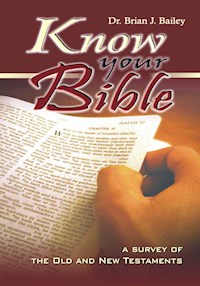
As believers, it is vital that we are well-grounded in the truth of God’s Word in order to stand strong in the coming days. Having a comprehensive overview of the Bible is a must, and it will become a reality through reading this anointed book.This survey of the 66 books of the Bible includes a brief commentary on the Intertestamental period of biblical history. Dr. Bailey has zeroed in on key concepts in each of the studies, and has interspersed many wonderful insights from his vast experience. Through this well-written survey, you will easily grasp the salient truths that flow through the pages of God’s Book and gain a greater desire to study His Word.
Das E-Book können Sie in Legimi-Apps oder einer beliebigen App lesen, die das folgende Format unterstützen:
Veröffentlichungsjahr: 2014
Ähnliche

Know Your Bible
A Survey of the Old and New Testaments
DR. BRIAN J. BAILEY
“Know Your Bible”
© 2006 by Brian J. Bailey
Version 1.2 (2022)
Design of Front Cover:
© 2006 Zion Fellowship Inc.
All Rights Reserved
No part of this book may be reproduced in any form or by any electronic or mechanical means without written permission from the publisher, except in the case of brief quotations in articles or reviews.
All Scripture quotations in this book are taken from the
King James Version Bible unless otherwise stated.
Published by Zion Christian Publishers
Published as an e-book in 2022
in the United States of America
E-book ISBN 1-59665-025-7
For more information, please contact:
Zion Christian Publishers
A Zion Fellowship ® Ministry
P.O. Box 70
Waverly, New York 14892
Phone: (607) 565 2801
Toll free: 1-877-768-7466
Fax: 607-565-3329
http://www.zcpublishers.com/
ACKNOWLEDGEMENTS
Editorial team: Joyce Aw, Carla Borges, Sarah Brogan, Mary Humphreys, David Kropf, Justin Kropf, Sarah Kropf, Leslie Sigsby, Caroline Tham, Paul Tham, and Suzanne Ying.
We wish to extend our thanks to these dear ones for without their many hours of invaluable assistance, this book would not have been possible. We are truly grateful for their diligence, creativity, and excellence in the compilation of this book for the glory of God.
PREFACE
The central theme of the Bible is God’s wondrous compassion for the human race, which was created in His image and likeness but has fallen so far short of His nature and goodness. Through the disobedience of the first man Adam, sin (meaning all that is evil) entered into the world and shattered the communion between Adam and His Maker.
God Himself had to pay the price to redeem us back into fellowship with Himself. Thus, it was He who had to give His only begotten Son, Jesus Christ, as a sacrifice for our sins. He therefore had to become man. God the Father prepared a body for His Son in the womb of Mary of Nazareth. Jesus was conceived by the third member of the Holy Trinity, the blessed Holy Spirit.
The Son of God called Jesus, meaning “Saviour”, lived a life without blemish. He then offered Himself without spot to His Father by the power of the Holy Spirit. Accepted and approved by God, Jesus Christ was the Lamb of God, who became the sacrifice for all who believe, upon the cross of Calvary outside the walls of Jerusalem. He was buried in a garden tomb, and He was raised on the third day as a sign for our justification.
The Lord Jesus lives forevermore seated at the right hand of God until He comes again with 10,000 of His saints to receive all who believe on His Name, and to punish all who reject Him with eternal fire.
This great salvation, which cleanses us through His shed blood on the cross of Calvary, is available to all. We must simply believe, confess we are sinners, ask Jesus to forgive us, ask Him to come into our hearts, and receive Him by faith. Then we will be born again by the Spirit of God and become a son or daughter of the Living God.
Jesus said, “For God so loved the world, that He gave His only Begotten Son, that whosoever believeth on Him should not perish, but have everlasting life” (Jn. 3:16). We invite you, gentle reader, to do so now and receive Jesus as your Saviour.
Now we invite you to “Know Your Bible” by looking at a survey of the treasures of God’s Word, which is a guide for believers from earth to heaven. Do so prayerfully and your eyes will be open to the wondrous truths that are contained therein. Jesus said, “And ye shall know the truth, and the truth shall make you free” (Jn. 8:32).
Old Testament Survey
INTRODUCTION
The great need of biblical students of today is to have a comprehensive overview of the Bible that they may understand the salient truths that flow through the pages of God’s Book. In so doing, students can grasp more easily the central message of redemption and God’s plan for the ages, as well as His plan for each individual life. This survey has been written with that goal in mind.
The Bible contains 66 separate books that have been divided into two parts: the Old Testament (39 books) and the New Testament (27 books) respectively. First, we will consider how the Old Testament was written and compiled.
The Divisions
The Pentateuch
This is composed of the first five books, which the Jews call the “First Five Books of Moses”. The Western world knows them as Genesis, Exodus, Leviticus, Numbers, and Deuteronomy.
The Historical Books
These comprise the following books: Joshua, Judges, Ruth, First and Second Samuel, First and Second Kings, and First and Second Chronicles.
The Restoration Books
The Restoration Books of Ezra, Esther, and Nehemiah were written after the return of the Jews from Babylonian captivity. They flow with the books written by the Restoration prophets, namely—Haggai, Zechariah, and Malachi.
The Poetic Books
These are the books of Job, Psalms, Proverbs, Ecclesiastes, and the Song of Songs.
The Major Prophets
These prophetic books were so called because of the length of their content. They are the prophecies of Isaiah, Jeremiah (including his Lamentations), Ezekiel, and Daniel.
The Minor Prophets
The Minor Prophets comprise twelve books, which contain less material than those which are termed Major Prophets. They are the books of Hosea, Joel, Amos, Obadiah, Jonah, Micah, Nahum, Habakkuk, Zephaniah, Haggai, Zechariah, and Malachi.
The Pentateuch
Pentateuch is a Greek word meaning “five volumes” and is used to describe the first five books of the Bible. Sometimes this section is referred to as the Book of the Law. This name is given in Scripture, as we read in 2 Chronicles 31:3: “He appointed also the king’s portion of his substance for the burnt offerings, to wit, for the morning and evening burnt offerings, and the burnt offerings for the sabbaths, and for the new moons, and for the set feasts, as it is written in the law of the LORD.” Nehemiah 8:18 also says, “Also day by day, from the first day unto the last day, he read in the book of the law of God. And they kept the feast seven days; and on the eighth day was a solemn assembly, according unto the manner.”
Jews also refer to this collection of writings as the Torah, which means teaching, doctrine, or instruction. It is easily the most important part of the Old Testament since its teachings form the foundation upon which all other Scripture is based. The Ten Commandments (found in Exodus 20 and repeated in Deuteronomy 5) are referred to by Jesus; and He declares that He came to fulfil them (Mt. 5:17). We are to keep these commandments, and they are to be written in our minds and upon the fleshly tables of our heart (Jer. 31:33).
The Book of Genesis
Introduction
The first book in the Bible is so named because it starts with the Hebrew word Bereshith, which means “in the beginning.” Genesis is the Greek word which means “beginning or origin.” In this book we find the beginnings of all things, some of which are:
1. Beginning of heaven and earth (1:1)
2. Beginning of vegetation and animal life (1:12)
3. Creation of man and woman, also marriage (2:21-24)
4. Beginning of sin (3:1-24)
5. Beginning of redemption by the shedding of blood (3:21)
6. Beginning of murder (4:8)
7. Beginning of polygamy (4:19)
8. Beginning of music (4:21)
Outline
1. Seven days of Creation 1:1-2:3
a. First day – night and day 1:5
b. Second day – heaven 1:8
c. Third day – earth, seas, and vegetation 1:9-13
d. Fourth day – sun, moon, and stars 1:14-19
e. Fifth day – fish and fowl 1:20-23
f. Sixth day – all living creatures and man 1:24-31
g. Seventh day – God rested – Sabbath Day 2:1-3
2. Garden of Eden 2:4-25
3. The Fall 3:1-20
4. Redemption foreshadowed 3:21
5. Cain and Abel 4:1-24
6. The line of the godly from Seth to Noah 5:1-32
7. Crossing of the lines of the godly and ungodly 6:1-7
8. Choosing of Noah and the building of the Ark 6:8-22
9. The Flood 8:1–9:29
10. Genealogies of Noah 10:1-32
11. Tower of Babel 11:1-9
12. Generations from Noah to Abraham 11:10-32
13. Life of Abraham 12:1–18:33; 20:1–25:10
14. Life of Isaac 25:10–28:5; 35:27-29
15. Life of Jacob 25:26–37:34; 42:1-36; 45:25–50:24
16. Life of Joseph 30:24–50:26
Main Themes
The Creation
The event of Creation—hotly contested by those who call themselves evolutionists—is proven by the fact that in the world, and with animal life in particular, everything brings forth of its own kind because God has ordained it (Gen. 1:11, 21, 24-25). This destroys the very foundation of the theory of evolution, which assumes that there is a transmutation or an evolving of the species over time, of which there is no evidence.
Man’s efforts to go beyond what God the Creator has ordained, has resulted in failure. For example, God worked for six days, and then He rested on the seventh and called that day holy (Gen. 2:3). Thus mankind and animals alike are ordained to work for six days and rest on the seventh, which day is termed the Lord’s Day.
The atheists of the French Revolution, seeking to change the decrees of God, tried to cause man and animal to work a ten-day cycle, but found that they had to revert to the seven-day cycle because all were overcome with fatigue. Another example of this is when scientists of the Soviet Union refused to acknowledge creation and sought to perpetuate evolution. The result was that scientific research in their country fell 50 years behind western nations.
Do the evolutionists believe their theories? Hardly so! Charles Darwin, upon his deathbed, asked that the windows of his room be opened so that he might listen to the hymns being sung by a church congregation nearby. When asked, “Mr. Darwin, what about your theories and beliefs in evolution?” Darwin replied that they were a figment of youthful imaginations (Bowden, Malcolm 259-276, section 6.6).
The agnostic, Aldous Huxley, (whose grandfather was another proponent of evolution), frankly confessed: “I had motives for not wanting the world to have a meaning; consequently assumed that it had none, and was able without any difficulty to find satisfying reasons for this assumption. The philosopher who finds no meaning in the world is not concerned exclusively with a problem in pure metaphysics; he is also concerned to prove that there is no valid reason why he personally should not do as he wants to do, or why his friends should not seize political power and govern in the way that they find most advantageous to themselves...For myself, the philosophy of meaninglessness was essentially an instrument of liberation, sexual and political” (Huxley, Aldous 270).
In other words, in response to the question of whether he believed that there was a God, he said in effect, “I do; but I held to a vain hope that there was none to assuage my evil conscience and so continue in my sinful ways.”
Creation means there is a Creator to whom we must give an account of our life lived here upon earth. His decree that we propagate after our kind also extends to the spiritual—what and who we are will determine the fruit that we produce wherever we go. Let us live godly lives befitting sons and daughters of a holy God, promoting holiness and the fear of the Lord in the lives of others.
Writing to the Romans, the Apostle Paul declared, “For the invisible things of him from the creation of the world are clearly seen, being understood by the things that are made, even his eternal power and Godhead; so that they are without excuse” (Rom. 1:20).
Let us appreciate the splendours and wonders of His creation by walking through the grassy glades and contemplating the awesome beauty of mountain scenery and the skies above. Then shall we exclaim as David did in Psalm 8, “O LORD our Lord, how excellent is thy name in all the earth! who hast set thy glory above the heavens. Out of the mouth of babes and sucklings hast thou ordained strength because of thine enemies, that thou mightest still the enemy and the avenger. When I consider thy heavens, the work of thy fingers, the moon and the stars, which thou hast ordained; What is man, that thou art mindful of him? and the son of man, that thou visitest him? For thou hast made him a little lower than the angels, and hast crowned him with glory and honour. Thou madest him to have dominion over the works of thy hands; thou hast put all things under his feet: All sheep and oxen, yea, and the beasts of the field; The fowl of the air, and the fish of the sea, and whatsoever passeth through the paths of the seas. O LORD our Lord, how excellent is thy name in all the earth!”
The Patriarchs
Adam
Genesis 1:26-27 states, “And God said, Let us make man in our image, after our likeness…So God created man in his own image, in the image of God created he him; male and female created he them.” The first man was made in the image of God, meaning that he possessed the same kind of body and features as God. “After our likeness” also signifies similarity in the area of emotions—with capabilities of love, hatred, and all the other attributes that form our character.
Adam was created in the state of innocence, not knowing good and evil. However, God is holy. Briefly stated, holiness signifies innocence which has been tried and tested. For this reason, Adam was placed in the beautiful Garden of Eden in which were the trees of Life and Knowledge. God had given the commandment that they were not to eat of the tree of Knowledge of Good and Evil or they would die.
Satan, in the form of the serpent, was permitted to tempt them. This he did, attempting to discredit the character of God by saying, “Hath God said?” (Gen. 3:1). Eve, the wife of Adam, was beguiled by his words concerning the fruit and gave some fruit to her husband. Thus they sinned and fell from the state of innocence. Driven from the garden, lest they take of the fruit of the Tree of Life and live forever in their sinful state, they were clothed upon with skins of animals.
This slaying of animals to clothe them depicted the sacrifice of the Lamb of God—the Lord Jesus Christ who would die for our sins. Christ is called the Lamb of God slain from the foundation of the world, since God knew from the beginning that man would sin and need a Saviour. We read in John 3:16, “For God so loved the world, that he gave his only begotten Son, that whosoever believeth in him should not perish, but have everlasting life.”
Cain and Abel, the first two sons of Adam and Eve, offered sacrifices unto God. God refused Cain’s offering because his life was evil, while the sacrifice of the righteous Abel was accepted. Cain then slew Abel because of this (Gen. 4:1-16). From Cain came the line of the evildoers, while another son Seth (who was given to replace Abel) produced the line of the godly. It was because the two lines intermarried that there came forth violent ones, until the whole earth was filled with corruption. God determined to destroy all flesh, but Noah found favour in God’s sight (Gen. 6:1-8).
Noah
Noah was one of the three most righteous men of the Old Testament, along with Daniel and Job (Ezek. 14:14). God commanded Noah to build an ark to save his family (eight souls in all) when all other flesh was destroyed through the Flood.
The ark, which speaks of safety from times of trouble, has spiritual truths revealed through its measurements. It has one door, speaking of Christ being the one and only Door to heaven, and one window speaking of the necessity for the Christian to have a singleness of eye upon heavenly and eternal things rather than the things of this world. The length was 300 cubits—the number 300 speaking of walking with God (Gen. 5:22). The ark also had three levels, portraying the three stages in the Christian life: little children, young men, and fathers (1 Jn. 2:12-14).
Abraham
There were ten generations from Adam to Noah and now another ten generations from Noah to Abraham, the father of the chosen nation (later to be called Israel).
After many trials, including the offering of Isaac, his firstborn through Sarah (Gen. 22:1-19), God designated Abraham, “The father of many nations.” In fact, through his son Ishmael, Abraham became the father of many Arab nations as well. He also had six sons by Keturah (Gen. 25:1). The Lord made a covenant promise to Abraham to give him the land from the river of Egypt to the great river Euphrates, and from the river Jordan to the Mediterranean. God promised that this would be accomplished through Isaac.
Abraham staggered not at the promise of God through unbelief, but was strong in faith. Being fully persuaded that what God had promised He was able also to perform, it was imputed to him for righteousness. This became the basis for our salvation, for the righteousness of God will be imputed to us if we believe that Jesus died for our sins (Rom. 4:20- 25).
Isaac
This miracle son of Abraham and Sarah, born in their old age, inherited the promises. Isaac then had twin sons—Esau and Jacob—by Rebekah. When Esau, the firstborn, was tired and hungry, he sold his birthright to Jacob for a pot of soup. Esau was a fornicator and a blasphemer; he despised his birthright and was denied repentance by the Lord (Heb. 12:16 17). Forever after, he and his descendants (Edom) became the enemies of Jacob (whose name was later changed to Israel). Together with Moab and Ammon (descendants of Lot), Esau’s descendants form the population that occupies what is known today as the kingdom of Jordan.
Jacob
Jacob, whose name was changed to Israel (meaning “a prince with God”), became the father of the twelve tribes of Israel. These tribes would later inherit the land of Canaan as God had promised Abraham.
Joseph
He was the chosen heir of Israel when he was a lad of 17 years of age. To signify this, his father gave him a coat of many colours. His brothers were jealous of him, especially when this choice had been confirmed by God through two dreams—revealing to him that he would rule over his brethren. Although Joseph’s brothers sold him into Egyptian slavery, God was with him. He became the overseer of the household of Potiphar, captain of Pharaoh’s guard.
However, one who is going to be entrusted with leadership must be tested in many ways. Therefore, Joseph was falsely accused of impropriety by Potiphar’s wife. Thrown into prison, there he languished in irons. Yet God was with him, and all the prisoners were entrusted to his care by the jailor of the prison. Because of his correct interpretations of the dreams of Pharaoh’s butler and baker, he was subsequently brought forth from prison to interpret dreams that God had given Pharaoh concerning a future famine (Gen. 39:1–41:14).
Pharaoh (recognising Joseph’s wisdom) appointed him the second ruler of the land in order to prepare for the coming famine. Joseph built storehouses during the time of plenty, so that he would be able to feed the Egyptians in the time of famine, as well as those from neighbouring countries who were also suffering from famine. Jacob, hearing that there was grain in Egypt, sent his sons into Egypt to buy corn. They had to petition the ruler to buy from his storehouses and came face to face with their brother Joseph, whom they did not recognise. After revealing his identity, Joseph treated them with compassion and kindness (Gen. 41–45).
Then Joseph revealed his spiritual secrets through the names of his sons. Manasseh, the firstborn’s name means “God hath caused me to forget all the sorrow of my father’s house.” What a precious truth; to have victory over all the injustices of life by holy forgetfulness! It makes it possible to forgive, because we do not harbour thoughts of the wrongs that have been committed against us.
From this place of victory, we enjoy the blessings of the second son, Ephraim, which means “double-fruitfulness.” Joseph did indeed inherit the birthright. He had a double blessing in the Land of Promise, having two portions by his sons. Both Ephraim and Manasseh became tribes of Israel.
Joseph provided for his brethren and his father, Jacob, who had come down to Egypt to dwell in the best of the land. There they multiplied greatly from the 70 souls that had come down, and became a great nation of some 3 million souls. When Joseph was dying, he extracted a promise from the children of Israel that when God brought them into the Land of Canaan again, they would take his bones and bury them in the place of his inheritance.
May we learn much from the life of this godly man, who although separated from his brethren in the purposes of God, was called “a fruitful bough” (Gen. 49:22). This may be our very path to fruitfulness too.
Conclusion
The book of Genesis is a book of beginnings. In it we see not only the beginnings of mankind, but also the beginnings of doctrines that influence our lives both here and in eternity. One is the great doctrine of redemption through the shedding of the Blood. Secondly, is the truth of salvation by faith in God’s Word. We further learn that the righteousness of God is counted to those who believe what He says, and by their works they reveal their faith (Jas. 2:21-22).
Another doctrine that is revealed is the necessity of trials to form the character of a man of God, and the essentiality of sexual purity to attain high office. Genesis covers all these, as well as others affecting eternal judgment. For example, Cain, who is spoken of as being “of the wicked one,” is used as a warning even to our generation (1 Jn. 3:12).
(We commend our expanded book on Genesis, ably edited by Dr. Paul Caram, for your consideration and further study of these truths.)
The Book of Exodus
Introduction
The theme of the book is revealed in its name, Exodus. It is an account of the children of Israel’s sojourn in Egypt from the time of Joseph until their deliverance through Moses and their arrival at Mount Sinai. It was the beginning of the journey from Egypt to Mount Zion. This journey was conceived in the heart of God before the foundation of the world.
The Apostle Paul tells us in 1 Corinthians 10:11 that they undertook this journey for our edification, upon whom the ends of the earth have come. Well did Saint Augustine say, “The New Testament is latent in the Old; the Old Testament becomes patent in the New.” In other words, the New Testament is in the Old Testament concealed, and the Old Testament is in the New Testament revealed.
Outline
1. Iron Furnace of Egypt 1:1-22
a. Pharaoh who knew not Joseph 1:8
b. Taskmasters 1:11
c. Genocide 1:16-22
2. Preservation of Moses 1:1-25
a. Becoming the son of Pharaoh’s daughter 2:10
b. Being trained in the court of Pharaoh Acts 7:22
c. Killing an Egyptian defending an Israelite 2:12
d. Fleeing to the wilderness 2:15
e. Marrying the daughter of a priest of Midian 2:21
3. Encounter of God with Moses at the Burning Bush 3:1–4:31
a. Name of God – I AM THAT I AM 3:14
b. Three signs 4:3-9
c. Being sent to Pharaoh of the hardened heart 4:21
4. Pharaoh who knew not the Lord 5:1-23
a. Increase of the burden of the children of Israel 5:1-19
b. Children of Israel complain to Moses 5:20-21
c. Moses turns to God 5:22-23
5. Moses sent back to Pharaoh 6:1–12:51
a. God reassures Moses 6:1–7:7
b. The signs 7:8-13
c. Ten plagues 7:14–11:10
6. Institution of the Passover 12:1-51
7. Institution of the Feast of Unleavened Bread 13:3-10
8. Wilderness Journey from Egypt to Mount Sinai 13:17–19:2
a. Crossing of the Red Sea 14:1-31
b. Song of Moses 15:1-21
c. “I AM the Lord that healeth thee” 15:23-26
d. Manna 16:12-36
e. Provision of water at Horeb from the rock 17:1-7
f. Defeat of Amalek 17:8-16
g. The delegation of responsibility 18:1-27
9. Mount Sinai 19:1–40:34
a. Giving the Ten Commandments and the Laws 20:1–24:18
b. Tabernacle of Moses 25:1–40:34
Main Themes
In this journey of the children of Israel, there are many important truths for us to learn as Christians, which we will now examine. The first of these truths is that God orchestrates everything. All history is controlled by God, and He rules in the affairs of man. This same truth was revealed at a much later date to Nebuchadnezzar, king of Babylon, as we read in Daniel 4:32: “And they shall drive thee from men, and thy dwelling shall be with the beasts of the field: they shall make thee to eat grass as oxen, and seven times shall pass over thee, until thou know that the most High ruleth in the kingdom of men, and giveth it to whomsoever he will.”
The fact that God was orchestrating all these events is proven by the following scriptural excerpt: “Moreover he called for a famine upon the land: he brake the whole staff of bread. He sent a man before them, even Joseph, who was sold for a servant: Whose feet they hurt with fetters: he was laid in iron: Until the time that his word came: the word of the LORD tried him. The king sent and loosed him; even the ruler of the people, and let him go free. He made him lord of his house, and ruler of all his substance” (Ps. 105:16 21).
Psalm 105 speaks of Jacob’s going down into the land of Egypt, and God’s causing the people to multiply greatly. Then the Lord turned the hearts of the Egyptians to hate His people. Concerning Pharaoh, the Lord stated in Exodus 9:16, “And in very deed for this cause have I raised thee up, for to show in thee my power; and that my name may be declared throughout all the earth.”
The children of Israel, in their anguish, cried unto the Lord, who sent His chosen deliverer, Moses, to release them from the iron furnace of Egyptian bondage. This gave the Lord the opportunity to perform great signs and wonders called the ten plagues that came as judgments upon the Egyptians, for these plagues were directed against the gods that the Egyptians worshipped.
The children of Israel were led out in triumph by Moses back to the land of their inheritance that was promised to Abraham, Isaac, and Jacob. The inhabitants of the lands through which the children of Israel passed on their way to Zion feared them because of the devastation of the plagues.
Before the last plague, the slaying of the firstborn in the land, God instituted the first of the Seven Feasts of the Lord, all of which have great significance for the Church and the individual Christian. We will look at them in detail later in our study on the book of Leviticus. For now, we will consider just the first three.
The Feast of Passover
The children of Israel were instructed to take one lamb for each house and sprinkle the blood upon the doorposts of their houses. They were to eat the lamb while girded as men on a journey. When the angel passed through the land to slay the firstborn, he would pass over the house if he saw the blood (Ex. 12:1-14). Thus the first feast was called the Feast of the Passover. The Apostle Paul tells us in 1 Corinthians 5:7 that Christ is our Passover Lamb sacrificed for us. Therefore, as the Israelites of old were saved by the blood of their lamb, so are we saved through the blood of Christ that He shed upon the cross for us.
The Feast of Unleavened Bread
In this feast, all leaven—which is a type of sin, hypocrisy, and false doctrine—had to be swept out of their abodes (Ex. 12:15-20). This, the Apostle Paul explains, is sin that has to be purged from our lives (1 Cor. 5:6-8).
After the celebration of this first Passover, the children of Israel moved out of the land of Egypt in rank. The Egyptians, now anxious for them to leave, bestowed great gifts upon them, even as God had declared to Abraham that they would do centuries beforehand (Gen. 15:14).
The Red Sea - the Feast of First Fruits
Through a miracle that God performed at the Red Sea, the children of Israel crossed over on dry land. Moreover, the Egyptians who were pursuing them were destroyed as the waters returned (Ex. 14).
Spiritually the significance of this episode for the Christian is the ordinance of water baptism—being buried with Christ and walking in newness of life with Him.
Passing over the Red Sea and out of Egypt, they sang the Song of Moses, the song of victory. This song will be sung by the redeemed even in heaven above (Rev. 15:3). This crossing of the Red Sea and foreshadowing of baptism is analogous to the resurrection of Christ who is termed the First Fruits (1 Cor. 15:20). Therefore, this is analogous to the Feast of the First Fruits.
Their journey continued along the eastern shorelines of the Red Sea past the bitter waters of Marah, which were turned sweet when the Lord told Moses to throw in a tree. This typifies the Christian going to the cross and receiving grace to triumph in such times of duress. In healing the waters of Marah, the Lord promises to be the Lord who heals us. Thus, healing was also experienced by those living in the Old Testament times (Ex. 15:23-25).
They then received water from the rock when Moses struck it at the command of the Lord. The rock speaks of Christ, who gave forth the water of life to His people when smitten on the cross.
Mount Sinai
Israel came to Mount Sinai in the third month, which is the time of Pentecost, the fourth feast. Here on Mount Sinai, they became acquainted with the powers of the world to come. “And mount Sinai was altogether on a smoke, because the LORD descended upon it in fire: and the smoke thereof ascended as the smoke of a furnace, and the whole mount quaked greatly. And when the voice of the trumpet sounded long, and waxed louder and louder, Moses spake, and God answered him by a voice. And the LORD came down upon mount Sinai, on the top of the mount: and the LORD called Moses up to the top of the mount; and Moses went up” (Ex. 19:18-20). This manifestation of God was given that they might learn to fear God all the days of their lives and keep His commandments.
Moreover, the elders of Israel had a unique manifestation of God upon the mountain: “Then went up Moses, and Aaron, Nadab, and Abihu, and seventy of the elders of Israel: And they saw the God of Israel: and there was under his feet as it were a paved work of a sapphire stone, and as it were the body of heaven in his clearness. And upon the nobles of the children of Israel he laid not his hand: also they saw God, and did eat and drink” (Ex. 24:9-11).
There, Moses received the Ten Commandments, written by the finger of God upon two tablets of stone. “And he gave unto Moses, when he had made an end of communing with him upon mount Sinai, two tables of testimony, tables of stone, written with the finger of God” (Ex. 31:18).
The Tabernacle of Moses
The great desire of the thrice-holy God to have fellowship with His people was expressed thusly to Moses upon the Mount: “And let them make me a sanctuary; that I may dwell among them” (Ex. 25:8). This sanctuary, known as the Tabernacle of Moses, consisted of three parts:
1. The Outer Court, to which there was but one door. This door symbolises Christ as we read in John 10:7,9,11: “Then said Jesus unto them again, Verily, verily, I say unto you, I am the door of the sheep...I am the door: by me if any man enter in, he shall be saved, and shall go in and out, and find pasture...I am the good shepherd: the good shepherd giveth his life for the sheep.”
The fence of the Outer Court was made of fine linen, speaking of the righteousness of Christ that is imputed to the believer when he accepts Christ as his Saviour. The Outer Court is the place of the elementary principles of biblical studies and experiences as given in Hebrews 6:1-3: “Therefore leaving the principles of the doctrine of Christ, let us go on unto perfection; not laying again the foundation of repentance from dead works, and of faith toward God, Of the doctrine of baptisms, and of laying on of hands, and of resurrection of the dead, and of eternal judgment. And this will we do, if God permit.”
2. The Holy Place contained the candlestick, typifying the Seven Spirits of the Lord, enumerated for us in Isaiah 11:2: “And the spirit of the LORD shall rest upon him, the spirit of wisdom and understanding, the spirit of counsel and might, the spirit of knowledge and of the fear of the LORD.” Thus, they are:
1. The Spirit of the Lord
2. The Spirit of Wisdom
3. The Spirit of Understanding
4. The Spirit of Counsel
5. The Spirit of Might
6. The Spirit of Knowledge
7. The Spirit of the Fear of the Lord
There were other pieces of furniture found in the Holy Place. These included:
• The Table of Shewbread, speaking of Christ, the Bread of Life. Spiritually, We also are to become broken bread to feed the nations.
• The Altar of Incense portrays the prayer life of our blessed Lord as well as our own.
• The Veil that separated the Holy Place from the Holy of Holies typifies the flesh of Christ (Heb. 10:20), and therefore the experience of the crucified life.
3. The Holy of Holies contained the Ark of the Covenant, in which were placed the two tablets of stone upon which God had written the Ten Commandments. These Ten Commandments are to be written upon the mind and heart of the New Testament believer.
The Levites were chosen to be the ministers of the Old Testament Covenant, and in Exodus 39:1-21, we have the account of the holy garments of the high priest.
Thus, at Mount Sinai, an onward vision of the spiritual life of the believer was given. In addition, we see the qualifications that would enable him to move from the status of little children in the Outer Court to young men in the Holy Place to fathers in Christ in the Holy of Holies. May we so attain!
The Book of Leviticus
Introduction
This book is often called the handbook of the priests. The main themes are the conduct of the priest, his duties, and the offerings that he was to make on certain occasions on behalf of the people unto God. The requirements to satisfy offerings that had to be made for the feasts are also given. (For further study, please see our commentary on this book entitled Feasts and Offerings.) All these have spiritual meanings for those who are called to be New Testament priests, as we are termed in 1 Peter 2:9: “But ye are a chosen generation, a royal priesthood, an holy nation, a peculiar people; that ye should show forth the praises of him who hath called you out of darkness into his marvellous light.”
This book of Leviticus was also given upon Mount Sinai, as we see in Leviticus 27:34: “These are the commandments, which the LORD commanded Moses for the children of Israel in mount Sinai.”
Outline
1. The Offerings 1:1–7:38
a. Burnt offering 1:1-17
b. Meal offering 2:1-16
c. Peace offering 3:1-17
d. Sin offering 4:1-35
e. Trespass offering 5:1–7:38
2. Installation of Aaron as High Priest 8:1–9:24
3. Difference between the clean and the unclean 1:1–15:33
4. Day of Atonement 16:1-34
5. Importance of sacrifices 17:1-16
6. Unlawful marriages and lusts 18:1-30
7. Summation of the Laws: love thy neighbour 19:1-37
8. Warning against idolatry and homosexuality 20:1-27
9. Laws governing the priesthood 21:1–22:33
10. The feasts of the Lord 23:1-44
11. Keeping the lamps burning 24:1-23
12. Reverence of sabbaths and blessings of obedience 25:1–26:13
13. Curses of disobedience 26:14-46
14. Concerning vows 27:1-34
Main Themes
The Offerings
There were five main sacrifices that the believer could offer:
1. The burnt sacrifice consisted either of a bullock, sheep, or birds, depending upon the wealth of the Israelite. This sacrifice was a voluntary offering that a believer offered to express his love for God. It typified the first commandment. “Jesus said unto him, Thou shalt love the Lord thy God with all thy heart, and with all thy soul, and with all thy mind. This is the first and great commandment” (Mt. 22:37-38).
2. The meal offering composed of fine flour and oil typifies the next great commandment. “And the second is like unto it, Thou shalt love thy neighbour as thyself. On these two commandments hang all the law and the prophets” (Mt. 22:39-40).
3. The peace offering speaks of Christ our peace and the experience of those words: “Peace I leave with you, my peace I give unto you: not as the world giveth, give I unto you” (Jn. 14:27). This peace of God that passes all understanding can be your portion, too (see Phil. 4:7).
4. The sin offering is representative of the Lord’s dealing with the nature of sin in our lives. We can reckon ourselves dead to sin and alive to God (Rom. 6:6-13).
5. The trespass offering speaks of the fact that if we trespass against God’s commandments, or we feel that we have displeased Him in any way, we can ask Him for forgiveness, and the blood of Jesus will cleanse us from all iniquity.
The installation of the high priest is important for us as New Testament priests, since the garments that he wore have spiritual significance. May we emphasise that the priest had to be washed (cleansed from sin), clothed with fine linen (the righteousness of the Lord), and anointed. Also, written upon his crown which sat on his head were the words, “Holiness unto the Lord,” for the priest must ever remember that he serves a holy God and, therefore, he too must be holy. We have dealt with these fully in our book on Feasts and Offerings.
Difference Between the Clean and the Unclean
One of the essential truths to learn is this: the insistence of Holy Scriptures that a clean animal chews the cud and has a divided hoof. These were two main qualifications to differentiate between the clean and the unclean animal. The interpretation is that we should meditate upon the Scripture verses that we have read, and walk in a circumspect manner, hating the evil and choosing the good.
Day of Atonement
This was the holiest day of the year for an Israelite. It was the day when the high priest would take two goats and choose one by lot. The high priest would lay his hands upon the chosen one and confess the sins of the people. That goat would then be led away into the wilderness and there released. The other would be slain, and by its blood the high priest would enter within the veil into the holy of holies.
The Day of Atonement signifies being crucified with Christ (Gal. 2:20). Hebrews 9:6-8 says, “Now when these things were thus ordained, the priests went always into the first tabernacle, accomplishing the service of God. But into the second went the high priest alone once every year, not without blood, which he offered for himself, and for the errors of the people: The Holy Ghost this signifying, that the way into the holiest of all was not yet made manifest, while as the first tabernacle was yet standing.”
Importance of Sacrifices
The Lord did not want the Israelite of old offering his sacrifices to other gods. For us, it is noteworthy that people make gifts large and small to various charities that do not promote the work of God (which, of course, would include giving to the poor). They might be praiseworthy in the sight of man but not acceptable in the eyes of God. It is therefore very important when giving, to do so under the direction of the Holy Spirit.
Unlawful Marriages and Lusts
If there is one social act in life that can determine our happiness and sometimes our prosperity and eternity, it is our marriage. Scripturally, it is God who chooses our mate in life. God brought Eve to Adam. He clearly chose the bride for Isaac, and He will choose our life partner for us. The key to successful marriages is to walk on the path that the Lord has chosen for us, and He will bring the partner of His choice.
Unlawful marriages are those between blood relatives. Also, believers are not to marry unbelievers, for they would pervert the ways of God’s children, even as Solomon’s heathen wives did to him. The good man Nehemiah remonstrated with the people of his day saying, “Did not Solomon king of Israel sin by these things? yet among many nations was there no king like him, who was beloved of his God, and God made him king over all Israel: nevertheless even him did outlandish women cause to sin” (Neh. 13:26). Let us beware of the age-old argument that says, “When I marry him or her, he or she will become converted.” It is so often the other way round!
Sundry Laws
All these are summed up by the following verse, “Thou shalt not avenge, nor bear any grudge against the children of thy people, but thou shalt love thy neighbour as thyself: I am the LORD” (Lev. 19:18). This is confirmed by our Lord, who said that upon the two commandments of loving the Lord and our neighbour, all the Law and the Prophets depend (Mt. 22:37-40). The Apostle Paul repeats this in Romans 13:10: “Love worketh no ill to his neighbour: therefore love is the fulfilling of the law.”
Warning against Idolatry and Homosexuality
We are to be holy even as God is holy. Throughout not only the Law but also the Prophets, there are clear-cut admonitions not to participate in idolatrous worship. The psalmist gives the reason in Psalm 135:15,18: “The idols of the heathen are silver and gold, the work of men’s hands...They that make them are like unto them: so is every one that trusteth in them.” We become like those whom we worship.
The Apostle Paul said in 1 Corinthians 10:20-21, “But I say, that the things which the Gentiles sacrifice, they sacrifice to devils, and not to God: and I would not that ye should have fellowship with devils. Ye cannot drink the cup of the Lord, and the cup of devils: ye cannot be partakers of the Lord’s table, and of the table of devils.”
Assuredly, the greatest reason for not practicing idolatry is that we dishonour the great Creator Himself, by attributing powers that belong to Him alone to these devilish idols.
Then let us consider homosexuality. It is so base and perverse that no animal practices it. It is contrary to nature. Moreover, the Word of God declares that it is one of the judgments upon mankind. Paul writes in Romans 1:21 27: “Because that, when they knew God, they glorified him not as God, neither were thankful; but became vain in their imaginations, and their foolish heart was darkened. Professing themselves to be wise, they became fools, And changed the glory of the uncorruptible God into an image made like to corruptible man, and to birds, and fourfooted beasts, and creeping things. Wherefore God also gave them up to uncleanness through the lusts of their own hearts, to dishonour their own bodies between themselves: Who changed the truth of God into a lie, and worshipped and served the creature more than the Creator, who is blessed for ever. Amen. For this cause God gave them up unto vile affections: for even their women did change the natural use into that which is against nature: And likewise also the men, leaving the natural use of the woman, burned in their lust one toward another; men with men working that which is unseemly, and receiving in themselves that recompense of their error which was meet.”
Homosexuality is judged with great severity, as we are reminded in Jude 1:7: “Even as Sodom and Gomorrha, and the cities about them in like manner, giving themselves over to fornication, and going after strange flesh, are set forth for an example, suffering the vengeance of eternal fire.” Finally, in Revelation 22:14-15, the Apostle John says, “Blessed are they that do his commandments, that they may have right to the tree of life, and may enter in through the gates into the city. For without are dogs, and sorcerers, and whoremongers, and murderers, and idolaters, and whosoever loveth and maketh a lie.”
God is a holy God and, as the Apostle Peter reminds us, “But as he which hath called you is holy, so be ye holy in all manner of conversation; Because it is written, Be ye holy; for I am holy” (1 Pet. 1:15-16).
So let us contemplate the significance of the following: “He that is unjust, let him be unjust still: and he which is filthy, let him be filthy still: and he that is righteous, let him be righteous still: and he that is holy, let him be holy still” (Rev. 22:11). There comes a time when those who have chosen the way of the unjust and filthy will remain in that path. There will be no return to the paths of the just.
Laws Governing the Priesthood
While many of these laws would seem, at first reading, not to be applicable to us, nonetheless, when we consider their spiritual interpretation, we see that they do indeed apply. There are the admonitions concerning the marriages of the priests, which would certainly apply to us in that we cannot marry someone who is profane.
Then there are twelve blemishes that prevent one from being a priest (Lev. 21:18-24). Whilst these referred to the physical for the Old Testament priests, for us today it is their spiritual significance that is important. To us, therefore, the religious leaders—the scribes and Pharisees—who did not understand spiritual truths, were like blind men leading others astray until they all would fall into the ditch of hell. Paul warns of those who are spiritually lame in Hebrews 12:13, describing them as the ones who are turned out of the way of righteousness. These are more fully described in our book entitled Feasts and Offerings.
The Feasts of the Lord
These are seven in number and have spiritual realisations both for the Church and the individual Christian. They are:
1. The Passover, which is the message of salvation.
2. The Feast of Unleavened Bread, speaking of the necessity of daily and continually throughout our lives feeding upon the Word of God.




