



1,99 €
Mehr erfahren.
- Herausgeber: Quickie Classics
- Kategorie: Gesellschafts- und Liebesromane
- Sprache: Englisch
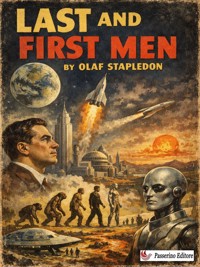
Last and First Men is a panoramic 'future history' charting eighteen successive human species across two billion years. Told as a telepathic testament from our descendants to the present, its essayistic, starkly impersonal prose fuses speculative anthropology with metaphysical reflection. Stapledon anatomizes cycles of civilizational ascent and collapse, genetic and social engineering, collective minds, planetary migration—including humanity's tragic relocation to Venus—and ultimately the Last Men's stoic cosmic perspective. Composed in the interwar years, it converses with Wellsian scientific romance while interrogating contemporary obsessions with nationalism, technocracy, and eugenics. An Oxford-educated philosopher with a doctorate in ethics who lectured in psychology and social philosophy at Liverpool, Stapledon brought a disciplined speculative method to fiction. His service in a First World War ambulance unit and his pacifist commitments sharpened his skepticism toward martial heroics and imperial destiny, while his engagement with emerging sciences—cosmology, evolutionary theory, and social planning—encouraged him to imagine humanity at planetary and transhuman scales. Readers seeking intellectually audacious science fiction will find this a demanding yet exhilarating classic: a work to savor for its cerebral grandeur, prophetic reach, and moral seriousness. Approach it as philosophy dramatized—an atlas of possible futures and human responsibilities. Quickie Classics summarizes timeless works with precision, preserving the author's voice and keeping the prose clear, fast, and readable—distilled, never diluted. Enriched Edition extras: Introduction · Synopsis · Historical Context · Brief Analysis · 4 Reflection Q&As · Editorial Footnotes.
Das E-Book können Sie in Legimi-Apps oder einer beliebigen App lesen, die das folgende Format unterstützen:
Veröffentlichungsjahr: 2026
Ähnliche








Last and First Men (Summarized Edition)
Table of Contents
Introduction
Between the audacity of human aspiration and the indifference of cosmic time, Last and First Men stages a long meditation on what it means for a species to endure. Olaf Stapledon’s 1930 work is a landmark of speculative science fiction, presenting a sweeping future history that ranges far beyond the familiar horizons of the novel. Written in the interwar period by a British philosopher and writer, it situates humanity within geological and astronomical scales, tracing civilizational arcs rather than individual destinies. The canvas extends from near futures to remotest posterity, planetary and eventually interplanetary, while the inquiry remains centered on mind, society, and value.
Stapledon adopts the stance of an historian writing from the vantage of posterity, a cool, reflective voice that surveys epochs rather than scenes. The style is lucid yet densely conceptual, favoring synthesis over dialogue and panoramic description over intimate detail. Readers encounter an essayistic narrative that treats wars, renaissances, and inventions as movements in a grand composition, punctuated by moments of awe at the cosmos and sorrow at recurring human follies. The tone is austere but not bloodless, carrying a quiet compassion for the fragile experiment called humanity and a disciplined curiosity about how intelligence, culture, and ethics might transform under shifting conditions.
Without relying on conventional protagonists, the book begins from a recognizable near-future world and follows the fortunes of our descendants through cycles of achievement, calamity, recovery, and transformation. Each era is sketched through its characteristic institutions, technologies, and ideals, allowing patterns to emerge across vast stretches of time. The premise is simple yet daring: to chart the long trajectory of humankind as if composing the natural history of a species whose environment includes worlds, ideas, and hazards it creates for itself. The experience is at once visionary and methodical, inviting readers to dwell on causes and consequences rather than cliffhangers or individual fates.
Stapledon’s central themes are the ambivalence of progress and the moral education of a species. Technological power recurs as both promise and peril; political energies veer between cooperation and domination; faith in destiny collides with the stubborn facts of ecology and scarcity. The narrative weighs short-term survival against long-term flourishing, asking what kinds of institutions and imaginations can sustain freedom, knowledge, and care over millennia. It also interrogates collective identity, wondering how communities define themselves without hardening into dogma. These concerns remain uncannily contemporary amid debates about planetary limits, resurgent nationalisms, and tools—industrial, biological, computational—that magnify human intention and error alike.
Philosophically, the book experiments with a secular cosmology, seeking meaning not in destiny but in the evolving capacities of mind to know, create, and act responsibly. It treats intelligence as a variable to be cultivated rather than an entitlement, exploring how aesthetic sensibility, scientific method, and ethical imagination might develop together. The perspective is both intimate and estranging: intimate in its concern for sentience wherever it arises, estranging in its insistence that humanity is one episode in a larger cosmic drama. The result is neither cynicism nor utopianism, but a disciplined humility about power, a wager that significance grows through clarity and care.
As a pioneering future history, Last and First Men helped establish a mode of science fiction that measures stories against planetary time, and it still feels singular in scope and seriousness. Its questions—how to think and act beyond a single lifetime, how to balance experiment with restraint, how to preserve diversity while seeking common purpose—speak urgently to an age of climate risk, rapid technological change, and global interdependence. The book encourages long-term thinking without fatalism, pressing readers to imagine institutions and virtues resilient enough for uncertainty. Its speculative audacity remains a tool for contemporary reflection, not a museum piece.
Approached with patience for abstraction and an appetite for grand patterns, this narrative rewards by enlarging the scale on which everyday choices appear meaningful. Stapledon asks readers to listen as if being addressed from afar, to consider how present habits might echo through futures we will never see, and to carry that perspective back into the immediacy of today. Without relying on revelation or tidy endings, the book offers a disciplined wonder that tempers dread with responsibility. To read it now is to practice a civic and planetary imagination, one that regards the fate of intelligence as a shared, unfinished project.
Synopsis
Published in 1930, Olaf Stapledon’s Last and First Men presents a sweeping future history that extends from the author’s present into a remote cosmic horizon. Framed as a communication from humanity’s far descendants to contemporary readers, the book narrates the rise, decline, and transformation of our species across eighteen successive forms. Rather than focusing on individual protagonists, it surveys societies, ideas, and environments, treating technology, biology, and culture as interwoven forces. The result is a speculative chronicle that studies how intelligence adapts to changing worlds, asking what might persist in human purpose when conditions, bodies, and institutions alter across unimaginable epochs.
In its opening movement, the narrative considers the First Men, whose twentieth-century anxieties, national rivalries, and industrial power foster alternating waves of innovation and disaster. Stapledon sketches cycles of expansion, crisis, and tentative unification, in which scientific prowess outpaces wisdom and social coordination struggles to keep pace. Experiments in global governance arise amid economic upheaval and ideological struggle, while new technologies simultaneously connect and imperil civilization. The survey emphasizes how short-sighted motives, myths of destiny, and the inertia of institutions can overwhelm reform, foreshadowing a repeated pattern: brilliance and hubris producing both breakthroughs and breakdowns as humanity searches for sustainable forms of collective life.
Over vast intervals, collapse yields to renewal, and evolution reshapes humanity into new species with altered bodies and minds. The Second Men inherit remnants of their predecessors yet diverge in temperament and capacity, developing more patient, long-horizon cultures and probing scientific inquiry. Their achievements illuminate a recurring tension that structures the book: whether intelligence can harmonize personal desire, social solidarity, and ecological limits. Where earlier civilizations were brittle, later ones test slower, more resilient forms of organization. Yet even these prove vulnerable to chance, environment, and internal contradiction, underscoring the precariousness of progress when knowledge, power, and value drift out of alignment.
As the chronicle advances, humanity becomes a planetary, then interplanetary, presence, adapting to foreign skies and unfamiliar ecologies. Colonization and planetary engineering pose stark ethical questions about remaking living worlds, especially when unfamiliar organisms and environments expose limits of foresight. Survival pressures compel difficult choices about coexistence, displacement, and transformation. Stapledon treats these episodes not as adventure set pieces but as tests of moral imagination, asking whether species-level self-interest can be reconciled with a broader sense of life’s dignity. Each migration reframes human identity, revealing how environment and purpose coevolve and how scientific ambition can enlarge or narrow moral horizons.
In middle epochs, mastery of heredity and psychology enables deliberate redesign of persons and polities. Societies experiment with selective breeding, engineered intellect, and collective consciousness, hoping to transcend the limits that once toppled empires. The results are mixed: heightened capacities yield new arts, sciences, and spiritualities, yet also produce rigid hierarchies and instrumental cruelties. Stapledon examines temptations to subordinate the many to specialized elites or autonomous systems, and the countervailing movements that restore reciprocity and creativity. Across these experiments, the book traces a central conflict between control and freedom, showing how even well-meant optimization can blunt curiosity, compassion, and the zest for shared discovery.
Later species refine communication beyond speech, cultivating forms of empathy and mind-to-mind understanding that anchor larger, more reflective communities. With this deepened interiority comes an amplified responsibility to memory: to preserve the lessons of former epochs and transmit them without distortion. In the remote future, humankind endures far from its cradle, confronting astronomical timescales and material constraints that no ingenuity can fully escape. The narrating descendants compose their message as both report and meditation, weighing the fate of intelligence against the vastness of nature. Their perspective reframes triumph and failure alike as moments in a longer inquiry into meaning.
Last and First Men stands as a landmark of speculative thought, notable for its disciplined sweep, sociological texture, and philosophical reach. Written before many modern scientific advances, it anticipates debates about global governance, engineered evolution, ecological stewardship, and the ethics of terraforming and contact. Rather than forecasting certainties, Stapledon dramatizes questions: what intelligence owes to other life, how power should serve value, and what forms of culture can endure. The book’s lasting resonance lies in its invitation to think across millennia without forgetting human scale, offering a sobering yet aspirational vision that challenges readers to imagine responsibility beyond their moment.
Historical Context
Olaf Stapledon’s Last and First Men appeared in 1930 in London through Methuen, emerging from interwar Britain’s intellectual milieu. Stapledon (1886–1950), a British philosopher and writer educated at Balliol College, Oxford, and the University of Liverpool, lived near Liverpool and worked in adult education, including extramural teaching linked to the Workers’ Educational Association. He wrote the novel in the late 1920s, a period framed by the League of Nations, expanding universities, and vigorous public debate about science and society. The book’s sweeping "future history" reflects its author’s academic training and the era’s appetite for grand syntheses that joined history, philosophy, and speculative inquiry.
Stapledon’s formative experience in the First World War shaped his outlook. He served with the Friends’ Ambulance Unit, a volunteer Quaker-founded service attached to the British war effort, witnessing mechanized slaughter and large-scale civilian suffering. The war’s aftermath—the 1918 armistice, demobilization, and the influenza pandemic—left Europe exhausted and skeptical about nationalist triumphalism. Peace activism grew alongside remembrance culture, while the League of Nations sought collective security amid fragile treaties. In this climate, Stapledon’s narrative treats warfare and state power with caution, emphasizing humanity’s capacity for self-destruction and the ethical need for international cooperation beyond patriotic rhetoric.
The interwar years saw ideological volatility. Fascism seized power in Italy under Benito Mussolini in 1922, Bolshevik Russia consolidated a one-party state and launched Five-Year Plans from 1928, and Germany’s Weimar Republic suffered recurrent crises. Britain faced the 1926 General Strike and imperial strains amid Irish independence and anticolonial movements. Cultural debate was colored by Oswald Spengler’s The Decline of the West (1918–1922), which popularized cyclical visions of rise and decay. Against this backdrop, Last and First Men draws on historical patterning to imagine civilizational arcs, countering both complacent progress narratives and fatalistic doctrines with a morally charged, long-range perspective.
Scientific discovery reshaped horizons in the 1910s and 1920s. Albert Einstein’s general relativity (1915) reframed space-time, and in 1929 Edwin Hubble reported galactic redshifts implying an expanding universe, vastly enlarging cosmic time and scale. Darwinian evolution, geology, and archaeology furnished deep histories of life and culture, while anthropology compared diverse human societies. Technological feats—long-distance radio, civil aviation, and Charles Lindbergh’s 1927 transatlantic solo flight—suggested planetary connectivity. Rocketry moved from speculation to experiment through Hermann Oberth’s 1923 treatise and Robert Goddard’s 1926 liquid-fuel launch. Stapledon’s narrative exploits these widened scales to situate human destinies within astrophysical immensity and evolutionary contingency.
Debates on heredity and planned society were prominent in Britain and beyond. The Eugenics Education Society (founded 1907, later the Eugenics Society) promoted selective breeding ideas that reached policymakers and public forums. Biologists such as J. B. S. Haldane, in Daedalus; or, Science and the Future (1924), and Julian Huxley discussed reproductive technologies and evolutionary futures, while statisticians advanced population studies. Urban planners and social reformers proposed technocratic governance to manage modernity’s risks. Last and First Men engages these currents by examining collective self-direction and its perils, scrutinizing the temptation to treat humanity as material for improvement without adequate ethical safeguards.
Stapledon’s book entered a speculative tradition shaped by H. G. Wells, whose The Time Machine (1895) and The War of the Worlds (1898) modeled extrapolative futures and global perspectives, and by popular syntheses like Wells’s The Outline of History (1920). European works probed modernity’s systems: Karel Čapek’s R.U.R. (1920) coined "robot," and Yevgeny Zamyatin’s We circulated in translation during the 1920s. British periodicals and presses supported essayistic and philosophical fiction alongside adventure tales. Against pulp sensationalism, Last and First Men adopts a quasi-historical voice, using speculation to test ideas about species, culture, and destiny rather than to stage narrowly personal dramas.
The novel was completed as the 1929 financial crash cascaded into global depression, intensifying unemployment in British industrial regions, including Merseyside. Radio networks, newsreels, and mass-circulation newspapers accelerated public awareness of catastrophe and scientific novelty alike. Military theorists such as Giulio Douhet, in The Command of the Air (1921), argued that strategic bombing could decide future wars, feeding urban anxieties about vulnerability from the sky. Aviation, chemical industry, and electrification promised mastery yet exposed systemic fragility. Stapledon’s sweeping chronology reflects these tensions, warning that technical capacity without commensurate moral development magnifies risk and that collective foresight is indispensable to survival.
Therefore Last and First Men mirrors the interwar moment: a Britain reassessing empire, a Europe haunted by war, and a world newly aware of cosmic vastness. It translates contemporary institutions—the university, the press, the League of Nations—into questions about species-scale responsibility. While gesturing toward engineering, biology, and spaceflight, it resists utopian certainty, stressing ethical limits and the precariousness of progress. The book channels pacifist and internationalist impulses without ignoring conflict’s recurrence, urging a planetary perspective that judges nationalism and technological hubris by long-term consequences. Its critique emerges from facts of its age rather than prophecy alone.




