


1,99 €
Mehr erfahren.
- Herausgeber: Quickie Classics
- Kategorie: Fantasy und Science-Fiction
- Sprache: Englisch
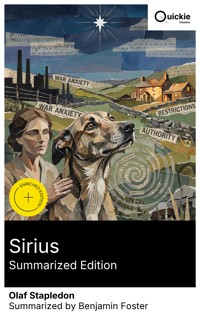
Sirius (1944), subtitled A Fantasy of Love and Discord, imagines a dog endowed with human intelligence by experimental breeding and raised beside his human companion, Plaxy. The quasi-biographical narrative follows his schooling, farm labor on the Welsh border, wartime suspicion, and a piercing musical and religious sensibility. Stapledon fuses realist reportage with essayistic speculation, probing mind, language, scent, law, and the ethics of species difference. A philosopher-novelist with a doctorate in ethics, Olaf Stapledon channels the rigor of A Modern Theory of Ethics and the visionary reach of Last and First Men and Star Maker into an intimate case study. Writing amid total war and adult-education work, he interrogates prejudice, belonging, and institutional power, reframing his humanist, pacifist concerns through a single nonhuman life. Readers of speculative fiction, animal studies, and philosophy of mind will find Sirius both moving and exacting: part tragic Bildungsroman, part inquiry into personhood and community. It is an indispensable bridge between Wellsian scientific romance and later bioethics-inflected SF, and a touchstone for thinking beyond the human. Quickie Classics summarizes timeless works with precision, preserving the author's voice and keeping the prose clear, fast, and readable—distilled, never diluted. Enriched Edition extras: Introduction · Synopsis · Historical Context · Brief Analysis · 4 Reflection Q&As · Editorial Footnotes.
Das E-Book können Sie in Legimi-Apps oder einer beliebigen App lesen, die das folgende Format unterstützen:
Veröffentlichungsjahr: 2026
Ähnliche






Sirius (Summarized Edition)
Table of Contents
Introduction
At its core, Sirius asks what it means to be a person when an extraordinary mind awakens in a nonhuman body, and whether love, education, and community can bridge the cleft between species while the pressures of fear, habit, and violence push a singular life toward isolation, so that every step forward in understanding demands a reckoning with the limits of sympathy and the weight of embodiment, and every moment of tenderness risks being undone by suspicion, accident, or the simple fact that a creature built for one set of senses must learn to speak, work, and hope in another’s world.
Olaf Stapledon’s novel belongs to the tradition of speculative fiction that tests philosophical questions through imagined lives, and it emerged in Britain during the Second World War, first published in 1944. Its setting ranges across Britain, with a strong presence in rural Wales as well as towns and laboratories, and its time frame spans the early twentieth century into wartime. The narrative adopts a documentary calm: a human observer pieces together the subject’s life from testimonies and records, speaking with sobriety rather than sensationalism. This mixture of biography, thought experiment, and quiet pastoral detail grounds the fable in social realities without reducing its strangeness.
The premise is disarmingly simple: a scientist’s research produces a dog endowed with humanlike intelligence, and the creature grows up within a family, learning language, craft, and affection alongside a human child. From this arrangement flow episodes of education, work, friendship, and friction, observed in measured prose that privileges inner weather over outward spectacle. The voice is reflective and humane, attentive to sensory textures—sound, scent, and landscape—as much as to argument. The tone is sympathetic yet unsentimental, moving from domestic quiet to tense encounters with a wider society, and inviting the reader to weigh competing claims of need, duty, and freedom.
Stapledon turns the life story into an inquiry into personhood: What constitutes a self, and who grants or withholds recognition? The book probes the moral responsibility of experimenters, the difference between educating and owning, and the stubborn entanglement of intellect with the appetites and limits of the body. Language and law lag behind lived reality; friendship and kinship outpace institutions. The animal’s heightened senses enlarge the field of imagination, while the awkward fit between canine form and human expectation complicates work, play, and intimacy. Through patient scenes, the novel tests the durability of sympathy when customs, property, and fear draw hard lines.
For contemporary readers, the questions feel newly urgent. Debates about artificial intelligence, gene editing, and animal cognition echo through the book’s quandaries about consent, guardianship, and the status of nonhuman minds. The narrative also anticipates discussions of disability and difference: accommodation, access, stigma, and the right to define one’s own flourishing. It is not a technological thriller but a moral laboratory, showing how communities normalize or resist otherness in classrooms, workplaces, pubs, and fields. In foregrounding care, communication, and institutional friction, Stapledon offers a vocabulary for thinking beyond fear or novelty, toward responsibilities that begin long before crisis and continue afterward.
The wartime backdrop matters less for battles than for mood: mobilization, rumor, scarcity, and suspicion intensify the novel’s exploration of trust. Rural pastures, hills, and sheepfolds contrast with laboratories, urban rooms, and official offices, staging conflicts between local belonging and bureaucratic control. Music, landscape, and work become means of self-making as well as points of contention. Through these textures, the book asks how a society under stress allocates risk and mercy, and who must justify a place at the table. The result is not polemic but a slow-blooming portrait of coexistence, sharpened by the ever-present possibility of misunderstanding.
Approach Sirius as you would a thoughtful biography: expect a steady accumulation of detail, ethical puzzles posed in lived scenes, and emotional weight carried without melodrama. The pace rewards attentive reading, and the story’s restraint keeps its most troubling questions open rather than settled. What endures is the conviction that sympathy requires imagination as well as rules, and that living together across real difference is both fragile and worth the effort. In bringing a singular being into focus with dignity and clarity, Stapledon leaves readers with a humane test case that continues to illuminate our choices, our fears, and our hopes.
Synopsis
Sirius, published in 1944, is Olaf Stapledon’s intimate speculative narrative about a dog endowed with human-level intelligence. Framed as a sober biography compiled by a family acquaintance from letters and recollections, the book follows the life of Sirius from engineered birth to conflicted adulthood. Stapledon treats the premise not as adventure but as an inquiry into mind, affection, and social order. The experiment that produces Sirius places him within a human household, where love and curiosity collide with caution and secrecy. The resulting portrait examines how an exceptional being might grow, learn, and struggle when neither nature nor society fully suits him.
Scientist Thomas Trelone undertakes a biological program to amplify canine intelligence, producing a small litter with unusual potential. Only one pup, named Sirius, proves truly extraordinary. To cultivate his mind, Trelone and his family raise him alongside their daughter, Plaxy, balancing scientific observation with genuine parental care. Early training combines play, discipline, and exposure to language, while Sirius’s body imposes limits on speech and manual skill. Even in childhood, he shows a distinctive sensibility shaped by scent and sound, reacting to the world with intensities alien to humans. The household’s protective secrecy foreshadows tensions between private affection and public incomprehension.
Education formalizes as tutors and specialists test Sirius’s capabilities, assessing memory, reasoning, and moral awareness. He learns to read and to make himself understood, yet every success sharpens the dissonance between his canine physique and humanized expectations. Adolescence brings a complex bond with Plaxy into clearer focus, affectionate and loyal yet constrained by difference and social taboo. The novel charts his efforts to reconcile instinctive drives with ethical reflection, a merging that neither human pedagogy nor animal training can entirely achieve. Stapledon uses these passages to probe identity: is mind decisive, or do species, body, and community define one’s possible life?
Seeking a role beyond the family, Sirius experiments with work suited to his strengths. In rural pastures he discovers that herding can reward both intellect and instinct, his extraordinary scent and spatial sense making him preternaturally effective. Yet the practical fit does not resolve his inner unease. He develops a deep response to music, finding in tone and rhythm a language able to express what speech cannot, and he contemplates the moral order intimated by his senses. These explorations open a spiritual dimension, neither conventionally doctrinal nor purely aesthetic, through which he measures love, duty, and the obligations of power.
The setting’s wartime climate intensifies pressure around the experiment. Authorities, neighbors, and professional observers interpret Sirius through their own interests: as a military resource, a research specimen, a marvel, or a threat. Issues of legal status, property, and rights become urgent as he moves outside the family’s immediate protection. Trelone is pulled between scientific responsibility and paternal feeling, while Plaxy argues for Sirius’s autonomy and dignity. Practical measures intended for safety—discretion, relocation, supervision—also isolate him. Stapledon’s careful pacing shows how good intentions and institutional caution can harden into constraint, forcing a question about society’s capacity to host true difference.
Rumor, superstition, and ordinary fears gradually gather around the unusual shepherd. Isolated incidents, some innocent, some ambiguous, are interpreted through anxiety and wartime suspicion. Religious sentiment and local pride are stirred by the unsettling spectacle of a speaking, reasoning dog, and resentment flares at privileges granted to an outsider. Sirius must wrestle with anger and the temptation to answer hostility with force, even as his ethical sense deepens through art, work, and loyalty. The narrative builds toward confrontation without easy villains, emphasizing how misunderstanding, secrecy, and fatigue corrode trust. Bonds within the Trelone circle strain under cumulative external pressures.
Without disclosing its ultimate turns, the book closes its inquiry by returning to the themes named in its subtitle: love and discord. Sirius embodies a test of what counts as a person and what kinds of fellowship a culture can sustain. Stapledon links intimate feeling to public norms, asking whether empathy can survive fear, utility, and doctrine. The novel’s restraint and biographical method grant it a persisting resonance, anticipating later discussions of uplift, animal minds, and the ethics of enhancement. More than a thought experiment, it endures as a careful meditation on kinship across difference and the costs of recognition.
Historical Context
Olaf Stapledon’s Sirius was first published in 1944 in Britain, amid the final years of the Second World War. Wartime paper rationing constrained book production, and the Home Front still lived with blackout rules, ration books, and the memory of the Blitz. Intellectual life persisted through universities, learned societies, and the BBC, which sustained public debate despite censorship and propaganda routines. The novel’s British settings align with a society organized by emergency regulations and mass mobilization. That climate—of vigilance, scarcity, and disrupted normality—frames its inquiry into belonging and threat, locating a speculative narrative within the daily realities of a nation at war.
In the interwar decades, British science invested heavily in physiology, neurology, and comparative psychology. The Medical Research Council, founded in 1913, funded laboratories that advanced brain science, endocrinology, and nutrition. Pavlov’s conditioning and behaviorism shaped debates on animal learning, while C. Lloyd Morgan’s canon cautioned against overreading animal minds. Ethical argument was vigorous: the Cruelty to Animals Act 1876 regulated vivisection, campaigns by the RSPCA and the British Union for the Abolition of Vivisection pressed for restraint, and researchers defended laboratory freedoms. Sirius draws on this milieu of ambitious experimentalism and public scrutiny to stage questions about method, responsibility, and the status of nonhuman intelligence.
Debate about heredity and “improvement” formed a prominent strand of British public culture between 1900 and the late 1930s. The Eugenics Education Society (later the Eugenics Society) promoted selective breeding as social policy, while geneticists modernized Mendelian theory and population genetics. Popularizers such as Julian Huxley and J. B. S. Haldane made biological futures a subject of journalism and lectures. Although policy impact was uneven, the language of fitness, degeneration, and biological planning circulated widely. Stapledon, writing amid these arguments and after his earlier super-being tale Odd John (1935), uses Sirius to probe the promises and perils attached to engineered minds and planned evolution.




