


Erhalten Sie Zugang zu diesem und mehr als 300000 Büchern ab EUR 5,99 monatlich.
- Herausgeber: Nosy Crow Ltd
- Kategorie: Für Kinder und Jugendliche
- Serie: Little Bird Flies
- Sprache: Englisch
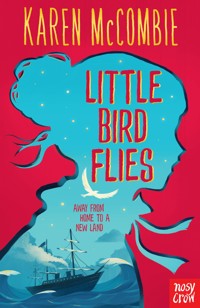
Nominated for the 2020 CILIP Carnegie Medal Bridie lives on the remote Scottish island of Tornish, the youngest of three sisters. Although she loves her island, with its wild seas and big skies, she guiltily nurses a secret dream of flight - to America and the freedom of the New World. But her family are struggling under the spiteful oppression of the new Laird, and it seems that even some of the Laird's own household are desperate to leave. When the Laird's full cruelty becomes apparent, there's no more time for daydreams as Bridie needs to help the people she loves escape to safety. Cover and chapter head illustrations by Jasu Hu. Map illustration by Hannah Horn. The first in a gripping, dramatic new series from much-loved author, Karen McCombie. "This involving, evocative tale, narrated by Bridie with a hint of period language, is a study of rich and poor, offering clearly-drawn characters."- Nicolette Jones, Sunday Times, Children's Book of the Week "There's heart in this Scottish adventure. . . This is (Karen's) best. It has a vivid setting, emotional punch and characters to really care about." - Alex O'Connell, The Times, Children's Book of the Week "It may all seem a far cry from the "slushy, gushy love songs" of Ally's World. And yet here, as there, McCombie displays her gift, which is to create a narrator who sounds thoroughly convincing, and to inhabit the consciousness of a child." Emily Bearn, The Telegraph "Little Bird Flies by Karen McCombie is the evocative and beautifully written tale of Bridie (Little Bird) who dreams of a bigger life than the one she's destined for on her tiny Scottish isle of Tornish. With themes of immigration and prejudice and characters you'll root for, this will appeal to fans of Emma Carroll and Marie-Louise Jensen." - Michelle Harrison, author of A Pinch of Magic
Sie lesen das E-Book in den Legimi-Apps auf:
Seitenzahl: 267
Veröffentlichungsjahr: 2019
Das E-Book (TTS) können Sie hören im Abo „Legimi Premium” in Legimi-Apps auf:
Ähnliche










![Tintenherz [Tintenwelt-Reihe, Band 1 (Ungekürzt)] - Cornelia Funke - Hörbuch](https://legimifiles.blob.core.windows.net/images/2830629ec0fd3fd8c1f122134ba4a884/w200_u90.jpg)


FOR MY M – ONWARDS AND UPWARDS, MY DARLING… KMcC
“A H-UILE LATHA SONA DHUT, ’S GUN LATHA IDIR DONA DHUT”
“MAY EVERY DAY BE HAPPY FOR YOU, AND NO DAY EVER BAD”
THE ISLE OF TORNISH, SCOTLAND, 1861
CHAPTER 1
The dream came to me again.
The one that often wakes me in the grey, pearl light before dawn.
In that quiet time, when only the earliest rising birds shyly begin their songs, I lie, eyes wide, alongside my sleeping sisters in the cramped box bed, my father and brother snoring and snuffling in the small room next door. And always I feel as comforted by my mind’s nightly wanderings as if Mother’s cool hand had stroked my brow.
But sweet as it is, I have no time to laze and think on my dreamings this morning. Something quite wondrous is happening on the island today and the sudden remembrance of it makes me turn and shake both Ishbel and Effie from their slumbers.
“Wake up! Wake up!” I call out, scrambling and wriggling from between the stirring bodies on either side of me, as if I am some skittish small child instead of a grown girl of twelve.
And with much haste and high spirits, we are all soon dressed and fed and about our usual early morning chores. Apart, that is, from Ishbel, who is already gone to the Big House, quite primped and preened, to help with the preparations for the Laird’s visitors.
Oh, I cannot wait to see old Mr Menzies’ relations! What a thing it is to have fancy folk from a great southern city like London come to our plain little island.
They are taking a Highland tour of course, which is quite the fashion for rich English and Lowland Scots these days, Father says, ever since Queen Victoria herself sang the praises of this northerly part of Scotland. But there must be finer islands for the tourists to see, for none have graced Tornish until now.
So, this day I shall surely always remember, since it is to be unlike all the other endless days here that are filled with nothing but chores and school and the same faces whichever way I look, whether they belong to family, neighbours, chickens or cows…
“Again, please!” I hear my younger brother’s cries from inside the cottage as Father rattles off a quick trill on his new tin whistle, bought from an Irish pedlar on the mainland this spring.
For a moment, I glance up from the stool I am squatting on here in the dry dirt yard and look at Lachlan and Father through the open front door. They are both infected by the coming day’s excitement, Lachlan jumping around – which risks the fabric of his too-small good jacket splitting, I fear – while Father laughs as he lowers the long whistle from his lips. He is very smart himself in his tweed jacket, waistcoat and trousers. He even had Effie trim his wiry dark-red hair and beard last night. But then we are all to look smart today, all in our Sunday best though it is the middle of the week.
“Ist, now!” says Father, using the short, sharp Gaelic hiss of a word to try to quieten and steady my brother. “You’ll hear enough music when Mr Menzies’ guests arrive.”
Turning back to the wooden bucket wedged between my knees, I find it hard to keep my mind on either the Laird’s never-before-sighted relatives or the dishes that need finishing before I change from my work clothes into my good things too.
Instead I idly gaze up at the towering mound of the Glas Crags, which the sun practically perches upon. A yearning to clamber and climb to the very top of the Crags grips me hard; for surely there, at the very summit, so close to the sky and the clouds and the sun itself, I can look out for a distant sighting of the ship! It must be setting off from the mainland soon, and I might see the faintest dot of it, as it begins its slow journey towards our humble harbour.
And with that thought, I am away, as quick and quiet as I am able. For the short while I am gone, I will not be missed, I tell myself, as the hard, stamped earth of the yard turns to the stubbly long grass that surrounds our cottage and those of the neighbours in our township. Father, Effie and Lachlan; they will perhaps suppose me off at the burn, fetching more water, I persuade myself, as the harsh grass turns to the softer green grazing of the slope, where some cattle idly watch me hurrying by, skirts held high, dirty knees on show.
Now the swoop of soft grass melds into hard, craggy stone dotted with scratchy heather and gorse, and I am breathlessly, happily scampering barefoot from rock to rock, with the sun seeping warm through my unravelling knitted shawl and the rough cloth of my work shirt.
I smile to myself as I gaze up towards the summit of the Crags, the final jags of glinting stone set against the blue summer sky and the white clouds that jostle and tumble over one another.
This far up, the herring gulls caw-caw and whirl around me. It seems the sight of a scrawny girl trying to join them is fine entertainment indeed.
“Little Bird!”
I hesitate for a second at the sound of my name and then turn, neatly, in the narrow path between prickly bundles of gorse bushes, with their strange mix of sun-yellow blossom, fierce thorns and whispers of wool they have stolen from the sheep that have passed this way.
“Am I too fast for you, Will Beaton?” I call down to the boy who has suddenly appeared and now struggles to keep up with me.
“Only here, Bridie MacKerrie,” he baits me.
Will is right, of course. On this rocky outcrop of a hill I am like every other person that might come this way. No one can see a limp when every surface is off-kilter and uneven and needs thought. But I have climbed the Crags so often it needs no thought at all.
Just to show Will how sure and fleet I can be, I turn and bound up the last few boulders, to the Glas Crags’ highest point; the flat place of stone, with a patched blanket of heather and moss tucked in its crevices.
And ever and always what I see takes my breath away.
Slowly I spin, arms out, and there … there is the endless circlet of sea that sways and ebbs around our island, the colour of iron for the most part, merging with an eye-dazzling turquoise on the far shore.
If I let my arms drop and my gaze settle due east, the looming mass of the mainland of Scotland greets me, a ragged jumble of rocks and headlands closest to us, while in the far distance snow-tipped mountains rise towering and immense.
Now I turn around and stare westwards, where the sea has the grand name of the Atlantic Ocean. Its vastness stretches to the horizon … and on and on and on it goes till it crashes up against the shores of America. Can you imagine?
It’s not just the sea and the far-off land that fill me with wonder. From up here there’s the weather to watch too, and the birds swirling and soaring in praise of it or in spite of it.
“I let you beat me,” says Will, as he finally joins me.
Between gasps, his broad grin shows off the space where a tooth was lost to him years ago, the time he fell on the Crags as we searched about us for gull eggs. I remember that Will and I worried wildly at all the blood. But after we scrambled down from the hill and I washed his face clean at the burn with the corner of my shawl, Will caught sight of himself in the water and could not stop laughing.
And always he is laughing, and always I laugh with him – unless he is taunting me, as he is now.
I am not bothered by Will’s teasing. I tease him all the more. For the way his light hair stands up, I am always calling him a thistle-head. And if not that, I tell him often that he is as handsome as the goat his mother keeps, or that even a potato grown on his croft is more bonny than him. Oh yes, Will Beaton might be able to outrun me down on the flat moors, but he can never catch up with my tongue when I let it loose…
“Are you quite well, William?” I ask my friend as his chest heaves from the climb. “The last time I heard a noise like that was when the cow was calving.”
Laughter bursts from Will’s chest, but I try to keep my countenance and gaze into the newly quiet sky. The gulls are gone – a sea eagle must be about, a winged giant on the hunt for its dinner.
At that thought a shadow passes over me … the sea eagle itself? I spot the flash of fanned white tail and the arc of brown wings as it swoops out across the choppy waters – and I remember I am here to catch a glimpse of the steamship that will bring the Laird’s guests.
But alas, the dancing, shifting carpet of silvery waves is still empty.
“So what are you doing up here?” I ask my friend.
“I called by for you, just as your father and Effie and Lachlan were setting off,” he tells me. “Your father saw you heading up here. He said he would be grateful if I found you and told you to hurry up!”
“I’ll have time enough,” I say, smiling at the thought of Father watching me go, and probably rolling his eyes in fond exasperation.
But I don’t think Will is listening.
“Ah, see now; John Mackay’s boat is at the harbour,” I hear him say. “I hope my brother George took his bagpipes with him, for he cannot walk home and back in time to play at the welcome.”
“Ha! Well, I suppose the Laird’s folk will have to hold their noses while they listen to your brother’s reels,” I reply merrily, as I consider the London ladies in their dainty muslins and lace, with the smell of the morning’s catch in their delicate nostrils.
As I speak, I need not look down towards the harbour; I can very well picture Will’s seventeen-year-old brother and John Mackay and the other fishermen landing creels of lobster on the flagstones at the harbour.
And I need not turn as Will is doing now, gauging the distance from the harbour to his own township. For I know that mine is just back down the way we came, ten low cottages nestled together, and that Will’s lies further on, tucked into the sandy bay, near the cove where the smaller rowboats are moored. There are two townships more, on the far side of the island, beyond the moor and the lochan and the forest and waterfall. Both face the nothingness of sea, with the promise of an invisible America in the impossible distance.
Should I care to gaze off towards the south of our small island – and I do not – I’d see the woods and the Big House, where the Laird’s staff, including my sister Ishbel, will be bustling in readiness for the guests.
I need not gaze down to know that close to the harbour is a little school that stands empty of its pupils today. And close by is the church and its small graveyard, where Mother lies at her rest in the ground, keeping company with the brothers and sisters that never lived long enough for the rest of us to know.
For whenever I am standing here high on the Glas Crags, I choose not to look at island life below – I know I am peculiar but I prefer to look up and away and beyond…
“Oh!” I gasp, as something so strange happens in that still moment.
Will’s hand has brushed against mine!
No – I will not have this. Swiftly, I lift that same hand to my brow and take a few steps forward, making that I am searching for the ship that is not due for two hours at least.
“Little Bird? Bridie?” says Will, not knowing what he has done wrong.
Perhaps he thinks I did not wish him to touch my weakened hand – as if that would bother me! – or perhaps he thinks my cheeks are hot with shyness, that I am coy at the thought of his touch meaning we might one day be sweethearts and not just friends.
But here’s the truth that rages in me; instead of shyness, I am full to the brim with a secret that can’t be shared or spoken of.
How can I tell Will that it makes me heart-sore to think of Ishbel settling for whichever of the doting, handsome Matheson boys she should prefer (Donal, I am sure), because everyone expects it? Just as they expect fifteen-year-old Effie to marry Will’s brother George, by and by?
How can I explain to him that I know neighbours are already supposing that in a few short years, the pair of us will be married and scratching a living from our own croft – and that I shudder when I think of such a thing?
For it is not the future I would choose for myself.
Oh yes, my sisters might think themselves blessed to spend all their days on this small patch of rough, grey rock in the choppy, grey sea, because Mother told us so. “Remember, we are the lucky ones,” she would say, and talk of the generations of hard-working Highland folk – just like us – who were evicted from their homes over the last hundred years. Father would listen and nod as Mother talked of those cruelly evicted so that their lands could become farms of sheep, with wool that would make the landowning lairds rich. Of ordinary folk whose belongings were cast out on to the road, cottages boarded up, thatched roofs set alight, sometimes with old, bedridden men and women inside!
Like my sisters, I would snivel at the sadness of these terrible truths, while Lachlan drowsed in Mother’s arms.
But a quiet, traitorous part of me listened, breath held, to stories of families gathering up their few things and heading for tall ships that would take them to the Carolinas in America, to the wilds of Northern Canada, to Australia and New Zealand on the other side of the earth.
My eyes closed, I would not think of the sorrowful reasons for my fellow Highlanders’ leave-takings and loss, but instead let my head fill with wild imaginings. I would yearn, nay, ache for such adventure…
For to travel – that is the future I would choose for myself, if I had a choice. Which of course, as a girl – and one that some might think too feeble for the wider world – I do not. But the worst of it is the words Father muttered over Mother’s grave, when the earth was but newly patted down.
“Aye, Bridget, you often said we were the lucky ones, and so I shall see to it that myself and the children stay here always.”
So there you have it; Father’s promise to my dear, dear mother binds me tight to Tornish. And so my raging and restlessness must stay secret and stamped down inside and known to no one.
“Listen, Little Bird,” Will says hurriedly, “I didn’t mean to—”
“Leave me be for a moment,” I murmur, trying to tame my temper.
Safe away from Will, I pick a flat spot a few steps away with a fine mattress of springy moss. I’ll lie here for a moment, calming myself with a memory of last night’s dream, where my sleeping mind’s eye pictured this:
I am standing on the summit of the Glas Crags, bare feet on tiptoes, treading on the soft moss, so close to the sky that I might touch it.
Tilting backwards, arms outstretched, I am caught; held by a cushioning of air, then borne off by wending winds…
It might well be an unsettling dream to another, but for me the sense of freedom it gives me is a joy. And it is a comfort too, because always, always as I glide there is a sense of some guiding hand slipping into mine, belonging to someone forever unseen…
“Little Bird?”
Will’s voice sounds uncertain; he sounds shy of me.
“What is it?” I answer more kindly, since my mood is not really his fault.
“Is that not the ship…?”
In an instant I sit up. The steamer is not the distant speck I expected to see, but a puffing beast appearing from behind the headland, where its journeying had been obscured.
“It is not meant to arrive at this hour!” I say, as if that changes the fact that a great, steel vessel is thundering its way towards Tornish, which it will reach in no time at all.
Scrabbling to my feet, I walk to the edge of the flat place where Will now stands and join him in staring down towards the harbour. Folk seem to be rushing to join the gathering crowd as news spreads of the ship’s approach. In that crowd will be my fluttering sisters, my excitable brother, and my father, no doubt muttering under his breath, hoping that I will not miss this most special occasion.
Wordlessly, Will turns to me and I turn to him.
He grins and I grin back.
“I’ll get there first!” I yelp, grabbing hold of my skirt, and seeing in that moment that it is the one with the long tear at the front, with my mended flannel petticoat showing through. My better skirt is folded in the chest at home, alongside the shawl that does not have holes and snags in it.
Ah, the grand folk from London will have to take me as I am, I laugh to myself, as Will and I hurtle down the hill, grabbing stunted tree branches and crackling handfuls of heather to stop ourselves tumbling head over heels.
Secrets, dreams and another sudden torn shred of my skirt; I leave them all behind as I charge towards the harbour and this day I will surely never forget.
CHAPTER 2
At the time of my birth, I arrived like a broken baby bird.
They say I came too soon, born in a bruising storm, instead of waiting a few more weeks for the warming sunshine of spring.
My mother’s cries were swallowed up by the winds from the west – from across the sea, from America, I like to think – as they battered and blustered the island, on their way east to wreak havoc on the rest of Scotland.
And then there I was.
“A poor, frail thing you were,” Ishbel likes to tell me on winter nights around the fire. “Your chest, it was heaving for breath.”
“And your wee foot all twisted,” Effie will always add, though she can’t truly recall the moment, since she was barely three years old at the time I was born.
Ishbel says Mother and Father thought I’d not last the night. But in the morning I was still there, my good hand clawing the air as if I was desperate to grab hold of life.
When the Laird arrived – with the coins and gifts of fine food and whisky that he always gave his tenants when a child came – my sisters, very young as they were then, proudly ushered him into the cottage.
“And what will you be calling this little scrap, Mr MacKerrie?” the Laird asked Father in English, as he leaned over to study me, bundled cosy inside the wooden crib.
“Bridie, after her mother Bridget, sir,” Father answered in English, the sound of the clipped words warmed with the roll and sing of his accent.
“Bridie? Ha! More like birdie. You’re just a little bird, aren’t you, my dear?” the Laird replied, smiling down at me in delight, my sisters assure me, and I have no doubt of it.
Exhausted as she was, Mother pulled her shawl tight around her and tried to rise from the box bed to properly greet their guest.
“Our girl may not be whole and hearty, sir,” she murmured in halting English, “but we will love her as long as we have her.”
Mother understood English nearly as well as Father, but stumbled to say the words of that language out loud, as if they were uncomfortable and dry as pebbles in her mouth. And for his part, Mr Menzies spoke mostly English, like all the landowners and rich gentlefolk of Scotland, but – unlike others of his class – he had an ear keenly tuned to the mother tongue of his tenants.
“Now, please don’t rise for me, mistress,” Mr Menzies told Mother, as he stroked my weak hand and watched my trembling fingers struggle to latch on to one of his. “And don’t be offended by my words. The small ones can be fighters. What of the linnet; it is not much bigger than my thumb, yet it soars as well as the buzzard. So this little bird of yours … she may yet fly, eh?”
I will always be grateful to Mr Menzies for trusting in my lust for life.
For here I am, twelve years grown.
Yes, I might be scrawny still, my wings somewhat bent, but I am strong.
And I may be a little bird in name only, but one day, I hope to say goodbye to this island, borne away, as my dream foretells.
One day I will fly…
However, this will not be that day. The closest I have come to flying is practically tumbling down the steep side of the Crags with Will.
“How do I look, Little Bird?” he asks now, when we finally stumble and skip towards the back of the milling crowd at the harbour.
The very sound of them stirs the heart; folk clap and stamp along as George – the island’s youngest and finest piper – plays a traditional rousing air to welcome the docking ship.
And though I cannot see him yet, I know Father will be tapping his foot, standing alongside the fiddlers with his whistle, in readiness with a tune when George stands down.
What I can plainly see is the newly moored steamer, towering over the flat cloth caps of the men and the pretty, crimp-edged, white kerchiefs that the women and many of the younger girls wear.
“You look fine,” I turn and answer my friend, and begin straightening his cap and plucking sprigs of heather from the good jumper that Mistress Beaton just knitted him. “But keep your arm across the front so your mother doesn’t see the hole there…”
I don’t ask Will how I look, because I know that I must seem like some savage child that has been living wild on the moor!
Will has no idea why I am laughing, but joins in anyway, all the while returning the favour and brushing away grasses and twigs and blossom that have stuck to me.
But we both stop laughing when we see Effie’s furious face. My middle sister might be talked of as pretty, having the rich red hair of Father, and apple cheeks in her soft, round face, but her prettiness is all too often disguised by all the scowling she does. She is like one of the cattle of a summer’s evening when the midges are biting and maddening them.
Now a smile slips unbidden on to my face, as I imagine fiery-haired Effie as Mr Menzies’ prized shaggy, red Highland cow, the one that stands out among the rest of the bulky black herd.
It is not a wise thing to do, of course. Effie – in her best skirt and her new-made checkered plaid shawl – steps straightaway from her friends and comes over to berate me.
“What humours you so, Bridie? Does it amuse you that you are to shame Father today? Where have you been? Why did you not go home and change into your good clothes?”
Her words come fast as they often do, allowing me no time to answer. Not that I have an answer that will suit her. The fact of it is, I never have an answer for either of my bossy sisters, who – without our mother with us – see it as their job to chide and order me around, as much as they pet and adore Lachlan.
“Yes, but it is the fault of the visitors for coming early,” says Will, trying to protect me. “You see, Little Bird––”
“For heaven’s sake, her name is Bridie, Will Beaton!” snaps Effie. “How many times have you been told over the years?”
Ah, but since we were both young children, Will has always mimicked Mr Menzies in calling me Little Bird, in English. Even Mother – who held on to her Gaelic like a treasure – would smile fondly when she heard Will call me so. Perhaps it amused her to hear such unnatural English words spring forth from the mouth of an islander child, or perhaps it was because Little Bird translated to Gaelic as “bìgein-Brìghde”, meaning “St Brìghde’s little bird”, the very name for a linnet.
But it is not just the English of my pet name that Effie dislikes. It is the fact that both Effie and Ishbel rail against this pet name itself. They worry that people hearing it will think of me as small and to be pitied. But I don’t think folk do pity me, and anyway, I don’t care if they do. I was born into this body and know no other. And if I can manage what everyone else can – even if it sometimes happens a little slower – then what of it?
“And the mess of your hair!” Effie turns back to me and sighs. “When Ishbel sees she will give me such trouble for not making sure that you were decent!”
To think of Effie getting a scolding from our eldest sister causes another smile to slip on to my face. At seventeen, Ishbel is only two years Effie’s senior, but being a maidservant for the Laird gives her airs and graces indeed.
“What is this!”
At those words my straggly long black hair is near pulled clean from my head.
Ishbel is not one for nagging chatter like hot-headed Effie. Her scorn is shown by a disapproving and quiet coolness.
“Effie, could you not have tied a simple braid for Bridie?” I hear Ishbel address our sister sharply, and straightaway feel her tug my grass-matted hair into something less like a broom that’s been sweeping leaves from the door.
Ishbel’s hair is as black as mine, but is pinned low around her head in shiny coils, the like of which any fine young lady of importance might be proud. She has worn it that way ever since Father took her to the far-off town on the mainland to buy food and cloth stuffs last year, where he said he caught her studying the fashions of a group of English ladies on their Grand Tour.
“Ow!” I yelp, as the tugging cricks at my neck.
“Bidh thu slàn mus pòs thu…” Ishbel grumbles as she grapples with my knots and tangles.
And then I feel my sister hesitate. “You’ll be whole by the time you marry”… it’s a common thing for mothers of the island – of all the Gaelic-speaking places, I suppose – to say to their whining daughters as they drag a comb or brush through their fresh-washed hair. I’ve always supposed it to mean that hair would grow back by and by; that it’s best to be patient and not moan.
I remember Mother laughingly saying those very words to us three girls often enough. Is Ishbel remembering too? Perhaps I should say some—
“OW!” I yelp louder, as Ishbel starts back at her task anew.
“For shame, Bridie!” she snaps at me. “Some things you must just bear.”
And that sums up Ishbel; she is tall and slight as a sapling, carrying herself with such serious forbearance, resigned to her lot and considering everyone foolish who does not think the way she does.
In fact, not so long ago, Father proclaimed – to Ishbel’s great pleasure – that she was like a stone statue he’d seen in a book, of some Greek goddess or another. Grand and queenly she was, Father said, with her chin held high and such a certainty about her. Well, the only certainty right now is that Ishbel is practically pulling the hair out of my head.
“Be still, Bridie, or I’ll—”
Ishbel’s warning is lost as cheers go up.
I don’t care whether my hair is tidy or raggedy; feeling her grip relax a little, I seize my opportunity and pull away from Ishbel’s hold, running from both her and Effie and their glowering. Hurrying forward, I sneak through the crowd – sure that Will cannot be far behind – so that I might see these grand folk from London at last…
And there they are, two men in long, thick coats and similarly patterned checkered trousers, with grey top hats and silver-tipped canes. Unlike the bearded men of Tornish, they wear just moustaches, but quite twirled at each end! They stride confidently off the steamer’s ramp to shake hands with the Laird, and make some small talk. They also nod at the musicians, some in kilts, within whose number stands, of course, George Beaton playing his pipes, Fergus and Donal Matheson with their fiddles, and my father holding his tin whistle, Lachlan crouched proudly at his feet.
“Well, you two,” says a warm voice beside me. “What do you think to our visitors?”
I have found myself by Mistress Beaton. She takes care of the old Laird’s washing, drying his bed linen and clothing on lines by the seashore, so that the Big House must always be filled with the fresh salty spice of the ocean.
“I think they look very smart!” I say, my heart surging with the excitement of having strangers from the outside world touch down on our shores.
“Have you found out who these kin are to Mr Menzies, Mother?” Will asks, catching me up.
“The first gentleman is the son of a long-dead cousin of the Laird, it seems,” says Mistress Beaton, with some satisfaction at knowing this detail. “I think the second gentleman is a friend, accompanying the family.”
I am listening keenly to Mistress Beaton’s words, at the same time as straining to watch the gentlemen turn their attention back towards the boat, holding their hands so that the ladies – oh, the fine ladies! – may descend safely from the ramp and on to dry land. The first two to step ashore wear bright-coloured dresses that puff out so, with many layers of fine cotton petticoats underneath their braid-edged skirts. With ruffles of intricate lace rippling softly at their wrists and necks, I feel I am looking at wondrous birds of paradise from the far Indies.
It gives me pleasure to see that one is quite young, perhaps the same age as Effie. I wonder, might I sometime be able to approach and talk to her during her visit? I would so like to hear what it is like to travel the whole length of the country in a steam train! What a strange affair that must be. My, she must have seen such things in her life: the sights and sounds of London, and of Glasgow too, where the train terminated. And on that journey alone, what wonders of towns and villages and valleys and hills did she see?
Oh, I know that in many places it might not be natural for a young lady of her kind to converse with a girl of my type, but the Laird is not a man to stand on ceremony. I am already a favourite of Mr Menzies’, so perhaps he might think to introduce me to her…?




