


Erhalten Sie Zugang zu diesem und mehr als 300000 Büchern ab EUR 5,99 monatlich.
- Herausgeber: Nosy Crow Ltd
- Kategorie: Für Kinder und Jugendliche
- Serie: Little Bird Flies
- Sprache: Englisch
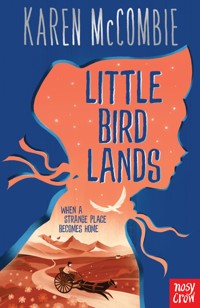
Little Bird has landed in America, far from her home in Scotland and far from the danger that stalked her family. But the new world holds new perils, and soon she's on the run again. From the teeming streets of New York to the prairies of the west, Little Bird holds tight to secrets and dreams of freedom. Then, on her journey, she comes face-to-face with an unwelcome ghost from the past... The brilliant sequel to Little Bird Flies, this is an exciting story of settling in the New World while still being haunted by everything you've left behind. Themes of emigration and immigration, race and social status are thought-provokingly explored by the brilliant Karen McCombie. A modern Little House on the Prairie!
Sie lesen das E-Book in den Legimi-Apps auf:
Seitenzahl: 268
Veröffentlichungsjahr: 2020
Das E-Book (TTS) können Sie hören im Abo „Legimi Premium” in Legimi-Apps auf:
Ähnliche











![Tintenherz [Tintenwelt-Reihe, Band 1 (Ungekürzt)] - Cornelia Funke - Hörbuch](https://legimifiles.blob.core.windows.net/images/2830629ec0fd3fd8c1f122134ba4a884/w200_u90.jpg)

iii
v
Fifteen years ago, my mother looked down upon me – cradled and broken in her arms – and made a wish. She wished that I might live, since it seemed likely that I would not.
But I was a determined little thing; determined not to die. And thanks to my mother’s words of strength and courage, whispered in her beloved Scots Gaelic language, I thrived.
Hopeful and heartened, Mother dared to make a second wish.
She wished that I might live a long and peaceful life, never leaving the small Scottish island that was home to our family. That wish did not come true … and I for one am glad of it. For if I had stayed on Tornish all my days, I would never have known an evening like tonight!
How my heart soared to see the glow of the distant lights of New York City as we left Mrs Drummond’s farmhouse – where we lodge – and rollicked along dark 3country lanes till the cartwheels met the smoothness of the new-built roads.
And the very racket of the city! Songs of street musicians, roars of peddlers, the hiss of the hundreds of gaslights illuminating grand carriages, gawping families and drunken carousers stumbling from saloons…
Then to be lost in a cloud of words I did not understand as we stood in the queue for the world-famous Barnum’s American Museum. Folk about us talked excitedly in a tumult of different tongues, of the wonders they’d see inside I supposed. Scientific exhibits, curiosities from around the globe, strange creatures never before seen.
And of course, if I had stayed in Tornish, I would never, never have found myself face-to-face with a monster…
“What is it, Little Bird?” Marthy-Jane asks me, teetering on tiptoe on the wooden viewing platform, her eyes just level with the glass window. Her small hand clutches my weaker one, nails as fine as pale pink seashells pinching my skin.
She gazes up at me for an answer. When I am not helping her grandmother around the farmyard, or with the laundry she takes in for the rich of the city, I help Marthy-Jane Drummond practise her letters and numbers. But right now I am too taken aback to act like a teacher and give her an explanation; I can do nothing 4but shake my head stupidly. For when the great, white, waxy bulk of a monster floats in front of you – one of its glossy, dark, apple-sized eyes locked on to yours – it is difficult to be certain of anything, to find a tongue in your head even.
“It is a bel … a bel … something whale,” I hear Lachlan saying as he tries to read the sign by the huge tank, while folk jostle alongside us for a good spot to see the creature.
Mind you, my eleven-year-old brother would struggle to read the brass plaque even if he were quite alone in front of it. He can speak and chatter as quickly as the mynah bird in Mrs Drummond’s parlour, but when it comes to reading and writing he stumbles as if words were rocks and ditches along a path, set on tripping him up. His teacher despairs of him.
“A beluga whale.” Father’s more certain voice comes from behind us. “It was captured off the coast of Labrador, with great difficulty, it says, and transported here.”
As I listen to Father read from the plaque, I suddenly think not of the animal’s capture or the means used to bring it to New York, but of how on earth they got the thing up the stairs of this building, all the way to the second floor!
“Dear me; Labrador is up in Canada. This beast has come from the great seas there only to be stuck in a 5tank,” I hear Mrs Drummond add with a sorrowful sigh. “Poor thing…”
I suppose our landlady will still be gripping Father’s arm. She is not in the best of spirits, and I think regrets letting herself be persuaded to come to the yearly Evacuation Day celebrations. She is used to the quiet life of her farm, she always says, though it gets less quiet every day. There is the building of Central Park nearby – where Father works as a stonemason – and the never-ending clunk, hammer and boom of explosions as the new roads and buildings march closer to small farms like Mrs Drummond’s, ready to swallow them up whole.
“It’s worse than that last one we looked at,” I hear her grumble, in a voice that makes her own Scottish heritage quite clear, though she last saw the shores of her homeland more than half-a-century ago, while my own little family have been here but two years.
Mrs Drummond’s grumbling is on account of her not caring for the “Happy Family” exhibit we just saw on the fifth floor. It is a large menagerie which Mr P. T. Barnum himself had seen on a trip to Scotland – of all places! – and shipped back to New York to add to his own renowned collections. Inside the large cage are cats and rats, rabbits and foxes, animals that would normally hunt and set upon each other in the wild, but here live contentedly together. “Unnatural…” Mrs Drummond 6said sourly of it.
And now, as I stand eye-to-eye with this colossus, I suddenly feel as agitated as Mrs Drummond. How trapped must the whale feel? Does it look at all our faces pressed to the glass and wish itself far away, in the pure, measureless ocean it was plucked from?
“Can we go, please?” I say, turning quickly to Father and Mrs Drummond, not wishing to gaze upon the whale in its watery prison a moment longer.
“Of, course,” says Father, reaching out to lift Marthy-Jane into his arms, the way he’d so easily lift my brother and myself – both our older sisters too – once upon a time. “What would you like to see next?”
“The waxworks, please, Father!” says Lachlan, without hesitation. “There’s one of the famous Siamese twins Eng and Chang – they are joined at the stomach! And there is also one of General Tom Thumb who is a grown man but stands smaller than Marthy-Jane! Oh, and after the waxworks we have to see the living bearded lady, and—”
“Robert, did you say there was a lecture hall in here, where we may sit awhile?” Mrs Drummond asks Father. She dotes on him, as she does all of us. I think we are as good as family to her, what with her only son – Marthy-Jane’s father – away at war in the Union Army, and Marthy-Jane’s mother dead from tuberculosis, that cruel disease that snuffed out my own mother’s life.7
“Yes, and a talk might be starting there soon,” says Father, jostling a path for us through the crowds and ignoring Lachlan’s disappointed sigh.
A few minutes later we find ourselves outside the lecture hall, waiting for the doors to be opened and the talk to commence. Lachlan stands a little away from us, leaning at the window and taking in the hustle and bustle below while he eats the sugared-coconut shavings that he bought from a Chinese street vendor on the way here. My brother is very taken with Manhattan, the very beating heart of New York, and is determined to be a bellboy in a grand hotel one day. Either that or a soldier in the army, if the war is still raging when he is of an age to serve. (Please let the war be over before that time!)
“Listen to this,” says Father, reading from a pamphlet he has been handed. “We are about to see Miss Annie Swan, who stands at eight feet in height, and is to discuss giants throughout history! Ah, she is from Nova Scotia, in Canada, Mrs Drummond. Wasn’t that where your own family first settled when they came to this continent?”
“Indeed, yes!” says Mrs Drummond, and she and Father begin to talk, as they so often do, about where the Scots emigrated to and from over the years.
“Little Bird?” says Marthy-Jane, tugging at my hand.
I am always gladdened to hear her call me by my 8old pet name; no one has had any use for it since we left Tornish. To everyone but Marthy-Jane I am plain Bridie these days. Mostly, being Bridie is just fine, but sometimes I do miss the Little Bird I once was.
“What is it, m’ eudail?” I ask, calling her “my treasure” in the Gaelic words I grew up with.
She is only a little thing and is perhaps weary of waiting. She’ll surely be wanting to hear one of my stories to pass the time … stories of my childhood on the island, then of my family’s life in the grand Scottish city of Glasgow, and of our stomach-churning journey across the sea to New York. She thrills to the tales of the mischief-making my old friend Will and I got up to back on Tornish, and of the ways I drove my bossy sisters Ishbel and Effie to distraction. She’s fond too of hearing about the well-to-do visitors who came to the island and became our friends: Samuel the portrait painter and Caroline, the young lady who arrived shrouded in black mourning clothes. Most of all she loves hearing about Patch, the wee terrier we sadly had to leave behind in Scotland.
I only tell her the cheerful stories, of course. I wouldn’t want to scare her with all of the truth, of the fear we sometimes lived with and the risky decisions my family had to make…
“Can I tell you something?” she says in reply, looking 9upon me with such a serious expression for one so young.
“Of course,” I say, crouching down to show that I am listening keenly to whatever troubles her.
“You are very small and pretty, like a doll,” she whispers, her blue eyes wide, her free hand stroking my long black hair, as if I am a beloved cat she cares for.
“Well, that is very kind of you to say,” I reply, smiling at her peculiar compliment.
I am small and slight for my age; even Lachlan, four years my junior, is taller than me. But I have never thought of myself as delicate and doll-like.
“And I think that you should not be here,” Marthy-Jane whispers again, this time more urgently.
“Why do you think that?” I ask, trying not to laugh at her earnestness, yet puzzling at her meaning.
“What if Mr Barnum should appear? What if he sees your … differences?” As she speaks, Marthy-Jane nods at the hand that I have placed on her arm, then glances down in the direction of my polished leather boots. “What if he wants to steal you away for his museum?”
Ah, now I understand. She talks of the weakness in my left hand and the twisting of my left foot.
“Oh, I’m not enough of an oddity for this museum, I’m sure!” I tell my little friend.
While I may be certain that the mighty Mr Barnum would not consider me suitable enough to be one of 10his human exhibits – to be goggled at and mimicked and pitied – I am suddenly very glad for the soft, laced boot that hides my foot, and the sleeves of the too-large second-hand winter jacket that half covers my withered hand.
I am also aware of an uncomfortable restlessness stirring inside me, and I suddenly wish that we could all leave this curious place and—
“Bridie! Father!” Lachlan calls to us, his voice loud so that he can be heard above some shouting – some merry-making? – going on outside in the street. “There is smoke coming from the hotel over the way, and people are running from the entrance!”
“What’s that, Lachlan?” asks Father, striding swiftly towards my brother before I can get up off my knees.
“FIRE! FIRE!”
Along with every person waiting outside the lecture hall, my head turns in the direction of the stairs from where this cry has come. For the merest moment, I think it must be someone who, like Lachlan, has spied the disturbance in the building nearby.
But then I see the haze of smoke at the end of the long, tiled corridor, and a strange chemical stench catches, scratches at my throat.
“FIRE! RUN! FIRE!” call out more voices, and I am on my feet, gripping tight to Marthy-Jane as I look to Father.11
“Go!” he calls out to me as he ushers Lachlan and Mrs Drummond ahead of him.
And now Marthy-Jane and I are in a crush of folk, streaming away from the smoke to what we must all hope is another exit in this fog of panic. And sure enough, here is the wide, sweeping stairwell, and we are quickly upon it, a thunder of feet and a shudder of panting breaths as we hurry in a human stream downwards.
There is a soft and steady surge of bodies pushing around us, and I cannot make out where Father, Lachlan and Mrs Drummond are, but still I hold tight to Marthy-Jane and remain calm – until a series of screams ring out. The surge becomes an unsettling, unsteadying jostle, and I turn my head sharply, expecting to spy flames licking at the walls of the floor above.
Instead I am instantly aware of the cause of the screaming; a desperately worried woman is in our midst. A desperately worried woman who towers above us, her great height alarming these already frightened people.
The crush on the stairs; it suddenly becomes the forceful surge of a wave that might well tip us forward. And in that sliver of a panicked second, I clearly picture three beloved faces. In my mind’s eye I see the smile of my childhood friend Will, who probably thinks I am settled still in Glasgow, since that was where my 12family were bound when we fled Tornish. I see my older sisters Ishbel and Effie, who chose not to come with Father, Lachlan and me to America.
Will, Ishbel and Effie.
All three lost from me; I have heard nothing from them and have no idea what has become of them.
And for their part, they have no idea that I might be about to die here in New York, in this strange museum, in a stampede, in a fire, by the side of Miss Annie Swan, the tallest woman in the world.
But wait… I have come close to death and danger since the day I was born – am I not as determined as I have ever been to survive?
“Hold tight. We’ll be fine!” I assure Marthy-Jane as I picture my mother just outside the now-wide open doors to the street, waving a corner of her knitted shawl like a flag, guiding us onward…
Clusters of iron-grey clouds bluster and bump me this way and that.
The wind twists my skirt tight about my legs then puffs it out again.
I flap and fly back and forth, knowing I have not the strength for the whole journey across the ocean.
“I don’t know where I am … but Father says it is for the best!” I call out, hoping that a faint trace of my voice will carry on the eastern wind, so it can trail my words all the way across the great, wide Atlantic, till the speckles of islands that cling to the west coast of Scotland come into view.
Then the wind will finally spy Tornish, and whirl my words to the ground like loose feathers, easing so that they gently drop on to Mother’s grave in the quiet, peaceful churchyard there…
“Bridie! Bridie, wake up!”
My brother shakes me hard, and my uneasy dream drifts away like damp fog.15
“We’re nearly there!” Lachlan says excitedly. His sadness at leaving New York and the future he saw for himself in the city has been tempered with a boyish thrill of the new.
When we first arrived in America two years ago, our heads and hearts were full of plans to travel west, to find ourselves a little piece of wilderness to farm in a place of rippling prairies and blue skies wide as the sea. But we are not in the west. For the “nearly there” my brother speaks of is the densely wooded, northernmost tip of Michigan, which itself is one of the most northerly states of the United States of America.
War was the reason that Father abandoned our plans to homestead when we first landed at the emigration depot in New York back in ’62. We had the misfortune to come to a country that was – and still is – fighting a terrible battle with itself. The northern, Union states fight southern, Confederate states. Those that want all the states of this vast country to stay together, those states that want to break away. Those against slavery, those very much for this unthinkable practice. So in those early days, Father lost his nerve – he thought it wise to stay near New York, far from the fighting and battlegrounds.
Only the fighting came to us, didn’t it? One week ago, on the night of the Evacuation Day celebrations, Confederate supporters slunk around the city, leaving 16carefully crafted firebombs in hotels, theatres, and of course at Barnum’s American Museum…
“Hurry! You can see Hawk’s Point!” says Lachlan, holding out his hand to me.
“Thank you,” I reply as I take hold of it and stamp my boots on the deck to bring life back to my frozen feet.
But standing up so fast was foolish. Maddeningly, I am as feeble as one of the newborn kittens Marthy-Jane and I used to play with back in Mrs Drummond’s barn. Oh, I cannot bear to feel this poorly! It seems so unfair that I was strong enough to escape the museum with Marthy-Jane and yet the chemicals used to set the fire – poisonous packages of sulphur, naptha and quicklime – have weakened my chest and let some infection in.
Still, I must do my best; not only to appear well and cheerful for Father’s sake and Lachlan’s, but for myself. If we are to have a new start here, I must set aside what I’d have hoped for and settle for what I have – an adventure!
And today, this hour, the adventure begins with forested cliffs rising dizzingly high to the left as we come close to shore. The prow of the steamship snaps and crunches through the thin crust of ice on the surface of the huge lake we’re crossing. Lachlan leads me to the railing nearby so I can better see the view of the town itself … and through fluttering flecks of snow, I see the 17raggedy wooden and tar-papered rooftops of Hawk’s Point; a half-built mining town teetering on the edge of Lake Superior, in the shadow of those tree-peppered cliffs. A remote place of Chippewa Indians, French-Canadian trappers, fur traders and wild nature – and of miners too, more recently, digging deep underground for copper, wanted the world over for decoration, pots and pans, industry and building. And this precious, rose-gold metal is the reason the coastline here is dotted with big, bustling mining towns and new, smaller settlements like the one we are headed for.
How beautiful will copper be in the raw? Will the very streets gleam and twinkle with pebbles of it, I wonder?
“Where is Father?” I now think to ask Lachlan, trying to steady myself with a deep breath – though all that does is make me cough.
“He went to ask someone how long it’ll take till we dock,” says Lachlan, too taken with the view to notice the coughing that now wracks and ruins me.
My brother has become so used to my constant coughing this last week that I think he barely notices it now. As for Father, I see him always watch me. I know he wished I were better than I have been for the days of travelling we have undertaken, but after the attack he did not want to stay in New York a minute longer. So I remember our juddering train journey to Buffalo, the 18steamship voyages across three of the Great Lakes in the north – Eerie, Huron and finally Superior – through a hot, murky haze of fever and exhaustion.
“Oh!” I call out, as the boat lurches and loses me my balance.
I reach out for Lachlan’s arm, but my younger brother has quite forgotten he has a sickly sister; in his excitement at seeing the shanty town and harbour growing ever closer, he has hurried back to rejoin the throng of folk who stand at the front of the ship, bundled in layers of coats and scarves and shawls against the slap of the winter winds and the lightly drifting snow.
And then a strong arm comes about me, and I feel moored again.
“Are you all right, Bridie?” says Father, gazing into my face in concern. His scruffy dark-red hair and beard bring a cheer of colour against the bruised sky and whirling snowflakes.
“I’m fine,” I lie, wishing – despite my best intentions to be cheerful – that I was resting in my bed in our rooms at Mrs Drummond’s, with the chicken coop and its chirping inhabitants outside the window and the merry sound of our landlady clattering about in the kitchen downstairs. I hold still for a second and can almost hear her singing “The Bonnie Banks of Loch Lomond” or some other Scottish song that Marthy-Jane likes to skip and dance around to.19
“I’m not sure you are quite fine yet, Bridie, but once we’re settled you’ll be back to your usual good health,” Father says with a nod, then stands straight and looks about him. “Ah, now … do you hear that?”
“Do you mean the ice cracking?” I ask.
“No. Listen again!”
Ah, now I do hear something else. I hear a hard, metallic thumping and presume it to be a mechanical matter from the bowels of the ship as it slows and gets ready to dock. I nod in reply, though it makes my head swirl unpleasantly.
“That is the sound of a stamp mill,” Father says.
“A stamp mill?” I repeat questioningly.
“Look. Can you see the top of that tall wooden structure just rising above the roofs of those buildings?” he asks.
“The thing that looks like a capital ‘H’?” I check.
“Yes! Though we can’t make it out from here, between the wooden struts are great metal hammers that come down one after the other upon rocks to crush them, and so release the copper welded inside.”
“How do you know about that, Father?” I ask, peering in the direction of the noisy piece of mining machinery.
“Gordon described it to me,” Father says, his face quite lit up with the marvel of it all.
Gordon. I never met this Gordon Gillespie, another 20Highlander who Father worked alongside in the making of Central Park. If it were not for him and his brother – who needed a winter tenant for his carpentry store in Hawk’s Point – we would not have found ourselves here.
“What luck to have found this place.” Father sighs contentedly, before looking at me with a knowing smile. “Or is it the ‘invisible thread’, Bridie?”
“Aye, Father, I suppose it is,” I say, remembering the conversation we once had around the table at Mrs Drummond’s.
We’d been speaking of the peculiar luck or coincidence that meant newly arrived immigrants to America – whether they be from Scotland, Russia, China or whichever land – should end up travelling hundreds or sometimes thousands of miles to some particular settlement, only to find themselves living right next to a neighbour from their old village back home!
But of course it is not luck or coincidence at all. For an immigrant coming to a new land, there is sense and comfort in following the routes and trails of those who have gone before. That night I told the others that I likened this to an invisible thread – fine as a spider’s web – that stretched almost magically from people’s homelands, across the ocean, only to weave and wander its way all across this vast country.21
And so our invisible thread has brought us here…
“Father, Bridie – listen!” Lachlan calls out to us over his shoulder.
At first I suppose that Lachlan is talking of the stamp mill’s steady chest-pounding clatter and bang, but there is another sound above it – the pleasing peal of a bell and sharp trill of whistling.
“The townsfolk are glad for us to be coming, Father!” Lachlan calls out again in delight.
“It seems so.” Father laughs at my brother’s words, before turning to me. “Is that not a good omen, Bridie? Showing us that we are in the right place? That we three shall be content here?”
My sister Effie was always one for omens, but I don’t truthfully think my city-loving sister would see any good ones here, in this tucked-away corner of a faraway state, in this biting cold.
“I hope so, Father!” I say as brightly as I can, feeling my chest burn and tighten after my last coughing fit.
But Father is now busy calling for my brother and hurriedly sorting through our luggage. In a few short minutes we are all laden like packhorses with bags and satchels, while Father and Lachlan carry the heavy trunk between them.
“Are the people of Hawk’s Point always as friendly and welcoming?” Father asks the deckhand who is wrestling with the gangplank that will let us ashore.22
“They are not welcoming you, sir,” the deckhand replies in some burred, Scandinavian accent. “They welcome the ship and the goods it brings.”
I see Father’s smile fade a little; so much for the good omen he foresaw.
“They all know that this is the last sailing of the year,” the deckhand continues. “Nothing more’s coming though this way till spring.”
At that last remark, I see Father’s smile reignite, while I cannot help myself shivering a little at the notion that we are to be stranded for months in this unknown place, as trapped as Mr P. T. Barnum’s beluga whale in its watery jail. However, Father clearly feels that we are all safely marooned, so very far from the Civil War and its battles – and acts of terror done in its name.
But if we are to be cut off from the world here, who will be our neighbours? I gaze out at the faces in the throng and see some women, perhaps twenty or so children of all ages, several babes-in-arms, and many rough-looking men in battered clothing, some with white clay pipes wedged in their mouths. Miners, they’ll be, taking time away from their underground burrowing to collect provisions for the coming winter.
“Thoir an aire, Bridie!”
Father tells me to take care in Gaelic as the crowd of locals jostle close to the end of the gangplank, leaving little space for us to disembark.23
And the single-minded business and chatter of the crowd carries on as we finally step on to dry land and seek out a cart that might take our luggage and chest to our new lodgings, at the carpenter’s store. A handcart is secured, and its owner is a young Indian man, I’m surprised to see. I have not met such a person before. New York’s streets team with people from countries far and wide across Europe and Asia, but if an Indian has walked the city’s streets, I have not been lucky enough to see one. I sneak a sideways glance at him, at his still, high-cheeked face, his long, black, braided hair and loose suede trousers, which he wears alongside a black jacket, shirt, waistcoat and wide-rimmed felt hat. His belt is unusual, though – it is a band made of many small, coloured beads.
As we walk towards what looks like one single street of shanty buildings, I try to catch a glimpse of the belt again, to make out the intricate pattern of it. But then I hear a raised voice and glance back towards the bustle of the harbour-front.
“You cannot be!” a very smartly dressed man is yelling, his face as florid red as his hair is startlingly white-blond. He is yelling at a tall woman who must have come from the ship, guessing from the luggage piled at her feet.
“Well, as you can clearly see, I am,” the bespectacled woman answers calmly, hands stuffed in the deep 24pockets of her long, thick overcoat.
“I’m expecting a STEPHEN Spicer,” the man bellows.
“You have STEPHANIE Spicer, I’m afraid, so we’ll just have to make the best of it, won’t we?” the woman states flatly.
“Bridie!”
I turn in the direction of my brother’s call and see that a skinny, rough-haired dog – with extraordinarily pale-grey eyes – seems to be padding alongside Lachlan, Father and the rattling cart and its owner. They are all swiftly leaving me dawdling, and so I do my best to make my leaden legs follow after them.
The conversation between the woman and the smartly dressed man – I can no longer hear it. But I suspect I’ll find out what it’s all about soon enough. In a place this small there can be no secrets, can there?
Then again, I wish most sincerely that no one will find out ours… Young Lachlan MacKerrie, a black-hearted thief. Our father Robert MacKerrie, suspected of a murder plot. And myself, Bridie MacKerrie, a kidnapper would you believe.
No, some secrets need to stay buried where they belong, back in Scotland…
“It’s a fine-looking animal!” says Father, his boots slip-sliding on the frozen ruts of the road.
The Indian nods in agreement as he pulls the handcart between two rows of low, roughly built wooden buildings.
In truth, the grey-eyed dog looks like some wild creature. A wolf from the mountains. But it walks – in its springy way – quite peaceably at the side of its master.
“What kind of dog is it, sir?” Lachlan asks.
The young man gives my brother a startled smile. Perhaps he is not used to being addressed as “sir”. “He’s an Alaskan husky. Got him as a pup from a hunter fella in a town along the coast. Alaskan huskies are working dogs up in Canada and further north.”
“Has he got a name?” asks Lachlan.
“I call him Odayan,” the man answers with a shrug, and the dog looks up sharply at him.
“Odayan… Odayan…” Lachlan carefully repeats, 26earning a glance from the dog himself. “Is that an Indian name?”
“Yes.”
“What does it mean?” Lachlan persists, hop-skipping alongside the dog and risking a shy stroke of its head. The wary dog lowers itself away from my brother’s hand.
“Dog,” says the Indian, with a hint of a smile.
“Dog!” Lachlan laughs, trying a second stroke, which this time the creature does not shy away from, only giving an unsure shiver.
But Lachlan’s laugh has a crack to it, and sure enough, while my brother’s mouth smiles, I see him quickly wiping at his eyes with the sleeve of his thick jacket.
The Indian notices; he frowns.
“We had a dog back in Scotland,” I tell the man, blinking as snowflakes land on my lashes. “We were not able to bring it when we came to America.”




