


7,99 €
Mehr erfahren.
- Herausgeber: Hard Case Crime
- Kategorie: Krimi
- Sprache: Englisch
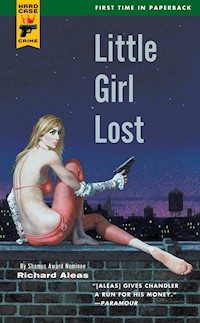
Miranda Sugarman was supposed to be in the Midwest, working as an eye doctor. So how did she end up dead on the roof of one of New York City's seediest strip clubs? Ten years earlier, Miranda had been P.I. John Blake's lover. Now he has to uncover her secret life as a strip tease queen. But the deeper he digs, the deadlier the danger... until a shattering face-off in an East Village tenement changes his life forever. Little Girl Lost - is the stunning debut novel from Richard Aleas, a writer whose stories have been selected for the Best Mystery Stories of the Year and The Year's Best Horror Stories. It was nominated for both the Edgar and Shamus Awards for Best First Novel.
Das E-Book können Sie in Legimi-Apps oder einer beliebigen App lesen, die das folgende Format unterstützen:
Veröffentlichungsjahr: 2011
Ähnliche



















I heard someone pick up and Roy took the phone. He was still holding tight to the front of my jacket with one huge fist.
“Mr. Khachadurian? This is Roy from the club. Yes. I’m with John Blake, he says you — Yes, in his apartment. Wayne did. Because he’s sticking his nose — He’s hanging around the club, he’s bothering the girls — No, I haven’t. Yes. Yes. Yes, I understand.” He slammed the phone down.
He pulled me close again. “You’re one lucky son of a bitch,” he said. He shoved me back and my knees buckled against the bed. I went sprawling. Then he was standing above me, blocking what little light came in through the window. I didn’t see his fist come down, but I felt it as he buried it deep in my belly.
“Murco,” I croaked.
“I don’t work for Murco,” he hissed. “I work for Wayne Lenz.” An uppercut slammed against the underside of my chin, snapping my head back against the mattress. “That’s first of all. Second, I don’t like getting sprayed in the eyes.” One more punch, this one aimed at my groin. I turned and caught it on my hip.
“He’ll kill... he’ll kill you.” I could barely get the words out.
“Well, now, that’s third,” he said, and I could hear the satisfaction in his voice. “The man said don’t do any permanent damage. Didn’t say don’t hit you.” The next blow caught me in the side of the head. After that, I didn’t feel the rest, just heard them as they landed...
SOME OTHER HARD CASE CRIME BOOKS YOU WILL ENJOY:
MONEY SHOT by Christa Faust
ZERO COOL by John Lange
SHOOTING STAR/SPIDERWEB by Robert Bloch
THE MURDERER VINE by Shepard Rifkin
SOMEBODY OWES ME MONEY by Donald E. Westlake
NO HOUSE LIMIT by Steve Fisher
BABY MOLL by John Farris
THE MAX by Ken Bruen and Jason Starr
THE FIRST QUARRY by Max Allan Collins
GUN WORK by David J. Schow
FIFTY-TO-ONE by Charles Ardai
KILLING CASTRO by Lawrence Block
THE DEAD MAN’S BROTHER by Roger Zelazny
THE CUTIE by Donald E. Westlake
HOUSE DICK by E. Howard Hunt
CASINO MOON by Peter Blauner
FAKE I.D. by Jason Starr
PASSPORT TO PERIL by Robert B. Parker
STOP THIS MAN! by Peter Rabe
LOSERS LIVE LONGER by Russell Atwood
HONEY IN HIS MOUTH by Lester Dent
QUARRY IN THE MIDDLE by Max Allan Collins
THE CORPSE WORE PASTIES by Jonny Porkpie
Little Girl LOST
byRichard Aleas
A HARD CASE CRIME BOOK
(HCC-004)
First Hard Case Crime edition: October 2004
Published by
Titan Books A division of Titan Publishing Group Ltd 144 Southwark Street LondonSE1 0UP
in collaboration with Winterfall LLC
Copyright © 2004 by Winterfall LLC. All rights reserved.
Cover painting copyright © 2004 by Robert McGinnis
All rights reserved. No part of this book may be reproduced or transmitted in any form or by any electronic or mechanical means, including photocopying, recording or by any information storage and retrieval system, without the written permission of the publisher, except where permitted by law.
This book is a work of fiction. Names, characters, places, and incidents either are the products of the author’s imagination or are used fictitiously, and any resemblance to actual events or persons, living or dead, is entirely coincidental.
Print edition ISBN 978-0-85768-315-1
E-book ISBN 978-0-85768-382-3
Design direction by Max Phillips
www.maxphillips.net
The name “Hard Case Crime” and the Hard Case Crime logo are trademarks of Winterfall LLC. Hard Case Crime Books are selected and edited by Charles Ardai.
Visit us on the web at www.HardCaseCrime.com
For Naomi
TABLE OF CONTENTS
Chapter 1
Chapter 2
Chapter 3
Chapter 4
Chapter 5
Chapter 6
Chapter 7
Chapter 8
Chapter 9
Chapter 10
Chapter 11
Chapter 12
Chapter 13
Chapter 14
Chapter 15
Chapter 16
Chapter 17
Chapter 18
Chapter 19
Chapter 20
Chapter 21
Chapter 22
Chapter 23
Chapter 24
Chapter 25
Chapter 26
Chapter 27
Chapter 28
Chapter 29
Chapter 30
Chapter 1
The headline made me sit down when I read it, that and the picture next to it and the article that spilled out over two columns underneath.
After I finished, I spread the paper out on the table, flattened it down with both hands, and stared at the photo. I wasn’t reading, not any more, just watching the girl in the photo stare back at me, a big smile on her face, all her teeth showing, her eyes squinting against the photographer’s flash, blond bangs hanging down under the peak of her mortarboard cap. That was one of two photos the paper had run; the other was on page nineteen, where the article continued. I didn’t turn to page nineteen, not again, just stood up, bearing down on the table, leaning on my fists, and looked at her. The strangest thought came to me then: I thought about the bird.
It was made of styrofoam, with a yellow-and-red coating on it meant to look like feathers, a black plastic beak, and wire feet twisted into claws at the ends. I found it in the incinerator room at the end of the hall, in a balsa wood cage balanced on the rim of the slop sink. I’d come out to throw out the kitchen garbage for my mother, so I went ahead and dragged the door to the incinerator open and let the knotted plastic bag slide down the chute. But my eyes were on the bird, the shoddy styrofoam bird in its shoddy wooden cage.
One of our neighbors must have thrown it out, either the Tolberts or the Nelsons or Mrs. Knechtel in 14-D. No one would mind if I took it. My mother complained that it was filthy, but it wasn’t, not very, and when I promised to wash it off, she said she’d let me keep it.
My father put a hook in the side of my bookcase and hung the cage on it, higher up than I could reach, and it stayed there, where I could see it every time I lay in bed, for the next ten years. My father left us somewhere along the way, but the bird stayed.
When Miranda Sugarman finally let me sleep with her, she did it looking up at that bird, a ten-year accumulation of dust mottling its coat, the cage splitting where the hook bit into the wood. It was the night before we graduated from high school and only a week before she would leave New York for summer school in Los Alamos, where she hoped to get a head start on the pre-med courses that would put her on track for a career as an optometrist, or an ophthalmologist, I could never remember which.
But that night I remember. I remember her eyelids trembling as she kissed me and how, afterwards, she weaved her fingers into my hair and pulled my head to her chest. I remember the curve of her shoulders as she leaned over the side of the bed to pick her glasses up off the floor. I remember listening to her heart as it hammered slower and slower against her ribs. Her chest was sticky with perspiration and so was my cheek, and we lay like that for a long time.
Out of nowhere she said, “I hate that thing. That bird. I really do.”
I followed her glance and it was as though I were noticing the cage up there for the first time. It was an ugly, god-awful thing. I couldn’t remember why I’d ever wanted it. I stood on tiptoe to get it down, wobbling a little as blood rushed to my head. Miranda laughed and I felt her hands around my waist, trying to hold me back, but I carried the cage out to the living room and she followed, my blanket wound around her body. She hissed at me as I unlocked the front door — “You’re naked!” — but she held the door for me and I walked out into the hall, past 14-B and 14-C and 14-D. The door to the incinerator room squeaked as I opened it and again, once I’d put the cage on the edge of the sink, when I let it slam shut.
I walked back, all the length of that long hall, to where Miranda waited wrapped in my blanket, a look of mischief and delight shining in her face; and at the last instant, while a neighbor might still have opened the door and seen her, she opened the blanket and let it fall to her feet.
A sign of things to come? I didn’t see it that way then. I only knew, in that instant, and maybe only for that instant, that I loved her: loved her as only an eighteen-year-old escaping from virginity and high school in the same night can. We swept the blanket under us. It didn’t matter to us that we were in my mother’s living room. We struggled to be silent, and failed. Thankfully, my mother didn’t wake up — or, if she did, she was discreet enough to stay in her bedroom with the door closed. Or if she wasn’t, we never noticed.
The following afternoon, as I mounted the stage to the sound of our music teacher pounding out “Pomp and Circumstance” on the piano, I was struck by a thought. Last night, I’d left the bird in exactly the same place I’d found it ten years earlier, in more or less the same position on the edge of the sink. And despite the decade that had passed, we still had all the same neighbors. One of them was the person who had thrown the thing out in the first place. What a shock it would be, I thought, what a Twilight Zone kick in the head, if the same neighbor who had thrown the bird out all those years earlier happened to walk into the incinerator room today and see it there, exactly as he or she had left it ten years ago. What would it be like? To think that you have safely disposed of something, that for better or worse it is out of your life forever, and then to walk into a room ten years later and find it there again, staring you in the face?
I saw Miranda for the last time a week later. She went away, and despite the best intentions on both sides we didn’t stay in touch. I didn’t know what happened next in her life, but I could imagine: after college, she settled down into a safe, sensible, hard-working Midwestern life, turned into a damn good doctor, while I — I stayed in New York and turned into what New York turns people into.
That was where I thought the story ended. And it was — until I walked into a room ten years after our graduation and saw Miranda Sugarman’s yearbook photo staring at me out of the Daily News under a headline that said “Stripper Murdered.”
Chapter 2
Visiting a strip club in the middle of the day is like visiting a well-lit haunted house. The magic, such as it is, is gone. At night, the Sin Factory was probably decked out like a casino, with a flashing marquee and a tuxedoed bouncer checking IDs at the door. Maybe even a velvet rope to make the patrons feel special when they were let in. But at three in the afternoon there was no one at the door, the neon was turned off, and even the beat of the music leaking out into the street sounded sluggish and half-hearted.
Under glass in a frame on the door were photos of this week’s featured performers, Mandy Mountains and Rachel Firestone. In her photo, Mandy was cradling breasts some mad doctor had built for her out of equal measures of silicone and cruelty. Rachel’s photo showed a thin brunette straddling a chair backwards, her bare breasts peeking out between the slats. Judging by their shape, hers had gone under the knife as well, but next to Mandy’s, Rachel’s breasts looked almost modest. Either to keep the cops from complaining or to keep passers-by from getting too much of the show for free, management had stuck tiny silver stars over each woman’s nipples. Along the top of the frame, a printed card announced the dates on which each woman would be appearing. Rachel had more than a week left, but tonight was Mandy’s last night.
I pulled the door open. The place was smaller than most strip clubs I’d seen, just a single, narrow room with a bar against one wall and a tiny wooden stage at the far end. Mirrors on all the walls struggled to make the place and the crowd it held seem larger, but the attempt was a failure. The stools at the bar were all empty, the crowd consisted of two men on opposite sides of the stage, and the mirrors weren’t fooling anyone.
Behind the bar, a woman was wiping glasses and racking them overhead. She was wearing an open black jacket over a lace-trimmed black bustier that gave her deep cleavage. Her chest couldn’t have been on display more if she’d been holding her breasts out to me on the palms of her hands. Her blonde hair was pulled back with an elastic band and her nails were painted the color of a cosmopolitan.
I sat on a stool and asked for club soda when she came over. She thumbed one of the buttons on her dispenser and tossed in a plastic stirrer and a piece of lime while the glass filled. “Just so you know,” she said, “it’s a twodrink minimum to watch the show. Doesn’t matter if you order club soda, I’ve got to charge you for wine.”
“And how much is wine?”
“Ten dollars a glass.”
I took a handful of bills out of my pocket, picked out a twenty and a five and put the rest back. “Must be pretty good wine.”
She tapped a few spots on the screen of her cash register and then the tray shot out and my twenty disappeared inside. The five went in the pocket of her jacket.
“You can take the glass with you. Just wave when you want another.”
“That’s okay,” I said. “I’ll stay here.”
“Suit yourself.” She resumed her work with the glasses, drying them and tucking them away in the overhead rack.
From the far end of the room came the sound of light applause from one of the patrons. The song had ended, and in the interval before the next one began the girl onstage padded around softly, swinging her hips awkwardly in time to the silence. She was neither Mountains nor Firestone, but like the headliners she was topless and looked surgically enhanced. She also looked exhausted, but apparently there wasn’t another girl to relieve her, so she kept on dancing, or anyway making enough of an effort to keep the air moving onstage.
The man seated to her left looked like a Wall Streeter on his lunch break, except that it was three in the afternoon and we were on west Twenty-fourth Street. He had an empty beer glass in front of him and a small pile of dollar bills soaking in a spill next to it. His tie was flung back over his shoulder and he kept taking his glasses off to wipe them with a paper napkin.
On the other side of the stage was the guy who had clapped at the end of the last song, and now he clapped again as the next song began. But between the beginning and end of each song, he showed his appreciation in a different way: as I watched, his hand stole into his pants through his open zipper.
I caught the bartender’s attention. “Doesn’t bother you that our friend there is jerking off?”
“Why? Does it bother you?”
“It’s not my club.”
“It’s not mine either,” she said.
“Yeah, but you’re going to have to wash his glass.”
“You want to call him on it, be my guest,” she said. “Far as I’m concerned, as long as he keeps it in his pants, it’s between him and whoever does his laundry.”
I held my hands up. “Fair enough.”
She topped off my drink, even though I had only taken a sip. “It’s disgusting,” she said softly, leaning forward to say it into my ear. “But, you know, this isn’t exactly Scores here.”
That was putting it mildly. There was top drawer and there was second rate in New York the same as anywhere else, but this wasn’t even second rate, it was tenth rate. Scores was a “gentleman’s club” where, between dances, you could get rare prime rib and watch hockey games on flat-screen TVs. A notch or two down, strip clubs like Flashdancers and Private Eyes dispensed with the steak but still had large dance floors and pretty girls in nice costumes, and gave the impression that they cared about the impression they gave. The Sin Factory was another animal altogether. It hurt to picture Miranda working here.
“Let me ask you something.”
“I don’t date customers.”
“That’s not it. I think you knew a friend of mine. She used to work here as a dancer.”
“Yeah? Who’s that?”
I drank some of my club soda. “Miranda Sugarman.”
I watched as the muscles under the skin of her face tightened. “What are you, a cop or a reporter?”
“Neither,” I said. “Just a friend of Miranda’s.”
She was trying to make up her mind whether to talk to me or throw me out of the place.
“We went to high school together,” I said. “Ten years ago. She was my girlfriend.”
The bartender shook her head. “I’m sorry, but I didn’t know her.”
“The paper said she was dancing here.”
“A lot of girls dance here.” She shot a glance at the dancer on the stage. “That one up there now, she’s been here at least as long as your girlfriend was. But I don’t know her. All I know is she calls herself ‘Star,’ and every day she complains about how cold it is in the dressing room.”
“Is it cold?”
“Like fucking Alaska.”
I stirred the ice in my glass. “What did Miranda call herself when she worked here?”
“Randy,” she said. “I didn’t even know her real name was Miranda. If you’d have asked me, I’d have guessed it was anything but Miranda, because why pick a stripper name that’s short for your real name? I didn’t know her any better than I know you.”
“You never spoke to her?”
“Sure — hello, how are you, how was your Thanks giving. Sometimes she’d be at the Derby when some of us got a bite after closing. But that was it.”
“How long had she been working here?”
“I don’t know, a few months? Look, I’m not going to be able to help you, I’m sorry.”
“That’s okay,” I said. I got up to leave. “The thing is, the last time I saw her, she was heading off to college to become a doctor. I’m just trying to understand how she got from there to here.”
“A doctor,” the bartender said. “Jesus. All I ever gave up was being a model.”
“Yeah. Well.” I drank the rest of my soda. “Thanks for the wine.”
The sunlight blinded me when I walked outside — I’d almost forgotten it was still day. This time of year, it wouldn’t be for much longer, and once the night came, the crowds would come with it. Business would normally be light the day after New Year’s, but tonight I imagined the Sin Factory would get an extra boost from rubberneckers drawn by the story in the paper. The murder had taken place on the roof, and unless I’d missed something there was no way for patrons to get up there, but that didn’t mean people wouldn’t show up and try. Maybe Mandy Mountains would make a little extra on her last night in town, and if her shift hadn’t ended yet, maybe that bartender would as well. But none of it would do Miranda any good.
Was that what I was trying to accomplish? I thought about this as I made my way to the subway station at Twenty-third Street. If it was, I was in for a disappointment, because nothing would do Miranda any good any more.
The 1 train carried me up to Eighty-sixth Street and from there I walked back two blocks. The red brick apartment building Miranda had lived in when we were in high school was still there, though the synagogue next to it was now a youth center with construction paper Christmas trees taped to the inside of the windows. If anyone could explain what had happened to Miranda, I figured it would be her mother — and even if she couldn’t, she deserved a visit.
But when I asked in the lobby to be buzzed up, the doorman didn’t know who I was talking about. Mrs. Sugarman? There was no Mrs. Sugarman in this building. 8-C? That was the Bakers. Look — And sure enough, on the intercom panel, a label said “Baker” where it had once said “Sugarman.”
“You used to have a tenant named Sugarman,” I said. “Is there anyone still on staff here who was working here ten years ago?”
He thought about it. “The super, maybe. You want to talk to him?”
I told him I did.
The super was a short man with a potbelly the size of a soccer ball and untrimmed grey hair around his ears. When I’d seen him last he’d had more hair, but it had already been grey. He’d just been a porter then, but seniority had apparently pushed him up the ladder. He jabbed a finger at me when he saw me and his face lit up. “Look at you! All grown up! How are you?”
I shook his hand and he dragged me into a hug. “I heard about the girl. It’s terrible. Terrible. The only good thing is her mother didn’t live to see it.”
“What happened?”
He stepped back. “You don’t know? New Year’s Eve, somebody shot her.”
“To her mother,” I said. “What happened to Mrs. Sugarman?”
“Oh, that — that was terrible, too,” he said, shaking his head. “Poor woman, six, seven years ago. Heart attack. She was young — fifty-six, I think. But one minute to the next, just like that.” He snapped his fingers. “She was trying on clothing at a store and—” He snapped his fingers again. “They found her on the floor, nothing they could do.”
Six, seven years. I did the math. Miranda would just have been finishing her bachelor’s degree, or maybe not even. I tried to imagine what it must have been like for her, alone, half a continent away, her only living relative suddenly gone.
“Did Miranda come back when it happened?”
“I didn’t see her. All I know is when it’s the end of the month, there’s no rent check, and the building tells us clean it out. We threw out a lot of stuff — a sofa, table, shelves. Books, lots of books. Records. We put it all on the sidewalk, maybe someone sees something he likes, he takes it before the garbage truck comes. We paint, put in a new stove, new refrigerator. The Bakers moved in two, three weeks later.”
“And you never saw Miranda again?”
“Never. Never. Except now, in the paper.”
A dead end. But maybe it was also the beginning of an explanation, since whatever money Mrs. Sugarman had left Miranda, it couldn’t have been a lot. And when you think about young women who start stripping, there’s usually money at the root of it. Here was Miranda with maybe a year left on her undergraduate degree and a dream of going to medical school, and suddenly the single-income parent supporting her vanishes, taking the support with her. Maybe the school offered Miranda financial aid, or maybe it didn’t, but either way there were living expenses to be paid, and what does an attractive twenty-year-old girl taking classes all day have to make money with other than her body at night? Oh, there were other answers, of course. She could have taken night-hour temp work filing and faxing for a law firm, or she could have flipped burgers for McDonald’s. But where else could you pull down a few hundred dollars in a night, all cash? Stripping might have been the sensible, conservative alternative to turning tricks.
But this was all speculation. There had to be someone who knew what had really happened. Someone she’d known in college, someone she’d stayed in touch with from high school, someone she’d confided in when she’d returned to New York. Someone I could find if I looked hard enough.
The super reached up to put his arm across my shoulders. “So, what are you doing now? Still in school?”
“No,” I said, “not for years now. I’m working.”
“You work for a big company? Bank? Computers?”
I shook my head. “Small company. Investigations.”
“What’s that?”
“I’m a private investigator.” His expression said the penny hadn’t dropped yet. “A detective,” I said.
“No!” He looked like he was waiting for me to laugh, tell him I was pulling his leg. I didn’t. “Yes? Like in the movies?”
“Sure,” I said. “Just like in the movies.”
Chapter 3
On the way home, I stopped in at the office. Leo was there, going through his files. He had five piles of paper on his desk and two on the floor next to his chair. The trashcan was overflowing. My desk was neat by comparison: just one stack of case documents and half-finished paperwork and a second, smaller pile of correspondence, junk mail, and phone messages. I glanced at the messages; none was more recent than a week ago. It’s not just the strip club business that slows down around the holidays.
“You go there?” Leo said without looking up from his work.
“I went.”
“And?”
“It’s a dive. Little hole in the wall, barely enough room for a stage. It just doesn’t make sense.”
“What doesn’t make sense?”
“None of it makes sense, Leo. What’s she doing back in New York, working as a stripper? This is a girl who... she didn’t have to be a doctor. If that didn’t work out there were plenty of things she could have done.”
He didn’t say anything.
“Okay, say she falls on hard times, she starts stripping. Somehow she ends up back in New York. Say that’s all true. But why the hell does she end up at a place like the Sin Factory? She was too smart to work there.”
“When did they start screening dancers for their IQ?”
“I just mean she would have known better. Fine, you need money, you’re an attractive woman, maybe you start dancing a few nights a week — but you don’t do it at a place like that, where you’re lucky if someone tips you in fives instead of ones.”
“Maybe she couldn’t get work anywhere better.”
“No, I don’t buy that. She had the figure for it; she could have worked anywhere she wanted.”
“Says the man who hasn’t seen her in ten years.” Leo put down the report he was working on and dropped his glasses on top of it. “You’re going to have to face facts, Johnny. She could have been strung out, worn down, overweight, out of her mind, she could have been a lousy dancer, you don’t know.”
“She was a good dancer,” I said.
“Ten years ago. You don’t know what she was now.”
No, all I knew she was now was dead.
“I’m not asking you to help,” I said.
“I’m not offering.”
“I know it’s a waste of time.”
“Your time’s my time, in case you’ve forgotten.”
“So what’s the big case you want me to work on instead? This?” I held up the phone messages. “A guy pretends to have a limp so he can collect disability from his employer?”
“It pays the bills.”
“Barely. And anyway I already got the photos. What’s left is just clean-up.”
“What about Leventon?”
“Leventon can wait.”
“She’s a paying customer.”
“And she can wait. A woman’s dead, Leo, someone who meant a lot to me. You can’t tell me to sit back and do nothing.”
“What do you think you can do?”
“I don’t know,” I said. “But I’ve got to do something. What’s the point of being a detective if when something like this happens you just let it?”
“Who said there was a point? It’s a living, like being a dentist or fixing shoes. That’s all it is.”
“You don’t believe that,” I said. “I certainly hope you don’t.”
“We’re private investigators. We’re not cops. We don’t solve murders. That’s paperback novel stuff.”
“At least let me look into it for a few days. I need to put it to rest, Leo. I can’t do that without knowing more.”
He smeared one hand across his jaw, a gesture of defeat. “You never could,” he said.
Leo Hauser was twice my age and looked older. Looking at him, you couldn’t picture him as the beat cop he’d been in the seventies, walking the streets of Times Square before Disney and Giuliani made it the oversized shopping mall it was today. But he’d shown me pictures, and by God, the uniform had fit him, he’d had good posture and a steely gaze, and if that wasn’t enough to make people take him seriously there’d been the couple of pounds of iron in a holster on his hip. Today — today he not only didn’t look like a cop, he didn’t look like the private detective he’d become. He looked like an accountant. His hair had gone white, where it hadn’t just gone. You looked at him in his twelve-dollar shirts, with his glasses propped on the top of his head, and you saw an uncle at a barbecue.
But Leo was the man who had taught me this business, and along the way I’d seen what he was capable of. A lot of the time when we were hired it was by a corporation that just wanted a background check on someone they were thinking of hiring — that was the bulk of any small agency’s business these days, and you did it over the phone or on the computer. But sometimes there was serious legwork to be done, and he’d done his share of it, chasing down leads and confronting the people behind them. Not recently, not so much since Arlene died — that had taken some of the chase out of him. But even now he’d insist on coming with me on a job every so often. I used to think it was his way of checking up on me, keeping an eye on the half-assed literature major he’d pulled out of NYU and tried to turn into a detective, but eventually I realized it was just his way of keeping his hand in.
When I’d shown him the article about Miranda, he’d warned me to leave it alone, and I knew he was speaking from experience. “You won’t like what you find. I’ll tell you that right off the bat. Whatever you find out about her, you’ll wish you hadn’t.”
“I already wish I hadn’t,” I said. “I wish she was still alive, raising two kids and practicing optometry in Wisconsin. And I wish I was there with her. But what does any of that matter? I’m here, she’s here, and somebody put a fucking bullet in her. I can’t just sit around and wait to read about it in the paper.”
“Better than ending up in the paper yourself.”
“I won’t.”
“Better not,” Leo said. “I’m too old to start again with some other kid.”
I picked up a sandwich at the Korean grocery on the corner and ate it on the way home. The wind had picked up as the sun had gone down and now there was no mistaking what season we were in. People complain more about New York in the summer, the heat of August, the humidity, the clothing sticking to your back, but it’s the winter that always makes me think about packing it in. Everything that’s wrong with the city is still wrong in the winter, only you’ve got the wind chill factor to think about, too.




