


0,49 €
Niedrigster Preis in 30 Tagen: 0,00 €
Niedrigster Preis in 30 Tagen: 0,00 €
Mehr erfahren.
- Herausgeber: Musaicum Books
- Kategorie: Geisteswissenschaft
- Sprache: Englisch
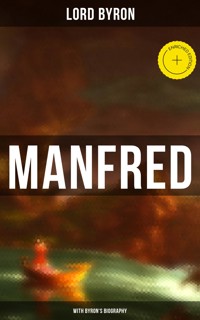
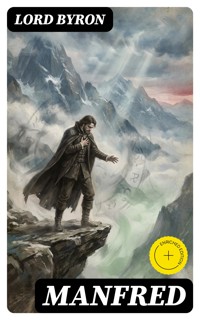
Lord Byron's 'Manfred' is a poetic drama that explores the complexities of the human soul, blending elements of Romanticism and Gothic literature. The story follows the protagonist, Manfred, as he grapples with guilt, existential questioning, and a desire for knowledge that leads him to make a pact with dark powers. Byron's evocative language and vivid imagery create a haunting atmosphere that captivates readers and delves into themes of individualism, morality, and the supernatural. Set against the backdrop of the Swiss Alps, 'Manfred' is a powerful exploration of human emotions and the struggle for transcendence. Byron's poetic style and dramatic dialogue add layers of depth to the narrative, making it a compelling and thought-provoking read. This edition of 'Manfred' also includes a biography of Lord Byron, shedding light on the author's life and influences, providing valuable insights into the context of the work. Recommended for readers interested in Romantic literature, Gothic fiction, and philosophical introspection. In this enriched edition, we have carefully created added value for your reading experience: - An Introduction draws the threads together, discussing why these diverse authors and texts belong in one collection. - Historical Context explores the cultural and intellectual currents that shaped these works, offering insight into the shared (or contrasting) eras that influenced each writer. - A combined Synopsis (Selection) briefly outlines the key plots or arguments of the included pieces, helping readers grasp the anthology's overall scope without giving away essential twists. - A collective Analysis highlights common themes, stylistic variations, and significant crossovers in tone and technique, tying together writers from different backgrounds. - Reflection questions encourage readers to compare the different voices and perspectives within the collection, fostering a richer understanding of the overarching conversation.
Das E-Book können Sie in Legimi-Apps oder einer beliebigen App lesen, die das folgende Format unterstützen:
Veröffentlichungsjahr: 2020
Ähnliche











Manfred (With Byron's Biography)
Published by
Books
Table of Contents
Introduction
Curatorial Vision
This collection brings together Manfred by Lord Byron and The Life of Lord Byron by John Galt to illuminate the dynamic between imaginative creation and narrated life. Read side by side, the dramatic introspection of the poem and the measured account of the man frame a single inquiry: how an author’s persona, choices, and reception converse with the figures he casts in verse. The aim is not to collapse art into biography, but to reveal their mutual pressure. By assembling both works, the volume encourages a cross-reading seldom undertaken when each title circulates alone.
Manfred embodies a searching meditation on autonomy, guilt, and the limits of human aspiration, shaped within a dramatic poem that stages inward conflict. Galt’s Life of Lord Byron surveys the public trajectory of the poet, portraying achievements and controversies through narrative prose. The through-line uniting them is a philosophical investigation of selfhood under strain: the will to defy constraint, the cost of defiance, and the longing for release that follows. Bringing these strands together highlights how existential questions posed in art reverberate across an author’s lived circumstances without reducing either work to a mere explanation of the other.
The curation foregrounds a central Romantic tension: inward liberty against outward obligation. Manfred articulates an uncompromising desire for self-mastery, while the biography traces the social consequences of a poet who embodied such impulses in conduct and career. Taken together, the works offer a composite portrait of responsibility, remorse, and resistance, inviting consideration of how imagination both challenges and mirrors worldly demands. The purpose is to guide readers toward patterns that become clearer in juxtaposition, including the rhythm of flight and return, solitude and scrutiny, confession and reticence, that circulates through the poem and through the life Galt recounts.
This gathering differs from presenting each work in isolation because it frames a dialogue rather than a sequence of separate encounters. Instead of approaching the poem as purely aesthetic or the biography as purely documentary, the set proposes a shared horizon where each refracts the other’s claims about truth and performance. It aims to expose assumptions that arise when either text is read alone, encouraging a recalibration of emphasis and tone. By situating artistic self-fashioning alongside narrative portraiture, the collection invites a layered understanding unavailable through single-work study, without privileging one genre over the other.
Thematic & Aesthetic Interplay
Manfred speaks in heightened verse marked by invocation, renunciation, and restless inquiry, while Galt writes in a composed, observational register. This tonal contrast generates a productive tension: the poem dramatizes the pressure of desire and remorse; the biography contextualizes such intensities within a life structured by choices, relationships, and public scrutiny. Each form delivers a way of knowing. The dramatic poem tests moral possibilities through staged utterance and confrontation; the biography traces continuity and consequence. Read together, they reveal how posture can be both authentic expression and crafted stance, and how narrative distills turbulence into coherence.
Recurring motifs echo across the works: isolation answered by summons to speak; the search for limits of human will; the burden of knowledge difficult to share or bear. In Manfred, voice becomes a theatre of conscience, measured against forces that resist coercion. In the biography, the public sphere becomes a different theatre, regulating reputation and memory. Symbols of ascent and descent, night and dawn, withdrawal and return, shift meaning as they pass between verse and prose. The poem’s intensity becomes legible as one register of a broader dialectic that Galt’s narrative spreads across time and circumstance.
The moral dilemmas at stake converge on agency and answerability. Manfred asserts the right to determine his fate, yet the very assertion exposes obligations he cannot entirely refuse. Galt’s portrayal of Byron brings these tensions into relief by charting how assertion plays out amid alliances, expectations, and accountability. Influence runs in both directions: the biography helps readers notice the poem’s negotiation with fame and judgment; the poem, in turn, conditions how a life story is perceived, highlighting the risks of reading character through art. Each text challenges the other’s explanatory reach, sustaining an unsettled but fruitful dialogue.
Formal differences reveal complementary aesthetics. The poem’s segmented scenes and concentrated lyric force condense experience into charged encounters, using silence and refusal as significant gestures. The biography’s continuity produces a long arc of causality, weighing moments without dramatizing every confrontation. Together, these approaches model two truths about experience: it appears as flashes of extremity and as sequences of consequence. The juxtaposition also clarifies how performative identity functions in multiple halls—on imagined stages and within social narratives. Through contrast, each work grants the other texture, showing how language can both unveil and veil what it most pursues.
Enduring Impact & Critical Reception
These works remain vital because they articulate questions that continue to organize modern experience: how far self-determination can go, what debts one owes to others, and how public visibility shapes private resolve. Manfred’s uncompromising tone meets Galt’s steady accounting, together presenting a composite inquiry into freedom and responsibility. Readers encounter not a conclusion but a frame for judgment, one that resists easy moralizing. The combined presence of poem and life-writing enables renewed attention to language, choice, and consequence, encouraging an ethical imagination attentive to complexity rather than certainty, and to persistence rather than closure.
In general reception, Manfred has stood as a concentrated expression of the defiant, self-interrogating figure often associated with Byron, while Galt’s biography has contributed to consolidating and questioning that image. Together they have shaped a durable conversation about the relationship between poetic character and lived character. Discussions of these works have recurrently addressed artistic autonomy, scandal and reputation, and the responsibilities of portrayal. Without adjudicating those debates, the collection re-centers a practical critical task: to weigh how aesthetic intensity and narrative explanation collaborate, compete, and sometimes correct one another in the ongoing making of cultural memory.
The cultural afterlife of these texts includes recurring reinventions on stage, in music, and in criticism, where Manfred’s voice and the biography’s portrait continue to provoke re-readings. Such afterlives testify to their adaptability: the poem invites reinterpretation through performance and setting, while the life narrative invites reassessment as new audiences gauge character and consequence. The sustained interest owes to a shared capacity to articulate crisis without dissolving it. Because the works engage both exalted aspiration and earthly reckoning, they provide a resource for artists and scholars who seek forms capable of bearing intensity and nuance.
Ultimately, the collection’s value lies in its invitation to reexamine the boundaries between poetics and life-writing. It shows how Manfred’s concentrated drama equips readers to hear Galt’s narrative with sharper ears for stance, gesture, and self-presentation, while the biography supplies coordinates that prevent the poem’s voice from floating free of history altogether. The lasting achievement of presenting them together is not synthesis but disciplined comparison. Such comparison keeps judgment active, safeguards complexity, and affirms the continuing relevance of Byron’s art and Galt’s portrayal as touchstones for thinking about the entanglement of creative will with human responsibility.
Historical Context
Socio-Political Landscape
Composed and published in the shadow of the post-Napoleonic settlement, Manfred enters a Europe reorganized by the Congress of Vienna and governed by suspicion of revolutionary contagion. Surveillance, censorship, and the consolidation of restored monarchies shaped the atmosphere in which a nobleman-turned-wanderer could be imagined resisting visible and invisible authorities. In Britain’s Regency era, aristocratic privilege coexisted with anxieties about legitimacy and public virtue. The author of Manfred, himself a peer, experienced the contradictions of elite status amid ideological retrenchment. John Galt’s The Life of Lord Byron later frames these tensions, offering a political contour to the private conflicts that the dramatic poem stylizes.
Public debate in early nineteenth-century Britain was mediated by an assertive periodical press that fused politics with entertainment. Reputation became a volatile currency, particularly for figures whose celebrity blurred boundaries between civic role and personal scandal. Manfred’s challenging tone resonated within this marketplace, appearing both as an aesthetic provocation and as an implicit critique of social hypocrisy. Galt’s biography, published after the author’s death, intervened in the same economy of judgment, supplying narrative evidence, chronology, and commentary. By assembling documents and anecdotes, Galt positioned readers to evaluate how a public figure’s conduct and convictions intersected with literary production during an era obsessed with moral exemplarity.
The dislocations of the Napoleonic Wars lingered as displaced soldiers, itinerant artists, and mobile aristocrats circulated through a Europe crowded with checkpoints and ruins. In 1816, extraordinary climatic anomalies darkened skies and unsettled crops, casting a spectral hue over continental travel. It is within this geography that Manfred situates its protagonist among Alpine precipices and cavernous depths, environments that mirror geopolitical and psychic instability. Galt’s The Life of Lord Byron records the author’s movements through these landscapes, converting itinerary into historical context. The poem’s dramatic solitude thus intersects with a broader culture of wandering shaped by war, diplomatic redrawing of borders, and atmospheric unease.
At home, Britain faced intensifying class tensions and demands for reform. Economic distress after demobilization, legal protection for grain interests, and urban crowding produced confrontations that alarmed the governing elite. The theater, too, was policed through licensing and managerial caution, which made experimentation risky. Manfred’s form as a dramatic poem, not written for conventional staging, sidesteps institutional control while appropriating the authority of drama. This literary choice signals awareness of cultural constraints without engaging their bureaucratic mechanisms. Galt’s biography, by narrating the author’s parliamentary status and social standing, clarifies how a privileged voice could critique the very mechanisms that sustained his order.
Religious authority remained a central pillar of public life, shaping education, charity, and the rhythms of social evaluation. Yet skepticism and reformist impulses pressed against the Church’s doctrinal and disciplinary boundaries. Manfred makes spiritual jurisdiction itself a topic of drama, testing whether ritual or office can reconcile a tormented conscience. Contemporary controversies over blasphemous libel and the legitimacy of heterodox belief amplified the poem’s resonance. When Galt recounts the author’s attitudes toward established faith and private scruple, he historicizes this friction between conscience and institution. The ethical drama of absolution and refusal thus appears not purely metaphysical but rooted in the contested authority of the period.
Across the Continent, national aspirations simmered beneath the restored diplomatic order. Calls for constitutional restraint, civil rights, and liberation from imperial rule spread in clandestine committees and public squares. Manfred’s rejection of subordination, though personal and metaphysical, echoed the rhetoric of autonomy circulating through Europe. Galt’s account of the author’s later commitment to Greek independence introduces a retrospective frame: the poem’s drama of self-command converses with subsequent political action. For readers, biography and poem together map a trajectory from internal revolt to outward engagement, revealing how literary iconography of defiance could be read beside real campaigns for sovereignty and civic dignity.
Intellectual & Aesthetic Currents
Manfred emerges from a Romantic valuation of inwardness, sublimity, and the solitary imagination. Mountain vistas, thunderstorms, and vertiginous spaces serve as emblems of states of mind rather than mere scenery. The poem’s dramatic architecture centers on confession and self-scrutiny, placing a single figure amid vast natural energies. Galt’s The Life of Lord Byron, by staging a life as drama, reinforces this emphasis on subjectivity as a public artifact. Biography and poem together exemplify an era that treated the self as both artwork and argument, inviting readers to weigh sensibility, will, and fate within an aesthetic that elevated emotion to philosophical significance.
The period’s appetite for the uncanny shaped the poem’s register. Manfred draws on occult vocabularies, ritual speech, and metaphysical disputation not to endorse superstition, but to dramatize the limits of empirical explanation. Intellectual curiosity about magnetism, vitality, and unseen forces haunted salons and laboratories, while skepticism tested every claim. The poem turns that curiosity into conflict, exploring whether knowledge can penetrate guilt or repair loss. Galt’s biography, attentive to the author’s reading and conversational range, situates such materials as part of a cultivated mind rather than mere theatrical ornament. The result is a portrait of a culture negotiating reason’s reach against the allure of mystery.
Formally, Manfred participates in a tradition of dramatic poetry designed for the page as much as the stage. Lyric intensity coexists with dialogue, producing a hybrid mode that privileges introspection over spectacle. This generic choice aligns with a readership increasingly accustomed to private consumption of performance through print. Galt’s work, by preserving drafts, recollections, and contemporaneous responses, illuminates the author’s experiments with genre as deliberate strategies. He shows how performance can be transposed into reading, and how the voice of a character becomes a chamber for philosophical debate. The poem thus stands at a crossroads where theater, lyric, and meditation converge.
Natural philosophy offered new scales of time and process that expanded what poetry could symbolize. Geology’s deep strata, glacial motion, and volcanic violence reimagined the Earth as history rather than static backdrop. Manfred’s Alpine setting carries these intimations of immensity, where rock and ice become metaphors for memory and endurance. Climatic disturbances after distant eruptions subtly shaped contemporary perceptions of sky and weather, sharpening attention to elemental agency. Galt’s biography embeds the author within travelling circles that traded observations of mountains, lakes, and storms. The interplay of scientific curiosity and poetic vision in both works reveals a culture learning to read nature as archive and oracle.
Aesthetically, the period cultivated a public image of the artist as principled outsider, fashioning identity through daring and candor. Manfred’s protagonist enacts this stance in moral and metaphysical terms, choosing self-authorship over submission. The Life of Lord Byron contributes to this construction by dramatizing choices, friendships, and labors in ways that emphasize coherence between life and art. Editorial selection, narrative pacing, and rhetorical framing all participate in myth-making. Yet the biography also registers cost and consequence, mapping how a celebrated persona exacts tolls on privacy and community. Together, poem and life trace the cultural economies of celebrity, sincerity, and dissent.
Legacy & Reassessment Across Time
Early readers encountered Manfred with a mix of admiration and alarm. Its daring engagement with guilt, power, and spiritual authority prompted questions about moral example. Some valued its high tragic temper; others worried about alluring defiance. When Galt’s The Life of Lord Byron appeared, it supplied a lens that organized these impressions, offering context for composition, travel, and conviction. The biography enabled a biographical reading of the poem without reducing it to confession, giving audiences a narrative scaffold for interpreting tone and stance. In the combined presence of text and life, judgment oscillated between aesthetic autonomy and ethical accountability.
Victorian culture, oriented toward respectability and social order, often read Manfred as an instructive spectacle in the dangers of uncompromising will. Anthologies and lectures highlighted penitence and responsibility, even when the poem resists conventional moral closure. Galt’s biography, repeatedly consulted for portraits of disposition and habit, was enlisted to show how temperament and circumstance shaped artistic choices. The pairing of poem and life furnished a case study in character, one that educators and clerics could cite as cautionary or exemplary according to their aims. The work’s arresting imagery remained, but its rebellious energies were sometimes reinterpreted as arguments for disciplined conduct.
As the nineteenth century progressed, emergent psychologies shifted attention from moral example to interior complexity. Manfred’s soliloquies invited analysis as case materials for obsession, grief, and self-division. Readers sought in its language the contours of a mind under strain. Simultaneously, biography as a genre professionalized, and Galt’s methods—rich in anecdote and direct reportage—came under scrutiny. His narrative was revalued: invaluable for immediacy, yet in need of corroboration. This tension refined how poem and life were paired, encouraging critics to distinguish between documentary record and interpretive frame while still acknowledging that Galt had preserved indispensable traces of a singular public figure.
Twentieth-century upheavals, especially global war, reframed Manfred’s defiance as a form of existential witness rather than aristocratic caprice. Readers learned to hear in its refusals an ethic of responsibility that balks at impure absolution. Galt’s biography, with its emphasis on action abroad and sacrifice for a cause, accentuated this shift: a movement from interior rebellion to outward commitment. The juxtaposition of poem and life let audiences consider whether personal integrity might require strategic separation from prevailing institutions. In classrooms and public lectures, the works together announced a modern theme: the dignity and danger of standing apart when collective endeavors threaten conscience.
Mid-century critical movements approached Manfred first as verbal artifact, bracketed from biography, then returned to context with renewed rigor. Close reading highlighted structural symmetries, imagery, and tonal modulation, insisting that the poem’s meanings are borne by form. Historicist critics later revisited Galt’s Life to test how the author’s experiences inflect those forms. Debate intensified over whether the poem encodes private scandal, transforms it into universal statement, or repudiates confessional decoding altogether. Galt’s text proved central to these arguments, simultaneously a source of evidence and an object of analysis for how narratives about authorship are constructed and circulated.
Contemporary reassessment presses in several directions at once. Ecocritical readings foreground the Alpine sublime alongside the era’s climatic disruptions, proposing that Manfred registers human limits within planetary scales. Transnational approaches read the work against routes of exile and return traced in Galt’s biography, linking aesthetic independence to mobility and precarious belonging. Digital editions and annotated reprints have renewed access to both texts, inviting broader publics to track revisions, sources, and reception. Ongoing debates address celebrity culture’s ethics: how admiration shades into intrusion, and how self-fashioning negotiates consent. Together, poem and biography continue to model the fraught reciprocity of art, life, and history.
Synopsis (Selection)
Manfred
A dramatic poem set in the Alps follows a tormented noble who summons elemental spirits yet remains haunted by an unnamed transgression he cannot expiate.
Confronting supernatural forces, social authority, and his own conscience, he seeks release on his own terms rather than through forgiveness granted by others.
The tone is austere and metaphysical, establishing the Byronic hero’s proud isolation amid sublime, Gothic landscapes.
The Life of Lord Byron by John Galt
An early biographical study that traces Byron’s upbringing, travels, literary ascent, public controversies, and later years abroad.
Galt blends anecdote with appraisal, sketching Byron’s temperament and relationships while gauging how society shaped—and was provoked by—his celebrity.
The perspective is observant and often cautionary, reflecting contemporary judgments even as it catalogs the poet’s creative range and public impact.
Across the Collection
Together, the works contrast an interior, self-fashioned myth with an outward, documentary portrait, inviting reflection on how art and life refract one another.
Pride, guilt, solitude, and defiance of external authority recur, with Manfred’s metaphysical struggle mirrored by biographical accounts of social conflict and self-fashioning.
The pairing highlights the Byronic hero as both literary construct and lived persona, setting lyrical introspection against the era’s moral and cultural scrutiny.
Manfred (With Byron's Biography)
Manfred
Hamlet, Act i. Scene 5, Lines 166, 167.
[Manfred, a choral tragedy in three acts, was performed at Covent Garden Theatre, October 29-November 14, 1834 [Denvil (afterwards known as "Manfred" Denvil) took the part of "Manfred," and Miss Ellen Tree (afterwards Mrs. Charles Kean) played "The Witch of the Alps"]; at Drury Lane Theatre, October 10, 1863-64 [Phelps played "Manfred," Miss Rosa Le Clercq "The Phantom of Astarte," and Miss Heath "The Witch of the Alps"]; at the Prince's Theatre, Manchester, March 27-April 20, 1867 [Charles Calvert played "Manfred"]; and again, in 1867, under the same management, at the Royal Alexandra Theatre, Liverpool; and at the Princess's Theatre Royal, London, August 16, 1873 [Charles Dillon played "Manfred;" music by Sir Henry Bishop, as in 1834].
Overtures, etc.
"Music to Byron's Manfred" (overture and incidental music and choruses), by R. Schumann, 1850.
"Incidental Music," composed, in 1897, by Sir Alexander Campbell Mackenzie (at the request of Sir Henry Irving); heard (in part only) at a concert in Queen's Hall, May, 1899.
"Manfred Symphony" (four tableaux after the Poem by Byron), composed by Tschaikowsky, 1885; first heard in London, autumn, 1898.]
INTRODUCTION TO MANFRED
Byron passed four months and three weeks in Switzerland. He arrived at the Hôtel d'Angleterre at Sécheron, on Saturday, May 25, and he left the Campagne Diodati for Italy on Sunday, October 6, 1816. Within that period he wrote the greater part of the Third Canto of Childe Harold, he began and finished the Prisoner of Chillon, its seven attendant poems, and the Monody on the death of Sheridan, and he began Manfred.
A note to the "Incantation" (Manfred, act i. sc. 1, lines 192-261), which was begun in July and published together with the Prisoner of Chillon, December 5, 1816, records the existence of "an unfinished Witch Drama" (First Edition, p. 46); but, apart from this, the first announcement of his new work is contained in a letter to Murray, dated Venice, February 15, 1817 (Letters, 1900, iv. 52). "I forgot," he writes, "to mention to you that a kind of Poem in dialogue (in blank verse) or drama ... begun last summer in Switzerland, is finished; it is in three acts; but of a very wild, metaphysical, and inexplicable kind." The letter is imperfect, but some pages of "extracts" which were forwarded under the same cover have been preserved. Ten days later (February 25) he reverts to these "extracts," and on February 28 he despatches a fair copy of the first act. On March 9 he remits the third and final act of his "dramatic poem" (a definition adopted as a second title), but under reserve as to publication, and with a strict injunction to Murray "to submit it to Mr. G[ifford] and to whomsoever you please besides." It is certain that this third act was written at Venice (Letter to Murray, April 14), and it may be taken for granted that the composition of the first two acts belongs to the tour in the Bernese Alps (September 17-29), or to the last days at Diodati (September 30 to October 5, 1816), when the estro (see Letter to Murray, January 2, 1817) was upon him, when his "Passions slept," and, in spite of all that had come and gone and could not go, his spirit was uplifted by the "majesty and the power and the glory" of Nature.
Gifford's verdict on the first act was that it was "wonderfully poetical" and "merited publication," but, as Byron had foreseen, he did not "by any means like" the third act. It was, as its author admitted (Letter to Murray, April 14) "damnably bad," and savoured of the "dregs of a fever," for which the Carnival (Letter to Murray, February 28) or, more probably, the climate and insanitary "palaces" of Venice were responsible. Some weeks went by before there was either leisure or inclination for the task of correction, but at Rome the estro returned in full force, and on May 5 a "new third act of Manfred—the greater part rewritten," was sent by post to England. Manfred, a Dramatic Poem, was published June 16, 1817.
Manfred was criticized by Jeffrey in the Edinburgh Review (No. lvi., August, 1817, vol. 28, pp. 418-431), and by John Wilson in the Edinburgh Monthly Magazine (afterwards Blackwood's, etc.) (June, 1817, i. 289-295). Jeffrey, as Byron remarked (Letter to Murray, October 12, 1817), was "very kind," and Wilson, whose article "had all the air of being a poet's," was eloquent in its praises. But there was a fly in the ointment. "A suggestion" had been thrown out, "in an ingenious paper in a late number of the Edinburgh Magazine [signed H. M. (John Wilson), July, 1817], that the general conception of this piece, and much of what is excellent in the manner of its execution, have been borrowed from the Tragical History of Dr. Faustus of Marlow (sic);" and from this contention Jeffrey dissented. A note to a second paper on Marlowe's Edward II. (Blackwood's Edinburgh Magazine, October, 1817) offered explanations, and echoed Jeffrey's exaltation of Manfred above Dr. Faustus; but the mischief had been done. Byron was evidently perplexed and distressed, not by the papers in Blackwood, which he never saw, but by Jeffrey's remonstrance in his favour; and in the letter of October 12 he is at pains to trace the "evolution" of Manfred. "I never read," he writes, "and do not know that I ever saw the Faustus of Marlow;" and, again, "As to the Faustus of Marlow, I never read, never saw, nor heard of it." "I heard Mr. Lewis translate verbally some scenes of Goethe's Faust ... last summer" (see, too, Letter to Rogers, April 4, 1817), which is all I know of the history of that magical personage; and as to the germs of Manfred, they may be found in the Journal which I sent to Mrs. Leigh ... when I went over first the Dent, etc., ... shortly before I left Switzerland. I have the whole scene of Manfred before me."
Again, three years later he writes (à propos of Goethe's review of Manfred, which first appeared in print in his paper Kunst und Alterthum, June, 1820, and is republished in Goethe's Sämmtliche Werke ... Stuttgart, 1874, xiii. 640-642; see Letters, 1901, v. Appendix II. "Goethe and Byron," pp. 503-521): "His Faust I never read, for I don't know German; but Matthew Monk Lewis (sic), in 1816, at Coligny, translated most of it to me viva voce, and I was naturally much struck with it; but it was the Staubach (sic) and the Jungfrau, and something else, much more than Faustus, that made me write Manfred. The first scene, however, and that of Faustus are very similar" (Letter to Murray, June 7, 1820, Letters, 1901, v. 36). Medwin (Conversations, etc., pp. 210, 211), who of course had not seen the letters to Murray of 1817 or 1820, puts much the same story into Byron's mouth.
Now, with regard to the originality of Manfred, it may be taken for granted that Byron knew nothing about the "Faust-legend," or the "Faust-cycle." He solemnly denies that he had ever read Marlowe's Faustus, or the selections from the play in Lamb's Specimens, etc. (see Medwin's Conversations, etc., pp. 208, 209, and a hitherto unpublished Preface to Werner, vol. v.), and it is highly improbable that he knew anything of Calderon's El Mágico Prodigioso, which Shelley translated in 1822, or of "the beggarly elements" of the legend in Hroswitha's Lapsus et Conversio Theophrasti Vice-domini. But Byron's Manfred is "in the succession" of scholars who have reached the limits of natural and legitimate science, and who essay the supernatural in order to penetrate and comprehend the "hidden things of darkness." A predecessor, if not a progenitor, he must have had, and there can be no doubt whatever that the primary conception of the character, though by no means the inspiration of the poem, is to be traced to the "Monk's" oral rendering of Goethe's Faust, which he gave in return for his "bread and salt" at Diodati. Neither Jeffrey nor Wilson mentioned Faust, but the writer of the notice in the Critical Review (June, 1817, series v. vol. 5, pp. 622-629) avowed that "this scene (the first) is a gross plagiary from a great poet whom Lord Byron has imitated on former occasions without comprehending. Goethe's Faust begins in the same way;" and Goethe himself, in a letter to his friend Knebel, October, 1817, and again in his review in Kunst und Alterthum, June, 1820, emphasizes whilst he justifies and applauds the use which Byron had made of his work. "This singular intellectual poet has taken my Faustus to himself, and extracted from it the strangest nourishment for his hypochondriac humour. He has made use of the impelling principles in his own way, for his own purposes, so that no one of them remains the same; and it is particularly on this account that I cannot enough admire his genius." Afterwards (see record of a conversation with Herman Fürst von Pückler, September 14, 1826, Letters, v. 511) Goethe somewhat modified his views, but even then it interested him to trace the unconscious transformation which Byron had made of his Mephistopheles. It is, perhaps, enough to say that the link between Manfred and Faust is formal, not spiritual. The problem which Goethe raised but did not solve, his counterfeit presentment of the eternal issue between soul and sense, between innocence and renunciation on the one side, and achievement and satisfaction on the other, was not the struggle which Byron experienced in himself or desired to depict in his mysterious hierarch of the powers of nature. "It was the Staubach and the Jungfrau, and something else," not the influence of Faust on a receptive listener, which called up a new theme, and struck out a fresh well-spring of the imagination. The motif of Manfred is remorse—eternal suffering for inexpiable crime. The sufferer is for ever buoyed up with the hope that there is relief somewhere in nature, beyond nature, above nature, and experience replies with an everlasting No! As the sunshine enhances sorrow, so Nature, by the force of contrast, reveals and enhances guilt. Manfred is no echo of another's questioning, no expression of a general world-weariness on the part of the time-spirit, but a personal outcry: "De profundis clamavi!"
No doubt, apart from this main purport and essence of his song, his sensitive spirit responded to other and fainter influences. There are "points of resemblance," as Jeffrey pointed out and Byron proudly admitted, between Manfred and the Prometheus of Æschylus. Plainly, here and there, "the tone and pitch of the composition," and "the victim in the more solemn parts," are Æschylean. Again, with regard to the supernatural, there was the stimulus of the conversation of the Shelleys and of Lewis, brimful of magic and ghost-lore; and lastly, there was the glamour of Christabel, "the wild and original" poem which had taken Byron captive, and was often in his thoughts and on his lips. It was no wonder that the fuel kindled and burst into a flame.
For the text of Goethe's review of Manfred, and Hoppner's translation of that review, and an account of Goethe's relation with Byron, drawn from Professor A. Brandl's Goethes Verhältniss zu Byron (Goethe-Jahrbuch, Zwanzigster Band, 1899), and other sources, see Letters, 1901, v. Appendix II. pp. 503-521.
For contemporary and other notices of Manfred, in addition to those already mentioned, see Eclectic Review, July, 1817, New Series, vol. viii. pp. 62-66; Gentleman's Magazine, July, 1817, vol. 87, pp. 45-47; Monthly Review, July, 1817, Enlarged Series, vol. 83, pp. 300-307; Dublin University Magazine, April, 1874, vol. 83, pp. 502-508, etc.
Manfred. Chamois Hunter. Abbot of St. Maurice. Manuel. Herman. Witch of the Alps. Arimanes. Nemesis. The Destinies. Spirits, etc.
The Scene of the Drama is amongst the Higher Alps—partly in the Castle of Manfred, and partly in the Mountains.
MANFRED. 106
ACT 1.
Scene 1.—Manfred alone.—Scene, a Gothic Gallery.107—Time, Midnight.
A star is seen at the darker end of the gallery: it is stationary; and a voice is heard singing.]
First Spirit.
Voice of the Second Spirit.
Voice of the Third Spirit.
Fourth Spirit.
Fifth Spirit.
Sixth Spirit.
Seventh Spirit.
The Seven Spirits.
(A voice is heard in the Incantation which follows.)117
Scene II.—The Mountain of the Jungfrau.—Time, Morning.—Manfred alone upon the cliffs.
Enter from below a Chamois Hunter.
As Manfred is in act to spring from the cliff, the Chamois Hunter seizes and retains him with a sudden grasp.




