


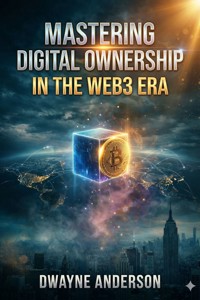
6,99 €
Mehr erfahren.
- Herausgeber: resourceinternet
- Kategorie: Fachliteratur
- Sprache: Englisch
The speculation is over. The real transformation has begun.
If you are reading this in 2025, you have lived through both extremes—the euphoria of early crypto speculation and the long, sobering reset that followed. When prices collapsed, the tourists left. What remained was something far more important: builders, infrastructure, and systems that actually work.
Mastering Digital Ownership in the Web3 Era is not a promise of quick riches. It is a strategic guide to the industrial phase of the digital economy, where ownership replaces access, systems replace hype, and value is engineered rather than imagined.
For decades, we believed we owned our digital lives—our money, our data, our identities. In reality, we were renters inside centralized platforms, dependent on permissions that could be revoked at any moment. That illusion is ending. A new model is emerging, one built on verifiable truth rather than institutional trust.
This book cuts through the noise to explain how digital ownership actually functions beneath the surface. It connects abstract crypto concepts to the real mechanics of on-chain settlement, programmable assets, and institutional-grade infrastructure.
Inside, you will explore how digital ownership is being rebuilt from the ground up—from separating custody and access, to the on-chain migration of real-world assets, to the rise of stablecoins as the settlement layer of a new financial system. You will see how decentralized infrastructure, regulatory clarity, and autonomous AI agents converge to form a system where value can move globally, instantly, and without intermediaries.
This is not a story about speculation returning. It is about systems stabilizing.
We are moving from platforms to protocols, from promises to proofs, and from permission to sovereignty. The question is no longer whether this transition will happen, but who will understand it early enough to participate intelligently.
Mastering Digital Ownership in the Web3 Era is your roadmap for navigating a world where value flows as freely as information—and where ownership finally means what it claims.
The future is no longer hypothetical.
It is already under construction.
Das E-Book können Sie in Legimi-Apps oder einer beliebigen App lesen, die das folgende Format unterstützen:
Veröffentlichungsjahr: 2025
Ähnliche









Table of Contents
Mastering Digital Ownership in the Web3 Era | Create, Own, and Navigate Value On Chain in the New Financial Era
Disclaimer and Revision Notice
Foreword
Introduction
Chapter 1 | What Digital Ownership Really Means Beyond NFTs
Chapter 2 | Web3 as Financial Infrastructure
Chapter 3 | On Chain Systems and Verifiable Truth
Chapter 4 | Tokenization in the Post Speculation Era
Chapter 5 | Real World Assets on Chain
Chapter 6 | Stablecoins and On Chain Settlement
Chapter 7 | Regulation Compliance and the CLARITY Act
Chapter 8 | Decentralized Finance After the Shakeout
Chapter 9 | DePIN and On Chain Infrastructure
Chapter 10 | On Chain Identity and Access
Chapter 11 | AI and Autonomous On Chain Systems
Chapter 12 | Programmable Ownership and Smart Contracts
Chapter 13 | Navigating Digital Ownership as an Individual
Chapter 14 | Risks Limitations and Unresolved Challenges
Conclusion | From Speculation to Systems The Ownership Era Has Begun
Mastering Digital Ownership in the Web3 Era
Create, Own, and Navigate Value On Chain in the New Financial Era
Foreword
Introduction
Chapter 1 :What Digital Ownership Really Means Beyond NFTs
Chapter 2: Web3 as Financial Infrastructure
Chapter 3 :On Chain Systems and Verifiable Truth
Chapter 4 :Tokenization in the Post Speculation Era
Chapter 5 :Real World Assets on Chain
Chapter 6 : Stablecoins and On Chain Settlement
Chapter 7 : Regulation Compliance and the CLARITY Act
Chapter 8 :Decentralized Finance After the Shakeout
Chapter 9 :DePIN and On Chain Infrastructure
Chapter 10 :On Chain Identity and Access
Chapter 11 : AI and Autonomous On Chain Systems
Chapter 12 :Programmable Ownership and Smart Contracts
Chapter 13 : Navigating Digital Ownership as an Individual
Chapter 14 :Risks Limitations and Unresolved Challenges
Conclusion
Disclaimer and Revision Notice
This book is provided for general informational and educational purposes only. It does not constitute financial, legal, investment, tax, or regulatory advice. The content reflects the author’s analysis and interpretation of digital ownership, on chain systems, and emerging financial infrastructure as part of a forward-looking examination of the industry. Readers should not rely on this material as a substitute for professional advice tailored to their individual circumstances.
Digital assets, on chain systems, and related technologies involve risk. Markets may be volatile, technologies may fail, and regulatory frameworks may evolve or change without notice. Readers assume full responsibility for their decisions and actions. The author and publisher make no representations or warranties regarding accuracy, completeness, or future outcomes.
This title was originally published in 2023. The current edition has been revised and updated to reflect developments and prevailing industry conditions through 2025. Revisions have been made to selected chapters to address changes in market structure, regulatory direction, and technological maturity, including updates to discussions on digital ownership, real world assets, stablecoins, decentralized finance, and on chain infrastructure.
Certain topics emphasized in earlier editions have been reduced or reframed to align with current realities.
References to laws, regulations, or policy initiatives are included for contextual and analytical purposes only. Certain regulatory frameworks discussed in this book, including the GENIUS Act, are referenced in a forward-looking or illustrative context. As of the time of writing, such legislation has not yet come into force and is expected to activate no earlier than 2027. These references do not assert current legal status and remain subject to legislative process, amendment, delay, or reinterpretation across jurisdictions.
Regulatory treatment of digital assets varies significantly by country and region. Readers are encouraged to verify applicable laws and regulatory requirements relevant to their jurisdiction before engaging in any related activity.
By reading this book, you acknowledge and agree that the author and publisher shall not be held liable for any losses, damages, or consequences arising from the use of, or reliance upon, the information contained herein.
Copyright © Dwayne Anderson
Foreword
History rarely moves in a straight line. It lurches. It explodes upward in fits of irrational exuberance, crashes down in devastating corrections, and then—when the smoke clears and the tourists have gone home—it begins the quiet, arduous work of building the future.
If you are holding this book in 2025, you are likely a survivor of the lurches. You remember the intoxicating highs of the early 2020s, when "digital ownership" was synonymous with flipping vibrant JPEGs for life-changing sums of money overnight.
You also remember the subsequent collapse, the domino effect of centralized failures masquerading as decentralized protocols, and the bitter taste of realized losses.
For a time, it felt as if the entire experiment had failed. The mainstream media wrote obituaries for Web3. Regulators sharpened their knives. The "crypto bro" became a cultural caricature of hubris and greed.
But while the prices collapsed, the blocks kept producing. Every ten minutes, like a heartbeat, the truth was verified. The infrastructure didn't break.
The speculators left, but the builders remained.
We are now entering a new phase. If 2017 was the "Proof of Concept" and 2021 was the "Speculative Frenzy," 2025 marks the beginning of the "Industrial Phase" of the digital economy.
This is the era where the technology grows up. It is the era where we stop talking about the novelty of the tools and start focusing on the necessity of their application. We are moving from a noisy casino to a global construction site. The shift is less glamorous, perhaps, but infinitely more consequential.
This book, Mastering Digital Ownership in the Web3 Era, arrives at precisely the right moment to document this tectonic shift. It is not a guide to getting rich quick. If that is what you seek, put this down and return to the lottery ticket lines of the remaining memecoin exchanges. This book is a manual for understanding the new operating system of the global economy.
To understand why this matters, we must first acknowledge the fundamental flaw of the internet's first two iterations. Web1 allowed us to read. Web2 allowed us to write and share—but in doing so, we inadvertently signed a Faustian pact. We traded our data, our attention, and our digital sovereignty for free access to walled gardens owned by a handful of corporate behemoths.
In Web2, you own nothing. Your social graph, your gaming assets, your audience, your financial transaction history—they are all entries in someone else's private database. You are a digital serf working land you do not hold title to.
You are dependent on the benevolence of terms of service that can change with a keystroke, de-platforming your livelihood or freezing your assets without due process.
Web3 is not merely about new digital money; it is about a fundamental restructuring of power and control in the digital realm. It is the reintroduction of property rights to the internet.
However, the definition of that "property" has matured significantly over the last few years. We are no longer just talking about collectible art or purely digital tokens. We are witnessing the financialization of everything.
We are entering the age of Real World Assets (RWA) moving on-chain. The next great migration is not people moving to the metaverse, but global capital moving onto blockchain rails.
Real estate deeds, US Treasury bills, intellectual property rights, carbon credits, and supply chain manifests are being tokenized.
Why?
Because on-chain assets operate 24/7, settle instantly, offer radical transparency, and can be programmed to interact with global liquidity pools without intermediaries.
We are seeing the rise of Decentralized Physical Infrastructure Networks (DePIN), where everyday citizens are incentivized to build out real-world hardware networks—from decentralized wireless hotspots to EV charging stations—and own a stake in the infrastructure they deploy.
This is a complete inversion of the traditional utility model.
Furthermore, we stand at the collision point of two civilization-altering technologies: Blockchain and Artificial Intelligence.
As AI agents become autonomous economic actors—hiring services, executing trades, and managing resources—they will require a financial rail that is permissionless and trustless.
They cannot open bank accounts at JPMorgan. They will operate on-chain, using the programmable ownership structures detailed in this book.
This new reality is complex. It is no longer enough to just set up a MetaMask wallet and buy some Ethereum.
The modern digital owner must understand the nuances of decentralized finance (DeFi) yields in a high-interest-rate environment.
They must navigate the emerging regulatory frameworks, such as the implications of the CLARITY Act, which seeks to draw hard lines between compliant financial instruments and rogue protocols. They must understand the risks of smart contract failures and the imperative of self-custody in an increasingly hostile cyber landscape.
This is why Mastering Digital Ownership is essential reading. It refuses to pander to the hype cycles of the past. It adopts a sober, analytical, and forward-looking lens focused on utility, infrastructure, and verifiable value.
The author has meticulously structured this work to reflect the reality of 2025. By treating on-chain systems as financial infrastructure rather than a speculative playground, the book provides the mental scaffolding necessary to operate in this new environment.
It bridges the gap between the abstract promises of decentralization and the concrete mechanics of managing wealth, identity, and access on the blockchain.
The transition to this new era will not be smooth. Incumbent institutions will fight to maintain their gatekeeper status.
Regulatory clarity will come swiftly in some jurisdictions and painfully slowly in others.
Technology will break, and bad actors will continue to exploit the unwary.
But the trajectory is undeniable. The digitization of value is as inevitable as the digitization of communication was thirty years ago. The question is no longer "if" this technology will be adopted, but "how," and more importantly, "who" will control it.
Will we replicate the feudal structures of Web2 on a new technological stack?
Or will we seize the opportunity to democratize ownership and build systems defined by transparency and verifiable truth?
The choice rests with those who take the time to understand the machinery. True sovereignty in the 21st century requires technical literacy. It requires the knowledge contained within these pages.
Welcome to the industrial phase. It’s time to build.




