


5,99 €
Mehr erfahren.
- Herausgeber: The Collins Press
- Kategorie: Für Kinder und Jugendliche
- Sprache: Englisch
?Michael Collins is one of the most famous figures in Irish history. He became the most wanted man in the British Empire, a minister in the first Irish government and Commander-in-Chief of the army. This is an action-packed biography of a great Irish hero.
Das E-Book können Sie in Legimi-Apps oder einer beliebigen App lesen, die das folgende Format unterstützen:
Veröffentlichungsjahr: 2008
Ähnliche










![Tintenherz [Tintenwelt-Reihe, Band 1 (Ungekürzt)] - Cornelia Funke - Hörbuch](https://legimifiles.blob.core.windows.net/images/2830629ec0fd3fd8c1f122134ba4a884/w200_u90.jpg)





About the author
Vincent McDonnell from County Mayo now lives near Newmarket, County Cork. In 1989 he won the GPA First Fiction Award and has published seven novels for children. His most recent book for younger readers is Titanic Tragedy (2007). Many of his short stories are published and he has won numerous prizes. He has been writer in residence at a variety of locations and gives workshops and readings all over Ireland.
By the same author
The Boy Who Saved Christmas Can Timmy Save Toyland? Children of Stone Titanic Tragedy
Vincent McDonnell
The Collins Press
.
© Vincent McDonnell 2008
Vincent McDonnell has asserted his moral right to be identified as the author of this work.
The material in this publication is protected by copyright law. Except as may be permitted by law, no part of the material may be reproduced (including by storage in a retrieval system) or transmitted in any form or by any means, adapted, rented or lent without the written permission of the copyright owners. Applications for permissions should be addressed to the publisher.
Typesetting by The Collins Press Typeset in AGaramond 13 pt
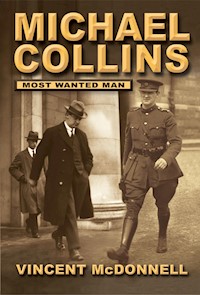
Cover images courtesy of the National Library of Ireland.
1. Michael Collins leaving Earlsfort Terrace, Dublin, after the Treaty ratification meeting in 1992.
2. Michael Collins in uniform at Portobello Barracks, Dublin, in 1922.
For my brother Michael, Ann and family
1 A Daring Escape
One winter morning in 1919, police and British soldiers raided a house in Dublin city. Heavily armed, they came without warning. Their mission was to capture or kill one man. His name was Michael Collins, the most wanted man in the whole of the British Empire.
The house, at 76 Harcourt Street, was Collins’ headquarters. From here he planned and directed a guerrilla war against the British Empire. The British government had already made many attempts to capture him, but all had failed. They had even put an enormous price on his head, but so far no one had claimed it.
Now, acting on a tip-off from a spy named Harry Quinlisk, the house was being raided. They hoped that their quarry would be caught off guard and they would at last catch him. By this time Collins had been on the run for over a year, and he knew from his many previous escapes that he had to be vigilant and prepared to flee at any moment.
Now he heard the police vehicles screech to a halt in front of the house. Men shouted urgent orders. There was the thump of heavy boots on the pavement. Michael had to get away.
He was prepared for such an eventuality. The house had a skylight in the roof though which he could escape. He had had a special lightweight ladder made with which he could climb onto the roof. He could then pull the ladder up with him and close the skylight.
Michael was a big man, but urged on by the seriousness of his situation, he scrambled up the ladder with the speed and dexterity of a monkey. He hauled himself out onto the roof and pulled up the ladder behind him. Then he closed the skylight. The shouts and the thumping of the soldiers’ boots were louder now. But Michael had no time to wait and listen. He scrambled across the roofs of the adjacent houses until he came to the Standard Hotel which also had a skylight.
He had already arranged that this skylight would be left open permanently for just such an emergency, and that another light ladder would be available so that he could climb down into the hotel.
Michael lowered himself through the skylight, only to discover to his horror that the ladder was missing. He was hanging by his fingertips over the well of the staircase. From here it was a sheer drop to the floor of the hotel lobby far below him. If he fell he would be killed, or at the very least, seriously injured. His only hope was to leap to the safety of the landing. But to reach there he would need to build up momentum to clear the landing rail. Still hanging by his fingertips, he began to swing his body back and forward like a pendulum.
When he felt he had built up sufficient momentum, he released his grip on the edge of the skylight. He leapt into empty space with that sheer drop to the lobby gaping below him. His momentum was sufficient to clear the landing rail, but he caught his foot and fell heavily. His leg was badly injured, but ignoring the pain, he quickly scrambled to his feet. Limping, he descended the stairs to the hotel lobby and made his exit onto the street.
By now a number of his comrades had arrived on the scene. They were watching the entrance to 76 Harcourt Street, which was sealed off by heavily armed soldiers. At any moment the watching men expected to see the man they knew as The Big Fellow being dragged out in handcuffs. Instead, to their utter disbelief, they watched Michael emerge from the Standard Hotel. Apart from the fact that he was limping, he seemed fine. He was smiling, as if at a great joke, calmly hailed a horse-drawn hackney cab and was driven off.
The police, yet again, had failed to catch their most wanted man. After searching No. 76 from top to bottom, they were forced to withdraw empty-handed. Once more Michael Collins had escaped to carry on the fight, a fight he would eventually win.
Within less than two years the British were forced to admit defeat. Collins, with a small group of guerrilla fighters, had beaten the army of the most powerful empire on earth. The British government, unable to capture him or defeat his fighters, was forced to sue for peace.
In October 1921, Michael sat down to negotiate freedom for Ireland with the very government that had sent their policemen and soldiers to capture or kill him. He signed a treaty with the British government that at last gave Ireland her freedom. Less than nine months later he would be dead. For years the British had tried to capture or kill him, but it was to be his, and Ireland’s, tragedy that it would be one of his guerrillas, his comrades in the fight for freedom, who would kill him.
This is the story of how Michael Collins, a farmer’s son, has come to be regarded as one of the greatest Irishmen of the twentieth century. It is the story of his fight for Irish freedom and of how he defeated the might of the British Empire. It is also the story of how and why he met his death on a lonely road at Béal na mBláth, in his native County Cork, on 22 August 1922.
2 A Boyhood Dream
Michael Collins was born on Thursday 16 October 1890, and named Michael after his father, a farmer who lived at Woodfield, near Clonakilty, County Cork. Michael had five sisters and two brothers and was the youngest of the family. His father was 75 years old when Michael was born, but father and son were very close and spent a great deal of time together on the farm. Because of the relationship that developed between them, for all of his life Michael had a great affection for older people. Michael was a normal boy who loved to play games. With five older sisters and his mother Marianne all doting on him, he never lacked for affection. Though spoiled a little by all the female attention, it nevertheless gave a caring and gentle side to his nature.
During their time together, Michael heard his father relate many stories and legends of Ireland’s past, usually of great heroes both real and imaginary. These fired the young boy’s interest and imagination. Less than thirty years before Michael’s birth, for example, there had been the Fenian rebellion, which failed, and one of the most prominent Fenians had been a local man from Clonakilty, Jeremiah O’Donovan Rossa. He and his fellow Fenians were revered in the area. Here was a real-life local hero for the boy to admire.
Michael also learned of the Great Famine, which had occurred in Ireland in the 1840s. Memories of this terrible famine were still fresh in people’s minds. West Cork had been badly affected by it, especially the nearby town of Skibbereen. Here hundreds of victims of the famine – men, women and children – had been buried in mass graves. In sessions of storytelling and song around the Collins’ fireside, one of the few entertainments available at that time, Michael heard about these terrible events. His father had lived through the famine, and had seen some of his own neighbours die of hunger and others forced to emigrate.
The cause of the Famine was the land system, whereby English landlords rented land to the Irish at high rents, which the people paid by growing grain crops. To feed themselves, they grew the potato, introduced to Ireland in the seventeenth century. It was easy to grow, even on poor land, and produced a good crop from a small amount of ground. Over time it became the main food source for the majority of Irish peasants. But the potato was prone to a disease known as potato blight, and in the years 1845 to 1847 blight became widespread all over Ireland. As the potato crop failed each year, more than a million people died of hunger or emigrated to Britain or America.
At this time Ireland was ruled directly from London, and had been since 1801. There was no Irish parliament in Dublin. Instead Irish members of parliament (MPs), went to London, where most English MPs did not know much about Ireland. By the time Collins was born, in 1890, there were two main political groups in Ireland. The Irish MPs, the Irish Parliamentary Party, were demanding Home Rule for Ireland. This meant that Ireland would have its own parliament sitting in Dublin, but would still be loyal to the British monarchy. The other group, the Land League, had been founded by Mayoman, Michael Davitt. The aim of the Land League was to rid Ireland of the landlords and their agents and for the Irish to own their own land.




