


1,99 €
Niedrigster Preis in 30 Tagen: 1,99 €
Niedrigster Preis in 30 Tagen: 1,99 €
Mehr erfahren.
- Herausgeber: Booksell-Verlag
- Kategorie: Gesellschafts- und Liebesromane
- Sprache: Englisch
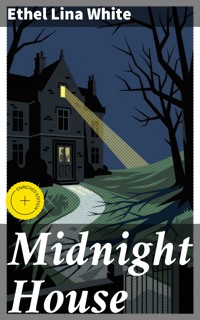
In Ethel Lina White's captivating novel, 'Midnight House,' readers are drawn into a labyrinthine narrative woven with suspense and intricate character psychology. The story unfolds in a remote, atmospheric setting, where a group of individuals becomes enmeshed in a web of mystery and impending danger. White'Äôs deft use of eerie descriptions and psychological tension typifies her trademark style, often characterized by an unsettling exploration of fear. Authored in the early 20th century, amidst a burgeoning interest in psychological thrillers, 'Midnight House' stands as a testament to White's keen ability to manipulate mood and evoke deep emotional responses. Ethel Lina White, a prominent figure in early crime fiction, was influenced by her own academic background in literature and a lifelong fascination with the darker aspects of human nature. Growing up in a time when women writers were often marginalized, White carved a niche for herself, producing narratives that blended domestic settings with thrilling suspense. Her experiences and insights into societal norms likely informed her narrative choices in 'Midnight House,' making it a profound reflection on isolation and paranoia. For readers seeking an enriching journey into the realms of psychological suspense, 'Midnight House' is highly recommended. It not only offers a gripping plot filled with dramatic twists but also invites readers to ponder the complexities of fear and human relationships, establishing Ethel Lina White as a pioneering influence in the genre. In this enriched edition, we have carefully created added value for your reading experience: - A succinct Introduction situates the work's timeless appeal and themes. - The Synopsis outlines the central plot, highlighting key developments without spoiling critical twists. - A detailed Historical Context immerses you in the era's events and influences that shaped the writing. - A thorough Analysis dissects symbols, motifs, and character arcs to unearth underlying meanings. - Reflection questions prompt you to engage personally with the work's messages, connecting them to modern life. - Hand‐picked Memorable Quotes shine a spotlight on moments of literary brilliance.
Das E-Book können Sie in Legimi-Apps oder einer beliebigen App lesen, die das folgende Format unterstützen:
Veröffentlichungsjahr: 2021
Ähnliche


















Midnight House
Table of Contents
Introduction
Midnight House brings together thirteen shorter works by Ethel Lina White, offered here as a single-author collection designed for sustained reading rather than selective sampling. The volume’s purpose is to present a representative span of her compact suspense writing in one place, showing how she builds tension, misdirection, and atmosphere with the economy of the shorter form. The contents are organized as individually titled narratives with internal divisions, encouraging an experience akin to moving through a sequence of self-contained cases or situations while still sensing a coherent authorial hand across the whole book.
The texts in this collection are works of crime and suspense fiction, written as discrete narratives rather than as criticism, memoir, correspondence, or documentary material. Their chaptered structures, indicated by Roman numerals under each title, suggest tightly paced plotting and a focus on scene-by-scene escalation. Readers should expect storytelling grounded in threat, uncertainty, and psychological pressure, delivered through prose crafted to keep attention on what is known, what is withheld, and what is merely assumed. Taken together, these pieces display the versatility of suspense as a form, from eerie menace to more overt criminal intrigue.
As a whole, Midnight House emphasizes enclosed places and narrowing choices: houses, lanes, cellars, and homes recur as focal points, not simply as settings but as engines of dread and speculation. Such spaces are traditionally associated with privacy and safety, and the collection repeatedly tests that expectation by turning ordinary environments into sources of unease. Even when the titles point outward toward movement or public life, the stories often return to questions of access, observation, and vulnerability, as though the real drama lies in the border between the familiar and the threatening. The result is a consistent atmosphere of domestic tension and precarious normality.
The sequence of titles suggests a careful range of tonal registers within suspense: the stark suggestion of absence in The Empty House, the overt promise of criminality in Murder Lane, the insinuation of organized threat in Black Hand, and the claustrophobic emphasis of The Cellar. Poltergeister introduces the vocabulary of disturbance and haunting without requiring the reader to assume any particular explanation in advance, while The Race and The Last Post imply urgency and finality in more outward-facing terms. By arranging these differing cues side by side, the collection showcases how suspense can be generated through setting, implication, and tempo as much as through overt action.
White’s stylistic signature in such work is an emphasis on controlled disclosure and the steady tightening of narrative focus. The chapter divisions invite a rhythm of suspense built from pauses, shifts in perspective, and incremental complications; they also highlight her ability to sustain curiosity across short spans without sacrificing coherence. Across the collection, tension arises not merely from what happens, but from how characters interpret partial information and how readers are encouraged to test their own assumptions. This disciplined approach to pacing and perception keeps the prose lean, alert, and oriented toward consequences rather than ornament.
The later titles broaden the thematic palette while keeping the core commitment to suspense. The Game, Crooked Mary, and "Home" invoke performance, reputation, and belonging—ideas that can heighten pressure without requiring elaborate external machinery. Ancient History and Good Victorians Never Die suggest the persistence of the past and the weight of social narratives, themes that align naturally with crime and psychological unease, where motives are often rooted in memory, custom, or concealed experience. The Last Word closes the volume with an emphasis on final statements and contested meanings, reinforcing the collection’s interest in what can be said, proven, or denied.
Midnight House remains significant as an example of suspense fiction’s capacity to explore fear, privacy, and moral ambiguity through concise storytelling. Without relying on excess explanation, these works demonstrate how atmosphere and inference can carry narrative force, inviting readers to participate actively in evaluating evidence, motive, and risk. The collection’s unity comes less from shared characters than from a consistent preoccupation with the fragile boundaries of safety and the volatility of ordinary life when touched by suspicion. Read together, the pieces show how White’s careful craft sustains tension while keeping attention on human perception and its limits.
Historical Context
Ethel Lina White (1876–1944) wrote most of the stories later gathered as "Midnight House" amid the interwar years, when British popular fiction was sharply divided between rational detective work and the revived pleasures of Gothic unease. The period after the First World War (1914–1918) brought widespread bereavement, economic uncertainty, and a shaken confidence in institutions. These conditions helped normalise plots in which respectable settings conceal violence, and where ordinary people—especially women moving through newly public lives—encounter predation or deception. White’s fiction sits close to this cultural fault line, blending everyday realism with sudden menace.
Between 1919 and the late 1930s, Britain experienced labour unrest, inflation, and uneven prosperity, culminating in the General Strike of 1926 and, later, the Great Depression’s effects after 1929. Such pressures intensified anxieties about social status, inheritance, and hidden debts, all staples of suspense. White repeatedly uses domestic interiors, boarding houses, and tight communities to show how precarious security can be when money and reputation are at stake. The interwar fascination with “closed” worlds—small towns, secluded houses, narrow lanes—mirrors a society negotiating fragility, where a small shock can dismantle the appearance of order and expose cruelty beneath conventional manners.
The so‑called Golden Age of detective fiction, associated with writers such as Agatha Christie and Dorothy L. Sayers in the 1920s and 1930s, also shaped expectations for mystery plotting and fair-play clues. White, however, often shifts emphasis from puzzle to dread, anticipating the later “psychological thriller.” Her contemporaries saw a market for shorter, high-tension narratives in magazines and cheap volumes, and White’s work benefited from that infrastructure. The collection’s recurring focus on fear, concealment, and misdirection reflects the era’s appetite for crime stories that were both technically crafted and emotionally immediate.
Interwar criminology and sensational trials influenced public perceptions of violence and deviance, while developments in forensic practice gave crime fiction new plausibility. In Britain, policing reforms and the growth of popular journalism meant crimes could be narrated with documentary force even when fictionalised. White draws on this environment by treating threats as credible, not purely supernatural, and by grounding danger in recognisable procedures: questioning, observation, and the weight of circumstantial evidence. At the same time, the period’s tabloids amplified panic and curiosity, so contemporary readers were primed to accept that the ordinary street or the familiar home might host the extraordinary crime.
Shifts in women’s lives after 1918 also informed the collection’s emotional landscape. Partial female suffrage arrived in 1918 and equal voting rights in 1928; employment patterns and urban mobility expanded, even as social surveillance remained strong. White’s heroines and female witnesses often navigate public spaces, rented rooms, and uneasy domestic arrangements, reflecting both new independence and persistent vulnerability. The tension between autonomy and exposure becomes a historical constant across the stories. Contemporary reception was shaped by these realities: readers recognised the risks of modernity—travel, anonymity, changing households—while also valuing narratives that punished coercive power and vindicated wary intelligence.
The supernatural and quasi-supernatural motifs that appear across White’s fiction echo the postwar resurgence of spiritualism and psychical research, which gained renewed attention after mass wartime deaths. Organisations such as the Society for Psychical Research (founded 1882) remained culturally visible, and séances, hauntings, and “poltergeist” talk circulated in popular media through the 1920s and 1930s. White typically uses such material not to affirm the paranormal, but to explore fear, suggestion, and the instability of perception. This suited a readership simultaneously sceptical and fascinated, attuned to how grief and uncertainty could make the uncanny feel plausible.
The built environment of interwar Britain—aging Victorian housing, new suburban developments, and the lingering grandeur of country houses—provided an ideal stage for White’s recurrent “house of secrets.” Older properties carried associations with inheritance law, class hierarchy, and hidden rooms; newer spaces could feel anonymous and socially unmoored. Technological change, from telephones to improved transport, altered how characters sought help and how quickly danger could spread, yet also introduced new points of failure and isolation. White’s settings thus reflect a society suspended between Victorian residues and modern systems, making the domestic sphere both a refuge and a trap.
Finally, the late 1930s and early Second World War years altered how suspense fiction was read: as distraction, as moral rehearsal, and as commentary on threatened order. White’s broader career includes the novel "The Wheel Spins" (1936), adapted by Alfred Hitchcock as "The Lady Vanishes" (1938), signalling the era’s cross‑fertilisation between print thrillers and cinema. That cultural traffic helped validate fast-paced, high-stakes narratives like those in "Midnight House." Across the collection, historical pressures—war memory, social change, media sensationalism, and modern mobility—converge to make private fear a credible public story.
Synopsis (Selection)
I. THE EMPTY HOUSE
A seemingly ordinary house becomes the focus of creeping unease when small inconsistencies suggest someone—or something—has arranged the setting for a purpose. White’s cool, observant style builds dread through domestic detail, exploring how privacy, class habits, and routine can mask danger.
The suspense turns on perception: what the protagonist notices, dismisses, and finally cannot ignore. Themes of isolation and the uncanny-in-the-familiar establish the collection’s recurring motif of safe spaces turning subtly hostile.
II. MURDER LANE
A quiet street with a sinister reputation draws an inquisitive outsider into local secrets that refuse to stay buried. The tone mixes everyday social observation with tightening menace, emphasizing community complicity and the peril of being noticed.
White keeps the premise grounded in place, using the lane’s geography and gossip as engines of tension rather than overt violence. Motifs of surveillance, reputations, and the thin line between curiosity and vulnerability are foregrounded.
III. BLACK HAND
A threatening sign and a pattern of intimidation disrupt normal life, forcing characters to question whether the danger is superstitious, criminal, or psychological. The story leans into controlled paranoia, using ambiguity and misdirection as its primary suspense tools.
The focus is less on spectacle than on how fear spreads through interpretation and rumor. Recurring themes include coercion, the fragility of social order, and the ease with which symbols can become weapons.
IV. THE CELLAR
A hidden or overlooked space beneath an ordinary building becomes the pivot of a mystery in which the past presses physically against the present. White’s restraint heightens claustrophobia, letting setting and atmosphere do much of the work.
The narrative explores secrecy, inheritance, and the psychological pull of forbidden knowledge without relying on explicit shocks. A notable stylistic signature here is the slow tightening of stakes through practical details and constrained movement.
V. POLTERGEISTER
Unsettling disturbances in a home challenge a household’s sense of control, raising questions about whether the source is supernatural, staged, or a symptom of strain. The tone is brisk and wryly skeptical, treating “haunting” as a social problem as much as a paranormal one.
White uses the phenomenon to test relationships, credibility, and the limits of rational explanation. Across the collection, this entry highlights her recurring interest in how fear reorganizes domestic life and authority.
VI. THE RACE
A competitive pursuit—whether literal or metaphorical—pushes characters into risky decisions where timing, nerves, and misjudgment matter as much as motive. The pacing is sharper and more kinetic than the more atmospheric pieces, emphasizing pressure and momentum.
Themes center on escalation, pride, and the hazards of treating life as a contest with winners and losers. It marks a tonal shift toward thriller-like propulsion while keeping White’s focus on ordinary people under abnormal strain.
VII. THE LAST POST
A message’s arrival—or its ominous absence—sets off a chain of suspicion in which communication becomes a trap rather than a safeguard. The story is taut and procedural in feel, turning small administrative or social mechanisms into sources of dread.
White examines dependence on systems, the vulnerability of those who wait, and the ways secrets travel. The recurring motif of everyday infrastructure enabling menace is especially pronounced.
VIII. The Game
A seemingly harmless contest or pastime reveals a darker structure of manipulation, where rules conceal power and participants misread the stakes. The tone is controlled and ironic, inviting the reader to watch how strategy slides into threat.
Thematic focus falls on deception, consent, and the danger of treating people as pieces in a plan. This entry amplifies White’s signature interest in misdirection and the moral slipperiness of “just playing along.”
IX. CROOKED MARY
A figure with a suggestive nickname becomes the center of a local puzzle, with folklore and personal history blending into a suspenseful portrait. White’s narration is crisp and socially attentive, using character gossip and reputation as narrative pressure.
The story probes how communities construct villains and how easily prejudice becomes evidence. Motifs of misremembered pasts, performative normality, and the menace of being talked about recur strongly here.
X. "HOME"
The idea of home—comforting, claimed, and defended—is destabilized when a character’s place in a household is questioned or undermined. The tone is intimate and unsettling, drawing dread from ordinary domestic negotiations rather than overt crime.
White emphasizes belonging and displacement, showing how security can be revoked by subtle shifts in power. It reinforces the collection’s through-line: domestic spaces as both refuge and stage for coercion.
XI. ANCIENT HISTORY
An old incident resurfaces, forcing characters to confront how the past can be curated, denied, or weaponized in the present. The mood is reflective but tense, with suspense emerging from memory, documentation, and what people choose to overlook.
Themes include guilt, social self-preservation, and the long afterlife of supposedly settled stories. Stylistically, White balances psychological insight with a steady mystery structure built on inference.
XII. GOOD VICTORIANS NEVER DIE
A veneer of respectability becomes suspect when Victorian ideals of propriety and legacy collide with present-day anxieties. White’s tone is dryly satirical under the suspense, using manners, inheritance, and moral posturing as engines of tension.
The story highlights a recurring shift in the collection toward social critique: danger is entwined with what a community calls “proper.” Motifs of performance, repression, and the persistence of old codes shape the dread.
XIII. THE LAST WORD
A final statement—spoken, written, or implied—drives a closing mystery in which the meaning of a message matters as much as the act itself. The tone is spare and decisive, emphasizing interpretation, timing, and the risks of certainty.
White ends on her characteristic note of controlled unease, where resolution depends on what can be proven versus what is merely persuasive. Recurring motifs of communication, misdirection, and the fragility of trust converge in this capstone.
Collection-wide motifs and stylistic signatures
Across these stories, White repeatedly turns everyday settings—houses, streets, rooms, routines—into instruments of suspense, favoring psychological pressure and social observation over sensational set pieces. Her signature is economical prose that escalates unease through small discrepancies, rumors, and the reader’s growing sense that normality has been staged.
Notable shifts occur between atmospheric, place-driven dread and more kinetic, game-like or procedural tension, but the thematic core stays consistent: vulnerability within domestic and communal structures. Recurring motifs include surveillance, reputation, coercion disguised as civility, and the destabilizing power of messages, symbols, and hidden spaces.
Midnight House
I. — THE EMPTY HOUSE
—I—
THE house had been barred, locked and shuttered for over eleven years[1q]. Thousands of days had dawned without a ray of sunlight striking through its windows. Thousands of nights had fallen with no flicker of a match within its walls.
Lying awake in the next house, Elizabeth Featherstonhaugh—aged nineteen and possessed of a fertile imagination—used to shudder at the thought of black emptiness pressing on the other side of her room. Herself a child of loneliness and twilight—she believed that the darkness must be in absolute possession of the deserted mansion. She imagined it clotted to material strength and shredded with solid cores of density—so that if an intruder dared to force a passage through it, he would be drawn in and crushed between rollers of atmospheric pressure.
Occasionally, as she listened, she thought she heard strange noises in the empty house. There were sounds of tapping, creaking, rumbling. Footsteps walked where there were no feet. Drawers seemed to be pulled open where there were no hands. When the furniture appeared to thud from spot to spot, she knew that it was time to switch on her bed-light.
The reassurance of her own cheerful room, with its comfort and fine proportions, reminded her that she was in charge of Captain Pewter's two children and that it was more than a job.
"This family belongs to my caste," she told herself. "The Captain comes from my wonderful India. I like Geraldine. I'm fond of dear little Philippa. And I love Barnaby... I won't be frightened."
When she was small, she had been so terrified of the dread "Black Man in the cellar" that she petitioned the angels to protect her. Now, as she sat up in bed, with her short fair hair ruffled from the pillow and her white pyjama-jacket open to reveal a thin neck, she looked almost a child again.
Her eyes were wide with fear as she stared at her bedroom wall, as though she were actually threatened by the crowding darkness. At such moments she pictured a sudden burst and bulge of masonry displaced by the encroachment of the evil force which had choked the light.
"There's someone—or something—in the empty house," she whispered before, once again, she prayed for protection.
"Deliver me from the Powers of Darkness."
—II—
The empty house was listed in the postal directory as No. 11 India Crescent, Rivermead, but it was a dead address. Its absentee owner and his wife were reported to be living abroad; but it was so long since they had been seen in the town that few people remembered them. During the years there had grown up a new generation who were too accustomed to the blinded building to be curious.
Occasionally strangers asked questions about it, only to be told that it was just another of those deserted homes sprinkled about every country—shrines to memory. Only a few residents remembered its tragic story of domestic tyranny, ill-starred love and early death.
Mr. Spree, the lawyer, knew more than any outsider, but as representative of legal caution his lips were sealed. He used to walk to his office and had been accustomed to pass No. 11 four times daily without giving it a thought. Towards the middle of November, 1938, his interest in it was revived by the calendar.
He was a healthy, well-preserved man of sixty, wearing the conventional clothes of his profession while resembling the traditional farmer. Doomed by inheritance to a sedentary life, he spent his leisure in chopping wood and cutting lawns. He was also a keen gardener and specialised in yellow tomatoes.
It gave him a pang to remember that he was still in the forties when he had been responsible for sealing up No. 11 India Crescent. This house had been the property of General Tygarth, who lived there for many years with his wife and two children. Mrs. Tygarth was a silly, snobbish woman, who got the sort of husband she deserved, for the General—irritable, eccentric and tradition-bound—pushed her about remorselessly.
The children were gentle, listless and apparently of poor stamina. The daughter, Madeline, married a local doctor who—in spite of his youth—was considered destined for the first flight. Her parents were glad to be rid of her, for they concentrated on their son—Clement.
In spite of their devotion they were deeply disappointed in his character. He was delicate, dreamy and devoid of the requisite lethal instincts. The sporting community had a name for him. Yet during the War of 1914-1918 he ran away from Oxford and enlisted as a private. He became a prisoner of war in Germany—escaped, only to be recaptured—and finally, after the Armistice, returned to his family as a total disability.
Three years later, the next-door house, No. 10, was bought by a retired sanitary-engineer. He was an excellent plumber and his drains remained after him as a valuable legacy to future tenants; but the other residents resented his connection with trade.
As leader of the opposition, the General did his utmost to freeze out the newcomer. However, he met his match in the plumber, for Alexander Brown had dug in his heels.
"I'll live to see you move out first," he prophesied to the General. "Then I'll clear out—and glad to leave the stinking place."
—III—
While their parents raged like bulls in combat, the General's son and the plumber's daughter fell deeply in love. Marion Brown was sweet, simple, and a perfect type of natural blonde beauty, but as far as the Tygarth family was concerned, she was mud. From the first kiss, the romance was doomed to follow the tragic tradition of Romeo and Juliet, for the worthy Browns—smarting from wounded pride—turned their daughter into a virtual prisoner, to keep her from meeting her lover.
For two years she never went out alone. Clement was powerless, since he was dependent on his father for every shilling and on his mother for the care which kept him alive. Forbidden to write to his beloved, he used to stand at his window, to watch her come and go on her daily walk.
Although it was so long ago, Mr. Spree, the lawyer, felt slightly choky at the memory of that white fading face behind the glass. Thwarted of love, the young War-hero's health grew steadily worse, and he died from collapse during an attack of influenza.
His parents were broken-hearted and possibly conscience-stricken. As No. 11 had become a place of hateful memories, the General decided to shut up the house and go abroad.
Thus was the plumber's prophecy fulfilled...
On that misty November morning, nearly twelve years later, the lawyer recalled the General's letter of instructions. No. 11 was to be sealed up and remain unopened, pending further orders or the owner's return. Upon a specified date, he was to assume the death of his client and open up the property.
"I wish you to be personally responsible for locking up the house" [wrote the General]. "We are leaving nothing of value behind and there are no animals. It is intolerable to contemplate some inquisitive bounder from an Estate Office prying into details of our private life. We are moving out early tomorrow morning, and hope our departure will be secret. We have suffered too deeply to endure further painful publicity."
Although his instructions were definite, the lawyer could not resist ringing up the General, to urge the sale of the property. He was nearly blasted over the wire by his client's rage.
"My letter stands," he roared. "No sale. Haven't you the gumption to realise the last thing I want is a pack of strangers let loose in my house, making a catalogue and passing remarks on my furniture? I regard the place as dead money."
Mr. Spree could congratulate himself that he had acted with none of the traditional Law's delay. That same afternoon, he unlocked the door of No. 11 with the key enclosed in the General's letter and went inside, to carry out his instructions. The house was dark, as many of the windows were already latched and shuttered. With meticulous care to avoid taking notice of his suroundings, he went from room to room, to make sure that every fastening was secure. While he waited in the hall for the Corporation employees to cut off the water and check the electric-light meter, he read his newspaper, to prove his lack of curiosity.
Later, when he was alone again, he locked the back door, which opened on to the area. Then, with a sense of drama, he walked out of the front door—reflecting that his would be the last foot to cross the threshold for many years.
The next morning, the windows were boarded up from the ouside, and both locked doors were double-chained. Even the chimneys were blocked, to prevent daws from building inside the pots. When all was finished, the lawyer remarked that the house would need a Houdini quality to wriggle itself free from its bolts and bars...
And now—within a fortnight—it would be opened again.
—IV—
Still held captive by the past, the lawyer stood in the road to gaze along the fine sweep of India Crescent. The tall Regency houses of buff stucco were too spacious for wholesale private ownership. Only a few nabobs had the means to install modern improvements and provide the essential domestic labour. Many of the mansions were converted into luxury flats. There was also an expensive private hotel and a very exclusive social club.




