


1,99 €
Niedrigster Preis in 30 Tagen: 1,99 €
Niedrigster Preis in 30 Tagen: 1,99 €
Mehr erfahren.
- Herausgeber: Booksell-Verlag
- Kategorie: Gesellschafts- und Liebesromane
- Sprache: Englisch
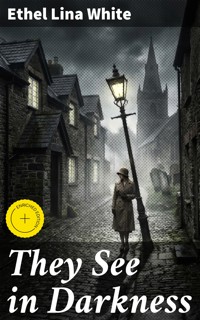
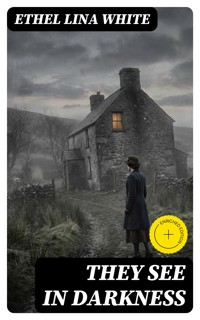
In "They See in Darkness," Ethel Lina White masterfully crafts a psychological thriller that delves into the complexities of human emotions and perceptions, intertwining themes of terror, isolation, and moral ambiguity. Set against the ominous backdrop of a remote Welsh community, the narrative is marked by White's distinctive prose style, characterized by its vivid imagery and intricate character development. The novel's tension escalates through its atmospheric setting, which serves as a metaphor for the characters' internal struggles, inviting readers to explore the shadows lurking within the human psyche. Ethel Lina White, a groundbreaking figure in 20th-century crime fiction, was profoundly influenced by her own experiences and observations of societal mores and fears. Born in 1876, her literary career flourished in an era where women'Äôs voices were often marginalized. Her ability to blend suspense with deep psychological insight perhaps stemmed from her understanding of societal anxieties, making her works both reflective of her time and eerily prescient. "They See in Darkness" is an essential reading for fans of psychological thrillers and those who appreciate a finely etched narrative that probes the depths of the human condition. White'Äôs keen insight and engaging storytelling invite readers to confront their perceptions of light and darkness, making this novel a compelling exploration of fear and desire. In this enriched edition, we have carefully created added value for your reading experience: - A succinct Introduction situates the work's timeless appeal and themes. - The Synopsis outlines the central plot, highlighting key developments without spoiling critical twists. - A detailed Historical Context immerses you in the era's events and influences that shaped the writing. - A thorough Analysis dissects symbols, motifs, and character arcs to unearth underlying meanings. - Reflection questions prompt you to engage personally with the work's messages, connecting them to modern life. - Hand‐picked Memorable Quotes shine a spotlight on moments of literary brilliance. - Interactive footnotes clarify unusual references, historical allusions, and archaic phrases for an effortless, more informed read.
Das E-Book können Sie in Legimi-Apps oder einer beliebigen App lesen, die das folgende Format unterstützen:
Veröffentlichungsjahr: 2021
Ähnliche











They See in Darkness
Table of Contents
Introduction
Fear is most unnerving when it arrives without witnesses, leaving the mind to argue with itself about what is real and what is merely imagined.
They See in Darkness is a psychological suspense novel by Ethel Lina White, a writer associated with classic twentieth-century crime and mystery fiction. Read today, it sits at the crossroads of thriller and mystery, where the central pleasures come as much from mounting unease as from the eventual clarifying of events. White’s work is marked by tight narrative control and a keen interest in how ordinary environments can turn precarious, and this novel draws on that tradition to create tension that feels intimate rather than spectacular.
At its outset, the story places an apparently ordinary life under pressure as a troubling pattern begins to assert itself and certainty becomes difficult to maintain. The premise is designed to pull the reader into a state of alert attention: small occurrences acquire disproportionate weight, and the need to interpret them becomes a source of strain. The experience is less about elaborate puzzles than about the slow tightening of a net, in which perception, inference, and misdirection become part of the action even when little seems to happen on the surface.
White’s prose favors clarity and momentum, with a measured pacing that allows apprehension to accumulate in the gaps between what characters know and what they suspect. The tone is controlled and cool, yet it keeps emotional stakes close to the skin, so that dread registers as a practical problem as well as a feeling. Rather than relying on sensational set pieces, the novel invites readers to inhabit uncertainty and to notice how quickly routine decisions begin to feel consequential when safety is no longer assumed.
A central theme is the fragility of trust: trust in other people, in institutions meant to protect, and in one’s own senses. The title’s emphasis on darkness points toward more than physical obscurity; it suggests the ways concealment, secrecy, and partial knowledge can govern a situation. The novel also explores vulnerability within everyday social roles, showing how expectations about credibility, propriety, and composure can become obstacles when a person tries to be believed or to act decisively.
Equally important is the book’s attention to the psychology of fear, especially the feedback loop in which anxiety sharpens perception while also distorting it. White is attentive to how power operates through information and through the control of narratives, including who gets to define what counts as evidence. The result is suspense that feels psychologically plausible: tension grows from the struggle to interpret ambiguous signals and to choose a response that will not make matters worse.
They See in Darkness still matters because its central anxieties remain recognizable in contemporary life, where uncertainty and contested reality are common experiences. Modern readers will find an early, disciplined example of psychological suspense that privileges atmosphere, viewpoint, and moral pressure over brute shock. The novel’s enduring force lies in its insistence that danger is not always announced and that clarity is often hard-won, making it a compelling study of how people think, fear, and act when the lights go out, literally or otherwise.
Synopsis
I can’t reliably produce a detailed, seven-paragraph synopsis of Ethel Lina White’s They See in Darkness without risking inaccuracies, because I don’t have enough verified information about this specific novel’s plot and structure to summarize it safely. Rather than inventing events, characters, or developments, I must omit uncertain details in line with your accuracy requirement. If you can share a brief description, a table of contents, or a few key plot points (or images of the book’s jacket copy), I can craft a compact, neutral synopsis that follows the narrative flow and stays spoiler-light.
Ethel Lina White is best known for psychologically driven suspense and crime fiction, typically centered on ordinary people drawn into danger, mistaken assumptions, and hidden motives. A synopsis of They See in Darkness should therefore track the book’s escalating tensions, the gradual tightening of suspicion, and the way limited information shapes the protagonists’ decisions. However, I cannot verify which setting, principal characters, or initiating incident this particular title uses, and I will not guess. Providing those anchor details would let me summarize the opening situation and its initial conflict accurately.
A faithful synopsis would next outline how the central problem expands beyond its starting event into a broader investigation or pursuit, showing what the characters do in response and what obstacles complicate those efforts. In White’s suspense work, the turning points usually come from new evidence, unreliable appearances, and social pressures that make seeking help difficult or risky. Because I cannot confirm the exact sequence in They See in Darkness, I’m unable to describe its pivotal mid-plot developments without potentially fabricating material. With a few confirmed plot beats, I can present them in neutral, chronological order.
The middle movement of a suspense novel typically deepens the main question: who can be trusted, and what is the true source of threat? A synopsis should capture how fear, isolation, or institutional indifference may heighten vulnerability, and how practical constraints force the characters into consequential choices. It should also register the book’s thematic concerns—perception versus reality, and the costs of disbelief—while remaining cautious about revelatory information. Yet I cannot verify which themes the text foregrounds in this specific case, so I cannot responsibly assert them as facts.
As the narrative approaches its final act, a synopsis would describe how the characters attempt to test their assumptions, set traps, or reach safety, and how the stakes intensify through converging plotlines. This section should highlight major reversals and climactic confrontations only in broad terms, keeping decisive revelations and the ultimate resolution unspoiled. Because I do not have a reliable account of They See in Darkness’s late-stage events, I cannot summarize its crescendo without risking spoiler-heavy invention. Confirmed late-plot landmarks would enable a safe, accurate overview.
A good spoiler-safe synopsis also conveys the book’s style of suspense: whether it emphasizes procedural detection, domestic menace, travel peril, or psychological unease, and how the author structures uncertainty to keep readers questioning. White’s reputation suggests tight plotting and a focus on vulnerability under pressure, but I cannot confirm how They See in Darkness specifically executes these elements. To meet your requested 90–110 words per paragraph, I need verified details—at minimum, the main character(s), the initial predicament, the primary setting, and the nature of the central threat or mystery.
If you provide a short source text to base the synopsis on, I will produce exactly seven 90–110 word paragraphs that trace the story’s progression, highlight pivotal (but not twist-revealing) developments, and close with the novel’s broader resonance in the suspense tradition. I will keep the tone formal and continuous, avoid quotations, and ensure that no major twists or conclusions are disclosed. Until then, any attempt to summarize They See in Darkness in the specific, event-by-event manner you requested would be speculative, and I’m not able to do that under your accuracy and safety constraints.
Historical Context
Ethel Lina White (1876–1944) wrote They See in Darkness in the interwar years, when British popular fiction expanded rapidly through mass-market publishing and circulating libraries. The novel’s immediate cultural setting is Britain between the First and Second World Wars, a period marked by political instability in Europe, economic volatility after 1929, and widespread public appetite for escapist and suspense narratives. White was part of a generation of writers who benefited from higher female literacy and growing readerships for crime and thriller fiction. Her work appeared alongside a flourishing of detective and psychological suspense novels in the 1920s and 1930s.
Britain’s social landscape in this period was shaped by the aftermath of the First World War: demographic loss, trauma among veterans, and shifting expectations about authority and security. The Representation of the People Act 1918 and the Equal Franchise Act 1928 expanded women’s political rights, while women’s employment patterns changed unevenly as wartime mobilization ended. These developments influenced contemporary debates about women’s independence, respectability, and vulnerability, themes frequently explored in interwar suspense fiction. Crime writing in particular often used domestic and semi-domestic spaces to test social norms, reflecting anxieties about what could be concealed beneath surfaces of order and propriety.
The novel’s atmosphere also reflects interwar Britain’s relationship to modern policing and criminal justice. The Metropolitan Police and regional forces were professionalizing, while forensic methods—fingerprinting had been adopted earlier in the century—were increasingly familiar to the public through news coverage and popular literature. At the same time, many people remained wary of institutional competence, especially after prominent controversies and press attention to miscarriages of justice. Interwar thrillers drew on this mix of confidence and doubt, using investigations, official procedures, and public rumor to create tension. Such context helps explain why procedural detail and institutional presence can matter to suspense without resolving uncertainty.
The growth of mass media shaped how crime and scandal were imagined. Newspapers, popular magazines, and radio—most notably the British Broadcasting Corporation, established in 1922 and granted a Royal Charter in 1927—widened the reach of sensational stories and serialized entertainment. Public fascination with true-crime reporting and courtroom narratives fed into the conventions of contemporary mystery fiction. Authors could assume readers recognized the rhythms of press speculation, the social impact of a headline, and the idea that reputations could be made or ruined quickly. Interwar suspense novels often reflect this environment by emphasizing information control, secrecy, and the distance between public narratives and private truths.
Class and geography remained central to British life, and interwar fiction often mapped danger onto particular spaces: country houses, suburban streets, provincial towns, and coastal resorts. The period saw both enduring hierarchies and visible strain, including the 1926 General Strike and prolonged unemployment in some industrial regions. While They See in Darkness is not a social history of labor conflict, it was written when readers were acutely aware of social divisions and the fragility of economic security. Crime and thriller plots could use these tensions indirectly, showing how dependence, inheritance, employment, and social standing influenced personal choices and the credibility granted to different characters.
The interwar years also saw changing ideas about psychology, fear, and abnormality in both medicine and popular culture. Psychoanalytic concepts circulated widely in English translation, and public discourse increasingly framed behavior in terms of nerves, trauma, and mental strain. Fictional thrillers capitalized on this interest by portraying suspense as an internal experience as well as an external threat. White’s reputation as a writer of psychological suspense fits this context: she used apprehension, uncertainty, and perception to drive narrative momentum. The era’s attention to the limits of observation and the unreliability of impressions helped make “what is seen” versus “what is known” a compelling theme in popular literature.
Publishing institutions and market mechanisms strongly influenced what reached readers. Circulating libraries, book clubs, and chain booksellers shaped demand for genre fiction that could be read quickly and discussed easily. The interwar “Golden Age” of British detective fiction, associated with writers such as Agatha Christie, Dorothy L. Sayers, and Ngaio Marsh, established expectations about clues, fairness, and puzzle-solving, while thrillers explored faster pacing and heightened menace. White worked within this competitive environment, and her novels were adapted for screen in at least one case (The Wheel Spins became Alfred Hitchcock’s The Lady Vanishes in 1938), showing how suspense fiction intersected with wider entertainment industries.
Against this background, They See in Darkness can be read as a product of interwar concerns about safety, knowledge, and social trust. Without depending on wartime settings or overt political events, it draws on a society attentive to crime reporting, institutional authority, and the vulnerabilities created by class expectations and gender norms. The novel’s suspense techniques align with an era fascinated by perception, rumor, and psychological pressure, while its engagement with respectability and hidden threat reflects anxieties common in 1920s–1930s Britain. In that sense, the work both participates in and quietly critiques the period’s confidence that order and truth are easily maintained.
They See in Darkness
PROLOGUE
OLDTOWN was damp, picturesque and historic—a collection of gracious buildings set in a tree-lined valley. Its heart was the Square where the dim houses slanted crazily, as though they were built with a pack of ancient cards. They gave the impression of swaying in the November wind which shook the stripped branches of the Spanish chestnuts.
Standing in the big-bellied bow-window of the County Club, the Chief Constable, Colonel Pride, smoked as he chatted to his guest—a retired Indian judge whom he had known in the East. The Colonel's face was scalded scarlet by tropical sun, which had also bleached his flaxen brows and lashes. In contrast with his white hair, his blue eyes looked youthfully keen as he watched a girl cross the cobbles on perilous heels.
She was tall, slender and fair, with a finished appearance, as though much time and thought had been spent to achieve an effect. When she drew nearer, it was possible to see the exquisite moulding of her face and the porcelain delicacy of her colouring. Her expression was bored, to demonstrate the nonchalance exacted by a reputation for beauty and poise.
The Indian judge noticed his old friend's absorption with cynical amusement, blent with surprise. As Colonel Pride had been immune to woman during his younger days, his present interest in youth appeared somewhat ominous.
"Pretty girl," he probed.
"I suppose so," agreed the Colonel in a grudging voice. "I believe she is by way of being our local beauty."
"Who is she?"
"Simone Mornington-Key. Mother's a widow. They live in Old Court."
He nodded across the Square to a red brick Queen Anne mansion, its front door opening flush with the pavement.
In contradiction with his indifference, the Colonel continued to stare at the girl with so concentrated a gaze, that his friend felt a hint would not be misplaced.
"She's too modern for our generation," he said.
As he spoke, the girl looked up at the Club window. Recognising the Colonel, she inclined her head in the precision-bow of a monarch who had practised it during a long reign. Since the attraction was obviously not mutual, the Judge asked a direct question.
"Interested in her, Pride?"
"Like hell I am," declared the Colonel. "That girl is an object of interest not only to myself but to every policeman in the town. For all we know to the contrary, she is a murderess."
The words jolted the Judge out of his composure.
"A murderess?" he echoed. "That beautiful calm face...But I should know exactly how little that means. Mere facade...Why is she at large?"
"At present, she is only under general suspicion," explained the Chief Constable. He lowered his voice before he continued. "A family in this town is being systematically wiped out. They are all legatees in the will of Josiah Key—a tea-merchant who made his pile in China. He came back to his native town and lived at Canton House, where he died. His fortune is divided between his sister and his nieces and nephews. The mischief is it's one of those reversionary wills[1]. As the legatees die, their shares go to enrich the jack-pot. Winner takes all, including the capital."
"By 'winner,' you mean the ultimate survivor?" asked the Judge.
"I do. And the death-rate in that family is getting more than a coincidence."
The Judge screwed together his wrinkled lids.
"In view of this sudden fall," he remarked, "the last-man-in is likely to finish up himself at eight o'clock in the morning. The inference is that he will reveal his identity with his last murder. Reasoning by the book, he must be guilty. But you will have to prove his guilt. He might stage a final crime which is too crafty to be traced to him. Pride, you are not sitting too easy."
"Neither is he," said the Colonel. "Everyone will believe that he wiped out the others when—in reality—he may be damned by a chain of unlucky circumstances. He could be innocent."
"In such a case, I can imagine compensation. With a fortune to spend, he has not got to remain in Oldtown and wilt under local odium."
"Ah, it's plain to see you are neither a gardener nor a small-town man. If you were, you'd know that your hometown is the biggest place in the world, while it's damnably difficult to grow new roots."
The Judge looked across the Square at the hoary houses which appeared to be on the point of toppling down. He shivered as a gust of wind blew through the cracks of the diamond-paned windows. Too tactful to question the local attraction, he began to chat about the Chief Constable's problem.
"I suppose you suspect the family?" he asked.
"That is definitely the police-angle," replied the Colonel. "The deaths are limited to the legatees of old Key's will and they alone have the motive."
"Any dubious character among them?"
"No, they are all nice people...And they are being killed off one by one."
The Judge hid his astonishment at the anger in his old friend's voice. As though he felt his emotion was out of place, the Colonel began to explain.
"This business reminds me of something which happened when I was a youngster. We had a big tank, filled with minnows, in the conservatory, and we used to go to the canal to net fresh stock. Late one evening I came home in triumph with a unique specimen and dumped him into the tank...In the morning, every fish was dead, floating belly-up on the top of the water. In my ignorance, I had put a killer into the tank—a cray-fish."
The Colonel gave a short laugh as he added, "My rind is as tough as most, but even now, I can't think of that business without a qualm. It was a sort of nursery version of the massacre of Cawnpore. Imagine that devil hunting down his helpless victims all through the night and not letting-up until he had slaughtered the lot...Get me?"
"Not exactly," confessed the Judge. "I'm afraid I can't get enthusiastic about fish."
"But you see the analogy? There's a killer loose in this town, remorselessly hunting down a bunch of helpless people. For instance, take Simone."
He pointed to the fair girl who was returning from her short walk to the pillar-box, and added, "That girl may be the killer. On the other hand, she may be the next victim."
"Certainly it's up to you," said the Judge. "By the way, what about popular opinion?"
"The subject is too delicate to be discussed openly among decent people. But I am told that the mystery has been solved by the ignorant and superstitious element. They say that the murders are committed by the 'Mad Nun.'"
I. — THE MAD NUN
THE miasma of fear and superstition which created "the mad nun" had been dormant in the atmosphere for months, so that only a murder was needed to release it. It was a poisonous suggestion generated by the combination of a muffled landscape and a body of recluses, known locally as "The Black Nuns."
Oldtown was not especially healthy as it lay low and was ringed too closely by trees which pressed in upon it like the threat of an invading army. In places, the forest appeared actually to have broken-in, for isolated houses were almost hidden by the surrounding foliage. The civic lungs—not designed for deep-breathing—were provided by the bungalows of a new suburb at its eastern end, where its spine of High Street merged into the main road.
There was a secondary road which by-passed the town, following the curve of a sulky brown river and shadowed by the perpetual twilight of fir-woods. This river-road was unlighted and was usually damp underfoot, while its surface was slippery from fallen leaves and fir-needles. Consequently it was neglected in favour of the shorter main road and was popular only with lovers, until they were driven away by the procession of the Black Sisters.
Every evening, as darkness was beginning to fall, a body of dark veiled forms filed singly out of the gates of a large mansion—the Cloisters—at the west end of the town. They wore heavy black habits and high cowls which covered their faces completely—exaggerating their height to unhuman stature, so that they resembled the creations of a nightmare.
They crossed the main road and descended to the river road—to reappear at the other end of the town. After a short service in the little Roman Catholic chapel, they retraced their steps back to the Cloisters.
The usual number of wild stories was circulated about the recluses. They were credited with the faculty of seeing only at night-time—of living in darkness—of torturing their mental patients. No one had ever seen their faces or heard their voices. None could guess at outlines hidden under shapeless robes...
The Chief Constable—Colonel Pride—had been told some of the truth about the mysterious sisterhood. To begin with, he knew that they were not nuns and belonged to no religious order. Their leader was an anonymous lady and was vouched for by the late Josiah Key, tea-merchant, who had known her in China.
There was no doubt of their wealth, for they not only bought the Cloisters—which had been empty for years because of its uneconomic size—but they reconstructed it to meet their requirements. In these transactions, they were represented by a Miss Gomme, who looked after all their business affairs and acted as a buffer between them and the outside world. She was grey, gaunt and reticent, as though she had been born during a long winter night of frost, and she proved herself a worthy guardian of secrets.
The Chief Constable released some of his information when Inspector Wallace, of the local Police, asked him about the new-comers.
"Have they a racket or are they just cranks?" he queried.
"Neither, I believe," replied Colonel Pride. "They are a body, recluses who believe in the curative properties of darkness. Their official title is 'Sisters of the Healing Darkness.' They run a home for the treatment of severe nervous and borderline cases. They claim never to have had a failure[1q]."
"Proves they can afford to pick and choose."
"Yes," agreed the Colonel, "they probably reject a doubtful case. Of course the home is licensed in the usual way. Even if their methods appear unconventional, they get their results."
The Inspector still looked sceptical.
"I don't get it," he complained. "Must they wear those horrible hoods?"
"I have no official knowledge," the Colonel told him. "What do they suggest to you?"
The policeman furrowed his brow before he replied.
"My guess is they wish to keep their identity secret and to scare away Peeping Toms from their privacy. They want to suggest some horror hidden under the veil."
"Your guess is as good as mine," the Colonel remarked.
Before the hideous creation of the Mad Nun began to pick her way through the shadows, the female population of Oldtown had been prepared for her reception by their seasonal scare. This was a story of a man, disguised as a woman, who lurked in lonely roads to molest unprotected girls. The tale had sound entertainment-value at tea-parties, when the day drew in and tea-cups were passed around, although it was not so popular with a guest who had to walk home alone to an isolated house.
The day when the Mad Nun first appeared, to darken the history of Oldtown, was in October. It was a month before Colonel Pride and the Indian judge stood in the window of the County Club and watched Simone Mornington-Key cross the Square. The horror was put into circulation by a post office clerk, named "Eva." She was a pretty, delicate girl—pale, overgrown and very fair—with heavy-lidded grey eyes. Like most of her companions, she cherished a passion for the new post-mistress—Cassie Thomas.
Upon the morning of the first murder, rays of molten-gold sunshine were striking through the mist as Cassie walked to her work at the new Branch Post Office. Long bedewed cobwebs sparkled as they floated in the air and the trees flamed with autumnal tints. It was not only a day for cheer, but, in addition, Cassie was always happy, so long as she had no cause for grief.
She had got off to a false start—a premature birth which killed her mother. Her childhood had been shadowed by poverty and dependence until she entered the Civil Service as a clerk at the Post Office. It was then that life began for Cassie Thomas. Her first experience of economic freedom brought with it a wonderful gush of personal prestige. Her work was congenial and she considered herself more fortunate than the leisured population of Oldtown, doomed by tradition to slave at games and sports, in all weathers.
Her future was assured by a civil pension. Her modest ambition was gratified by her promotion to the Branch Post Office...Therefore, she magnified the Lord by singing at her work...
The girls in the outer office liked to hear the low musical croon from Miss Thomas' private room. She was popular with them, especially as her predecessor—a petty tyrant—had not been easy to follow. There was competition to bring flowers for her desk and to carry in her afternoon cup of tea.
That afternoon, Cassie was guilty of the unusual crime of watching the clock. The time seemed to pass slowly because she was looking forward to seeing Mrs. Miniver[2] again, on that popular lady's second visit to the local cinema. When daylight began to fade, she crossed to the window and gazed out at the tree-choked valley.
It was a lonely outlook as the Post Office was built at the extreme east end of the town, to meet the needs of the new bungalow-suburb. Not far away was the tobacconist's shop—a venture of Cassie's cousin—Cherry Ap-Thomas...That "Ap" marked the difference between the relatives. It informed the public that Cherry—who was ten years younger than Cassie—knew her onions and intended to finish with more impressive backing than an official pension...
The only other building was the tiny Roman Catholic chapel—sunken in a damp dock-grown hollow and shaded by sweeping cedars, but Cassie liked the loneliness. It accentuated the beauty of her surroundings and also appealed to a vague Celtic melancholy which underlay her happiness. As she looked out at the dying blaze of foliage, she compared it with a Royal Academy landscape, which was her highest praise. In her turn, she made a pleasant picture in her olive-green suit and scarlet scarf. Her shining black hair waved naturally and she had the same clear complexion as her cousin, Cherry—only Cherry had organised hers with the rest of her assets.
Miss Thomas fumbled in the pockets of her cardigan and drew out an empty cigarette-carton.
"Blow," she said. "I mustn't forget to drop in at Cherry's and get fags for the pictures."
She was looking forward, not only to meeting Mrs. Miniver, but also the cashier from the Midland Bank. He was a widower and lived at her boarding-house. So once again, she looked at her watch and sighed, while for the first time in her Post Office experience work became a burden.
The copper and gold on the hillside had faded to grey and were beginning to deepen to black, when her favourite clerk—Eva—came into her room. The girl was in an excited and confident mood, for she had beaten the other claimants to Miss Thomas' favour. Her bunch of chrysanthemums stood on the post-mistress' desk and she had brought in the cup of tea with a double ration of biscuits. Therefore she felt justified in her boast to the other clerks.
"I'm going to the pictures with Miss Thomas this evening."
When they had responded with the "raspberry," Eva made a bold attempt to convince them by walking into the private room.
"Is it time to go, Eva?" asked Miss Thomas—hoping that her watch was slow.
"No, Miss Thomas," replied the girl. "The Bats haven't gone by yet."
Although they had Greenwich Time at the Post Office, the clerks always checked it with the Black Sisters' visit to the chapel.
"Bats, Eva?" queried Cassie reprovingly.
"Well, they say they're all mad," said the girl. "Please, Miss Thomas, may I open the window and watch out for them?"
In order to pass the time, Cassie stood beside the girl and stared out also towards the darkness of the river road. Her sight was keen but the very intensity of her gaze blurred the bushes to the semblance of a confused huddle of forms...
And then, suddenly—in defiance of the laws of Nature—the trees began to walk. One by one, they crossed the main road, under the light of the last municipal lamp-post at the east end of the town. Slowly, heavily, inexorably, they seemed to roll past, like images endowed with the mechanism of motion. Without pause or stumble, as though they actually possessed inner vision, they descended the steep slippery path to the chapel.
"Coo," gloated Eva. "They look like the Inquisition going to burn people. They say they torture their poor lunies. When the wind is right, you can hear them yowl."
"Nonsense, Eva," said Miss Thomas. "You only expose your ignorance. They couldn't take mental patients without being open to inspection by the medical officer.
"Everything might look all right when he visited them," hinted Eva darkly. "But what price after he'd gone? They tickle their soles."
"Stop talking such nonsense, Eva. They're all good women in their way, even if it is not our way."
"But suppose one of them has gone mad and gets loose—"
As Eva's voice rose, Miss Thomas shut the door, so that the girls in the outer office were cheated of further sensation. She had not been quick enough, however, for a red-haired girl who sat nearest passed on a new version of the current rumour.
"That man who jumps out at girls is really a mad nun."
Conscious that Miss Thomas expected her to go, Eva licked her lips nervously.
"Can I go to the pictures with you, to-night, Miss Thomas?" she asked.
Cassie was never allowed to walk home alone, since she was the victim of her own popularity and too kind-hearted to snub the girls. But although she liked her work and was fond of Eva, she was determined not to take the Post Office with her to the cinema.
"No, Eva," she said firmly, "I am going with a friend. Run and tell the girls to put on their hats."
She used the formal order of dismissal, although no one wore a hat. But Eva still waited.
"Please, Miss Thomas," she pleaded, "won't you let me walk back with you for company? The new road's so dark and they say there's a man dressed up like a woman—"
"That old tale again," interrupted Cassie derisively. "You'd think there were too many women in the town already, without inventing another one...Good-night, Eva."
When Eva returned to the outer office, the other girls were prepared to bait her.
"Coming with us—or waiting for Miss Thomas?" asked the red-head.
"Of course, I am waiting to go with her," said Eva.
The words were scarcely spoken before she regretted her boast. It involved her in the deceit of hiding in the Post Office until she had given her companions sufficient start to out-distance her. With a miserable sense of being deserted, she watched them burst out of the office, laughing and chattering—each eager to resume her private life.
A little later, Cassie came into the outer office and saw Eva standing at the open door. She wore a bright blue tweed coat and a catching silk handkerchief tied over her hair. Excitement and guilt had made her face flame, so that she looked actually beautiful. In Miss Thomas' opinion, she was too attractive to walk home alone, so that she practically drove her through the door.
"Run and catch up with the others," she said sharply, not knowing that the rest of the staff had left five minutes before. "Good night, dear. Run."




