


1,99 €
Mehr erfahren.
- Herausgeber: Quickie Classics
- Kategorie: Geisteswissenschaft
- Sprache: Englisch
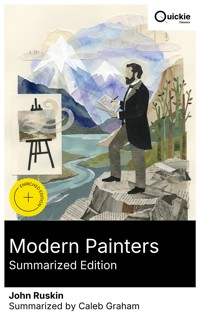
Modern Painters (Vol. 1–5) is Ruskin's great Victorian treatise on landscape, fusing lyrical cadence with minute observation. Over seventeen years he vindicates Turner and the principle of "truth to nature," opposing academic formulae with analyses of clouds, rocks, foliage, and light informed by geology and travel. He coins the "pathetic fallacy," frames a moral theology of seeing, and links Giotto to the Pre-Raphaelites. Born to a cultivated wine-merchant father and exposed early to Turner's work, Ruskin joined evangelical rigor, Oxford study, and Alpine sketchbooks. Travels through Switzerland and Italy taught him to measure mountains and skies before reputations; the first volume (1843) began as a defense of Turner against hostile critics. Later volumes deepen his synthesis of science, theology, and connoisseurship. This is indispensable for artists, historians, and attentive readers. Approach it for lessons in looking: how perception bears ethical weight and how description can rise to judgment. Read patiently, pencil in hand; Modern Painters still recalibrates the eye and conscience, providing a durable standard for criticism and a companion to the practice of seeing nature and art anew. Quickie Classics summarizes timeless works with precision, preserving the author's voice and keeping the prose clear, fast, and readable—distilled, never diluted. Enriched Edition extras: Introduction · Synopsis · Historical Context · Author Biography · Brief Analysis · 4 Reflection Q&As · Editorial Footnotes.
Das E-Book können Sie in Legimi-Apps oder einer beliebigen App lesen, die das folgende Format unterstützen:
Veröffentlichungsjahr: 2026
Ähnliche



![Stones of Venice [introductions] - John Ruskin - E-Book](https://legimifiles.blob.core.windows.net/images/bbc8b2fc235b859daa0429d722b5ed07/w200_u90.jpg)

Modern Painters (Summarized Edition)
Table of Contents
Introduction
Modern Painters turns on the urgent claim that truthful seeing—patient, exact, and morally awake—must guide modern art against complacent convention, as John Ruskin sets a demanding standard for how mountains, skies, waters, and the labor of the human eye should be honored, arguing that fidelity to nature is not mere imitation but a discipline of conscience and perception, a tension between the habitual ease of received taste and the strenuous effort of attending to what is actually there, where the duties of the artist and the responsibilities of the viewer become inseparable acts of attention.
In genre terms, Modern Painters is an expansive work of art criticism and aesthetic theory from mid-nineteenth-century Britain, issued in five volumes between 1843 and 1860. Conceived amid vigorous public debates about landscape painting, it draws authority from Ruskin’s first-hand observation of European scenery and from sustained encounters with pictures in galleries and collections. The book presents no fictional setting; instead, its stage is the studio, the museum wall, and the open air, where questions of accuracy, taste, and judgment are argued. Its publication cadence mirrors an evolving inquiry, with each installment deepening and widening the original critical brief.
As a premise, the first movement of the work defends the achievements of modern landscape painters, especially the radical force of J. M. W. Turner, against formulaic reverence for the Old Masters, then develops into a comprehensive meditation on art’s relation to truth. The reading experience is at once polemical and patient: sentences unspool with Victorian amplitude, yet they rest on close looking and precise distinctions. Ruskin’s voice is ardent, exacting, sometimes uncompromising, but also generous in praise when he finds integrity. The tone joins moral seriousness to sensuous description, yielding criticism that feels both forensic and rapt.
Across its arguments, several themes recur with accumulating force. The book insists on truth to nature: a disciplined fidelity to observed form and process, not a photographic literalism. It interrogates the role of imagination, proposing that creative power refines and reveals rather than distorts. It explores the beautiful and the sublime in landscapes, linking sensation to ethical insight. It treats natural phenomena—mountains, clouds, rivers, foliage—with the care of field study, drawing on contemporary scientific awareness without surrendering aesthetic judgment. Through comparisons among painters and schools, Ruskin shows how generalization, manner, and cliché undermine respect for the world’s particularity.
Modern readers will find in these pages a rigorous pedagogy of attention that counters hurried, image-saturated habits. Ruskin’s method trains the eye to discriminate structure from surface, patience from fashion, and sincerity from show, proposing that careful seeing is a civic as well as an artistic virtue. His integration of observational detail with ethical reflection anticipates later conversations about environmental care and the responsibilities bound up with representation. Without relying on technical jargon, he models a bridge between scientific curiosity and humanistic judgment, and he invites readers to practice that bridge in their own looking, thinking, and making.
Historically, the work helped to revalue Turner’s late paintings and gave intellectual ballast to a generation of artists and critics. Its emphasis on precision and sincerity resonated strongly with the Pre-Raphaelite commitment to exacting observation, while its historical and comparative reach shaped later approaches in art history. The writing broadened the audience for serious criticism by demonstrating how exact description can become an argument. For students, curators, and general readers alike, it remains a touchstone for thinking about how to look, how to compare, and how to connect an artist’s choices with the ethical and sensory demands of nature.
Approached as a whole, the five volumes trace an argument that enlarges as it proceeds, moving from defense to diagnosis, from particular canvases to principles for seeing. Readers may move through it steadily or sample its chapters, but either way the governing invitation is the same: slow down, look harder, and let judgment be educated by the world’s intricacy. Modern Painters endures because it offers more than opinions; it offers methods for perception. In a time that prizes speed and novelty, Ruskin’s Victorian patience becomes radical again, reconnecting artistic value with truthfulness, and truthfulness with attentive, responsible seeing.
Synopsis
Modern Painters, issued in five volumes between 1843 and 1860, begins as John Ruskin’s defense of contemporary landscape art—especially the work of J. M. W. Turner—and grows into a comprehensive theory of art, nature, and perception. Ruskin writes as a critic and observer, arguing that artistic excellence depends on fidelity to observed nature rather than adherence to inherited conventions. Across the series, he links careful seeing with moral seriousness, proposing that truthful representation of the visible world discloses deeper order. The work advances stepwise: first establishing the case for modern practice, then developing principles of beauty and imagination, and finally grounding art in sustained study of natural forms.
Volume I frames the central claim that modern landscape painters surpass many revered predecessors because they attend more accurately to the facts of nature. Ruskin compares conventions in established schools with direct observation of atmosphere, light, and land, contending that earlier formulae often misrepresented natural effects. He highlights the precision of recent painters in rendering sky and weather, the behavior of water, and the subtleties of color and tone. The argument insists that disciplined looking, not mechanical rule-following, yields truth. This initial defense of modern practice sets the foundation for Ruskin’s broader principle: artists attain greatness by submitting imagination to the realities of the natural world.
Developing the same line, Ruskin criticizes what he sees as generalized or mannered habits in celebrated traditional landscapes. He distinguishes carefully between conventions that clarify perception and those that replace it, arguing that art declines when it repeats a style instead of confronting phenomena. To demonstrate, he pairs extended visual analysis with comparisons to natural effects observable by any attentive spectator. The volume thus introduces his evidentiary method: reasoned, empirical, and pedagogical. It proposes that the sublime and the beautiful cannot be secured by inherited patterns alone; they arise when the artist’s vision is shaped by the specific, verifiable appearances of nature.
Volume II shifts from technical debates to aesthetic philosophy. Ruskin analyzes the faculties that govern perception and creation, asking how imagination interprets and organizes what is truthfully seen. He distinguishes types of beauty and examines the conditions under which beauty becomes intelligible to the mind. The discussion links form, order, and purity with mental and moral states, proposing that artistic insight involves disciplined feeling as well as accurate sight. He argues that invention does not license falsification; rather, imagination deepens truth by revealing relationships latent in nature. The volume thus extends his defense of modern practice into a theory of how and why art matters.
Continuing in Volume II, Ruskin considers the education of perception and the formation of taste. He describes how training, habit, and humility equip artists and viewers to detect qualities easily missed by unprepared eyes. Natural forms are treated as intelligible signs, whose structure and harmony invite careful study. Without prescribing rigid formulas, he articulates principles of composition that favor unity arising from the subject itself. The analysis maintains a balance between description and valuation: beauty is not merely pleasing but instructive, and art’s coherence derives from its responsiveness to the ordered complexity of the world it represents.
Volume III returns to critical practice while clarifying key terms in the debate about feeling and fact. Here Ruskin introduces the notion that sentiment can distort perception when it projects states of mind onto external nature, a phenomenon he analyzes to safeguard accuracy without denying emotion. He also differentiates traditions of landscape—especially so-called classical treatments—from modern efforts grounded in observation. The book expands his earlier studies of atmospheric and aqueous effects, pressing for exactitude in depicting transient conditions. Throughout, he argues that sound criticism tests claims against experience, and that the vitality of art depends on the integrity of its response to what is seen.
Volume IV concentrates on mountain scenery, especially the Alps, to demonstrate how scrupulous study enriches both science and art. Ruskin examines rock structure, snow, cloud, and light, showing how particular forms generate characteristic appearances at different scales and seasons. He relates contour, fracture, and weathering to visual impression, guiding artists toward depictions that are both faithful and expressive. The inquiry reinforces his principle that grandeur is not an abstraction but a property disclosed by attentive analysis. By uniting geological understanding with painterly judgment, Ruskin illustrates how knowledge refines vision without subordinating art to technical description.
Volume V synthesizes the argument historically and critically, assessing the achievements of individual artists and the development of landscape painting. Ruskin reaffirms the superiority of works founded on sustained observation and conscientious workmanship, warning against the decline that follows when manner displaces truth. He considers how artistic excellence is nurtured by patience, reverence for nature, and rigor in craft, while also reflecting on the conditions that enable art to flourish. The final volume gathers his technical, philosophical, and natural-historical studies into a coherent outlook, returning to the claim that modern landscape art, at its best, realizes the highest potential of the genre.
Taken together, the five volumes offer a unified view: art and nature are joined by the discipline of truthful seeing, guided by imagination that clarifies rather than falsifies. Ruskin’s project confronts questions about accuracy, beauty, feeling, and moral responsibility, shaping subsequent discussions of aesthetics and criticism. Without prescribing a single style, he proposes standards grounded in observable reality and sustained attention. The enduring message is that fidelity to nature—pursued with intellect and conscience—enlarges both artistic practice and human understanding, and that great landscape painting invites viewers to perceive the world more deeply, with curiosity, patience, and respect.
Historical Context
Modern Painters, issued in five volumes between 1843 and 1860, emerged from Victorian Britain’s intertwined art, science, and religious cultures. John Ruskin, initially signing himself “A Graduate of Oxford” after completing his degree in 1842, wrote from London and Oxford while traveling across Britain and the Continent. The Royal Academy set artistic standards and maintained a hierarchy that favored history painting over landscape, while the National Gallery (established 1824) shaped public taste. Periodicals and exhibitions amplified disputes about “truth” in art. Against this backdrop, Ruskin set out to assess modern landscape painting, defend J. M. W. Turner, and reform English critical judgment.
British landscape art had grown in stature since the late eighteenth century through Gainsborough, Constable, and Turner, yet institutional prestige remained limited. Romantic literature and natural theology encouraged close attention to mountains, weather, and flora. Ruskin’s childhood tours and repeated expeditions to the Alps and Italy in the 1830s and 1840s supplied firsthand observation; he sketched glaciers and rock strata, read Charles Lyell’s geology, and attended lectures by Oxford geologist William Buckland. Such study supported his principle of “truth to nature,” aligning artistic practice with contemporary empirical science and travel, and challenging studio conventions derived from Claude Lorrain and other revered continental masters.
Volume I (1843) directly answered period critics who derided Turner’s later canvases as chaotic or unfinished. Ruskin, still anonymous, marshaled close visual analysis to argue that Turner’s atmospheric effects, light, and color rendered nature more truthfully than the formulaic compositions of Claude and Salvator Rosa then favored in polite taste. The Royal Academy’s exhibitions and London journals provided the forum for these disputes. Photography’s public debut in 1839 sharpened arguments about fidelity to appearance, but Ruskin distinguished mechanical record from artistic insight. His case for modern landscape challenged academic hierarchies and widened public appreciation of contemporary British painting.
Volume II (1846) broadened the inquiry from individual masters to the structures of natural form: mountains, clouds, water, and vegetation. Ruskin absorbed current science—drawing on meteorological observation after Luke Howard’s cloud nomenclature and on geological debates—while insisting that faithful depiction required moral sincerity as well as skill. In the same period, the National Gallery’s picture-cleaning controversy (1846–1847) made color and conservation a public issue; Ruskin intervened in letters to The Times to caution against destructive methods. His heightened attention to optical truth, atmosphere, and local color thus reflected both advances in natural knowledge and anxieties about preserving artistic heritage.
The artistic climate shifted after 1848 when the Pre-Raphaelite Brotherhood promoted minute natural observation and early Renaissance sincerity. Their controversial pictures provoked fierce criticism, and Ruskin publicly defended them in The Times (1851) and in his pamphlet Pre-Raphaelitism. Turner’s death in 1851 and the eventual public disposition of the Turner Bequest (settled in 1856) further focused attention on modern landscape. Volumes III and IV (both 1856) extended Ruskin’s method into art and literature, introducing concepts such as the “pathetic fallacy” to test perception colored by emotion. He also wrote Notes on the Turner Gallery at Marlborough House to guide viewers through newly accessible works.
The mid-century industrial boom reshaped cities and countrysides: railway expansion, ironworks, and London’s Great Exhibition of 1851 advertised technological prowess. Debates over machine production and ornament—driven by reformers like Henry Cole and by Gothic revivalists such as A. W. N. Pugin—framed art’s social purpose. While Ruskin published The Stones of Venice (1851–1853) alongside his critical project, Modern Painters increasingly connected aesthetic judgment to labor, craftsmanship, and the health of environments he sketched in Britain, Switzerland, and Italy. His praise of careful handwork and organic form implicitly challenged utilitarian design, linking the study of natural truth with moral and civic responsibility.
Scientific culture supplied further tools. Color theory circulated through Michel-Eugène Chevreul’s contrast studies (widely discussed in Britain by mid-century), while Alexander von Humboldt’s Kosmos (1845–1862) modeled a unified vision of nature. Government-backed art education expanded under the Department of Practical Art (founded 1852) and the South Kensington Museum, promoting design for industry. Ruskin lectured widely and taught drawing, but criticized systems that reduced art to technical routine. Modern Painters draws on contemporary optics, geology, and botany to argue that precise observation must be joined to ethical purpose, aligning with Pre-Raphaelite naturalism yet resisting any purely mechanical, school-based approach to making and judging art.
Volume V appeared in 1860, the year Ruskin began publishing Unto This Last, signaling his turn toward political economy and social reform. Modern Painters as a whole both reflects and critiques its era: it embraces Victorian science and travel, engages public institutions and exhibitions, and champions living artists; yet it resists utilitarian values, defending imaginative truth, conscientious labor, and the preservation of nature and art. The work helped shape British taste, supported the Pre-Raphaelite cause, and influenced later movements like the Arts and Crafts. Its sustained argument links aesthetics to ethics, offering a lasting evaluation of what modernity should require from art.
Author Biography
John Ruskin (1819–1900) was a British writer, art critic, and social thinker whose work shaped Victorian debates on art, architecture, nature, and political economy. Ranging from multi‑volume criticism to public lectures and letters, his writings argued that aesthetic judgments carry moral and social consequences. He championed close observation of the natural world, the ethical value of craftsmanship, and the responsibilities of wealth and power. Ruskin’s influence extended across movements—including the Pre‑Raphaelites, Gothic Revivalists, and the Arts and Crafts—and reached beyond Britain through artists, educators, and reformers who encountered his books. His prose style, at once exacting and prophetic, made him a defining Victorian voice.
Ruskin was educated at the University of Oxford, where he studied classical literature and natural science, won the Newdigate Prize for poetry, and honed his skills in drawing and watercolor. Extensive travels in the Alps and Italy deepened his fascination with geology, landscape, and medieval art. The literature of Romanticism, particularly Wordsworth, and the painting of J. M. W. Turner decisively shaped his sensibility. Thomas Carlyle’s critique of industrial modernity further sharpened Ruskin’s social concerns. From these sources he formed a belief that artistic truth rests on truthful perception of nature and on communities organized around meaningful labor rather than mere profit.
Ruskin achieved early prominence with Modern Painters (published in five volumes between the 1840s and 1860s), an ambitious defense of contemporary landscape painting, especially Turner. There he set out principles of “truth to nature,” insisting that beauty arises from exact study of natural forms and atmospheric effects. He also developed the idea later known as the “pathetic fallacy,” not to banish emotion but to warn when sentiment distorts observation. Modern Painters combined criticism, travel writing, and natural history, and it popularized careful looking as a moral discipline. The work’s scope and eloquence made Ruskin a central authority on art for Victorian readers.
In The Seven Lamps of Architecture and The Stones of Venice, Ruskin advanced a moral philosophy of architecture. He praised the Gothic for its expressive imperfection, collective workmanship, and honesty of materials, contrasting it with mechanical regularity and deceptive ornament. His analyses of structure, carving, and urban fabric treated buildings as embodiments of social life, not merely styles. These books inspired architects, preservationists, and craftspeople, reinforcing a return to handwork and ethical construction. The argument that beauty is inseparable from the conditions of labor helped prepare the way for later critics and practitioners associated with the Arts and Crafts movement.
Beyond books, Ruskin reached audiences through teaching and public initiatives. As the first Slade Professor of Fine Art at Oxford from the late 1860s, he delivered influential lecture series, promoted drawing as a tool of attention, and established what became the Ruskin School of Art. He supported the Pre‑Raphaelite painters in public letters, urging viewers to value sincerity and precise observation. Manuals such as The Elements of Drawing and lectures including The Two Paths and Aratra Pentelici translated his principles into practice. He also encouraged civic and student projects that linked education with physical work, seeking moral renewal through shared effort.
From the 1860s Ruskin turned increasingly to social questions. In essays and books such as Unto This Last, Munera Pulveris, Time and Tide, and the long-running series Fors Clavigera, he criticized laissez‑faire economics and argued for justice in production, fair wages, and stewardship of land. He founded the Guild of St George to foster small-scale craftsmanship, education, and rural economies, assembling collections for public study that were displayed in Sheffield. Though controversial in his day, these writings influenced reformers and artists; readers as different as William Morris and Mohandas Gandhi found in them a moral critique of industrial society and consumerism.
Ruskin’s later career brought both acclaim and dispute. His fierce review of a work by James McNeill Whistler led to a libel trial in the late 1870s, an episode emblematic of his uncompromising standards. He continued to publish on art and nature, including The Storm‑Cloud of the Nineteenth Century, which warned of environmental and atmospheric degradation. Periods of ill health reduced his public activity, and in his final decade he wrote Praeterita, a reflective autobiography. Ruskin died in 1900 at Brantwood in the Lake District. His legacy endures in art criticism, heritage conservation, design education, and ongoing debates about economy and ethics.
Modern Painters (Summarized Edition)
Volume 1
The volume opens with four prefaces followed by a detailed framework. Part I, devoted to general principles, first explores the nature of conveyable ideas—greatness, power, imitation, truth, beauty, relation—then investigates power itself and the sublime. Part II, devoted to truth, lays out its connection with beauty, the difficulty of discerning it, the hierarchy of particular, rare, and color truths, then applies those maxims to tone, hue, chiaroscuro, spatial focus and range. Further sections test truth in sky, earth, water, and vegetation, culminating in remarks on modern art, modern criticism, and a closing postscript with reflective epilogue.
Outraged by shallow attacks on a living master, the speaker began a note that soon grew into a defense of landscape art. No personal loyalty drives him; public taste sinks while critics praise pretence and mock exalted truth, so he bears witness to the Beautiful and the True. He honors genuine talent, raising the neglected without lowering the admired, blaming only three offenders. Though he faults old schools for nature’s distortion, later parts promise to show their strengths. A practitioner who has studied works from Antwerp to Naples, he cites Dulwich pictures[2], offers fragment with apology, and vows completion if its spirit is welcomed.
In the second preface he likens his single volume to a ship breaking the enemy’s line. Attack by successive divisions requires inner superiority; sure of that strength, he hurled the lightest craft forward, eager to join the thick of fire. The lonely vessel now endures broadsides like the Royal Sovereign at Trafalgar[1] while heavier ships, delayed by accidents, remain astern. Initial anxiety fades: the flag of truth flies bright through the smoke, opponents fixate on the leading hull, drift into disarray, and expose themselves to the approaching columns. Confident in ultimate victory, he waits to launch the rest.
He begins by admitting his early publication caused confusion: readers mistook the volume for a finished system, whereas it is only a prelude. It was welcomed beyond his boldest hopes, often proving its principles, stirring curiosity, and prompting people to weigh Art against Nature, yet its influence would have been larger had its scope been understood. The book merely sketches elementary rules, praising those gains won by keen eye and faithful hand; all matters of feeling, judgment, and the deeper meaning of natural phenomena await forthcoming essays. To forestall future error, he now outlines his motives, plan, and intended conclusions.
He observes that challenging the honor of figures enthroned by centuries seems presumptuous, for great minds have knelt humbly before antiquity while waiting for their own crowns to age; the petty and inept assault the dead. Yet the same spite hides in safer guise, belittling the living and inflating the departed, veiling new stars while clouds round the old are seen. People begrudge praise that yields pleasure, waste it on tombs, relish criticism that wounds. “To the best and wisest,” Hooker warns, “the world is a froward opposite… it will not endure to hear that we are wiser than any have been which went before.
Therefore anyone who defends living excellence against ancient fame must brave universal hostility: the generous dread slighting revered names, the envious resent glory, the wise trust centuries over days, the foolish lack judgment. Still, reverence for the past safeguards art; the discipline won by ages would perish in gusts of fashion without that authority. Yet nothing inherited is perfect. Each era may birth a master who, aided by experience, pushes farther. Antiquity must guide, not chain. Let the young artist prize every landmark yet refuse to let canvas or tradition eclipse sky or God; greatness blooms only when he breaks his models and invents anew.
First, even celebrated antiquities remain visibly imperfect and could be surpassed; each age owns a special faculty that may yield works as great, perhaps greater, than the past if fired by equal labor and honesty. “Nothing has been for centuries consecrated by public admiration without possessing in a high degree some species of sterling excellence,” yet excellence in one kind never guarantees supremacy in all. Perugino yielded to Raphael, Claude[12] may yield to Turner. The reviewer who cries, “he admits the superiority of these time-honored productions,” builds a false inference and mistakes abstraction for total, final perfection.
Second, a genius able to rival antiquity would naturally craft works unlike any predecessor; the very dissimilarity that alarms convention signals a fresh, perhaps higher, canon founded on eternal truths. Third, such audacity must split opinion: a loud majority bound to precedent will rail harder as the master strides beyond their petty canons, while a dwindling minority, versed in general knowledge, grows ever warmer in admiration until only a devoted few remain beside him at the summit. Such a mind stands among us now, “gone on from strength to strength,” powerful yet already entering the chill of fading popularity.
Its supremacy demands proof, and proof I shall give, for, as Southey[9] declares, “No man was ever yet convinced of any momentous truth without feeling…the desire of communicating it.” Baxter[10] adds, “We mistake men’s diseases…when we think there needeth nothing to cure them but the evidence of truth,” yet, once evidence lies before them, my task is done and belief will follow. Newspaper critics merely echo the crowd; the Blackwood hack[6], armed with a week’s tree-study and dictionary raids, flogs Turner with birch. Years of toil will unveil such buffoonery, explore laws, and ask whether art ever warms hearts, recalling Rome’s goblets and Italy’s walls.
Landscape painting has wielded colour and form without touching the soul. It has neither preserved the fleeting, unveiled the hidden, nor stirred devotion; its promise to proclaim divine omnipotence has shrunk into a show of human dexterity. The canvas that should lift thoughts heavenward clutters them with man-made tricks. Stand before a celebrated scene and listen: spectators praise brushwork, composition, clever mimicry; almost none fall silent in awe of nature. Hundreds chatter about Claude, yet not one leaves murmuring gratitude to God. Such applause betrays a false, degraded school whose strength ends the instant it is noticed.
True mastery begins where both painter and process disappear. In a great poem or oration, we see with the seer yet forget his name; Cassandra’s hush or Lear’s wail holds us, not the poet’s craft. Likewise the brush has done nothing until its maker is lost, but connoisseurs roam galleries hunting signatures, counting hairs on donkeys, glorying in potsherds, drunken boors, and beldames only to applaud the flash of pigment. Genius itself has been squandered: even works hailed as the summit of beauty by Claude or Salvator begin and end as exhibitions of private skill, never as hymns to God.
The fault lies in artists who recast creation, fling shadows across it, and prize fanciful combinations because they are impossible. Critics celebrate this artificiality as invention, applauding blurred species, distorted rocks, and monsters as steps toward a ‘grand style.’ Genuine grandeur rests on intimate knowledge and plain rendering of each thing; to alter form is to trade truth and majesty for laziness or insolence. Mythic figures need no warped earth beneath them, for real woods and waters birthed the dream. The true ideal seeks perfected specific character of every cloud, flower, and stone, expressed with austere power for the sublime or utmost delicacy for beauty.
Contradiction appears only because the principle was misapplied. Historical painters, used to briskly scratching in backgrounds and fearing that careful foliage might compete with their figures, advise broad masses and vague forms: flexibility without species, hardness without mineral truth. They commend the maxim, “the landscape painter works not for the virtuoso or the naturalist, but for the general observer of life and nature.” Yet a sculptor, though carving for common eyes, still studies every muscle; detail is his means, not his end. So botanical and geological truth, reverently gathered, becomes the indispensable material of expression and beauty in landscape.
Reynolds praises the St. Pietro Martire[3] foreground because the plants are distinguished “just as much as was necessary for variety, and no more.” Imagine applauding a scene where lion, serpent, and dove barely differ; vegetable forms are no less profound than animal. Their subtlety excuses no neglect. Yet Reynolds overlooks what he does not expect: the Italian masters, above all Titian, labor over every petal. In “Bacchus and Ariadne[4]” the blue iris, aquilegia, and wild rose show stamens, clustered leaves, relentless accuracy. Raffaelle wrestles with sea colewort in his cartoons. Such fidelity deepens figure interest and bears ideal grace.
Beginnings and consummation often mirror each other: the child’s broken line and the master’s apparent carelessness share a lively freedom, whereas the rigid middle stage strays farthest. Early taste craves precise feathers and petals; maturing taste scorns them for breadth; perfected taste unites both, praising Raffaelle’s shells and delicate stamens beside Saint Catherine. Many stop midway, mistaking complete parts for weakness, dashing them off the pupil’s canvas, never reaching the final reconciliation. Great art gathers minutiae for a noble end. Titian’s roses display every stamen and sweeping leaf curve, yet ignore moss, dew, or insects, offering pure, simplified color.
Obey these laws, and the landscape painter not only may but must press into the smallest particulars. Every herb, flower, rock, earth, and cloud owns a distinct beauty, dwelling place, and purpose; the loftiest art captures that identity and sets it where it strengthens the picture’s impression. Hence the mantra of the critic—“the features of nature must be generalized”—is exposed as a lazy disguise for incapacity. “Generalized!” he cries, as though things generically different could merge. One Athenæum voice[11] sneers, “He would turn us into geological, dendrological, meteorological painters—alas!” Ancient masters, it adds, “gave only general features, attaining harmonious union and simple effect.
Answering such talk is simple: granite and slate cannot be blended any more than man and cow. An animal is either one or the other; a rock likewise. If a foreground creature leaves us unsure whether it is pony or pig, the critic might call that a “generalization,” but it is merely bad drawing, and Salvator’s crags are the same monstrosity. Mixtures breed corruption or annihilation. True, rocks, plants, and clouds are less obvious than animals, yet ignoring them does not elevate art—it explains why no perfect landscape school has appeared. As figure painting rests on anatomy, so landscape rests on geology and meteorology.
Knowledge alone does not ennoble; purpose does. The botanist tallies stamens, yet the painter studies hue, line, vigor, and habitat until the flower speaks in his picture. Shakespeare and Shelley used such names for melody. Strip the detail and the ignorant learn nothing while the informed lose delight; illegible writing aids no one. True breadth springs from perceiving each distinction and relation, whereas ignorance breeds chaos. Thus the painter must master every rock, soil, cloud, and climate, for each geological order fashions singular cliffs, skies, plants, and moods. Their varieties defy fusion, though nature composes them: peaks lean through slopes into vine-lit valleys below snow.
A landscape artist may either devote himself to one distinct character or assemble varied fragments whose contrasts merely glitter. I maintain that an unbroken scene, shaped by ideal beauty, reaches deepest; contrast may dazzle yet weakens feeling. In any composition, superfluous figures burden and discordant ones shatter unity; "He that gathereth not with me, scattereth." The same law rules rocks, clouds, and rivers: crowding unmatched moods breeds noisy emptiness, while a single prevailing spirit bestows power. A solitary accent may heighten it, but equal opposition dilutes everything until emotion fades like blended pigments into white.
The canvas called "Il Mulino" proves the danger. An enchanting forest foreground, peasants dancing beside a brook, could have sufficed. Instead, across the water a shepherd drives bulls and goats that collapse mid-stride; behind them Roman horsemen on toy chargers, urged forward by a striding leader, rush the musicians. A crumbling round temple supports a busy water-mill whose trough leaps its own walls. A stiff weir flattens the river into a dull pond where anglers drift. Nearby rise twenty-five identical towers and a pyramid; beyond, a bridge, broken aqueduct arches, Alpine cones, and, to the left, Tivoli’s cascades.
Imagine evening over the lonely Roman plain: crumbling earth, long grass trembling, ruined arches marching toward dim mountains beneath poisonous purple haze. Now watch the so-called idealist improve it: swap the Apennine ramparts for four sugar-loaves, the Alban height for a rubbish heap, endless aqueducts for two polite arches, sunset for bright blue sky and puffy clouds; erase the haunted foreground, plant elegant trees, summon fiddlers, spread a picnic. Likewise he converts Rome’s varied slopes into meaningless round towers, mud-brown rivers into ornamented ponds. Such prettified patchworks cheapen feeling, turning art into toys; only faithful, reverent study of untouched nature can ennoble paint.
Heartfelt love for nature and total obedience to her teaching are vital, yet airy sketches of passing impressions and mechanical copies of trifles stain modern easels. The sparkle of a shower, a sun-beam, harvest glow, or copse shade must not be tossed forth unfinished and forgotten. A real picture distills the living emotion of many studies through long-tested, carefully chosen forms, idealized not by reckless “imagination” that debases creation but by complete knowledge of every part. Labor must serve chosen scenes—hedgerow or palace—each unique, forming an ascending chain that draws every level of creation closer to the human heart.
He therefore divides his labor in three. First, he will chart nature with scientific precision, exposing the ancient painters whose lofty dreams rest on neglected groundwork. Next, he will probe the feelings of Beauty and Sublime, reveal the ceaseless loveliness God imprints on every scene, and define the moral purpose of art, binding it to daily life and the artist’s responsibility as preacher. The opening survey, hard and joyless like hammer and eudiometer, cannot pause for emotion. Still, fervent loyalty to Buonaroti, Leonardo, Raffaelle, Titian, and Cagliari justifies sharp blows at Gaspar Poussin[13] or Vandevelde[14], and champions Turner against conventions and Michael Angelo against modernities.
Accused of irreverence, he answers that words pierce superstition, adding, "Such a man cares for truth." He often withholds reproof to spare artists. Long taunted that Turner "is not like nature", he proved the opposite and watched foes retreat. One reviewer cries, "I dislike the natural style; let people look at nature herself." Another insists, "It is not what things are, but how mind makes them what they are not." He urges reality, reveres fragments, Michael Angelo, and the Madonna di San Sisto[5], and prizes originality rooted in study, recalling Spencer's "Truth is one" and Byron's "Vice must have variety; Virtue stands like the sun.
With reluctance the speaker turns from higher aims to baiting critics, yet, urged by earnest friends of art, he unveils their blunders so the public may judge. One calls Poussin "Chrysoprase" for his mere "composition", ignoring the painter’s famed classical scholarship; another, reviewing the Academy of 1842, declares, "He often reminds us of Gainsborough’s best manner, but he is superior to him always in subject, composition, and variety." The writer summons Gainsborough’s shade, then, respecting Lee’s honest, nature-minded canvases, contrasts them with the immortal master: unrivalled colour, cloud-light touch, vast masses, ideal forms—qualities the reviewer cannot even recognise.
He proceeds to link a line from the Frogs[7]—"I rejoiced in the silence"—with the veiled, fiery depths of Turner’s canvases; like Æschylus, the painter earns popular scorn. More Greek excerpts sparkle, clouds sliding "δια τῶν κοίλων καὶ τῶν δασέων, πλάγιαι[8]", every phrase breathing mountain wind and dew. Such melting forms bear no lumpish bulk, only drifting light. Let no one confuse this principle with Fuseli’s cry against ocular deception: true realisation touches the mind, not the eye. Later he will prove universal canons of beauty, yet for now demands only knowledge of nature, not impossible labour.
Knowledge, he insists, would blossom if artists traded barren sketching for keen study: Martin, had he watched the shore instead of puffing his Canute, could have conjured the sea with a few immortal strokes. Byron’s jest—"A green field is a sight which makes us pardon the absence of that more sublime construction…"—glances by, followed by a note that Campagna soil is lava-born pumice. Constable’s attitude nearly models devotion, yet shuns fellowship; Beaumont’s creed of "Cremona fiddle tone" and the weary question, "Where do you put your brown tree?" reveal mindless idolatry. True service walks humbly with Nature, not Art.
Artists desire to finish grand conceptions, yet the market forces them into quick sketches; ten people more readily pay ten guineas than one pays a hundred. Whenever a painter strains beyond manufacture, the effort is left unrewarded. Last year David Cox hung a majestic forest hollow, sheep pushing through deep fern beneath solemn evening sky; it surpassed all his scattered fragments, yet buyers snatched the clever blots—“ducks, chickweed, ears of corn”—and abandoned the real picture. Cattermole, once painstaking, now rushes superficial sheets for gain. Such tricks degrade taste; yet the crowd takes no pains to tell mastery from showy brushwork.
With reluctance I let these early chapters stand, though they were forged in haste and are ill-suited to introduce a sober inquiry into art. I have lopped off what seemed irreparable, inserted a few supports, yet left the book essentially as first written, trusting readers to value its intention above its heat. Its fixed purpose remains: to lower Claude, Salvator, Gaspar and Canaletto, to exalt Turner, and to prove his latest landscapes supreme. The older masters, I contend, have poisoned the continental eye and dulled contemplation everywhere; only a separate English school has resisted. Added notes deepen sea-studies, yet neither indignation nor enthusiasm is trimmed.
At friends’ urging I now release one final thousand-copy impression of Modern Painters, plates worn though still serviceable; the Mill Stream and Loire sides suffer, yet Armytage, Cousen, Cuff and my own etchings remain adequate. I confess the first volumes glow with narrow zeal, but their lessons and descriptions stand. Turning to principles, I insist that centuries of enduring fame rest not on crowds but on a steadfast minority: wrong opinions perish, right ones spread downward, leavening the mass. The multitude gawks at slipper satin and cloak lining, blind to noble thought; judgment begins with the few who are equal to the master.
When time has crowned a work, fair comparison falters; only minds both trained and bold enough to shake off prejudice can weigh a rival. “It is much easier,” Barry warns, “to repeat praise of Phidias than to discover the worth of Agasias.” In painting, verdicts demand technical mastery, yet the competent judges are themselves on trial and therefore silent, so centuries may pass while patriarchal fame tyrannizes genius. Nowhere is the blight deeper than Rome, where pupils copy Raffaelle’s surface, not what Raffaelle studied. Whoever can show modern superiority must face hostility; I accept that task, lifting the veil between ancient and living landscape art.
I proceed cautiously, testing every doubt and resting each claim on demonstration, for great names cannot overrule evidence. The fifteenth-century historical painters and seventeenth-century landscapists must not be bundled beneath the badge “old masters”; their principles clash. My study of Michelangelo and Leonardo has estranged me from Claude, Gaspar, Salvator, Cuyp, Berghem, Both, Ruysdael, Hobbima, Teniers, Potter, Canaletti, and many a Van, though I except Nicolas Poussin. Before judging, I shall lay down clear principles and free criticism from cryptic jargon. If fondness for modern art peeps through, forgive it: honor the dead, but thank the living, for in art the minority often speaks true.
There are countless conditions that make public acceptance of a work needless, swift, or hopeless. In arts aimed at stirring crowds, outside guidance is superfluous because the crowd judges at once. When lofty qualities ride with appeals common to every heart, fame bursts forth earnestly: witness Don Quixote. The simplest laugh at the knight’s mishaps and love the squire; middling minds relish its satire, wit, and elegance; rare spirits pass mockery and pain to detect the hero’s steadfast love and self-devotion. Scott and Byron rose similarly, yet most fans prize their weakest pages, just as worshippers applaud the dullest part of a popular sermon.
When a piece contains little bait yet much to enjoy once guided, acclaim follows authority; thus Shakespeare. Early playgoers granted common approval, lured by ghosts, clowns, kings, daggers. When higher minds pronounced him supreme, the multitude echoed, repeating scraps they barely grasped; their delight in Maclise’s flashy Hamlet betrays the ignorance. Where nothing tempts and something offends, popularity is impossible: Wordsworth and George Herbert cannot win the crowd. Masterpieces by Raphael or Da Vinci face like misreading, pride and pretence swelling thin praise. Giotto or Perugino remain with the few, while Wilkie, stirring universal feelings, attains the many.
True rank rests on the gap between workmanship and the mind directing it. Painting, like speech, is merely a tongue; mastering form and colour is only grammar. Greatness comes not from how things are rendered but from what is told. Skillful brushwork makes a versifier, subject makes a poet. In “Old Shepherd’s Chief-mourner” the shining coat, green twig, coffin wood, and blanket form flawless language, yet the dog’s tense embrace, the closed Bible, the silent room carry the thought that ennobles it. The loftier the idea, the less it needs adornment; decorative sparkle may entertain, yet many celebrated hands are only ornamental scribes.
Pictures of the Dutch school—barring Rubens, Vandyke, Rembrandt—strut like orators reciting empty phrases, while Cimabue and Giotto, though halting, carry blazing prophecy. Judgement must sift language from thought, praising pictures chiefly for the latter. A canvas laden with noble, abundant ideas, however awkward, surpasses a flawlessly polished trifle; no weight of execution outweighs a grain of thought. Three pen-strokes by Raffaelle eclipse the slickest surface Carlo Dolci ever burnished into inanity. Color and finish are blessings only when they deepen meaning; the moment refinement steals even a shadow of idea, "all refinement or finish is an excrescence, and a deformity.
Still, language carries its own ideas, for even the richest prism delights less than deliberate color guided by mind. Locke calls ideas "things which the mind occupies itself about in thinking," so sensations join the count once the eye hands them to intellect. Therefore the greatest picture is the one that feeds the spectator the greatest number of the greatest ideas. Not mere mimicry, pleasure, or lesson defines supremacy: some art pleases, some teaches, some creates. Whatever means it chooses, the art that most fully exercises and exalts the loftiest faculties stands highest; the artist who embodies such wealth stands greatest.
Ideas spring from five wells: Power, Imitation, Truth, Beauty, Relation. Ideas of Power arise when mind senses the energy that forged the work; they awaken veneration and the wish to act. From an Indian paddle carved end to end to the fretted face of Rouen Cathedral, delight grows with evidence of time, strength, dexterity, judgment. Whatever absorbs a great force bears its image and is called "excellent." A mighty engine cannot waste itself on a nut; so no great power clings to a petty task. Only those who have wrestled with equal difficulty—in vain sketching Titian's flesh—truly feel that excellence.
Wherever difficulty is mastered, excellence appears; to prove it, display the struggle. Pleasure lies in confronting resistance for its own sake, and witnessing another’s victory ennobles. Fault starts when an artist brags of beating a petty technical hurdle instead of a great one, for simplicity is harder than complexity, restraint than ceaseless display; beauty and real difficulty walk together. Power never wastes: exertion yields worth in proportion to its dignity, and sensing that exertion measures worth. Though Johnson calls an excellent person one “abounding in any good quality,” I use “excellent” for works won by great effort—music and poetry qualify, flowers do not.
Debate over “imitation” and “copying” drifts because the words blur; some even claim, like Burke, that we admire scenes we would hate in life simply through the power of imitation. Strip away that haze and a single, sharper delight emerges: when an object fashioned by art looks so thoroughly like something else that the eye almost surrenders, yet another sense exposes the trick, a bright shock of pleasure flares, akin to clever jugglery. Perfect likeness plus instant disproof are required. Hence paint can conjure velvet on a flat panel, wax can feign living flesh, but marble merely presents authentic form.
Such deception yields the meanest joy, for the mind must turn from the thing’s import and gloat over the fraud; noble feeling cannot breathe alongside that shallow surprise. Moreover, only trifles submit to exact mimicry: one may “paint a cat or a fiddle, so that they look as if we could take them up,” yet no brush can imitate ocean thunder, Alpine immensities, pasture or rainbow. The feat is also easy; steady hand and practiced eye suffice, as with a pin-maker, whereas true sleight of hand demands finer ingenuity. Diorama or stage may charm, but lacking illusion they rank lower still.
Whenever I name imitation, I point to the instant jolt when the eye grasps that a crafted thing is not what it seems: a painted sphere that proves flat, a marble wave that stands still. Pleasure springs from that afterthought. Truth, in contrast, means a faithful statement of fact, whether of matter, feeling, or thought. Imitation touches only the material; truth ranges from form to emotion, and the latter realm outweighs the first a thousand fold. An outline, a color, a gesture—anything that plants a precise conception in the mind—transmits truth even if it resembles nothing it describes.
A scratch of pencil gives two slim facts—the edges of a branch—so the mind receives truth without any likeness to wood or air. Fill the shape with wash and shade; add distance and projection; gather enough fragments and at last the viewer exclaims that the picture imitates nature. Yet the truths collected may be crude. The senses, untrained, demand little more than rough breadth of space and outline; perspective may wobble, muscles dislocate, foliage turn crude green, skin dull buff, but deception still succeeds. I could twist every bone in an arm and, with careful modeling, still draw applause for its lifelike thrust.
At Bruges I sketched a marble Madonna when a French enthusiast pressed me to admire modern canvases. 'Rubens never managed this—Titian never colored so,' he cried; then, hands aloft, 'By heaven, Michelangelo produced nothing finer! Monsieur, it jumps out!' He recognized only flesh tone and projection, the minimum that fools the eye. Such imitation diverts the mind toward the trick, not the subject. When signs are transparent, thought rests on the reality they convey; when they masquerade, we delight in exposing the lie, and the earlier truths rot in service of deceit. Therefore deception kills art, and beauty lives only with truth.
A material thing that delights the eye by its mere outward aspect, without any deliberate thinking, is "beautiful". Delight springs as inevitably as sweetness from sugar; the Creator planted the instinct. Training can refine or pervert it, yet obedience to the native law, savoring what was meant to please, makes a man of "taste". Perfect taste draws the fullest possible joy from objects that accord with moral nature in its purity; scant joy signals want of it, joy drawn from alien sources signals false taste. "Judgment" is different: a deliberate weighing of congruity, truth, or difficulty, wholly intellectual, while taste chooses instantly, reasonless, by nature.
Though intellect does not labor in the first thrill, beauty still stirs hidden perceptions of fitness and harmony; the beholder cannot say why the sight fills and exalts him. Should he name a clear thought, the charm has shifted into a higher relation. Such visions purify and uplift. Nature keeps the soul beneath them, for almost every leaf, cloud, or stone shows far more fair than foul; deformity is a dark fleck that heightens surrounding glow. Each species owns its special measure of grace; the utmost degree, joined to flawless structure, is the ideal. These delights touch moral sense, yet guide art toward that ideal.
Beyond beauty stand "ideas of relation": thoughts caught the moment two things are linked, demanding swift intellect. They include expression, sentiment, character, the chosen incident, color, or light that yields meaning. The children sailing toy boats in Turner's "Building of Carthage" proclaim the passion that will build an empire; a pen scratch could tell it, leaving paint subordinate. Claude’s red trunks and iron locks offer only mimicry. Thus ideas of relation govern art, all other pleasures serving as language. Even flesh yields to the agony of a dog or prophecy across Sistine vault. Henceforth the term covers every delight that wakes mind on sight.
We dismiss imitation at once: it is unworthy, a mere by-product of certain truths, and whenever a canvas merely deceives we say, “It deceives, therefore it must be bad.” Attention turns to power. Real delight in a swift chalk outline never lies in finger-skill but in knowledge expressed boldly. Power reaches us in two ways: through accurate reckoning of the difficulty conquered, and through the bodily shock of watching strength overwhelm resistance. Where estimate and sensation unite—as in Michelangelo—the impression is supreme; elsewhere they quarrel. We feel more energy in half-hewn Medicean twilight, Parthenon friezes, or Raphael’s inked Saint than in polished marble gods.
This disparity deepens because sensation grows when slight means yield startling effect, while each finishing touch adds less and less. The humblest five strokes conjure a head from nothing; no later five alter it so greatly, hence perfect work offers least felt force. Sketches and rough blocks rightly done possess a thrill absent from the completed piece, yet completion hides greater strength. Highest power lies where a flawless end is gained with the fewest, perfectly placed lines. Frederick Tayler’s flashes dazzle—each dash counts, yet the tale remains unfinished. John Lewis lavishes thousands of marks; none wasted, water-colour can advance no farther, and quiet mastery endures.
Therefore chase insight, not mere shiver of effort. Execution means the right mechanical use of means toward an end. Its foremost grace is truth: unerring knowledge spoken in a single precise line, every hairbreadth alive with meaning. Possessing this, an artist may ignore flashy swiftness; to those who boast, “qu'ils n'ont demeuré qu'un quart d'heure a le faire,” the candid Alceste replies, “Monsieur, le temps ne fait rien a l'affaire.” Next comes simplicity: modest, unshowy strokes. Then mystery: methods as unfathomable as nature herself. Fourth, felt inadequacy; fifth, fearless decision; sixth, velocity. Seek these only when inseparable from the first.
Velocity, the sixth noble quality of handling, delights like decisive action; two strokes otherwise equal, the swifter unfailingly excels, bearing more grace, gradation, uncertainty, and unity akin to nature. Some add a seventh pleasure, strangeness: once the core virtues stand firm, odd means may heighten wonder at the painter’s knowledge. Rubens proves it with the bull’s head tucked in the Adoration at Antwerp: he sweeps a transparent, wood-coloured film across the canvas, sketches eye, nostril, and cheek in a few rude brown flicks, rims the head with protruding warm white, then taps five cold bluish sparks for the highlight.
Viewed arm’s length away the beast seems flimsy and far, while the backdrop juts forward; step ten yards back and the head swells into solid, breathing life, the wall recedes, and the spectator thrills at such uncanny triumph. Berghem works opposite: first a silky dark ground, then laborious modelling in bright white, each tuft raised; the result glares like a distant lantern when one retreats, robbing pleasure. Hence strangeness charms yet rests on ignorance. The rightful delights remain truth, simplicity, mystery, inadequacy, decision, and velocity, though mystery clashes with inadequacy, and the first trio lift the mind while the latter parade raw power.
Fascination with visible might tempts painters to chase swift or resolute strokes until truth and simplicity slip; the descent is steep. One renowned contemporary, once full of promise, rushed to please admirers of his racing brush, surrendered precision, then veracity, then beauty; now his canvases flaunt empty bravado, speed serving nothing. The safest path favors overcoming hidden, weighty difficulties, not flashy trivial ones; discerning this keeps the sense of power noble. Coarser lures—shallow “boldness”, sugary smoothness, idle trickery—remain vices outright. When greatness in matter, space, force, virtue, or beauty lifts the spirit, the work becomes sublime, a height no glossary can reduce.
I accept much ingenuity in Burke's link between the sublime and self-preservation, yet death towers so high that its mere contemplation clears away all littleness. Whatever hints at it—most dangers, uncontrollable powers—is sublime. But grandeur lives in deliberate survey, not in blind shuddering. Strength rises while we defy, not while we cower. Where is the higher vision: the frantic plea, “Fall on us,” “cover us,” or the calm assurance, “And though after my skin worms destroy this body, yet in my flesh I shall see God”? Self-preserving terror kills sublimity; a coward feels little. Pure conception of suffering or ruin exalts, stirring compassion or fortitude.
Beauty need not shrink into littleness; when free of it, beauty itself becomes a wellspring of the sublime. Whatever lifts the mind above itself is sublime, for it beholds something higher and recognizes its height. The word, drawn from sublimis, carries that plain sense, sparing us tangled metaphysics. Sublimity, therefore, is no separate pleasure, but a mode of truth, beauty, or relation. The inquiry may rest on those three pillars: ideas of truth, which rank artists as reporters of nature; ideas of beauty, which test their harmony of craft, color, composition, and ideal purity; ideas of relation, which measure their power to originate just thought.
The landscape painter follows two ends. First, he sets the viewer where he stood, handing over facts of rock, tree, and cloud, then leaving the mind free or idle. Second, he stays beside the viewer, pours out quick thoughts and fiery feelings, speeds him to what is lovely, drags him from what is base, and sends him away ennobled. Choosing merely pleasing objects suits the first aim yet breeds sameness and petty rules. Choosing for meaning suits the second, and each canvas flashes unique intellect. Simple truths charm every eye; profound visions speak only to kindred, solitary spirits and may offend the crowd.
Truth, he argues, is the indispensable first stage of art: facts must precede thoughts, or the latter rot into falsehood. He pictures art as a palace whose unseen brick foundation supports crystal halls; some onlookers marvel only at the sturdy base, others gaze upward into the radiant upper storey where the artist’s spirit dwells, yet both depend on the same groundwork. The mind should be no warped pane that distorts nature, but strong, clear glass tinted with “sweet and strange color,” bringing reality nearer. Neither dazzling fancy nor lofty feeling can redeem the slightest lie.
Greatness in art, he continues, demands truth; grace, originality, and vivid color flourish only where observation is minute. Beauty does not lure the painter from accuracy, it multiplies the need for it: boldest visions stand upon wider knowledge than the dull cataloguer possesses. Because truth is measurable, every artist can be set before its bar, his rank rising with his fidelity. He therefore resolves to test ancient and modern landscapists solely on “bare, clear, downright” fact, ignoring glamour, passion, or light effects, and to weigh a living master publicly rumored the most deceitful of all.
“Cannot we see what nature is with our own eyes, and find out for ourselves what is like her?” the public protests. He admits that, with patient training, anyone can judge fidelity; yet before study, certainty is presumption. Minds must be schooled in steady observation, or glass they think pure Venice will betray them. Quoting Locke, he reminds them: “Whatever impressions are made on the outward parts, if they are not taken notice of within, there is no perception.” Sight, being constant, rarely wakens attention, so hills, clouds, and color rush past actually unseen utterly.
Men may live blind to the world, their minds taken by pursuits or dulled by a sluggish eye. Degrees of bluntness and acuteness range from torpor to rapture; culture can enlarge even the poorest sense, yet the pleasure rarely repays the toil, so the quest is dropped. Where feeling is keen, nature calls insistently, louder at every step; where feeling is blunt, her voice is smothered and faculties perish. This bodily alertness to color and form joins the higher pulse of love, which hallows perception and steadies judgment; without that holy warmth, perception dims and truth slips from the cold-hearted.
Impressions flood the acute man, yet without reflection and memory they vanish or breed fantasy. He sees what he expects and judges with his heart, not his eyes. Travelers, beguiled by praise of Italian serenity, face the gray haze and still swear the sky bluer than the north; before a painting they hail garish cobalt as “truthful” and spurn the faithful golden light. Imagination rules sight: the child sketches a roof as a T, Chinese reject converging lines, Indians call a half-lit portrait “half a face.” Barry warns, “The imitations… are like those of children—nothing is seen… unless it be previously known and sought for.
Nature offers endless change: no two bushes match, no pair of leaves, waves, or branches repeat. Only long, patient watchfulness distills their constant character, the hidden ideal. Small wonder the crowd cannot prize full truth when it confronts them; shameful is their refusal to admit it. A connoisseur who has raced across Europe cannot sketch an elm leaf yet chatters about landscapes “like nature.” An eager critic in the Sistine Chapel cannot count his own ribs yet pronounces muscles ill drawn. We cling to the least important signs of things, mistaking shallow familiarity for real sight.
A few tests might brand spectators as incompetent were it not for their defense that they “recognize what they cannot describe” and “feel what is truthful though ignorant of truth.” Recognition, however, moves by trifles: a friend’s binding identifies a book, a dog knows its master by scent, a tailor by coat, a friend by smile, yet only God sees the man himself. So one portrait may copy every feature and be “as like as it can stare”; another distorts form yet captures the rare flash of lip and eye; a third fixes the single instant when deepest powers blaze. Which likeness rings truest
First image shows transient accidents—flesh molded by climate, diet, time—prey for corruption. The second bears the stamp of soul, yet only in feelings common to many, perhaps even disguising what lies rooted beneath. The third reveals the hidden, mighty core, when every mask, habit, and fleeting emotion—ice, bank, and foam—break before a divine summons that calls forces the spirit itself cannot command. So with Nature: she has body and soul, her soul the Deity. Paint only the body and senses applaud; paint the familiar spirit and watchers assent; paint the secret spirit and only the vigilant perceive. Truths rise in dignity with the painter’s reach.
In weighing painters we must rank truths, for art cannot voice them all. The proverb “General truths are more important than particular ones” resounds yet deceives. I praise Turner’s variety; someone objects, “That is painting particular truths.” Logic rewards poverty of thought. A lady fills a lull with “What an excellent book the Bible is!”—hollow words. Say instead, “How evidently is the Bible a divine revelation!” and ears lift. Call a stranger ‘a man’ and say nothing; call him ‘Sir Isaac Newton’ and minds leap. Predicates sharpen with particularity: claim all Chinese eat opium and attention fixes. Thus in art the particular outweighs the general.
To depict anything faithfully, seize the qualities that define its kind. Drapery is drapery not because it is silk, wool, or flax, but because it spreads, bends without spring, hangs as one united, relatively thin sheet. A waterfall’s united veil or weed-net over a wall shares these traits and therefore counts as drapery. Such defining properties first separate a genus from all else, then subtler variations separate one example from another. Thus ‘silken’ or ‘woollen’ scarcely matter, while the unique fall of each fold matters deeply, just as the structure that marks a man human matters before the quirks that make him Newton or Shakespeare.
The most characteristic truths usually prove beautiful, for the features that shape a species embody its perfection, whereas most individual deviations betray flaw. Still, details may charm in isolation yet offend beside nobler themes. If a painter studies a single hanging cloth, he may revel in color, weave, and sheen; but when that cloth clothes a Madonna, such richness distracts and debases the vision. The drapery must whisper its nature with the lightest hint. Hence an unnecessary tassel spoils Canova’s Perseus, while the simple button on the Sistine Daniel, rendered by the slightest touch, remains right and lovely.
Rarity next affects importance. An uncommon fact gains worth only when it expresses nature’s principles in a striking way, not when it breaks them. Nature aims at beauty; though she occasionally allows a discord, these blemishes serve special ends and should appear in art sparingly, as momentary dissonance. An artist who hunts oddities alone—crooked forms, perpetual deformity—acts falsely, even if each example exists somewhere outside the studio. Clouds illustrate the rule: their edges are generally angled and straight; once a month a watcher may see a puff of pure curves, yet a canvas filled with nothing but rounded vapors betrays nature.




