


1,99 €
Niedrigster Preis in 30 Tagen: 3,49 €
Niedrigster Preis in 30 Tagen: 3,49 €
Mehr erfahren.
- Herausgeber: Booksell-Verlag
- Kategorie: Gesellschafts- und Liebesromane
- Sprache: Englisch
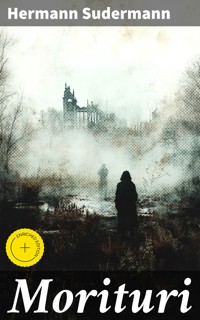
Hermann Sudermann's "Morituri" is a compelling exploration of existential dread and the collision of personal desires with societal expectations. Set against a backdrop of early 20th-century Europe, the novel delves into the intricacies of human relationships and the omnipresence of mortality, employing a stylistic approach that oscillates between lyrical prose and piercing dialogues. Sudermann's narrative is rich with psychological depth, as he examines the internal struggles of his characters, reflecting the broader themes of decadence and the search for meaning in an increasingly fragmented world. Sudermann, a prominent figure in the expressionist movement and a contemporaneous voice to writers like Gerhard Hauptmann, often engaged with the tumultuous shifts in society and morality. His insights into human nature and the limitations of individual choice were likely influenced by his own experiences and the philosophical currents of his time. "Morituri" embodies Sudermann's adeptness at weaving intricate character studies coupled with the existential crisis faced by individuals caught in a web of societal obligations. This introspective novel is highly recommended for readers interested in a nuanced exploration of the human psyche and the moral dilemmas of its time. Those who appreciate profound literary works that blend rich emotional landscapes with incisive social commentary will find "Morituri" to be both enlightening and thought-provoking. In this enriched edition, we have carefully created added value for your reading experience: - A succinct Introduction situates the work's timeless appeal and themes. - The Synopsis outlines the central plot, highlighting key developments without spoiling critical twists. - A detailed Historical Context immerses you in the era's events and influences that shaped the writing. - A thorough Analysis dissects symbols, motifs, and character arcs to unearth underlying meanings. - Reflection questions prompt you to engage personally with the work's messages, connecting them to modern life. - Hand‐picked Memorable Quotes shine a spotlight on moments of literary brilliance. - Interactive footnotes clarify unusual references, historical allusions, and archaic phrases for an effortless, more informed read.
Das E-Book können Sie in Legimi-Apps oder einer beliebigen App lesen, die das folgende Format unterstützen:
Veröffentlichungsjahr: 2019
Ähnliche


















Morituri
Table of Contents
Introduction
Balanced on the edge of ultimatum and consequence, Morituri explores how people confront themselves when time has narrowed choices to a single, searing instant and every word or silence carries the weight of a life’s meaning.
Morituri is a collection of one-act plays by Hermann Sudermann, a prominent German dramatist of the late nineteenth century. First appearing in the 1890s, the volume belongs to the era’s realist and naturalist theater, where psychological scrutiny and social pressure drive dramatic action. The Latin title, meaning “those who are about to die,” signals the book’s governing preoccupation with finality and reckoning. Although the settings vary across the pieces, the atmosphere consistently evokes the tensions of the fin-de-siècle, when established codes of honor and duty collided with modern self-awareness, creating compact stages on which private crises unfold with public gravity.
Each one-act offers a concentrated dramatic encounter in which characters face an irreversible test—moral, emotional, or existential—within a tightly framed span of time. Sudermann’s craftsmanship favors economy: backstories surface through charged dialogue, and decisive turns arrive at the pressure points of conversation rather than in sprawling action. The result is an experience of mounting intensity, where the reader or spectator feels the dramatic vice tightening scene by scene. The style is lucid and purposeful, the mood sober and urgent, and the voice attentive to the subtle gradations between pride, fear, tenderness, and the dread of consequences.
The themes cohere around responsibility and the costs of choice. Morality is not abstract in these plays; it is negotiated in real time between individuals whose loyalties—to family, principle, or reputation—strain against desire and self-preservation. Honor and guilt emerge as twin forces, binding characters to past decisions even as they search for release or redemption. Sudermann’s realism lends the conflicts a recognizable texture: the friction of social expectation, the limits of confession, and the power of silence. Mortality hovers as a constant horizon, not always literal death but the figurative end of a life as it has been known.
Sudermann populates the volume with figures drawn from both public and domestic spheres, placing them in sharply etched circumstances where ambiguity refuses easy judgment. Rather than dividing the stage into victims and villains, he lets contradictions breathe: courage may look like obstinacy; compassion may entail a wound that cannot be undone. This psychological shading matters because the plays depend on moral sightlines—who knows what, when, and how. The compression of the form heightens these questions, turning simple gestures into pivots of meaning and making the audience attentive to small shifts that reveal the deeper architecture of a conscience.
In the context of late nineteenth-century theater, Morituri exemplifies the power of the one-act structure to distill social anxieties into intimate confrontations. The form allowed playhouses to pair short pieces in an evening while giving writers a crucible for focused conflict. Sudermann uses that crucible to test the period’s language of duty, reputation, and love against the personal need for truth. The plays’ realism aligns with contemporary stagecraft—unadorned rooms, plausible motivations—yet the stakes feel classical in their severity. That blend of immediacy and gravity situates the book within a transitional moment between traditional codes and emerging modern sensibilities.
For readers today, Morituri offers a bracing encounter with ethical pressure in its purest dramatic form. The brevity of each piece intensifies attention, inviting reflection on how swiftly an ordinary moment can harden into fate. The book poses questions that remain current: What do we owe others, and what do we owe ourselves, when the two diverge? How much truth can a bond bear? Its disciplined structure and humane insight make it valuable both as a historical document of fin-de-siècle drama and as a living prompt to examine the choices that define a life.
Synopsis
Morituri is a triptych of concentrated dramas by Hermann Sudermann, unified by the Latin motto meaning those who are about to die. Each one-act piece presents characters meeting death at close quarters, not as spectacle but as a clarifying circumstance that strips away pretense. Sudermann places his figures in varied social worlds, from the sphere of leaders and fighters to the confines of family rooms and private salons. Dialogue propels the conflicts in compressed timeframes, creating taut arcs around decisive hours. Without overt commentary, the plays examine duty, love, and reputation under stress. The collection’s sequence moves from public crisis to domestic trial to intimate self-mastery.
The opening drama adopts a historical and martial frame, focusing on a commander and a dwindling following confronted by hostile forces. Exile, defeat, and the pressure of loyalty dictate their options as daylight narrows to a final stand. The leader weighs the competing claims of honor and survival while gauging the morale of companions. News arrives that rearranges the tactical landscape, testing nerves and unity. An adversary or emissary introduces a mirror of values, deepening the ethical stakes. The camp’s stillness, broken by brief surges of movement, underscores the waiting inherent in reckoning. The piece aligns external siege with internal resolve.
As tension mounts, the first drama narrows to crucial exchanges between the commander, a devoted youth, and a seasoned opponent who respects courage even across lines. Tokens of homeland and memory surface, anchoring abstract ideals in tangible keepsakes. The leader outlines a plan that protects a legacy while confronting necessity, asking others to interpret duty in their own terms. The language remains spare and ceremonial, allowing motives to reveal themselves in small concessions. Approaching footsteps, distant signals, and measured silences replace battlefield spectacle. The turning point arrives as a choice rather than a blow, carrying the story to its unshown culmination.
The second drama shifts to a bourgeois interior where a gravely ill child has drawn a household into vigil. Parents alternate between hope and dread while attending to practicalities that grind on regardless. A physician’s steady counsel sits beside family anxieties and social expectations that shape their responses. Through errand sounds, whispered updates, and small domestic rituals, time seems both frozen and urgent. Financial strain and career demands intrude, intensifying a conflict between presence and responsibility. The illness acts as a lens for marital fissures and unspoken grievances, inviting reassessment of promises made in easier days. Everything revolves around the bedside.
Developments in the second piece are conveyed through objects, recollections, and a modest but revealing confession. A child’s toy, a letter saved, or a forgotten promise becomes a fulcrum for shifting blame and forgiveness. The parents’ differing temperaments, one practical and guarded, the other tender and implacable, find a new equilibrium under pressure. Visitors bring sympathy tinged with advice, highlighting how public propriety complicates private grief. With careful restraint, Sudermann keeps the medical outcome offstage, centering instead on a renewed pact between the adults. Their recalibration, neither idealized nor bitter, suggests a path through uncertainty without guaranteeing relief.
The closing drama presents an intimate portrait of a woman confronting a terminal diagnosis with controlled grace. In a quiet urban room, she arranges farewells, calling on people who represent stages of her life. Her poise, cultivated over years of social performance, becomes a tool for shaping the final chapter. Old hierarchies and expectations reenter, but she asserts preferences about company, memory, and ritual. Material tokens and carefully chosen music or reading set tone and meaning. Sudermann emphasizes consciousness and choice, letting the character craft coherence from fragments. The atmosphere is neither solemn nor sentimental, but composed, attentive, and exacting.
As visitors arrive, the third piece explores the alignment and misalignment of how one wishes to be remembered with how others need to say goodbye. A family member seeks reassurance, a former companion asks for absolution, and a younger protege petitions for guidance. The central figure sets conditions that test loyalty and candor, insisting on truth devoid of theatre. A decisive request resolves a lingering ambiguity about her public image and private motives. Acts of gifting and slight reordering of the room achieve symbolic closure. The ending avoids spectacle, settling on a quiet final arrangement whose details remain withheld, yet emotionally legible.
Across the collection, impending death functions as a clarifier rather than a catastrophe. The public sphere underscores honor and legacy; the domestic sphere measures endurance and care; the private sphere foregrounds autonomy and self-definition. Sudermann’s method is to compress time, pare setting, and advance conflict through layered dialogue. He offers no sermon, allowing characters to articulate values through choices made under constraint. Recurrent motifs include tokens of memory, negotiated truth, and the tension between reputation and authenticity. The result is sober, evenly paced, and attentive to the dignity of ordinary language. Each play closes with reticence, preserving ambiguity.
Morituri ultimately communicates that the manner of facing the end illuminates what mattered all along. Without prescribing conduct, the book observes how duty, love, and pride are reweighted when postponement is no longer possible. Its progression from collective danger to household trial to solitary resolve suggests a comprehensive survey of modern life under ultimate pressure. In concise forms, Sudermann captures the temper of his age, balancing realist detail with restrained pathos. The collection invites readers to consider how values become actions when time contracts. Its economy, clarity, and composure make the pieces accessible while leaving interpretive space intact.
Historical Context
Morituri, a cycle of one-act dramas by Hermann Sudermann published and staged in the mid-1890s, is set in sharply contrasting times and places to test characters at the edge of life. The historical play Teja unfolds in sixth-century Italy during the final phase of the Gothic War, amid rugged Campanian terrain near Mount Vesuvius. By contrast, the companion pieces—commonly given as Fritzchen and Das ewig-Männliche—are grounded in late nineteenth-century German bourgeois interiors, often read as Berlin or another Wilhelmine urban setting. The result is a juxtaposition of collapsing post-Roman polities and modern urban domesticity, allowing Sudermann to compare martial doom with contemporary social fatalities.
The Gothic War (535–554) between Justinian I’s Eastern Roman Empire and the Ostrogothic Kingdom provides Teja with its grand historical frame. General Belisarius captured Ravenna in 540, seemingly ending Gothic rule, but the Gothic king Totila reignited resistance, retaking Rome multiple times between 546 and 549. In 552, the imperial eunuch-general Narses crushed Totila at Taginae (Busta Gallorum), using a disciplined infantry-archer formation against Gothic cavalry. After Totila’s death, Teia (Teja) assumed command. The war devastated Italy’s demography and economy, dislocating elites and peasants alike. Sudermann’s stage compresses these upheavals into a last stand where military defeat intertwines with cultural extinction.
Teia’s final battle at Mons Lactarius near Vesuvius in 552/553—recorded by late antique historians such as Agathias—ended organized Ostrogothic resistance. Narses’ composite army of Byzantines and Lombard, Herul, and Armenian auxiliaries held the mountain passes; Teia fell in repeated charges, his severed head displayed as proof of victory. The fighting symbolized the eclipse of Gothic sovereignty that had begun under Theoderic a half-century earlier. Sudermann seizes on the pathos of this moment: a leader who knows he must die yet insists on the continuity of honor. Teja refracts the clash between imperial order and a warrior aristocracy reduced to desperate fidelity.
The broader late antique context deepens Teja’s resonance. Justinian’s codification of Roman law (529–534) and his reconquest policy sought to restore imperial governance; Italy’s religious landscape was fractured between Arian Goths and Chalcedonian Romans. Postwar reorganization culminated later in the Exarchate of Ravenna (from c. 584), but the immediate 550s brought fiscal strain, depopulation, and urban ruin. Within decades, Lombards invaded (568), proving Byzantine victory tenuous. Sudermann’s depiction evokes the grim arithmetic of empire: consolidation through law and taxation versus provincial identities and loyalties. Teja’s defiance, staged against this administrative rationality, dramatizes how political transformation translates into private renunciation and irrevocable loss.
Sudermann wrote in the aftermath of German unification (1864–1871), forged through the wars with Denmark, Austria, and France, and proclaimed at Versailles on 18 January 1871. The new Empire cultivated martial remembrance, veterans’ associations, and monuments that ennobled sacrificial death. Born in 1857 near Tilsit in East Prussia, a militarized borderland, Sudermann absorbed a culture of duty and frontier insecurity. Morituri’s very title ("those who are about to die") converses with this canonization of stoic endurances. While Teja projects an antique paradigm of heroic fall, the contemporary one-acts translate national ideals into private reckonings, questioning what, and whom, modern patriotism actually serves.
Rapid industrialization and urbanization in the Kaiserreich reshaped family life and class relations. Berlin’s population surged from roughly 826,000 (1871) to nearly 1.9 million (1900), straining housing and health. Bismarck’s Anti-Socialist Laws (1878–1890) repressed the SPD even as he introduced social insurance—health (1883), accident (1884), old-age and disability (1889)—to answer the "social question." Public health advanced (Koch identified the tuberculosis bacillus in 1882; Behring’s diphtheria antitoxin in 1890), yet child mortality in many cities still exceeded 150 per 1,000. Fritzchen, set within a middle-class home, draws on this milieu of medical anxiety and domestic pressure, exposing how respectability masks ethical evasions under industrial-capitalist stress.
Contests over gender and morality in Wilhelmine Germany form another crucial backdrop. The Bürgerliches Gesetzbuch (civil code) was adopted in 1896 and came into force on 1 January 1900, entrenching the husband’s marital authority, guardianship prerogatives, and control over family property. Public morality debates culminated in the Lex Heinze affair (drafted 1892–1893; restrictive provisions enacted 1899/1900), tightening obscenity laws and reinforcing stage censorship under police oversight. Das ewig-Männliche responds to this legal and cultural order by staging the costs of male prerogative for women and dependents. Sudermann’s domestic crucibles convert statutory hierarchies into emotional casualties, registering how law and custom legitimate everyday coercion.
As social and political critique, Morituri juxtaposes heroic myth and quotidian suffering to interrogate authority. Teja exposes the tragic seduction of militarized honor: a code that dignifies loss while normalizing the annihilation of peoples and lifeworlds. The contemporary plays scrutinize the bourgeois household as an instrument of state ideology—an arena where class aspiration, legal patriarchy, and moral policing compress individual agency. By forcing characters to face death or irreversible harm, Sudermann strips away euphemisms of empire, prosperity, and propriety. The cycle reveals how national glory depends on private silences and how lawful order—whether Justinianic or Wilhelmine—can perpetuate inequity under the guise of civilization.




