


1,99 €
Mehr erfahren.
- Herausgeber: Quickie Classics
- Kategorie: Abenteuer, Thriller, Horror
- Sprache: Englisch
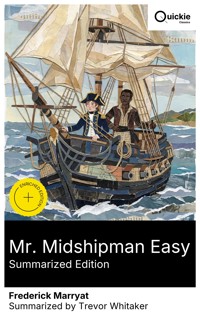
Set amid the Napoleonic Wars, Mr. Midshipman Easy follows Jack Easy, a youth reared on his father's doctrine of absolute equality, as he collides with the Royal Navy's hierarchies. Marryat blends crisp nautical realism with comic satire and a coming‑of‑age arc: boarding actions and Mediterranean cruises, Sicilian interludes, and a mock island republic steadily expose theory to sea-tested fact. Published in 1836, it anchors early Victorian maritime fiction. Frederick Marryat (1792–1848) rose from midshipman to post captain, seeing hard service against France and the United States; his rescue exploits and later invention of a widely used signaling code attest to practical mastery. After retiring, he edited magazines and turned experience into narrative art. The era's debates on reform and order sharpened his skepticism toward abstract egalitarianism and his sympathy for competence, captured in figures like the resourceful Mesty. Recommended to readers of O'Brian and Forester, to historians of the long nineteenth century, and to anyone curious how ideas fare at sea. It entertains vigorously while provoking thought about authority, loyalty, and growth—an enduring gateway to the tradition Marryat helped define. Quickie Classics summarizes timeless works with precision, preserving the author's voice and keeping the prose clear, fast, and readable—distilled, never diluted. Enriched Edition extras: Introduction · Synopsis · Historical Context · Brief Analysis · 4 Reflection Q&As · Editorial Footnotes.
Das E-Book können Sie in Legimi-Apps oder einer beliebigen App lesen, die das folgende Format unterstützen:
Veröffentlichungsjahr: 2026
Ähnliche




















Mr. Midshipman Easy (Summarized Edition)
Table of Contents
Introduction
Between a boy’s abstract belief in universal equality and the Royal Navy’s uncompromising hierarchy, Mr. Midshipman Easy stages a lively and probing contest of principles that unfolds in gales, gun smoke, and the crowded routines of a man‑of‑war, asking whether freedom is best safeguarded by defiance or by discipline, whether justice grows from rights declared or duties learned, and whether youthful certainty can withstand the intricate pressures of command, comradeship, and danger at sea, where ideals meet ballast, courage meets custom, and the quicksilver imagination of adolescence is tempered by the slow, exacting craft of seamanship, all without abandoning buoyant comedy.
Frederick Marryat, a seasoned officer of the Royal Navy before turning author, published Mr. Midshipman Easy in 1836, contributing a formative title to the English tradition of nautical fiction. The novel is a seafaring coming‑of‑age comedy and social satire set during the Napoleonic Wars, when Britain’s fleet patrolled home waters and distant stations. Drawing on professional experience, Marryat renders shipboard life with practical detail—watches, messes, drills, punishments, and battle routines—without losing narrative momentum. The result is an accessible, adventurous story anchored in contemporary maritime realities of the early nineteenth century, yet shaped by the brisk storytelling and wit popular with readers of the 1830s.
At its outset, the book follows Jack Easy, the indulged son of a country gentleman enamored of tidy theories about equality and natural rights, whose conversational certainties have shaped the boy’s opinions. Seeking independence and excitement, and eager to test principle against practice, Jack enters the Royal Navy as a midshipman. He joins a mess of older lads and practical tars, learns the habits of the lower deck, and encounters the subtle economy of influence and effort that keeps a ship moving. Early episodes mix comic blunders with energetic instruction, sketching the hazards, rituals, and loyalties that define a young officer’s apprenticeship.
Marryat’s narrative voice is brisk, conversational, and lightly ironic, guiding the reader through nautical jargon by context and rhythm rather than pedantry. Scenes are episodic yet cumulative, alternating tight, kinetic action with characterful interludes and quick comic turns. Dialogue crackles with shipboard banter and class inflections, while the narrator’s aside‑like observations produce a genial intimacy without undermining tension. The tone is cheerful but not frivolous; danger has weight, and consequences matter, though the emphasis remains on resourcefulness, camaraderie, and the ingenious contrivances of life at sea. Readers encounter a spirited blend of adventure, satire, and procedural detail that rarely lingers unnecessarily.
Under the bustle, the novel considers how institutions educate desire and judgment. Jack’s tidy abstractions run up against a service organized by rank, habit, and a sometimes uneasy mixture of patronage and merit. The discipline that initially feels like oppression reveals itself as a grammar of cooperation, while unexamined slogans meet the test of responsibility for other lives. Leadership, fairness, and practical justice are weighed in mess‑room quarrels as much as in quarterdeck decisions. The book also explores the social theater of the Navy—class manners, national rivalry, and ritualized bravado—seeing how performance can train character, and how character, in turn, restrains performance.
For contemporary readers, Mr. Midshipman Easy matters as both entertainment and inquiry. It offers a vivid primer in the everyday mechanics of a sailing warship and a humane study of how young people revise beliefs under pressure. It also demands a historically aware eye: the novel reflects nineteenth‑century attitudes about empire, class, and race, some of which are troubling today. Reading it critically does not diminish its virtues; it deepens them, allowing the humor and the craftsmanship to coexist with scrutiny. The book’s enduring attraction lies in its candid curiosity about how rules, risks, and friendships reshape untested ideals.
Approached as a lively sea‑adventure and a thoughtful apprenticeship tale, Mr. Midshipman Easy rewards with crisp action, flexible wit, and a clear sense of professional practice at sea. It invites comparison between youthful doctrine and earned judgment without preaching, trusting incidents to reveal the slow education of a generous but impulsive mind. For readers new to Marryat, it also serves as an entryway to an influential current of naval fiction, marrying technical verisimilitude to comic verve. Above all, it remains fresh because its central question—how to balance liberty with obligation—feels as modern as tomorrow’s weather report, even under Age‑of‑Sail canvas.
Synopsis
Frederick Marryat’s 1836 novel Mr. Midshipman Easy follows Jack Easy, the privileged but impressionable son of an English gentleman whose fondness for sweeping theories about equality and natural rights shapes his son’s outlook. Chafing at inactivity and eager to test ideas in the world, Jack enters the Royal Navy as a midshipman during wartime. The book opens in a satiric key, contrasting drawing-room philosophy with the practical, tradition-bound culture of a man‑of‑war. Marryat frames the tale as a comedic coming‑of‑age set against naval service, using Jack’s naïveté to explore how ideals, when confronted with duty, risk, and hierarchy, evolve under pressure.
Once aboard his first ship, Jack encounters the rigid order of watches, messes, and quarterdeck authority. He befriends a witty, experienced Irishmate, O’Brien, whose advice moderates Jack’s impulsive lectures on universal rights. Early boat service and gunnery drills introduce him to seamanship’s demands, while a brisk skirmish at sea shows that skill and courage, not abstractions, decide outcomes. Jack’s tendency to challenge rank produces comic friction, yet his good nature and quick learning win some indulgence. The ship’s varied company—seasoned tars, ambitious youngsters, and stern officers—provides a living school in which Jack measures theory against the realities of discipline.
A pivotal alliance forms when Jack grows close to Mesty, a capable seaman of African origin with a hard-won understanding of freedom and survival. Mesty’s sardonic intelligence and practical knowledge make him both protector and provocateur, testing Jack’s convictions while helping him navigate the lower deck’s unspoken codes. Small-boat expeditions, cutting-out attempts, and chases with privateers highlight the pair’s resourcefulness. In these hazardous tasks, Jack learns to command a crew and keep his head under fire. He also begins to recognize that fairness in action often depends on judgment, responsibility, and earned trust rather than proclaimed equality.
Operations carry the ship into the Mediterranean, where inshore patrols and coastal raids blur the line between naval war and local entanglements. Ashore, mishaps and separation from the main force leave Jack and a handful of companions to fend for themselves among unfamiliar languages and customs. Encounters with banditti and suspicious authorities test his wits as much as his courage. With Mesty’s ingenuity and Jack’s growing steadiness, the small party improvises defenses, negotiates with doubtful allies, and endures privation. These episodes broaden Jack’s view beyond shipboard routines, showing how command can hinge on persuasion, restraint, and the careful use of force.
Back with the fleet, the rhythm of blockade service alternates with sudden violence: night cutting-out ventures, prizes hurried into port, and terse reports of losses. Jack’s reputation improves as he proves reliable in his station, while O’Brien’s fortunes rise and fall with the hazards of promotion. Marryat dwells on the texture of naval life—the midshipmen’s berth, the purser’s reckonings, the articles of war—without losing momentum. Jack’s schoolboy pranks yield to measured initiative, and his tongue, once quick with theory, becomes cautious where orders and lives are at stake. Recognition comes in increments, earned through vigilance, endurance, and restraint.
Periodic returns ashore reintroduce Jack to his father’s undimmed enthusiasm for universal equality and private systems of thought. Household comforts contrast with the ship’s regimen, while questions of property, rank, and responsibility emerge as more than abstractions. Legal and familial concerns begin to matter, not merely as satire, but as obligations a young gentleman must meet. Friendship and hinted attachment color his choices, though romance is kept secondary to service. The central tension persists: whether Jack can honor humane impulses without undermining authority, and whether personal independence can coexist with a profession that demands obedience, courage, and steadiness under trial.
Without divulging late turns, the novel’s arc traces Jack’s movement from facile theorist to a humane, competent officer who reads character and circumstance before pronouncing principles. Marryat, a veteran captain, balances humor with practical detail, offering one of the nineteenth century’s formative naval bildungsromans. The narrative suggests that liberty has meaning only when joined to responsibility, and that justice in a hard world begins with experience-grounded judgment. Mr. Midshipman Easy endures for its lively scenes, memorable comradeship, and clear-eyed picture of service, while its debate between abstract rights and disciplined duty remains recognizable far beyond its historical setting.
Historical Context
Mr. Midshipman Easy (1836) was written by Frederick Marryat (1792–1848), a former Royal Navy officer whose service during the Napoleonic Wars lends the novel its technical credibility. The story is set in the era of Britain’s long conflict with Revolutionary and Napoleonic France, roughly 1793–1815, when the Navy dominated national defense and imperial logistics. Marryat had entered the service in 1806, fought in Atlantic and colonial waters, and later commanded vessels, experiences he mined for fiction. Readers in the 1830s recognized in his work authentic shipboard routines, rank relations, and combat practices drawn from the navy of Nelson’s generation.
Britain’s naval war against France required sustained blockades of enemy ports, protection of merchant convoys, and pursuit of privateers across the Atlantic and Mediterranean. Key engagements, from the Glorious First of June (1794) to Trafalgar (1805), established maritime supremacy under admirals such as Lord Nelson, while constant frigate actions and coastal raids shaped daily service. Mediterranean stations, including waters around Sicily, Naples, and Malta, were vital to British strategy and alliances. The Navy’s success underwrote trade, diplomacy, and the security of the British Isles, making sea power a central institution in political life and a natural stage for fictional narratives.
The Royal Navy’s internal order rested on the Articles of War, strict discipline, and a rigid hierarchy. Midshipmen were officer cadets who learned navigation, seamanship, and command through apprenticeship at sea. Advancement relied on patronage but also formal thresholds: to sit the lieutenant’s examination, candidates typically needed at least six years of sea service and to satisfy Admiralty examiners. Prize law distributed captured ships’ value among crews, powerfully motivating pursuit of enemy commerce. Flogging was a legally sanctioned punishment, debated but common. These institutional realities shaped expectations of duty, courage, and obedience that informed both real careers and literary archetypes.
Keeping ships manned demanded aggressive recruitment. Impressment—legally authorized compulsion of seafarers—supplemented volunteers, while measures such as the 1795 Quota Acts pressed counties to supply men. Charitable and training bodies, including the Marine Society (founded 1756), funneled youths into naval service. Hard conditions and stagnant pay sparked major collective protests in 1797 at Spithead and the Nore; the government raised wages and adjusted provisions, yet discipline remained severe and authority unyielding. Such tensions between necessity, coercion, and reform formed the backdrop to any portrayal of lower-deck life, offering a realistic context for episodes of loyalty, grumbling, and professional pride.
Technologically, the Navy deployed ships of the line, nimble frigates, and smaller brigs and sloops armed with long guns and carronades. Copper sheathing reduced fouling and increased speed, while sextants and increasingly reliable marine chronometers improved navigation. Communication employed numbered flag codes, notably Sir Home Popham’s signal book (1803). Mediterranean cruising involved boat service, cutting-out expeditions, and cooperation with local allies. Malta, taken from the French by 1800 and ceded to Britain in 1814, and Sicily, allied to Britain during the wars, served as strategic bases. These realities frame the novel’s attention to ship handling, pursuit, and small-scale naval warfare.
The novel’s comic debates about equality echo wider intellectual upheavals. Thomas Paine’s Rights of Man (1791–1792) popularized democratic and egalitarian arguments in Britain, provoking loyalist backlash and governmental repression through sedition and assembly laws in the 1790s. Within a service founded on rank and deference, such ideas were viewed with suspicion, particularly after revolution and war in France. Marryat uses the clash between abstract political doctrines and practical seamanship to satirize over-simple readings of 'natural rights', while acknowledging that competence and character, not birth alone, earned respect at sea. The result mirrors contemporary disputes over authority, reform, and merit.
Imperial commerce and coerced labor shadowed the maritime world. Britain abolished the transatlantic slave trade in 1807 and established the West Africa Squadron in 1808 to suppress it, though slavery in most British colonies ended only after the 1833 abolition act took effect in the 1830s. Mediterranean waters also saw conflicts with North African corsairs, culminating later in the bombardment of Algiers in 1816. Marryat’s portrayals of non-European characters reflect prevailing racial attitudes, sometimes critically refracted through satire yet marked by period stereotypes. These contexts inform episodes of captivity, manumission, and service, situating personal adventures within debates on freedom, hierarchy, and empire.
Published in 1836, on the eve of the Victorian era and after the 1832 Reform Act, the novel reached a growing literate audience hungry for realistic adventure. Nautical fiction had become a popular vehicle for national self-understanding, and Marryat helped codify its conventions. His narrative celebrates professional expertise, initiative, and comradeship while exposing the absurdities of fashionable philosophy, the fragility of patronage, and the costs of discipline. By grounding humor in accurate procedure and combat detail, it affirms Britain’s maritime identity yet questions social pretensions on shore. The work thus both documents and critiques the world that produced it.




