


4,99 €
Mehr erfahren.
- Herausgeber: Gustavo Espinosa Juarez
- Kategorie: Für Kinder und Jugendliche
- Sprache: Englisch
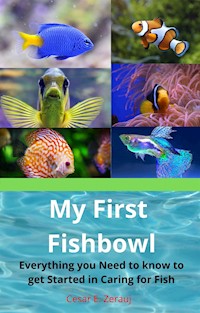
In this book you will find everything you need to get started in caring for fish, topics ranging from the choice of the type of fish tank, type of fish are discussed. feeding until the maintenance of the entire aquarium. A book for everyone who starts in the exciting world of fish.
Das E-Book können Sie in Legimi-Apps oder einer beliebigen App lesen, die das folgende Format unterstützen:
Veröffentlichungsjahr: 2021
Ähnliche













![Tintenherz [Tintenwelt-Reihe, Band 1 (Ungekürzt)] - Cornelia Funke - Hörbuch](https://legimifiles.blob.core.windows.net/images/2830629ec0fd3fd8c1f122134ba4a884/w200_u90.jpg)




My First Fishbowl
Everything you Need to know to get Started in Caring for Fish
Cesar E. Zerauj
Welcome to fish keeping
Whether you plan on starting a freshwater fish tank or a saltwater aquarium, it goes without saying that it will be much more rewarding in the long run to get it right.
Not all people are intuitive about how to care for fish. For example, it may not be apparent to everyone that you shouldn't have big fish in a small tank, or that small fish probably won't do well with large, aggressive fish. And, unless you follow the advice of the clerk at the store where Betta fish are purchased, you may not know what to put in multiple male Betta fish.
in the same fish tank is a bad idea!
When it comes to general maintenance and setup, there are a few essential steps to keep in mind before your fish are introduced to your new home.
This short book will help you move forward with a better understanding of what is involved in creating a stable and healthy environment for fish.
Table of Contents
Fresh water vs. Saltwater .3
Tank Considerations4
Aquarium size4
Aquarium capacity6
Tank configuration7
A note on Filtration7
Recycle aquarium8
Water maintenance 9
Adding fish10
Caring for your fish11
Maintenance program 11
10 basic rules for a successful aquarium 13
10 things to consider before buying your aquarium 13
Freshwater aquarium vs. saltwater aquarium.
Each environment has its own criteria, including costs and daily maintenance, and related fish care requirements. Sure, a saltwater tank requires a lot more work and attention, but it's hard to beat the satisfaction of knowing that you've created a unique environment for hot-water fish that few people enjoy.
Obviously, many will argue that a freshwater system has its own merits. Most notable is the fact that environments rarely allow "live" rock, live corals, or other mobile organisms or invertebrates. And, depending on your reason for building an aquarium in the first place, these additions can be equally enjoyable to care for, giving freshwater enthusiasts yet another reason to enjoy a cold-water fish environment.
At the end of the day, personal preferences allow for the correct installation for you.
Of course, in practice, the same goes for a budget. But if the commitment to creating and maintaining any type of system is not daunting, you are rewarded for your efforts from the moment the fish enter your tank!
An instant comparison between the two aquatic systems
Saltwaterfreshwater
Requires specially formulated salt water Tap water can be used
Requires high levels of calcium Avoid objects containing calcium
Increased fish population Smaller fish population
the most stringent maintenance programs More than forgives maintenance programs
Specialized filtration simple filtration requirements
Requires a heater No heater required
More expensive More economical
Tank Considerations
Whichever configuration you are going to use, buying an aquarium involves more planning than meets the eye. For example, your decision to purchase a specific form of the aquarium will have a direct impact on the amount of fish you can add to your tank, based on the amount of surface that an adequate amount of oxygen exchange can support.
In addition, you will have to take into account its location (avoid excessive sunlight, drafts, and other extremes of temperature), the needs of the fish that live in it, and maintenance. Initially, the most obvious requirement is whether to go with an acrylic or glass tank.
In summary, the characteristics of a glass tank are ...
Heavy
Most likely, the chip
Less prone to scratch (easier cleaning)
Requires support only along the outer edges of the tub
On the contrary, the characteristics of an acrylic glass tank are ...
Light
The chip is less likely
best insulator easily scratched
Clearer (less distortion; more light)
A greater variety of forms
Requires support along the entire length of the bottom of the tank
More expensive
Aquarium size
The size of the tank normally dictates the number of fish that can be safely kept in the tank. The general rule of thumb is one inch of fish per net gallon of water, considering that fish purchased from the pet store are probably not fully developed yet and only getting bigger. Also remember that fish with a thicker body require more space than fish with a thin body.
Generally speaking, the larger the aquarium (or less the fish), the greater the chance of maintaining a stable environment. This is an obvious case of "bigger is better."
You know that a precious aquarium of more than 15 gallons of water will weigh more than two hundred pounds, so make sure you use an appropriate bracket. Consider the following table to determine tank weights and ultimately the permanent location of your tank.
Aquarium Basic sizes
(Weights are for aquarium glass; acrylic will weigh less)
small aquariums(Not recommended for beginners)
Tank size
L x W x H
Full weight
2 1/2 gallon
12 "x 6" x 8 "
27 pounds
5 gallon
16 "x 8" x 10 "
62 lbs
10 gallon "leader"
20 "x 10" x 12 "
111 lbs
15 gallon
24 "x 12" x 12 "
170 lbs
15 gallons high
20 "x 10" x 18 "
170 lbs
AQUARIUMS Medium-size
Tank size
L x W x H
Full weight
20 gallons high
24 "x 12" x 16 "
225 pounds
20 gallon long
30 "x 12" x 12 "
225 pounds
25 gallon
24 "x 12" x 20 "
282 lbs
29 gallon
30 "x 12" x 18 "
330 lbs
30 gallon breeder
36 "x 18" x 12 "
348 lbs
40 gallon Breeder
36 "x 18" x 16 "
458 lbs
40 gallon long
48 "x 12" x 16 "
455 lbs
LARGE AQUARIUMS
Tank size
L x W x H
Full weight
50 gallon
36 "x 18" x 19 "
600 lbs
55 gallon
48 "x 13" x 21 "
625 lbs
65 gallon
36 "x 18" x 24 "
772 lbs
75 gallon
48 "x 18" x 21 "
850 lbs
90 gallon
48 "x 18" x 24 "
1050 pounds
125 gallons
72 "x 18" x 21 "
1400 pounds
150 gallon
72 "x 18" x 28 "
1800 lbs
180 gallon
72 "x 24" x 25 "
2,100 pounds
Note: Don't make the assumption that your tank will hold this exact amount of water. Remember that the volume of your tank will also include things such as gravel, stones, plants and various decorations - things that disperse the volume of water indicated in the table above. In reality, the volume of water in your tank will often be 10-15% less than the actual capacity of the tank.
Aquarium capacity
The amount of oxygen available to fish is essential for their survival. Not only the size of the matter tank, but its shape also affects the efficiency of the exchange of oxygen and carbon dioxide. Naturally, larger surface areas result in more oxygen entering the water, so avoid tall, thin tanks and opt for longer ones.




