


3,99 €
Mehr erfahren.
- Herausgeber: Ched
- Kategorie: Geisteswissenschaft
- Sprache: Englisch
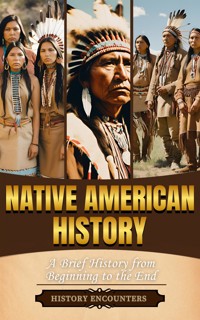
History Encounters unearths the greatest stories with the major events from Native American History to expand reader horizons for readers to be best informed.
Native American history and culture is unique and beautiful. Having endured dire circumstances and oppressive colonization, they have fought for generations to keep their spirit alive. Fighting, though, is not the legacy that they will leave this world. A love for nature, community and beautiful traditions encompass a lot of the Native American identity and teach us in a modern world that is much too westernized and toxic that old civilizations really knew what they were doing.
Learning about history will keep you perceptive and make sure to not repeat mistakes that others made in the past. The different stories in this series will show the readers that history should not just be seen from one perspective, but from the different eyes of the groups of people involved. You never know, you might finally understand their choices, their actions and their reactions.
In this historical series, you will discover:
- The history of different countries and cultures
- The inner workings of major historical turning points in different countries.
- Different perspectives of major events in history
- The reasons behind different wars or battles throughout history
These historical series are for anyone who wants to learn fun, exciting and influential facts of what happened years before their time. Do you want to learn history through a multitude of different eyes?
Das E-Book können Sie in Legimi-Apps oder einer beliebigen App lesen, die das folgende Format unterstützen:
Veröffentlichungsjahr: 2024
Ähnliche



















Irvine Press
Native American History
A Brief Overview from Beginning to the End
Copyright © 2024 by Irvine Press
All rights reserved. No part of this publication may be reproduced, stored or transmitted in any form or by any means, electronic, mechanical, photocopying, recording, scanning, or otherwise without written permission from the publisher. It is illegal to copy this book, post it to a website, or distribute it by any other means without permission.
Irvine Press asserts the moral right to be identified as the author of this work.
Irvine Press has no responsibility for the persistence or accuracy of URLs for external or third-party Internet Websites referred to in this publication and does not guarantee that any content on such Websites is, or will remain, accurate or appropriate.
Designations used by companies to distinguish their products are often claimed as trademarks. All brand names and product names used in this book and on its cover are trade names, service marks, trademarks and registered trademarks of their respective owners. The publishers and the book are not associated with any product or vendor mentioned in this book. None of the companies referenced within the book have endorsed the book.
First edition
This book was professionally typeset on Reedsy Find out more at reedsy.com
Contents
Introduction
The Origins of Native Americans
The Earliest Known Tribes
The relationships between native Americans
The Arrival of the Europeans
The Takeover of Native American Lands
Key Figures in Indigenous History
Aspects of Native American Culture
The Connection Between the Indigenous People of America and Canada
Modern Day Native Americans
Discussion Questions
True or False Questions
Conclusion
Works Cited
Introduction
The history of Native Americans is a fascinating and complex tapestry woven from the threads of countless diverse cultures and traditions. Spanning thousands of years and covering a vast geographical area, the story of the indigenous peoples of North America is one of resilience, perseverance, and enduring spiritual connection to the land.
Long before the arrival of Europeans, Native American communities thrived across the continent, each with its unique culture, traditions, and beliefs. From the nomadic hunting and gathering tribes of the Great Plains to the advanced civilizations of the Mississippian and Anasazi cultures in the South and Southwest.
Native Americans have demonstrated remarkable adaptability and resourcefulness in their relationship with the environment. These indigenous peoples developed intricate systems of governance, spiritual beliefs, and social structures that allowed them to thrive in their respective environments. They formed complex trade networks and created sophisticated agricultural systems. They built impressive architectural feats, such as the massive earthen mounds of the Mississippi Valley, which still stand today as a testament to their ingenuity and skill.
However, the arrival of Europeans in the late 15th and early 16th centuries marked the beginning of a new era for Native Americans. European expansion and colonization brought with them disease, violence, and cultural suppression, causing the death of countless indigenous peoples and devastating their communities. The forced relocation of entire populations, such as the Trail of Tears, in which thousands of Cherokee people were forcibly relocated from their ancestral homelands in the southeastern United States, is a prime example of the horrific toll that European expansion took on Native American communities.
Despite these obstacles, Native American culture and traditions have remained resilient. Despite centuries of oppression and marginalization, many indigenous communities have worked to preserve their languages, spiritual practices, and cultural heritage. Today, Native Americans are a vibrant and diverse community with a rich history and cultural heritage that is an integral part of the fabric of North American society. From the powwows and tribal gatherings of the Great Plains to the elaborate potlatch celebrations of the Pacific Northwest, Native American communities continue to preserve and celebrate their cultural traditions.
The contributions of Native Americans to American society are far-reaching and significant, from agriculture, where indigenous peoples domesticated a variety of crops such as corn, beans, and squash, to the arts, where Native American artists have made profound contributions to fields such as painting, sculpture, and basket weaving. In politics, Native American leaders have been instrumental in advocating for indigenous rights and sovereignty, such as the activism of Vine Deloria Jr. in the 1960s and 1970s, who became a prominent voice for Native American rights and sovereignty and co-founded the National Congress of American Indians.
The spiritual beliefs of Native Americans are also an important aspect of their cultural heritage. For many indigenous communities, spirituality is deeply entwined with their relationship with the natural world. Their ceremonies and rituals maintain a connection with the spirits of the land, animals, and ancestors. The Ghost Dance, a religious movement that spread throughout the Great Plains in the late 19th century, is a prime example of the powerful connection that Native Americans have with spirituality and their relationship with the land.
The history of Native Americans is a rich and diverse tapestry woven from the threads of countless cultures and traditions. Through their resilience, perseverance, and spiritual connection to the land, Native Americans have profoundly impacted American society, and their legacy will continue to inspire generations to come. From the grand cultural traditions of the past to the ongoing activism of Native American leaders today, the story of the indigenous peoples of North America is a testament to their strength, endurance, and enduring cultural heritage.
The Origins of Native Americans
Beaver Teeth Dice(one of the tools of Native Americans)
The story of how Native Americans came to the Americas is a subject of ongoing research and debate among scientists and historians. However, the prevailing theory is that they arrived from Asia over 20,000 years ago, likely via a land bridge that existed during the last Ice Age.
The Ice Age lasted from approximately 2.6 million to 11,700 years ago and was a time of significant climate change. During the last stages of the Ice Age, huge ice sheets covered much of the northern hemisphere, including large parts of Asia and North America. This caused the sea levels to drop significantly, exposing a land bridge between Asia and North America known as Beringia.
The land bridge of Beringia connected Asia and North America for thousands of years and allowed for the migration of animals and humans from Asia to North America. Scientists believe that the first humans to migrate from Asia to North America were hunters and gatherers in search of new hunting grounds and resources.
The first humans to arrive in North America were likely part of a larger group known as the Ancient Beringians. These early humans were hunters and gatherers who relied on various animals for food, clothing, and tools. They were also skilled in using stone tools and building shelters.
The Ancient Beringians journeyed across Beringia on foot, likely following the herds of animals they hunted for food. This journey likely took several generations, as the group likely encountered many challenges along the way, such as harsh weather conditions and limited food sources. This shows that many cultures around the world at that time were nomadic and traveled where they could find more supplies to live. They would start settling down as they developed tools that allowed them to withstand the climate of a specific place for longer periods and learn how to cultivate crops and build houses in that area.
Once they arrived in North America, the Ancient Beringians continued to move south, gradually colonizing the continent. As they moved, they adapted to the changing environment and developed new technologies and cultural practices. Over time, they split into different groups, each with a unique cultural identity.
As the climate continued to change, the land bridge of Beringia eventually disappeared as the sea levels rose, and the Indigenous peoples of North America were isolated from Asia. This allowed for development of unique cultural traditions and languages among different Indigenous groups and advanced civilizations, such as the Mayans, Incas, and Aztecs, in Central and South America. This is why there has been the theory by certain archeologists that the native people of South America and Canada are very closely related genealogically to the Native Americans of the United States. Their cultures developed very differently as a result of them settling in different areas of the world.
After the separation of Asia from America, the Native American populations were isolated from the rest of the world for thousands of years. During this time, they developed unique cultures and traditions tailored to their regions’ specific environmental conditions. For example, the Inuit people of Alaska learned to survive in the harsh and unforgiving arctic environment by hunting and fishing. In contrast, the people of the Great Plains became expert horsemen and hunters, using their skills to hunt the vast herds of bison that roamed the prairies.
It’s important to note that the story of how Native Americans came to the Americas is still being researched and refined, and new discoveries and theories continue to emerge. However, the evidence currently suggests that the first Native Americans arrived from Asia over 20,000 years ago and gradually colonized the continent, adapting to the changing environment and developing their own unique cultures and civilizations. Unfortunately, during the colonization of Native American cultures, much information about their origins was lost due to children being separated from their parents and forced into European education systems.
The journey of the Native Americans from Asia to the Americas over 20,000 years ago was a remarkable feat of human determination and adaptation. Despite the challenges they faced along the way, they persevered and established themselves as the Indigenous peoples of the Americas, with their rich and diverse cultures and traditions that continue to shape the history and identity of the Americas to this day.




