


1,99 €
Mehr erfahren.
- Herausgeber: Quickie Classics
- Kategorie: Geisteswissenschaft
- Sprache: Englisch
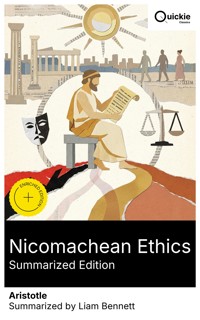
Aristotle's Nicomachean Ethics offers a rigorous map of human flourishing (eudaimonia), arguing that virtue is a practiced mean between extremes, guided by practical wisdom (phronesis). Organized as lecture-books, its style is dialectical and precise, testing reputable opinions (endoxa) against lived experience. Across discussions of character, choice, pleasure, justice (distributive and corrective), weakness of will (akrasia), and the varieties of friendship, Aristotle integrates psychology and politics, culminating in the priority of contemplation and the claim that ethics requires a civic framework. Situated after Plato yet distinctly empirical, it crystallizes Peripatetic moral philosophy. Student of Plato and founder of the Lyceum, Aristotle combined wide-ranging biological research with constitutional studies, an outlook shaped early by his physician father at the Macedonian court and later by tutoring Alexander. The Ethics likely derives from teaching materials for his school, marrying systematic analysis to case-sensitive observation and orienting moral inquiry toward action. This book rewards readers who seek ethical guidance without dogma: students of philosophy, leaders, jurists, and anyone negotiating habit, emotion, and deliberation. Read it for its lucid architecture and its humane insistence that character is formed by practice, choice, and community under the aim of living well. Quickie Classics summarizes timeless works with precision, preserving the author's voice and keeping the prose clear, fast, and readable—distilled, never diluted. Enriched Edition extras: Introduction · Synopsis · Historical Context · Author Biography · Brief Analysis · 4 Reflection Q&As · Editorial Footnotes.
Das E-Book können Sie in Legimi-Apps oder einer beliebigen App lesen, die das folgende Format unterstützen:
Veröffentlichungsjahr: 2026
Ähnliche









Nicomachean Ethics (Summarized Edition)
Table of Contents
Introduction
At the heart of Nicomachean Ethics lies a sustained inquiry into how human beings can live well, balancing desire and reason, private aspiration and civic duty, enduring principles and the shifting demands of particular circumstances, so that a life becomes not a sequence of impulses or accidents but an intelligible project guided by cultivated character and practical judgment, as it probes the relation between ends and means, habit and choice, pleasure and nobility, luck and agency, and the ways friendship, justice, and education embed moral striving within the institutions and practices of a shared life.
Aristotle’s Nicomachean Ethics is a philosophical treatise from the fourth century BCE, composed in Athens within the intellectual milieu of the Lyceum. Organized in ten books, it examines ethical questions with a systematic, argumentative approach characteristic of ancient Greek philosophy. Rather than a narrative, it offers a sequence of analyses that build on one another, moving from the question of the human good to the qualities of character and the forms of reasoning that shape action. As part of the classical corpus, it has been read continuously across centuries, influencing moral thought in late antiquity, medieval scholarship, and modern philosophy.
The premise is straightforward yet far-reaching: to identify the highest human good and to clarify the virtues and capacities through which that good is realized in a complete life. Readers encounter a voice that is precise, patient, and practical, attentive to familiar examples and wary of rigid formulas. The style is concise and methodical, with definitions refined by distinctions and by attention to ordinary experience. The tone is sober, neither cynical nor utopian, and it invites participation in disciplined reflection rather than passive reception. The work rewards steady, cumulative reading, as later discussions illuminate earlier claims and tighten the argumentative weave.
Among the central themes are eudaimonia, often rendered as human flourishing, and the account of virtue as a stable disposition cultivated by habituation. The work explores how virtues regulate emotion and action, avoiding excess and deficiency in ways calibrated to the particulars of a situation. Practical wisdom plays a guiding role, directing choice toward fitting ends and sound means. Aristotle analyzes responsibility, distinguishing what is voluntary from what is constrained, and he investigates weakness of will as a challenge to ethical consistency. Throughout, ethical reflection remains inseparable from action: knowing well is oriented toward doing well within concrete circumstances.
The inquiry extends from individual character to the social forms that support or distort it, considering friendship, justice, and the role of law and education in shaping shared life. Friendship is treated as a moral phenomenon, involving mutual recognition and the exchange of benefit, but also as a school of virtue in which motives are tested and refined. Justice links personal excellence to public order, asking how distributions, rules, and judgments can align with the common good. In each case, the analysis balances universals with attention to context, insisting that ethical wisdom must take form within practices, institutions, and enduring relationships.
For contemporary readers, the book matters because it connects ethics to character formation, decision-making, and the cultivation of communities capable of sustaining trust. Its emphasis on habit and practical wisdom enriches current debates in virtue ethics and complements insights from psychology about learning, emotion, and self-regulation. The focus on purposes and ends clarifies questions in professional life, leadership, and public policy, where technical skill alone cannot determine what ought to be done. By treating flourishing as more than pleasure or wealth, the work reframes discussions of well-being, inviting reflection on how excellence, friendship, and responsibility can be integrated across a lifetime.
Newcomers will find the text most rewarding if approached as a disciplined conversation: terms acquire nuance as they recur, examples are provisional, and conclusions are calibrated rather than absolute. The argumentative movement encourages comparative reading with one’s own experience, testing claims against cases and practices. While written in a distant era, the work’s measured confidence in reasoned inquiry and formative education offers a counterpoint to ethical cynicism and moralism alike. It does not promise certainty; it models judgment. By inviting readers to align desire with reason through sustained exercise, Nicomachean Ethics proposes a way of living that remains both demanding and humane.
Synopsis
Aristotle’s Nicomachean Ethics is a systematic inquiry into how humans should live, arranged in ten books and oriented to practice rather than theory. He begins from the observation that every action and craft aims at some good, and that politics, as the art ordering collective life, aims at the highest and most comprehensive good. Because ethical matters admit of variation, the inquiry seeks the degree of precision the subject allows. The work frames ethics as part of political science, concerned with forming character through institutions and education, and sets out to identify the human end that guides choice, evaluation, and instruction.
He argues that the highest human end must be final and self-sufficient, something chosen for its own sake and making life lacking in nothing important. To approach it, Aristotle proposes a function analysis: if the human being has a characteristic activity related to reason, then the good for a human is excellent performance of that activity. On this basis, he characterizes happiness as rational activity in accordance with virtue across a complete life, while acknowledging that external goods can support or obstruct such activity. The opening book closes by indicating that the virtues, once clarified, will supply the practical standards.
Aristotle then explains how character is formed. Moral virtue is not a feeling or mere capacity but a stable state developed by habituation. It regulates passions and actions by steering a mean between excess and deficiency, always relative to the agent and the circumstances. Pleasure and pain are diagnostic, since they reveal what has become second nature through practice. Upbringing and law matter because repetition shapes dispositions. He distinguishes moral virtue from intellectual excellence, which requires teaching and time, and stresses that praise and blame track the quality of states shaped in youth. This framework prepares the treatment of specific virtues.
With this framework, he examines responsibility and particular virtues. Voluntary action involves awareness of particulars and originates in the agent; compulsion and ignorance can excuse. Choice concerns means to ends we take as good, and deliberation addresses variable matters where reasoning can guide action. He presents courage and temperance as paradigms: courage moderates fear and confidence regarding dangers, while temperance governs bodily pleasures. He then surveys social and dispositional excellences—generosity in giving, magnificence in large expenditures, magnanimity in claims to honor, gentleness in anger, truthfulness about oneself, affability in social life, and ready wit—each flanked by recognizable excesses and defects.
Justice receives a dedicated analysis. In a wide sense it names complete virtue in relation to others, expressed through lawfulness and the common good. In a narrower sense it is a distinct virtue concerned with fair distribution and rectification. Distributive justice apportions shares according to a proportion tied to merit or contribution, while corrective justice restores equality in voluntary and involuntary transactions. Aristotle also considers reciprocity in exchange and the role of money as a common measure. Political justice has both natural and legal components; because rules are general, equity serves as a prudent correction when strict application would miss the mark.
Turning to the mind’s excellences, Aristotle outlines intellectual virtues: scientific knowledge, craft skill, practical wisdom, intuitive understanding, and theoretical wisdom. Practical wisdom orients deliberation about how to live well in particular situations, integrating right reasoning with appropriately trained desire. It differs from technical expertise because its domain is action, not production, and from theoretical wisdom because it addresses variable human affairs. Moral virtue and practical wisdom need each other: sound character enables perception of what matters, while practical wisdom steers choice toward fitting means. The account emphasizes experience, sensitivity to particulars, and the role of good upbringing in making rational guidance effective.
He then investigates continence and incontinence, asking how someone can act against better judgment. The analysis distinguishes knowing in a full, active way from merely possessing information that fails to command action. Weakness is contrasted with self-control and endurance, and states beyond ordinary virtue and vice are noted. A sustained discussion of pleasure assesses whether it is good, bad, or neither, and in what sense it completes activities. Aristotle considers common arguments on each side and examines differences among pleasures, while maintaining the practical focus: a clear view of motivation and reward is necessary for reliable counsel about living well.
Friendship occupies two books and is treated as essential for individuals and communities. Aristotle differentiates three main kinds—based on utility, pleasure, and character—showing how each arises, endures, and dissolves. He explores reciprocity, goodwill, concord, benefaction, and the special challenges of unequal relationships. The analysis connects friendship with justice, since stable exchanges and shared aims bind citizens. Questions about self-love, whether the happy person needs friends, and how friends share life and activity are pursued to clarify the place of others in one’s flourishing. Throughout, friendship is presented as both a personal good and a structural support of civic life.
In closing, Aristotle revisits pleasure and reflects on the activities that best fulfill human capacities, considering the claims of practical and contemplative lives. He emphasizes leisure as the context in which the finest activities can be sustained and argues that ethical excellence requires a supportive civic framework. Education and law are therefore crucial: habits must be formed and sustained by institutions that cultivate reasoned choice. The work ends by linking ethics to political science and legislation, inviting further inquiry into constitutions and education. Its enduring significance lies in articulating virtue, practical reasoning, and community as central to human flourishing.
Historical Context
Aristotle’s Nicomachean Ethics emerged in fourth‑century BCE Greece, centered on Athens after the Peloponnesian War and its democratic restoration in 403. The polis remained the primary political and moral framework, with institutions like the Assembly, law courts, and civic festivals shaping public life. Education took place through paideia in households, gymnasia, and schools, notably Plato’s Academy and, later, Aristotle’s Lyceum. Intellectual exchange was intense, overlapping with rhetorical training for litigation and politics. In this milieu, questions about virtue, law, and the aims of human life were not merely theoretical but bound to civic practice, reputation, and the responsibilities of citizenship.
Aristotle was born in 384 BCE at Stagira in Chalcidice, the son of Nicomachus, a court physician. He joined Plato’s Academy in Athens in 367 and studied there for about twenty years. After Plato’s death in 347, he left Athens, working in Assos and Mytilene, where he conducted biological research. In 343/2 he was invited to Macedon to tutor the young Alexander. Returning to Athens in 335, he founded the Lyceum, where he taught and led a research community. His life spanned the consolidation of Macedonian power and the transformation of Greek politics, experiences that shaped his practical philosophical outlook.
Fourth‑century debates about ethics were animated by the legacy of Socrates, the metaphysical ambitions of Plato, and the pedagogical programs of Sophists and rhetoricians such as Protagoras and Isocrates. Courts and assemblies rewarded persuasive speech, prompting reflection on whether virtue is teachable and by what methods. Aristotle inherited these questions and developed a critical approach grounded in endoxa—credible opinions of the wise and the many—tested by analysis. He combined dialectic with observation, favoring explanations that locate purposes in nature and action. The Nicomachean Ethics responds to this climate of competing schools by articulating a practical inquiry suited to civic life.




