


1,99 €
Mehr erfahren.
- Herausgeber: Quickie Classics
- Kategorie: Geisteswissenschaft
- Sprache: Englisch
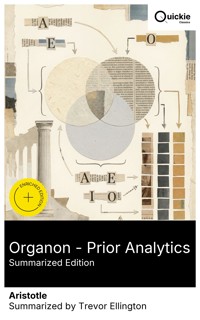
Prior Analytics, the cornerstone of the Organon, offers the earliest systematic theory of deductive inference. In lapidary, schematic prose, Aristotle defines terms, classifies propositions (A, E, I, O), and demonstrates how syllogisms yield necessity from a middle term across three figures and many moods, with reductions to first-figure 'perfect' forms. He develops conversion rules, proofs by ecthesis and reductio, and ventures a demanding theory of modal syllogisms. Situated within the Organon, in dialogue with Topics and Posterior Analytics, the treatise frames dialectical practice while underwriting scientific demonstration; its method became the lingua franca of reasoning through late antiquity and the medieval schools. Aristotle, trained in Plato's Academy and later founder of the Lyceum, conceived logic as organon, the instrument of knowledge. His empirical bent and taxonomic imagination, coupled with disputes against sophists and Academic dialecticians, pressed him to codify inference. Likely distilled from lecture notes, Prior Analytics supplies the formal scaffolding presupposed by his scientific and metaphysical inquiries. Readers in philosophy, classics, and the history of science will find this work indispensable. Use a sound translation with commentary, and read it alongside Topics and Posterior Analytics. Patient study rewards with a lucid map of validity that still instructs modern analysis. Quickie Classics summarizes timeless works with precision, preserving the author's voice and keeping the prose clear, fast, and readable—distilled, never diluted. Enriched Edition extras: Introduction · Synopsis · Historical Context · Author Biography · Brief Analysis · 4 Reflection Q&As · Editorial Footnotes.
Das E-Book können Sie in Legimi-Apps oder einer beliebigen App lesen, die das folgende Format unterstützen:
Veröffentlichungsjahr: 2026
Ähnliche





Organon — Prior Analytics (Summarized Edition)
Table of Contents
Introduction
At the heart of Prior Analytics lies the audacious claim that reasoning can be mapped with precision, its pathways charted by form rather than content. Composed by Aristotle in the fourth century BCE and preserved within the Organon, it stands as a foundational treatise in formal logic. Instead of narrative, the text sets out a method for analyzing arguments and specifying when a conclusion follows of necessity. Readers meet a disciplined, technical voice that states definitions and procedures with austere clarity. The result is spare and exacting: a blueprint for deductive reasoning that trades ornament for rigor.
Prior Analytics introduces and develops the syllogism, a structured pattern of deduction that relates terms through premises to yield necessary conclusions. Aristotle’s discussion proceeds by laying out figures and moods, exploring which configurations guarantee validity and which do not. The work belongs to a cluster of logical treatises transmitted together, but it is distinctive for treating deduction as a formal calculus before content enters. Its style is schematic, often using letters and placeholders to show structure, and its tone is patient yet uncompromising. Readers should expect careful distinctions, incremental demonstrations, and occasional proofs by reductio that test the limits of inference.
Composed within the Peripatetic school and surviving through complex manuscript transmission, Prior Analytics reached later readers as part of a curriculum that shaped logical study for centuries. The treatise is organized into two books, moving from basic structures of deduction to more intricate analyses, including variations involving necessity and possibility. While terse, it rewards slow, methodical reading, since definitions build on earlier distinctions and proofs often rely on previously established conversions or reductions. Many modern editions provide section numbering and editorial aids, but the core experience remains austere: a ladder of rigor whose rungs must be climbed in order.
Central to the book is the distinction between the form of an argument and the truth of its premises: validity concerns structure, not subject matter. Aristotle classifies terms and propositions, specifies how they convert, and catalogues the configurations in which two premises entail a conclusion. He shows how some arguments can be reduced to more basic forms, creating a toolkit for testing and constructing deductions. The treatment often isolates universal and particular claims to examine how quantity and quality affect inference. Later sections extend the framework to modal contexts, probing what follows when necessity or possibility modifies the relations among terms.
Though superseded in scope by modern symbolic logic, the work remains a powerful primer on what makes deductions succeed or fail. Its insistence on explicit structure trains readers to separate persuasive language from valid consequence, a skill invaluable in contemporary discourse, law, policy, and scientific reasoning. The emphasis on form also resonates with computational thinking, where rules operate on symbols independently of their meanings. Engaging it today invites a disciplined habit of paraphrase and reconstruction: identify terms, state premises clearly, and test whether the pattern licenses the conclusion. In that practice, Aristotle’s method continues to sharpen judgment and clarify debate.
Within the larger Organon, Prior Analytics furnishes the general account of deduction on which Aristotle’s discussions of definition, inquiry, and scientific demonstration elsewhere depend. For later traditions, it supplied the template from which commentaries, teaching manuals, and debates about reasoning unfolded across languages and schools. That history matters for readers not as antiquarian detail but as evidence of the text’s portability: its rules can be lifted into new domains without rewriting their core. Approaching it with this lineage in mind helps explain its spare style and modular structure, designed to be applied, combined, and examined rather than admired for rhetorical flourish.
Reading Prior Analytics today means entering a workshop rather than a gallery, where progress comes from assembling pieces and testing joins. The voice is authoritative but economical, inviting readers to supply examples and to check the reach of each rule. That demand for participation is part of its enduring power: it models inquiry as a craft governed by explicit constraints. In an age saturated with claims and counterclaims, the book offers a compact discipline for assessing what genuinely follows. Its central wager—that form can be mastered—remains a live challenge, and its pages still teach how to think with care and economy.
Synopsis
Prior Analytics, part of Aristotle’s Organon, is a systematic investigation of deductive reasoning. Composed in the fourth century BCE, it sets out to identify what makes a conclusion follow of necessity from given premises. Aristotle narrows the focus to categorical statements and the structures formed when such statements are combined. He defines the elements of an argument—premise, conclusion, and term—and frames deduction as the securing of necessity by form rather than by subject matter. Throughout, the treatise aims to sort valid from invalid patterns by general rules and by rigorous demonstrations, establishing a framework for analyzing arguments independent of their content.
At the outset, Aristotle classifies propositions by quantity and quality: universal or particular, affirmative or negative. A proposition joins a subject and a predicate, and syllogistic reasoning depends on how such propositions are paired. He introduces three terms across two premises: the major term, which becomes the predicate of the conclusion; the minor term, which becomes the subject; and the middle term, which links them. By fixing these roles, Aristotle treats validity as a question of configuration. He distinguishes premises that speak about all members of a class from those speaking about some, and he examines how affirmation or denial affects what can be strictly inferred.
With these preliminaries, the work turns to the figures of the syllogism, differentiated by the position of the middle term in the two premises. Aristotle systematically canvasses the configurations, identifying those that are perfect, whose validity is manifest, and those imperfect, which require derivation from perfect patterns. He provides routes of reduction, showing how an imperfect inference can be transformed—by conversion of a premise or by indirect argument—into a form already established. This program does not merely list valid patterns; it supplies proofs that their validity depends on structural features, and it outlines techniques for testing doubtful forms step by step.
A central tool is conversion, the transformation of a proposition by interchanging subject and predicate under strict constraints. Aristotle argues that universal negatives and particular affirmatives convert without loss, universal affirmatives convert only to a weaker particular, and particular negatives do not convert. Using these rules, he proves which pairings of premises yield a conclusion in each figure and what the conclusion’s quantity and quality must be. The analysis emphasizes that the distribution of terms and the quality of premises govern necessity. Many proposed forms are shown to fail, while others succeed only with a conclusion weaker than the premises suggest.
Aristotle’s investigations also cover cases with negative premises, mixed quantities, and varied positions of the middle term, establishing where nothing follows at all. He is careful to track when a universal premise supports only a particular conclusion, and he articulates how a denial in one or both premises constrains the outcome. Alongside straightforward derivations, he employs indirect proof: assuming the contradiction of a sought conclusion and deriving an impossibility to secure the result. These methods yield a catalogue of valid assertoric syllogisms and delimit invalid forms, furnishing a practical toolkit for drawing consequences and for refuting pretended inferences.
Beyond the enumeration of forms, the treatise reflects on proof strategy. Aristotle contrasts direct derivations with refutations that expose hidden fallacies, emphasizing that sound deductions preserve the sense of terms and avoid equivocation. He shows how changing the placement of terms or altering a premise can salvage an argument or reveal its defect, and he illustrates how chains of deductions may be broken into shorter, three-term steps. The underlying lesson is methodological: necessity hinges on stable form and clear term relations. Where these conditions lapse, no conclusion follows, and the boundaries of valid inference can be displayed rather than presumed.
The second book extends the analysis to modal propositions—those stating what is necessary, possible, or contingent. Aristotle formulates how modalities attach to universal and particular statements and asks how they behave under conversion and combination. He investigates which mixtures of necessary, possible, and non-modal premises license a necessary or merely possible conclusion. Some patterns that are valid in the assertoric domain fail under modal constraints, while others require the modalities of the premises to be preserved or weakened in the conclusion. The inquiry shows that modality interacts with figure and quantity, demanding additional care in reduction and in the assessment of validity.
Within the modal analysis, Aristotle explores relations among necessity, possibility, and impossibility, assessing how the denial or affirmation of one bears on the others within a syllogism. He presents cases where necessity transmits, where it downgrades to possibility, and where no modal conclusion follows. The discussion includes guidance on converting modal propositions and on applying indirect proof in a modal setting. By clarifying these constraints, the treatise situates deductive form as the core of demonstration, preparing for inquiries into scientific explanation elsewhere in the Organon. The result is a mapped terrain of valid and invalid modal deductions, tested by explicit transformations.
Taken as a whole, Prior Analytics offers the first sustained theory of syllogistic deduction, aiming to ground necessity in form and to provide techniques for proof and refutation. Its lasting significance lies in the idea that validity can be codified by general rules independent of subject matter, and that arguments can be evaluated by structure, conversion, and reduction. The treatise became a cornerstone for later logical traditions and remains a reference point for discussions of formal inference. Without presupposing conclusions beyond its analyses, it equips readers with durable habits of rigorous reasoning and a framework for assessing when an inference truly follows.
Historical Context
Aristotle composed the treatise known as Prior Analytics in the late fourth century BCE, during a career that bridged multiple Greek intellectual centers. Born in Stagira in 384 BCE, he arrived in Athens as a youth and spent roughly two decades at Plato’s Academy. After Plato’s death in 347, Aristotle worked in Assos and Mytilene, and later in Macedon, before returning to Athens in 335 to found the Lyceum. The Lyceum, a gymnasium-based school, housed lectures, collections, and collaborative research. Prior Analytics belongs to the Organon, a set of logical works that framed method across disciplines in this institutional context.
Athenian civic life shaped the intellectual agenda. Litigation and deliberation in courts and assemblies rewarded argumentative skill, while sophists and rhetoricians trained speakers across the Greek world. Within the Academy, dialectic—methodical questioning of definitions and hypotheses—was central to philosophical inquiry. Greek mathematics, exemplified by rigorous geometric proofs and proportion theory associated with Eudoxus, offered models of demonstrative reasoning. Philosophers also grappled with paradoxes raised by Eleatic and Megarian thinkers. Against this backdrop, Aristotle sought to analyze valid inference as such, distinguishing reliable deduction from persuasive but non-demonstrative argument, and to articulate standards by which scientific explanation could be securely grounded.
The Prior Analytics is preserved within the Organon, the traditional set of Aristotle’s logical writings: Categories, On Interpretation, Prior Analytics, Posterior Analytics, Topics, and Sophistical Refutations. Their arrangement as a unified corpus was established by Andronicus of Rhodes in the first century BCE, whose editorial work shaped subsequent transmission. Prior Analytics treats the structure of deduction through syllogisms, offering the earliest extant systematic account of valid inference using terms and premises. Together with the Posterior Analytics on demonstration and scientific knowledge, it supplied a methodological foundation for inquiry across the Lyceum’s curriculum, from natural philosophy to ethics and politics.
Aristotle’s school operated as a research community. The Lyceum’s peripatetic teaching combined lectures with collective investigation, visible in extensive studies of animals, constitutions, and rhetoric. Many Aristotelian treatises, including the logical works, survive in the form of tightly organized lecture notes rather than polished dialogues. Their technical vocabulary and schematic presentation suit classroom use. Theophrastus, Aristotle’s successor as head of the Lyceum, continued work in logic and classification, and early Peripatetics circulated summaries and expansions. In this institutional milieu, Prior Analytics supplied tools for evaluating arguments, setting standards for proof that other Lyceum inquiries could apply and test.
The political context was turbulent. Aristotle spent 343–335 BCE in Macedon, traditionally as tutor to the young Alexander, whose later conquests reshaped Greek public life. On founding the Lyceum in 335, Aristotle worked under Athenian regimes increasingly influenced by Macedonian power. After Alexander’s death in 323, an anti-Macedonian reaction in Athens led to charges of impiety against Aristotle; he withdrew to Chalcis in Euboea and died there in 322. Modern scholarship dates the composition of Prior Analytics to his Lyceum years, when institutional stability, resources, and teaching needs aligned to support systematic treatment of demonstration, dialectic, and the evaluation of inference.
Prior Analytics builds on and coordinates themes from Aristotle’s other logical treatises. Topics addresses dialectical argument from generally accepted opinions; Sophistical Refutations catalogues fallacies used by eristic disputants. The Analytics shift focus to necessary consequence, laying out forms of valid deduction and conditions for scientific proof. Early Peripatetics such as Theophrastus and Eudemus extended these studies, refining modal and hypothetical reasoning while keeping Aristotle’s terminology central. The treatise thus responds to contemporary debate culture—rhetorical, legal, and philosophical—by distinguishing demonstration from persuasion, and it offers standards by which arguments in ethics, physics, and biology could be assessed beyond mere verbal success.
The survival and influence of Prior Analytics depended on successive waves of commentary and translation. In late antiquity, figures such as Alexander of Aphrodisias analyzed its structure and terminology, helping to stabilize the text. From the ninth century, the Arabic translation movement rendered the Organon into Arabic and Syriac; philosophers including Al-Farabi, Avicenna, and Averroes wrote extensive commentaries and adapted its doctrines. In the Latin West, Boethius transmitted parts of Aristotelian logic and discussed syllogisms, and from the twelfth century full translations of the Analytics entered scholastic curricula. The treatise thereby shaped medieval theories of proof, inference, and scientific method.
As a product of Classical and early Hellenistic scholarship, Prior Analytics reflects a culture moving from agonistic debate toward systematized inquiry. It transforms the conversational dialectic of the Academy and the persuasive strategies of courtroom rhetoric into explicit criteria for valid deduction and demonstration. By abstracting from particular subject matters to the form of inference, the treatise answers practical needs of teaching and research in the Lyceum while critiquing merely verbal victory. Its methods crystallize fourth-century BCE aspirations for rational explanation and intellectual order, providing a durable framework through which later traditions assessed argument, evidence, and the scope of scientific knowledge.




