


4,99 €
Mehr erfahren.
- Herausgeber: Edizioni del Faro
- Kategorie: Für Kinder und Jugendliche
- Sprache: Englisch
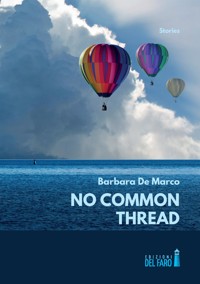
Rebecca is a troubled teenager, not comfortable in the shoes of a good girl, she rebels to cover up her malaise. Alessia looks to the tarot cards “for something that would help her solve her enigma”, fill the void she has within. Anxiety torments Luigi, an apparently confident man, who is in fact rather lonely, and who finds comfort and relief in surrounding himself with thousands of books. In Jana’s eyes you can read her atavistic fear. They recount the intricate complexity of adapting to the social conventions typical of a small provincial town, on the borders of Italy. The delicate portrait of the elderly protagonist in “Alzheimer’s”, the drawer-full of memories in “Trieste” and the young broken life of Goran, all paint a portrait for the fragility of human relationships seeking, in love, the strength to fight illness and death. Will the reader, along this bumpy path, at times tortuous, at times easy, other times harsh, a metaphor for life itself, be able to find the deeper meaning, the common thread?
Das E-Book können Sie in Legimi-Apps oder einer beliebigen App lesen, die das folgende Format unterstützen:
Veröffentlichungsjahr: 2023
Ähnliche












![Tintenherz [Tintenwelt-Reihe, Band 1 (Ungekürzt)] - Cornelia Funke - Hörbuch](https://legimifiles.blob.core.windows.net/images/2830629ec0fd3fd8c1f122134ba4a884/w200_u90.jpg)




Barbara De Marco
No Common Thread
Copyright© 2023 Edizioni del Faro
Gruppo Editoriale Tangram Srl
Via dei Casai, 6 – 38123 Trento
www.edizionidelfaro.it
Italian edition: Senza filo conduttore
First digital edition: May 2023
Cover: Baloon, Piro4d – Pixabay
Translation: Mary Valentine Nganga
ISBN 978-88-5512-791-2
http://www.edizionidelfaro.it/
https://www.facebook.com/edizionidelfaro
https://twitter.com/EdizionidelFaro
http://www.linkedin.com/company/edizioni-del-faro
The book
Rebecca is a troubled teenager, not comfortable in the shoes of a good girl, she rebels to cover up her malaise. Alessia looks to the tarot cards “for something that would help her solve her enigma”, fill the void she has within. Anxiety torments Luigi, an apparently confident man, who is in fact rather lonely, and who finds comfort and relief in surrounding himself with thousands of books. In Jana’s eyes you can read her atavistic fear. They recount the intricate complexity of adapting to the social conventions typical of a small provincial town, on the borders of Italy. The delicate portrait of the elderly protagonist in “Alzheimer’s”, the drawer-full of memories in “Trieste” and the young broken life of Goran, all paint a portrait for the fragility of human relationships seeking, in love, the strength to fight illness and death. Will the reader, along this bumpy path, at times tortuous, at times easy, other times harsh, a metaphor for life itself, be able to find the deeper meaning, the common thread?
The author
Born in Trento in 1970, Barbara De Marcograduated in Modern Foreign Languages and Literature at the University of Trento and after an interesting experience as a journalist at a local television station, she now teaches English. She is a happily married mother of two – Andrea and Elisa. Over the years she has actively collaborated with various magazines dealing with topics such as education, pedagogy, school inclusion and classroom distress. For years she has been an active member of the Sillabaria – Scritture di donne association. The short story Appunti di scuola, published in this collection, won second prize in the Storie di Donne literary competition (2009). Amori diversi was reported a worthy read by the jury of the same competition the following year. She has taught creative writing in high schools and recently edited the collection Storie di incontri e di parole nude, 2022.
to my father
“What the eye has seen,
the heart does not forget”
(ancient Malagasy proverb)
No Common Thread
Chiara, up to that moment, had been dreamy and a little sleepy because of the wine and the sunbathing earlier that day, suddenly her throat felt dry and her heart tightened. Her glass slipped from her hands, shattering to smithereens. A large dark spot began to spread slowly across the beige carpet, but her eyes remained riveted to the screen. She stared intensely at that small object so dear to her, on which the camera was zooming in at that moment.
Preface
The stories you hold in your hands begin with a proverb, almost a philosophical maxim, one that is both timeless and locationless because it stands true, always and everywhere: “What the eye has seen, the heart does not forget”.
Eyes and heart: the external and the internal man. Thus the most significant experiences are born, when what we see penetrates within, right to the heart; when the observer’s eyes are guided by a throbbing heart, one that partakes, a heart that inclines us and disposes us to truly see.
We may cross continents oblivious of what surrounds us when reality holds no wonder for us, in and of itself, as it would have when we were children, in our eager curiosity. Or perhaps when we feel paralyzed by our own expectations: or when what we want to happen must happen; we must fulfil our desires, at all costs, regardless of everything.
But if we allow ourselves the liberty to learn from life, from occurrences, and the people we come across, as the author of these tales has done, consequently, stories come to life. Subsequently, our subjective, our personal experiences – our visual angle – meets the rest of the world and discovers behind each reality, a parallel reality: deeper perhaps, greater, more dramatic, and even more mysterious.
No human story stands nor ends alone. Each one of the characters of these accounts, utters a metaphysical cry: why? Why that joy, that hurt, that bewilderment?
Who, therefore, is the little girl portrayed in the first story with the “red nail polish, nail-file, balls of cotton wool, squared paper, markers, highlighters, elastic hair-bands” on her desk during class hours?
Is she a real person, in flesh and blood? Is this perhaps an autobiographical reference? Are you one of the pupils the author encountered in her capacity as a teacher?
The answer only matters to some extent: what the story suggests is that there are gestures, demeanors that may appear banal, foolish, unsettling, ridiculous… unless we know how to delve deeper, to grasp that essential detail which is “invisible to the naked eye”.
Hence, if we really dig deep, that little girl will no longer be, to her teacher and classmates, just a foolish, listless and indifferent young person, but, au contraire, a suffering child who begs to be listened to, to be understood, to be given, as much as possible, that love which she so desperately needs.
In observing that girl, the author has perhaps perceived how fascinating a teacher’s task is. We could try not hardening our hearts towards our neighbour and try to love him while fulfilling our own desires and acknowledging our own helplessness.
Wouldn’t this be the case if instead of finding a “stranger” placed in our path by fate or providence we were to find one of our loved ones?
You cannot read the story “Alzheimer’s”, which is about an ailing widowed mother, without shedding a few tears.
There is an infinite tenderness in the way a daughter looks at a mother, who has become overrun by the passing of time and by a dark evil that is devouring her mind: where are you headed, dear mama? Where have your interests gone, your passions, your glow, your multiple activities, now that a pressing night seems to overwhelm everything?




