


7,99 €
Mehr erfahren.
- Herausgeber: Rob Botwright
- Kategorie: Wissenschaft und neue Technologien
- Sprache: Englisch
Unlock the World of Intelligence with the "OSINT 101 Handbook" Bundle!
Discover the power of Open Source Intelligence (OSINT) with our comprehensive book bundle—your key to expert-level intelligence gathering, advanced reconnaissance, threat assessment, and counterintelligence.
📚 BOOK 1 - OSINT Fundamentals: A Beginner's Guide Embark on your OSINT journey with this beginner's guide. Learn the significance of open source intelligence, master fundamental techniques, and acquire the skills to navigate the digital landscape.
📚 BOOK 2 - Advanced OSINT Strategies: Mastering Techniques Take your OSINT skills to the next level! Craft complex search queries, harness the power of automation, and explore expert-level OSINT tools. Elevate your expertise and unlock the true potential of OSINT.
📚 BOOK 3 - Digital Footprint Analysis: Profiling and Investigations Uncover the secrets hidden within digital footprints. Dive into behavioral analysis, extract insights from social media activity, and become a master of profiling and investigations.
📚 BOOK 4 - Expert OSINT: Cyber Reconnaissance and Threat Intelligence Immerse yourself in the world of cyber reconnaissance and threat intelligence. Explore real-world examples of expert-level operations and safeguard critical assets from cyber adversaries.
With the "OSINT 101 Handbook" bundle, you'll:
✅ Master OSINT techniques from beginner to expert. ✅ Uncover hidden threats and make informed decisions. ✅ Navigate the complex digital terrain with confidence. ✅ Elevate your intelligence gathering and reconnaissance skills. ✅ Harness OSINT for cybersecurity and threat assessment.
Don't miss out on this opportunity to become an OSINT expert. Get the "OSINT 101 Handbook" bundle today and unlock the world of intelligence!
Das E-Book können Sie in Legimi-Apps oder einer beliebigen App lesen, die das folgende Format unterstützen:
Veröffentlichungsjahr: 2023
Ähnliche



















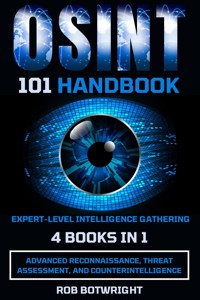
OSINT 101 HANDBOOK
EXPERT-LEVEL INTELLIGENCE GATHERING
ADVANCED RECONNAISSANCE, THREAT ASSESSMENT, AND COUNTERINTELLIGENCE
4 BOOKS IN 1
BOOK 1
OSINT FUNDAMENTALS: A BEGINNER'S GUIDE TO OPEN SOURCE INTELLIGENCE TECHNIQUES
BOOK 2
ADVANCED OSINT STRATEGIES: MASTERING OPEN SOURCE INTELLIGENCE TECHNIQUES
BOOK 3
DIGITAL FOOTPRINT ANALYSIS: HARNESSING OSINT FOR PROFILING AND INVESTIGATIONS
BOOK 4
EXPERT OSINT: CYBER RECONNAISSANCE AND THREAT INTELLIGENCE
ROB BOTWRIGHT
Copyright © 2023 by Rob Botwright
All rights reserved. No part of this book may be reproduced or transmitted in any form or by any means, electronic or mechanical, including photocopying, recording, or by any information storage and retrieval system, without permission in writing from the publisher.
Published by Rob Botwright
Library of Congress Cataloging-in-Publication Data
ISBN 978-1-83938-545-2
Cover design by Rizzo
Disclaimer
The contents of this book are based on extensive research and the best available historical sources. However, the author and publisher make no claims, promises, or guarantees about the accuracy, completeness, or adequacy of the information contained herein. The information in this book is provided on an "as is" basis, and the author and publisher disclaim any and all liability for any errors, omissions, or inaccuracies in the information or for any actions taken in reliance on such information.
The opinions and views expressed in this book are those of the author and do not necessarily reflect the official policy or position of any organization or individual mentioned in this book. Any reference to specific people, places, or events is intended only to provide historical context and is not intended to defame or malign any group, individual, or entity.
The information in this book is intended for educational and entertainment purposes only. It is not intended to be a substitute for professional advice or judgment. Readers are encouraged to conduct their own research and to seek professional advice where appropriate.
Every effort has been made to obtain necessary permissions and acknowledgments for all images and other copyrighted material used in this book. Any errors or omissions in this regard are unintentional, and the author and publisher will correct them in future editions.
TABLE OF CONTENTS – BOOK 1 - OSINT FUNDAMENTALS: A BEGINNER'S GUIDE TO OPEN SOURCE INTELLIGENCE TECHNIQUES
Introduction
Chapter 1: Introduction to Open Source Intelligence
Chapter 2: Setting Up Your OSINT Toolbox
Chapter 3: Online Privacy and Ethical Considerations
Chapter 4: Basic Search Engine Techniques
Chapter 5: Leveraging Social Media for OSINT
Chapter 6: Web Scraping and Data Collection
Chapter 7: Analyzing Publicly Available Information
Chapter 8: Geolocation and Mapping in OSINT
Chapter 9: OSINT in Investigations and Research
Chapter 10: Future Trends and Advanced Learning Paths in OSINT
TABLE OF CONTENTS – BOOK 2 - ADVANCED OSINT STRATEGIES: MASTERING OPEN SOURCE INTELLIGENCE TECHNIQUES
Chapter 1: Review of OSINT Fundamentals
Chapter 2: Deep Dive into Advanced Search Queries
Chapter 3: Targeted Information Gathering
Chapter 4: Advanced Social Media Analysis
Chapter 5: Dark Web Exploration and Monitoring
Chapter 6: OSINT Automation and Scripting
Chapter 7: Ethical Hacking for Intelligence Gathering
Chapter 8: Advanced Analysis and Visualization Tools
Chapter 9: Threat Intelligence and Cybersecurity
Chapter 10: Case Studies in Advanced OSINT Operations
TABLE OF CONTENTS – BOOK 3 - DIGITAL FOOTPRINT ANALYSIS: HARNESSING OSINT FOR PROFILING AND INVESTIGATIONS
Chapter 1: Understanding the Digital Footprint
Chapter 2: Establishing a Comprehensive OSINT Workflow
Chapter 3: Tracing Online Identities and Personas
Chapter 4: Analyzing Social Media Trails
Chapter 5: Uncovering Digital Artifacts and Metadata
Chapter 6: Profiling Individuals and Organizations
Chapter 7: Investigative Techniques with Digital Footprints
Chapter 8: Legal and Ethical Considerations in Footprint Analysis
Chapter 9: Cybersecurity Implications and Threat Assessment
Chapter 10: Real-World Case Studies in Digital Footprint Analysis
TABLE OF CONTENTS – BOOK 4 - EXPERT OSINT: CYBER RECONNAISSANCE AND THREAT INTELLIGENCE
Chapter 1: Advanced OSINT Recap
Chapter 2: Cyber Reconnaissance Fundamentals
Chapter 3: Mapping the Digital Battlefield
Chapter 4: Advanced Dark Web Investigations
Chapter 5: Deep Dive into Attribution and Deception
Chapter 6: Threat Intelligence Frameworks and Models
Chapter 7: OSINT in Counterintelligence Operations
Chapter 8: Advanced OSINT Tools and Techniques
Chapter 9: Predictive Analysis and Threat Assessment
Chapter 10: Case Studies in Expert Cyber Reconnaissance
Conclusion
Introduction
Welcome to the "OSINT 101 Handbook: Expert-Level Intelligence Gathering" bundle—a comprehensive and illuminating journey into the captivating realm of Open Source Intelligence (OSINT). In this multifaceted collection, we embark on an exploration of intelligence gathering, reconnaissance, threat assessment, and counterintelligence, spanning four distinct volumes designed to empower both beginners and seasoned professionals alike.
In an age where information is currency and knowledge is power, the ability to harness open source intelligence is not just advantageous; it is indispensable. OSINT has emerged as a cornerstone of modern intelligence operations, offering insights, strategies, and techniques that transcend traditional boundaries and redefining the way we approach intelligence gathering.
"BOOK 1 - OSINT Fundamentals: A Beginner's Guide to Open Source Intelligence Techniques" serves as your entry point into this world of digital espionage and analysis. Here, we lay the groundwork, providing novice learners with an accessible and enlightening introduction to OSINT concepts and methodologies. From understanding the significance of open source intelligence to mastering fundamental techniques, this volume is your gateway to a universe of information waiting to be unveiled.
Building upon this foundation, "BOOK 2 - Advanced OSINT Strategies: Mastering Open Source Intelligence Techniques" immerses you in the intricate web of advanced strategies employed by seasoned OSINT professionals. Delve into the art of crafting intricate search queries, harness the power of automation, and uncover the secrets of expert-level OSINT tools. With this volume, you'll elevate your skills and unlock the true potential of open source intelligence.
As we delve deeper into the world of OSINT, "BOOK 3 - Digital Footprint Analysis: Harnessing OSINT for Profiling and Investigations" takes center stage. Here, we explore the intriguing realm of digital footprints, behavioral analysis, and extracting valuable insights from social media activity. Profiling and investigations become your domain as you uncover the secrets hidden within the digital trails left by individuals and organizations.
Finally, "BOOK 4 - Expert OSINT: Cyber Reconnaissance and Threat Intelligence" catapults us into the heart of cyber reconnaissance and threat intelligence. Real-world examples of expert-level operations reveal the intricate processes by which cyber adversaries are identified, malicious infrastructure is disrupted, and critical assets are safeguarded. This volume immerses you in the dynamic and ever-evolving world of cybersecurity and intelligence.
As you embark on this extraordinary journey through the "OSINT 101 Handbook" bundle, remember that OSINT is not just a collection of techniques; it's a mindset. It's about curiosity, adaptability, and an unquenchable thirst for knowledge. It's about embracing the world of open source intelligence as a canvas upon which you can paint a detailed portrait of the digital landscape.
Each volume within this bundle equips you with the tools and knowledge needed to navigate the complex terrain of information, uncover hidden threats, and make informed decisions. It's a journey that leads you to a deeper understanding of the power and potential of OSINT—a journey where learning never ceases, and expertise is earned through dedication and practice.
The "OSINT 101 Handbook" bundle is an invaluable resource that empowers you to excel in the realms of intelligence gathering, reconnaissance, threat assessment, and counterintelligence. It is a guide that illuminates the path forward, a beacon that pierces the darkness of the digital world, and a trusted companion as you embark on your quest for knowledge.
With each turn of the page, you'll delve deeper into the art and science of open source intelligence, gaining insights that will not only enhance your professional capabilities but also shape your perspective on the world of information. Welcome to the world of OSINT, where the pursuit of knowledge is endless, and the potential for impact is boundless.
BOOK 1
OSINT FUNDAMENTALS
A BEGINNER'S GUIDE TO OPEN SOURCE INTELLIGENCE TECHNIQUES
ROB BOTWRIGHT
Chapter 1: Introduction to Open Source Intelligence
In this chapter, we will delve into the fundamental concepts of Open Source Intelligence, commonly referred to as OSINT. OSINT is a crucial discipline in the world of information gathering, and comprehending its core principles is essential for anyone venturing into the field of intelligence analysis and research. OSINT, at its core, is about collecting information from publicly available sources. These sources encompass a wide array of mediums, ranging from websites, social media platforms, news articles, and more. The primary distinction lies in the fact that OSINT relies solely on open, unclassified information, readily accessible to anyone with an internet connection. It's a valuable resource for understanding various aspects of individuals, organizations, and events.
At the heart of OSINT lies the principle of openness, which distinguishes it from other forms of intelligence. Unlike classified information or classified intelligence methods, OSINT operates in the public domain. This openness presents both opportunities and challenges, making it a captivating and complex domain of study. In essence, OSINT is the art of extracting meaningful insights and actionable intelligence from publicly available data.
One critical aspect of OSINT is the emphasis on ethical and legal considerations. While the information gathered is openly accessible, it is vital to respect privacy rights and adhere to ethical guidelines. OSINT practitioners must tread carefully to ensure they do not infringe upon individuals' privacy or violate any applicable laws. Understanding these ethical boundaries is fundamental for responsible and effective OSINT.
Another pivotal concept in OSINT is the notion of information triage. Information triage involves the process of filtering and prioritizing data based on relevance and reliability. Given the vast amount of publicly available information, OSINT analysts must develop the skill of discerning which sources and data points are credible and valuable. This discernment enables them to focus on the most pertinent information for their analysis.
Furthermore, OSINT encompasses various techniques for data collection and analysis. These techniques range from basic web searches to more advanced methods like web scraping, social media analysis, and geospatial analysis. The ability to harness these techniques effectively is a hallmark of a proficient OSINT practitioner. Each method serves a distinct purpose, allowing analysts to paint a comprehensive picture of the subject under investigation.
In our exploration of OSINT concepts, we must also acknowledge the ever-evolving nature of the field. The digital landscape constantly changes, and with it, the sources of publicly available information. New platforms, websites, and communication channels emerge regularly, providing fresh avenues for OSINT practitioners. Staying updated with these developments is essential for maintaining the relevance and accuracy of OSINT efforts.
As we move forward in this book, we will delve deeper into the practical aspects of OSINT. We will explore the tools and techniques that enable effective information collection and analysis. Additionally, we will address the ethical considerations that underpin responsible OSINT practices. By the end of this journey, you will have a solid foundation in OSINT and be equipped to leverage its power for a wide range of purposes, from research and investigations to cybersecurity and threat assessment.
Chapter 2: Setting Up Your OSINT Toolbox
In the previous chapter, we discussed the fundamental concepts of Open Source Intelligence (OSINT). Now, as we embark on this journey to master OSINT techniques, we must equip ourselves with the essential tools and resources. Your OSINT toolbox is the key to effective information gathering and analysis. In this chapter, we'll explore the components of this toolbox and how to set it up for success.
The OSINT toolbox consists of a collection of software, applications, and online resources that facilitate the various stages of OSINT work. Whether you're an investigator, researcher, journalist, or security professional, having the right tools at your disposal is paramount. These tools not only enhance your efficiency but also enable you to extract valuable insights from the vast ocean of publicly available information.
One of the first tools you should consider adding to your OSINT arsenal is a web browser with extensions tailored for intelligence work. Extensions like data scrapers, search engine modifiers, and privacy-focused add-ons can significantly enhance your browsing experience. They allow you to extract data, refine your search queries, and protect your privacy while conducting OSINT activities.
Next, a good note-taking and organization tool is indispensable. Effective data management is crucial in OSINT, as it helps you keep track of your findings, sources, and analysis. Tools like Evernote, OneNote, or specialized OSINT notebooks can aid in this aspect, allowing you to maintain a structured and accessible repository of information.
Beyond web browsing and note-taking, specialized OSINT tools play a vital role. These tools cater to specific OSINT functions, such as social media analysis, domain information retrieval, or geolocation. For example, social media intelligence platforms like Maltego can help visualize relationships and connections among individuals and entities. Domain research tools like WHOIS databases provide information about website owners and their registration details. Geolocation tools allow you to pinpoint the physical location of IP addresses or devices. These tools are invaluable for OSINT practitioners, offering precision and depth in their investigations.
Furthermore, a solid understanding of advanced search operators is essential. Search engines like Google offer a plethora of operators that enable you to refine your queries and extract more relevant results. Learning to use operators like site:, filetype:, and intitle: can greatly improve the efficiency of your OSINT searches.
In addition to software tools, consider the importance of online resources and communities. OSINT practitioners often rely on forums, blogs, and social media groups to exchange knowledge and stay updated on the latest developments in the field. These communities offer valuable insights, share tips and techniques, and foster a sense of camaraderie among OSINT enthusiasts.
As you assemble your OSINT toolbox, keep in mind that flexibility is key. The field of OSINT is dynamic, and new tools and resources emerge regularly. Therefore, it's essential to adapt and experiment with different tools to determine which ones align best with your specific needs and objectives.
In the subsequent chapters, we will dive deeper into the practical aspects of OSINT, where we'll use these tools and techniques to gather and analyze information effectively. So, let's get ready to explore the world of open source intelligence, armed with our OSINT toolbox.
Open Source Intelligence, or OSINT, plays a pivotal role in the world of information gathering, offering a unique and valuable approach. OSINT is the art of collecting and analyzing information from publicly available sources, and it operates on the principle that a wealth of data exists in the open domain. In today's digital age, where information is abundant and accessible, OSINT has become an indispensable tool for various purposes, including research, investigations, cybersecurity, and threat assessment.
The significance of OSINT lies in its ability to provide insights and intelligence from sources that are open to anyone with an internet connection. Unlike classified information, which is restricted and often concealed, OSINT relies on openly accessible data from websites, social media, news articles, public records, and other public sources. This openness allows OSINT practitioners to gather a wide range of information about individuals, organizations, events, and more, without the need for special permissions or clearances.
OSINT serves as a powerful force multiplier for intelligence gathering efforts. It complements other forms of intelligence, such as Human Intelligence (HUMINT), Signals Intelligence (SIGINT), and Geospatial Intelligence (GEOINT). While these intelligence disciplines have their strengths, they often operate in classified environments and deal with information that is not readily available to the public. OSINT, on the other hand, can fill critical gaps by providing context and background information that enhances the overall intelligence picture.
One of the key strengths of OSINT is its versatility. It can be applied across a wide spectrum of domains and disciplines. Researchers can use OSINT to gather data for academic studies or market research. Journalists can employ OSINT to uncover facts and verify information for news articles. Law enforcement agencies can use OSINT to support investigations and track down suspects. Cybersecurity professionals rely on OSINT to identify potential threats and vulnerabilities. Additionally, OSINT has a vital role in national security and defense, helping governments monitor and assess international developments.
Ethical considerations are paramount in OSINT. While the information gathered is publicly available, practitioners must adhere to ethical guidelines and respect privacy rights. OSINT professionals should operate within legal boundaries and ensure that their activities do not infringe upon individuals' privacy or violate any applicable laws. Ethical OSINT practices are essential for maintaining trust and credibility in the field.
The process of conducting OSINT involves several key stages. It begins with defining the objectives and scope of the investigation. OSINT practitioners must have a clear understanding of what information they are seeking and why. Next, they embark on data collection, which involves searching, accessing, and retrieving information from various sources. This phase requires the use of specialized tools and techniques to extract relevant data.
Once the data is collected, the analysis phase begins. OSINT analysts sift through the gathered information, looking for patterns, connections, and insights. This analytical process may involve data visualization, link analysis, and the identification of significant trends or anomalies. The goal is to transform raw data into actionable intelligence that can inform decision-making.
The final stage of OSINT involves reporting and dissemination. Analysts compile their findings into reports, briefings, or presentations, tailored to the needs of the intended audience. These reports convey the insights gained from OSINT analysis and provide recommendations or conclusions based on the data. Effective communication of OSINT findings is crucial for informing stakeholders and facilitating informed decision-making.
In addition to its role in investigations and research, OSINT also plays a pivotal role in cybersecurity and threat assessment. Organizations and cybersecurity professionals leverage OSINT to monitor the digital landscape for potential threats. By analyzing publicly available information, such as online forums, social media posts, and hacker chatter, cybersecurity experts can identify emerging threats, vulnerabilities, and attack trends. OSINT enables proactive measures to be taken to protect networks, systems, and sensitive data.
Furthermore, OSINT is a valuable tool for tracking and assessing geopolitical developments and global events. Governments and intelligence agencies use OSINT to monitor international news, social media activity, and online discussions to gain insights into global trends and potential threats. OSINT can help anticipate emerging crises, assess the intentions of state actors, and enhance national security.
In summary, OSINT is a critical component of modern information gathering and intelligence analysis. Its role extends across a wide range of fields and disciplines, from academia and journalism to law enforcement, cybersecurity, and national security. OSINT's ability to harness publicly available information and transform it into actionable intelligence makes it an indispensable tool in the digital age. As we delve deeper into this book, we will explore the practical aspects of OSINT, including the tools, techniques, and methodologies used to conduct effective information gathering and analysis.
Chapter 2: Setting Up Your OSINT Toolbox
In our journey to master Open Source Intelligence (OSINT) techniques, we must familiarize ourselves with the essential tools and software that empower OSINT practitioners. These tools are the backbone of effective information gathering and analysis in the world of OSINT. Whether you're a newcomer or an experienced analyst, having the right OSINT tools at your disposal is crucial for success.
Let's start by exploring some of the fundamental software and applications that can enhance your OSINT capabilities. At the core of any OSINT operation is your web browser. While standard browsers like Chrome, Firefox, or Safari are commonly used, it's essential to equip them with extensions and add-ons tailored for OSINT work. These extensions can provide advanced features such as data scraping, search query optimization, and privacy protection.
One such extension is Maltego, a powerful OSINT and data visualization tool that enables you to explore relationships and connections among individuals, organizations, and entities. Maltego's ability to generate interactive graphs and charts from OSINT data simplifies the process of identifying key players and their associations.
For those diving into the world of domain research, WHOIS databases are indispensable. Tools like WHOIS Lookup allow you to retrieve information about domain names, including ownership details and registration history. This information is valuable for understanding the background and affiliations of websites and online entities.
When it comes to social media analysis, tools like Social Mention and Mention can help you monitor online conversations, track brand mentions, and identify trends in real-time. These tools provide insights into social media activity and sentiment analysis, making them invaluable for OSINT practitioners focused on social media intelligence.
Furthermore, geospatial analysis plays a significant role in OSINT. Tools like Google Earth and Google Maps offer geolocation capabilities, allowing you to pinpoint physical locations, track movements, and visualize data on a map. Geospatial analysis is particularly useful for understanding the geographic aspects of OSINT investigations.
For data collection and web scraping, solutions like Octoparse, Import.io, or BeautifulSoup (for Python enthusiasts) can automate the process of extracting data from websites. These tools streamline the retrieval of structured data and save time, especially when dealing with large volumes of information.
To manage the vast amount of data collected during OSINT operations, consider using note-taking and organization tools like Evernote or OneNote. These applications help you structure your findings, create research notebooks, and maintain a systematic repository of information for future reference.
When conducting in-depth analysis, data visualization tools like Tableau or Gephi can help transform raw data into visual representations. Visualizations provide a clearer understanding of relationships, patterns, and trends within the data, enhancing the overall analysis process.
For monitoring online discussions and forums, tools such as Hootsuite and TweetDeck allow you to track hashtags, keywords, and specific accounts across various social media platforms. These social media management tools facilitate real-time monitoring and engagement with online communities relevant to your OSINT objectives.
In addition to software tools, OSINT practitioners often rely on specialized search engines. Google, for instance, offers a plethora of advanced search operators that allow you to refine your queries and access more precise results. Understanding and mastering these operators can significantly enhance the effectiveness of your OSINT searches.
Now that we've explored some essential software and tools, it's important to highlight the role of online resources and communities in the OSINT ecosystem. OSINT enthusiasts and professionals often engage in forums, blogs, and social media groups dedicated to the field. These communities serve as valuable platforms for knowledge exchange, sharing tips and techniques, and staying updated on the latest developments in OSINT.
It's worth noting that the OSINT landscape is dynamic and continuously evolving. New tools, techniques, and resources emerge regularly. As an OSINT practitioner, it's essential to remain adaptable and open to experimenting with different tools to determine which ones align best with your specific needs and objectives.
In our journey through this book, we will delve deeper into the practical application of these tools and software. We will explore how to leverage them effectively for data collection, analysis, and reporting in various OSINT scenarios. By the end of our journey, you'll have a comprehensive understanding of the OSINT toolkit and how to harness its power for a wide range of purposes, from investigations and research to cybersecurity and threat assessment.
As you delve deeper into the world of Open Source Intelligence (OSINT), one of the critical aspects to consider is the configuration of your OSINT workspace. Your workspace serves as the foundation for your OSINT operations, providing the environment where you collect, analyze, and organize information effectively. In this chapter, we will explore the key elements and best practices for configuring your OSINT workspace to optimize your productivity and ensure efficient information management.
One of the first considerations when configuring your OSINT workspace is the choice of hardware. While OSINT can be conducted on various devices, including desktop computers, laptops, and even mobile devices, it's essential to select hardware that meets your specific needs. A computer with sufficient processing power, memory, and storage capacity is advantageous for handling large datasets and running resource-intensive OSINT tools and applications.
Operating system selection is another critical decision. The choice of the operating system often depends on personal preferences and the software tools you intend to use. Many OSINT practitioners prefer using Linux distributions due to their flexibility, security features, and compatibility with a wide range of OSINT tools. However, Windows and macOS also support OSINT activities, and you can configure them to meet your requirements.
The software tools you select for your OSINT operations play a pivotal role in your workspace configuration. As discussed in previous chapters, OSINT tools encompass web browsers with extensions, data scraping applications, data analysis software, geospatial tools, and more. Ensure that you have these tools installed and properly configured on your system to streamline your OSINT workflow.
Effective data management is crucial in OSINT, and your workspace should reflect this. Consider using dedicated note-taking and organization tools like Evernote, OneNote, or specialized OSINT notebooks to structure your findings, maintain source references, and create a systematic repository of information. Proper organization ensures that you can easily access and reference data during your OSINT investigations.
To enhance your workspace's functionality, consider setting up virtualization software like VirtualBox or VMware. Virtualization allows you to create isolated virtual machines (VMs) for different OSINT tasks. For example, you can have a separate VM for web scraping, another for data analysis, and yet another for online investigations. This isolation helps maintain a clean and organized workspace, preventing cross-contamination of data and applications.
Maintaining privacy and security is paramount in OSINT, particularly when dealing with sensitive or confidential information. Configure your workspace with security in mind by using virtual private networks (VPNs), encryption tools, and secure communication platforms. These measures protect your identity and data integrity while conducting OSINT activities.
An often overlooked aspect of workspace configuration is ergonomic considerations. Ensure that your workspace is set up in a comfortable and ergonomic manner. Ergonomic chairs, keyboard placement, and monitor positioning can contribute to your overall well-being during long OSINT sessions. A comfortable workspace reduces physical strain and enhances your focus and productivity.
Backup and data recovery strategies are essential components of workspace configuration. Regularly back up your OSINT data to external storage devices or cloud services to prevent data loss in case of hardware failures or unforeseen circumstances. Familiarize yourself with data recovery procedures to retrieve information in case of accidental deletions or system issues.
Furthermore, consider the integration of automation and scripting into your OSINT workspace. Scripting languages like Python and tools like AutoIt can automate repetitive OSINT tasks, saving you time and effort. By configuring your workspace to accommodate automation, you can increase the efficiency of your OSINT operations and reduce manual workload.
Collaboration is often part of OSINT projects, and configuring your workspace to facilitate teamwork is essential. Utilize collaboration and communication tools like Slack, Microsoft Teams, or encrypted messaging apps to collaborate with colleagues or share findings securely. Properly configured communication tools enhance information sharing and decision-making within your OSINT team.
In summary, configuring your OSINT workspace is a critical step in your journey to becoming an effective OSINT practitioner. Consider factors such as hardware, operating systems, software tools, data management, privacy and security measures, ergonomic setup, backup strategies, automation, and collaboration tools. Tailoring your workspace to meet your specific needs and objectives will significantly contribute to your success in the field of Open Source Intelligence. In the upcoming chapters, we will delve deeper into practical OSINT techniques and methodologies, allowing you to put your well-configured workspace to good use in real-world OSINT scenarios.
Chapter 3: Online Privacy and Ethical Considerations
In an era where our lives are increasingly intertwined with the digital world, protecting your digital footprint has become a matter of paramount importance. Your digital footprint, often referred to as your online presence, is the trail of information you leave behind while engaging with digital technologies and platforms. It includes your interactions on social media, the websites you visit, the data you share, and the digital traces of your activities.
Why is protecting your digital footprint crucial, you may wonder? Well, your digital footprint is more than just a collection of data; it's a reflection of your identity, preferences, and behaviors in the online realm. It can be a valuable resource for individuals and organizations seeking to understand you, target you with advertisements, or even exploit your personal information for malicious purposes.
One fundamental step in protecting your digital footprint is safeguarding your personal information. This includes details such as your full name, birthdate, address, phone number, and email address. Avoid sharing this information freely on public platforms unless it is absolutely necessary. Cybercriminals often scour the web for such data to engage in identity theft or phishing attacks.
Social media plays a significant role in shaping your digital footprint. The content you post, the photos you share, and the comments you make contribute to your online persona. It's essential to think twice before sharing personal or sensitive information on social media platforms. Adjust privacy settings to control who can view your posts, and be cautious about accepting friend requests or connections from unknown individuals.
Regularly review and update your social media profiles. Remove outdated or irrelevant information, and be mindful of the content you post. What you share online can have lasting consequences, and potential employers, colleagues, or acquaintances may view your online presence. Maintaining a professional and responsible online persona is key to managing your digital footprint effectively.
Your online activities, such as web searches and website visits, also leave traces. Search engines, like Google, often collect data about your search history to personalize search results and advertisements. To mitigate this, consider using private browsing modes or search engines that prioritize user privacy, such as DuckDuckGo. These measures help reduce the data that companies collect about your online behavior.
The use of cookies and tracking technologies by websites is another aspect to be aware of. Cookies are small pieces of data that websites store on your computer to remember your preferences and track your online activities. While some cookies are harmless, others can be used for tracking and profiling. You can manage and delete cookies through your browser settings to minimize their impact on your digital footprint.
Email is a common communication tool, and your email address is often used as a primary identifier for various online accounts. Protecting your email account is crucial, as it can serve as a gateway to other aspects of your online presence. Enable two-factor authentication (2FA) for your email account to add an extra layer of security. Be cautious of phishing emails that may attempt to steal your login credentials.
Your digital footprint extends beyond the personal realm; it also encompasses your professional and financial information. Secure your work-related accounts and financial accounts with strong, unique passwords. Use a password manager to help you generate and store complex passwords securely. Regularly monitor your financial statements for any unauthorized transactions or unusual activity.
Consider using virtual private networks (VPNs) when accessing the internet, especially on public Wi-Fi networks. VPNs encrypt your internet connection, making it more challenging for cybercriminals to intercept your data. They also mask your IP address, enhancing your online privacy.
Educating yourself about online threats and scams is an essential part of digital footprint protection. Stay informed about the latest cybersecurity threats and best practices. Be cautious about clicking on suspicious links, downloading unknown attachments, or sharing personal information with unsolicited contacts.
When it comes to mobile devices, apply security measures such as PINs, fingerprints, or facial recognition to lock your phone or tablet. Install security updates promptly to patch vulnerabilities that could be exploited by malicious actors. Additionally, review and adjust app permissions to limit the data apps can access.
In essence, protecting your digital footprint is about being mindful of your online activities and taking proactive steps to safeguard your personal and sensitive information. Your digital presence is a valuable asset, and by implementing these measures, you can maintain control over your online identity and reduce the risks associated with a vast and interconnected digital world.
Ethical guidelines are the cornerstone of responsible Open Source Intelligence (OSINT) practices, ensuring that OSINT practitioners conduct their activities in an ethical and responsible manner. OSINT, by its nature, involves collecting and analyzing information from publicly available sources. However, ethical considerations are paramount, as OSINT practitioners must adhere to principles that protect privacy, respect legal boundaries, and maintain the trust of the public and stakeholders.
One fundamental ethical principle in OSINT is the respect for privacy. OSINT practitioners should always be mindful of individuals' rights to privacy when gathering information. This means avoiding the collection of personal information that is not publicly available or engaging in activities that could intrude upon someone's privacy. It's essential to strike a balance between the need for information and respecting personal boundaries.
Another key ethical guideline is the principle of transparency. OSINT practitioners should be transparent about their intentions and activities when interacting with individuals or organizations. If inquiries are made, they should clearly identify themselves and the purpose of their information gathering, whenever possible. Maintaining transparency helps build trust and credibility in the OSINT community.
Respecting copyright and intellectual property rights is crucial in OSINT. Practitioners should be cautious when using and sharing information obtained from copyrighted sources. Whenever possible, attribute the source and ensure that the use of such information falls within the boundaries of fair use or other applicable legal exceptions. Unauthorized use of copyrighted material can lead to legal consequences and damage the reputation of the OSINT community.
Another ethical consideration relates to the dissemination of OSINT findings. OSINT practitioners should be responsible and consider the potential impact of the information they share. Avoiding the spread of unverified or false information is critical. Verifying the accuracy and reliability of information before sharing it is an ethical duty. Disseminating inaccurate or misleading information can have serious consequences and harm the reputation of the OSINT practitioner.
Respect for cultural and social norms is another aspect of ethical OSINT practices. Practitioners should be sensitive to cultural differences and avoid making assumptions or judgments based on cultural or social biases. Conducting OSINT in a culturally sensitive manner is essential when dealing with global issues or diverse communities.
An often-overlooked ethical guideline in OSINT involves consent. While OSINT relies on publicly available information, OSINT practitioners should be cautious about using information in a way that goes against the intent or consent of the source. For example, if an individual's social media profile is set to private, respect that choice and avoid circumventing privacy settings to access their information.
The ethical use of automation and data collection tools is also a matter of concern in OSINT. While automation can enhance efficiency, it should be used responsibly. Avoid engaging in automated activities that may disrupt websites, violate terms of service, or overwhelm servers. Responsible automation ensures that OSINT activities do not harm the availability or functionality of publicly available sources.
In OSINT, the importance of data retention and deletion cannot be overstated. OSINT practitioners should establish clear policies and practices for the retention and deletion of data obtained during their activities. Ensure that data is kept secure and protected to prevent unauthorized access or data breaches. Additionally, establish procedures for securely deleting data when it is no longer needed for legitimate OSINT purposes.
An ethical OSINT practitioner should always adhere to the law. This includes local, national, and international laws and regulations that govern information collection and dissemination. Practitioners should avoid engaging in activities that could violate applicable laws, such as hacking, harassment, or unauthorized access to restricted information.
In summary, ethical guidelines are a crucial foundation for responsible OSINT practices. They serve as a compass, helping OSINT practitioners navigate the complex landscape of information gathering while maintaining the highest standards of integrity, privacy, and respect for the rights of individuals and organizations. By embracing these ethical principles, OSINT practitioners contribute to a positive and trusted OSINT community, where the pursuit of information is balanced with ethical considerations.
Chapter 4: Basic Search Engine Techniques
Mastering effective keyword search strategies is essential in the world of Open Source Intelligence (OSINT). Keywords serve as the gateway to unlocking valuable information from the vast ocean of publicly available data on the internet. Whether you're conducting research, investigations, or monitoring online discussions, the way you craft and deploy keywords can make a significant difference in the success of your OSINT endeavors.
Understanding the power of keywords begins with recognizing that they are the terms or phrases you use to instruct search engines and databases to retrieve relevant information. These words act as queries, guiding search algorithms to identify and present content that matches your specified criteria.
When selecting keywords, it's crucial to start with a clear understanding of your objectives. What specific information are you seeking? Who or what is your target? Having a well-defined goal helps you choose keywords that are precise and relevant. For instance, if you're investigating a cyber threat, your keywords may revolve around malware names, threat actors, or indicators of compromise.




