



0,49 €
Mehr erfahren.
- Herausgeber: Booksell-Verlag
- Kategorie: Sachliteratur, Reportagen, Biografien
- Sprache: Englisch
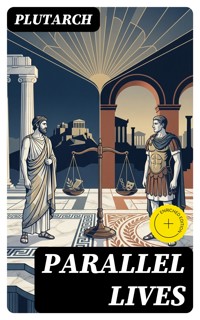
In "Parallel Lives," Plutarch offers a compelling examination of prominent figures from ancient Greece and Rome, juxtaposing their lives to illuminate their character and virtues. This collection, written in a biographical style, is characterized by deeply engaging narrative techniques and moral insights, which reflect the Hellenistic preoccupation with ethics and personal conduct. Plutarch meticulously selects pairs of figures'—such as Alexander the Great and Julius Caesar'—to provide a comparative analysis that underscores the similarities and differences in their lifestyles, decisions, and impacts on history. His work thrives in its dual purpose: not only to entertain but also to impart moral lessons reflective of Stoic and Platonic philosophies, making it a critical text in understanding the ideals of leadership and virtue in the classical world. Plutarch, a Greek biographer and philosopher of the late 1st and early 2nd centuries AD, was deeply influenced by his upbringing in a culturally rich environment in Chaeronea, Greece. His extensive studies in Athens and engagements with influential figures underscored his belief in the ethical responsibility of leaders. This belief drove him to document the lives of great men, helping to foster a sense of shared identity and moral reflection among his contemporaries and posterity. "Parallel Lives" is an enriching read for anyone interested in ancient history, philosophy, or moral leadership. Its timeless relevance resonates through the ages, offering profound insights not just into the lives of its subjects, but also into the ethical dilemmas that continue to confront humanity today. Readers seeking to delve into the complexities of character and virtue will find this work an invaluable addition to their literary and philosophical explorations. In this enriched edition, we have carefully created added value for your reading experience: - A comprehensive Introduction outlines these selected works' unifying features, themes, or stylistic evolutions. - The Author Biography highlights personal milestones and literary influences that shape the entire body of writing. - A Historical Context section situates the works in their broader era—social currents, cultural trends, and key events that underpin their creation. - A concise Synopsis (Selection) offers an accessible overview of the included texts, helping readers navigate plotlines and main ideas without revealing critical twists. - A unified Analysis examines recurring motifs and stylistic hallmarks across the collection, tying the stories together while spotlighting the different work's strengths. - Reflection questions inspire deeper contemplation of the author's overarching message, inviting readers to draw connections among different texts and relate them to modern contexts. - Lastly, our hand‐picked Memorable Quotes distill pivotal lines and turning points, serving as touchstones for the collection's central themes.
Das E-Book können Sie in Legimi-Apps oder einer beliebigen App lesen, die das folgende Format unterstützen:
Veröffentlichungsjahr: 2023
Ähnliche












Parallel Lives
Table of Contents
Introduction
This collection presents Plutarch’s Parallel Lives in a two-volume arrangement under the long-established English title Lives of the Noble Grecians and Romans. Gathered here as a single-author compendium, these volumes guide readers through a series of biographical portraits composed in antiquity to examine character, conduct, and public action. Rather than functioning as modern history or as imaginative literature, the Lives organize historical material to encourage ethical reflection and comparison. The aim of the collection is to provide a coherent pathway through the surviving sequence of Lives, preserving the comparative design that gives the work its shape and continuing relevance.
The works assembled here belong principally to the genre of biography, specifically comparative biography. Each Life narrates the career and character of a statesman, commander, or civic leader, drawing on historical sources to present a morally inflected portrait. The set also contains the formal Comparison that typically follows a pair, in which similarities and differences are weighed. Brief prefaces and occasional digressions frame the narratives and clarify method or theme. There are no novels, poems, or plays in this collection; instead, readers will encounter historical narrative, character study, and ethical commentary presented in lucid, purposeful prose.
The overarching theme uniting the Lives is the assessment of character under the pressures of public duty and fortune. Plutarch pairs a Greek and a Roman figure to explore virtue, ambition, judgment, and the unforeseen effects of power. The narratives consider how upbringing, education, and habit shape decisions, and how civic institutions channel personal qualities toward the common good or private ends. Across the volumes, the focus remains steady: deeds are presented as windows into moral disposition. This framework has ensured the work’s enduring significance, inviting readers to reflect on leadership and responsibility beyond the particulars of time and place.
Stylistically, Plutarch combines concise narrative with arresting anecdote. He selects episodes that reveal temperament—gestures, choices under stress, and habits of speech—rather than offering exhaustive chronology. The prose balances clarity with breadth, moving from domestic scenes to military councils, from private counsel to public debate. Authorial commentary appears at key moments, guiding interpretation without obscuring the actors. Plutarch often signals his sources and acknowledges uncertainties, while maintaining a steady moral lens. The result is a distinctive blend of history and ethical portraiture: vivid, economical, and oriented toward the intelligibility of character as it unfolds in civic life.
Plutarch of Chaeronea wrote in Greek during the late first and early second centuries CE, under the Roman Empire. His position as a Greek intellectual living within a Roman world gives the Lives a cross-cultural vantage. He was attentive to local traditions, philosophical discourse, and the practical realities of governance. The Lives draw on a wide range of earlier historians and memoirists and reshape them for an audience concerned with conduct and example. This historical and cultural context informs his comparisons, allowing Greek and Roman experiences to illuminate one another and enabling the work to address questions of power, virtue, and community.
The comparative structure is central. A Greek figure is paired with a Roman counterpart who shares notable resonances—vocation, temperament, or circumstance—and a concluding Comparison evaluates convergences and contrasts. Some Lives survive independently without an extant partner, yet they still participate in the same moral project. The two-volume arrangement preserves this architecture by presenting biographies in sequences that foreground their dialogic design. The approach invites readers to hold two careers in mind at once, to weigh motives and outcomes, and to consider how differing political systems and customs test similar qualities of judgment, courage, restraint, or ambition.
The influence of Parallel Lives has been far-reaching. It helped define the aims and possibilities of biography in Western literature, modeling a form that is neither annalistic history nor panegyric. The work shaped educational and political discourse from late antiquity through the Renaissance and beyond. Its impact on literature is widely attested: early modern dramatists, for example, drew on English translations for depictions of Roman statesmen. More broadly, the Lives supplied a treasury of moral exempla and cautionary tales for readers interested in practical ethics, leadership, and civic responsibility, ensuring the work a continuous presence in cultural and intellectual history.
Unifying themes recur: the tension between private virtue and public role; the durability of habit and education; the uses and limits of power; the interplay of prudence, courage, justice, and self-control. Plutarch probes the force of fortune and contingency, yet he emphasizes the steadiness of character revealed through repeated choices. The Lives also examine friendship, rivalry, and counsel—how advisors shape decisions and how leaders receive advice. Religious observance and respect for law appear as tests of civic sensibility. Together these threads establish a comprehensive moral field in which actions are weighed for their meaning, not merely their spectacle.
These volumes support several modes of reading. One may approach them sequentially, experiencing the rhythm of pair and comparison, or dip into individual Lives with attention to their prologues and closing assessments. Reading across pairs highlights recurring dilemmas—command and consent, wealth and integrity, mercy and severity—and shows how different polities test similar virtues. The comparisons, especially, distill the ethical argument of each pairing and sharpen the interpretive lens. Whatever the path, the collection rewards careful attention to transitions, source remarks, and authorial asides, which often announce the criteria by which actions are presented and character is judged.
The English designation Lives of the Noble Grecians and Romans has long served as a title for Parallel Lives, especially in two-volume presentations. While the Lives were composed in Greek, they have circulated for centuries in various languages and arrangements, which explains the persistence of traditional English titling. This collection adopts that familiar naming while keeping sight of the work’s original comparative conception. The volumes aim to offer a stable, accessible framework for modern readers, preserving the sequence and pairing logic that underwrite the Lives’ argument about character, action, and civic life across Greek and Roman experience.
Readers should note Plutarch’s declared priorities. He is interested above all in moral portraiture, not in exhaustive chronological reconstruction. Accordingly, he compresses or expands material to foreground decisive moments of choice and disposition. He weighs testimony from earlier authorities, sometimes reporting divergences, and his selection of episodes highlights the everyday springs of conduct as much as spectacular events. This method yields a distinctive accuracy of emphasis: actions are arranged to clarify the inner life they express. The resulting biographies are neither mere records nor ornaments but instruments of ethical inquiry, inviting judgment moderated by context and attentive to complexity.
As a whole, Parallel Lives remains compelling because it transforms history into an arena for reflection on responsibility, community, and the burdens of command. Presented here in two volumes, the work’s comparative scaffolding is easy to navigate and rich in implication. Each Life stands on its own, yet the pairings enlarge perspective and deepen judgment. The collection’s purpose is not to deliver final verdicts but to train perception, allowing readers to discern how character moves through institutions and events. In that sense, these volumes offer more than biography: they provide a durable education in civic imagination and ethical awareness.
Author Biography
Plutarch was a Greek biographer, essayist, and moral philosopher active from the mid-first to the early second century CE. Born in Chaeronea in Boeotia, he became one of the most influential interpreters of Greek and Roman character and history. His two chief bodies of work—the biographical Parallel Lives and the miscellany known as the Moralia—combine learned inquiry with a sustained interest in ethical formation. Writing in Greek for audiences across the Roman Empire, he bridged cultural traditions and offered portraits of statesmen that shaped subsequent ideas of leadership and virtue. His works circulated widely in antiquity and have remained central to humanistic education.
Plutarch was educated in the classical curriculum and studied philosophy at Athens, where he is reported to have learned under the Platonist Ammonius. He mastered rhetoric, history, and moral philosophy within a broadly Middle Platonist framework, engaging critically with Stoic and Epicurean doctrines while drawing inspiration from Plato and the Academy’s ethical concerns. His training emphasized dialectic, textual exegesis, and the civic role of paideia, shaping his later practice as a teacher and writer. The scholastic milieu of Athens furnished him with models for dialogue and essay forms, and encouraged his eclectic but principled method of argument, attentive both to conduct and to the interpretation of tradition.
After his studies, Plutarch returned to Chaeronea, took part in local public life, and maintained an active literary career. He visited Rome on several occasions in the later first century, lecturing and cultivating friendships among senators and intellectuals. Through the patronage of the senator Mestrius Florus he obtained Roman citizenship, assuming the name Lucius Mestrius Plutarchus, and some of his works are dedicated to the consul Sosius Senecio. Throughout, he wrote in Greek and presented Greek history and moral reflection to mixed audiences of Greeks and Romans. His public commitments and cosmopolitan readership informed his effort to relate exempla drawn from both cultural lineages.
Plutarch’s Parallel Lives consist of paired biographies of notable Greeks and Romans followed by brief comparisons. The project aims less at strict chronology than at the revelation of character and the moral causes of action. He drew on historians, speeches, and civic records, often signaling his sources and uncertainties. Among the figures treated are Theseus and Romulus, Lycurgus and Numa, Demosthenes and Cicero, and commanders and statesmen whose careers framed classical and republican history. The Lives were widely read for their ethical insight, lively anecdote, and reflections on fortune, education, and leadership, becoming a foundational model for character-driven biography.
The Moralia is a diverse collection of essays and dialogues on ethics, religion, education, politics, and natural philosophy. It includes pieces such as On Tranquility of Mind, How a Young Man Should Read Poetry, Precepts of Statecraft, On Talkativeness, On the E at Delphi, On the Decline of the Oracles, and On Isis and Osiris. Across this corpus Plutarch explores practical virtue, household and civic responsibilities, and questions of providence and ritual, often using historical exempla to illustrate counsel. The style ranges from conversational to discursive, reflecting the lecture room and symposium, with an emphasis on accessible moral reasoning supported by erudition.
Religiously and philosophically, Plutarch is a Middle Platonist who balances reverence for tradition with critique of credulity. He argues against superstition and against reductive skepticism, proposing a cosmos ordered by providence and mediated by daimonic powers. His long association with Delphi, where he served as a priest of Apollo, informed essays on oracular practice and temple symbolism, and grounded his conviction that philosophy should sustain civic cult rather than displace it. His ethical writings consistently promote moderation, friendship, self-knowledge, and public service, themes that also organize the Lives, where judgments of character are aligned with the practical cultivation of virtue.
Plutarch spent much of his later life in Chaeronea and at Delphi, combining local duties with writing and teaching until his death in the early second century. His works were preserved in Byzantine manuscript traditions and rediscovered with renewed force in the Renaissance, when Jacques Amyot’s French versions and Thomas North’s English translation of the Lives brought him to new publics. Montaigne drew extensively on the Moralia; Shakespeare relied on North for Roman plays. Modern historians mine the Lives cautiously for data while valuing their psychological acuity. Plutarch endures as a major source on antiquity and as a classic of ethical reflection.
Historical Context
Plutarch of Chaeronea, writing in the late first and early second centuries CE, composed the Parallel Lives as a sequence of paired biographies setting Greeks beside Romans to weigh virtue, vice, and statesmanship across cultures. Produced largely under the emperors Domitian (81–96), Nerva (96–98), Trajan (98–117), and possibly Hadrian (117–138), the work reflects the relative stability of the Pax Romana, which allowed provincial intellectuals to collect books, travel, and converse across the Mediterranean. The Lives arrange exempla from legendary founders and lawgivers to republican commanders and imperial-era actors, presenting moral history as a guide for civic elites within a shared Greco-Roman world.
Born at Chaeronea in Boeotia around 46 CE, Plutarch was educated at Athens under the Platonist philosopher Ammonius and maintained lifelong ties to Attic schools of rhetoric and philosophy. He received Roman citizenship through Lucius Mestrius Florus, adopting the name Lucius Mestrius Plutarchus, and visited Rome several times, lecturing and cultivating patrons among senators. He served repeatedly as magistrate in his native city and, after about 95 CE, as priest of Apollo at Delphi, near his home. He died sometime after 119 CE. These positions grounded his biographies in both local Hellenic civic life and the administrative realities of empire.
The political framework of the Parallel Lives is the early Principate, in which Augustus (27 BCE–14 CE) had reshaped republican institutions into monarchical rule masked by traditional offices. In Greece, the province of Achaea, with its capital at Corinth, was governed by a senatorial proconsul, while cities like Chaeronea and Athens retained councils, magistracies, and liturgies that preserved civic identity. Under the Flavians and Trajan, provincial notables contributed taxes and military recruits, staged festivals, and sought imperial benefactions. Plutarch writes from this milieu of municipal elites negotiating authority, where Roman law, Latin administration, and Greek custom met daily in courts, assemblies, and sanctuaries.
Culturally, the Lives belong to the Second Sophistic, the Greek renaissance in rhetoric and classical learning flourishing from Nero to Hadrian. Educated notables cultivated Atticized Greek, revived archaic political vocabulary, and delivered declamations modeled on Thucydides, Xenophon, and Demosthenes. Plutarch’s prose is shaped by this paideia, interweaving moral philosophy with stylistic imitation of classical models. The biographies assume an audience trained on Homer, tragedy, and civic oratory, alive to the ethical resonance of exempla. This cultural movement encouraged the curation of the past as a living resource, turning the achievements and failures of statesmen into material for philosophical self-scrutiny.
Plutarch inherited mixed traditions of historiography and biography. Greek writers like Xenophon and Theopompus embedded character sketches within narrative histories, while Hellenistic scholars compiled encomia and diadoch histories. On the Roman side, Cornelius Nepos offered short Lives of commanders, and Livy provided annalistic history rich in moral judgments. Writing contemporaneously with Tacitus and Suetonius, Plutarch adopted biography as an ethical laboratory, subordinating strict chronology to the evaluation of ethos. He anchors events with dates and names but privileges small acts and sayings that reveal prohairesis, the deliberate moral choice. This method permits wide comparisons across centuries without claiming exhaustive completeness.
The gathering of sources for the Lives reflects the antiquarian energy of the early empire. Plutarch cites Greek historians such as Herodotus, Thucydides, Ephorus, and Hieronymus of Cardia, consults Roman records and annalists, and visits shrines, treasuries, and family monuments to inspect inscriptions. He notes conflicting traditions on events like the founding of Rome or battles in Sicily, and weighs testimonies from archives at Delphi, Athens, and Rome. The spread of libraries in cities like Alexandria, Pergamon, and Rome, and private collections of senatorial patrons, gave him access to otherwise scattered documents, while epigraphic habit preserved decrees, treaties, and proxeny lists.
Many Lives meditate on Greek civic identity after the loss of autonomy marked by 146 BCE and earlier by the defeat at Chaeronea in 338 BCE. Greek cities under Roman rule sustained their prestige through festivals, education, and euergetism, whereby wealthy citizens funded temples, theaters, and grain distributions. Plutarch, a benefactor and priest, writes from inside this honor economy, attentive to how honor, shame, and public memory guide conduct. By pairing Greek with Roman figures, he suggests continuities in civic virtue and the relevance of Greek moral vocabulary to Roman magistrates and generals, even as imperial sovereignty set the boundaries of political action.
The Parallel Lives presuppose classical debates about constitutions traceable to Plato and Aristotle, as well as Roman reflections on mixed government and mos maiorum. Plutarch evaluates lawgivers, speakers, and commanders by their moderation, justice, and temperance, themes shaped by Middle Platonism and by practical civic experience. He is sensitive to the corrosion of republican norms under wealth and war, highlighting the perils of demagogy and tyranny, and the stabilizing effects of balanced institutions. The biographies thus function as mirrors for magistrates, inviting readers in Athens, Corinth, or Rome to examine prudence in crisis, clemency in victory, and firmness under popular pressure.
Religious practice frames the moral world of the Lives. As priest of Apollo at Delphi, Plutarch saw oracles, sacrifices, and sacred calendars as integral to civic order. He records vows before battles, prodigies in Rome, and festivals in Sparta and Athens, acknowledging both piety and superstition. The imperial cult coexisted with ancestral rites, and emperors from Augustus to Hadrian patronized old sanctuaries, including restorations at Delphi. Such contexts matter for choices of leaders who consult seers, dedicate spoils, or violate sacred law. In Plutarch’s moral calculus, reverence for gods, moderation in ritual, and respect for ancestral custom reinforce political legitimacy.
Though not a military manual, the corpus rests on the centrality of war to Greek and Roman public life from the Persian Wars to the civil wars of the late Republic. It spans hoplite phalanxes and triremes, Macedonian combined arms, and Roman legionary tactics refined after Marius. Commanders confront dilemmas of logistics, pay, spoils, and discipline, while sieges from Syracuse to Corinth reshape economies and memory. Plutarch scrutinizes leadership under extreme stress, considering strategic caution versus audacity, treatment of allies, and clemency toward the defeated. Victories and failures become moral tests that illuminate character more than they celebrate conquest.
The social fabric informing the Lives is stratified and slaveholding. Elite wealth derives from land, rents, mines, and war booty, while cities extract resources through taxes and liturgies. Roman patronage binds clients to aristocrats in courts and elections; Greek cities distribute honors by decrees and crowns. Grain supply from Sicily, Africa, and Egypt sustains urban populations, and coinage reforms signal fiscal stress. Economic shocks follow civil wars, proscriptions, and confiscations, which Plutarch notes as corrupting civic virtue. The biographies track how household management, liberality, luxury, and austerity bear on public trust, exposing tensions between private opulence and communal obligation.
The geographic sweep of the Lives mirrors the connected Mediterranean under Roman rule. Roads like the Via Appia and sea lanes through the Aegean, Ionian, and Tyrrhenian seas facilitate rapid movement of armies, envoys, and texts. Campaigns stretch from Gaul and Britain to Pontus and Parthia; Greek statesmen orbit between Athens, Sparta, Thebes, and Asia Minor. Plutarch himself travels from Boeotia to Athens, Corinth, and Rome, and likely to Alexandria by way of study and inquiry. Exiles, embassies, and triumphs structure careers, while diasporic communities of Greeks in Italy and Romans in the East blur cultural boundaries central to his comparative project.
The collection surveys an enormous chronological arc. It begins with archaic and classical Greek figures traditionally dated between the seventh and fourth centuries BCE, proceeds through Hellenistic monarchs after 323 BCE, and follows Roman history from legendary kings to the Republic’s collapse in 31 BCE and beyond into the tumult of 69 CE. Anchors include 509 BCE for the Roman Republic, 404 BCE for the fall of Athens, 146 BCE for Corinth’s destruction, 44 BCE for Caesar’s assassination, and the Battle of Actium in 31 BCE. This panorama allows Plutarch to detect enduring patterns in ambition, law, and civic virtue.
Plutarch announces that he seeks not the number of battles but the signs of a soul, drawing on ethical discourse from Socrates to the Stoa while remaining a Platonist. He organizes Lives around virtues like justice, courage, and sophrosyne, and vices like envy and anger, illustrated by anecdotes, letters, and reported sayings. Prefaces to paired Lives frame themes and acknowledge divergent sources. The Comparative essays, or synkriseis, set counterparts side by side to clarify strengths and failings. This ethical orientation, honed also in his Moralia, turns history into practical philosophy for administrators, soldiers, and teachers during the Principate.
Dedications to the consul Sosius Senecio, who held office in 99 and 107 CE under Trajan, situate the project within elite Roman networks. Plutarch likely circulated individual Lives as bookrolls before assembling pairs, revising in response to friends and patrons. Bilingual readers in Rome and Greek cities could navigate both traditions, while Latin translations or summaries by intermediaries widened reach. The physical conditions of publication, from papyrus rolls to professional copyists, and the custom of public readings, shaped reception. The work instructs boys and magistrates alike, harmonizing Greek paideia with Roman civic ideals within a cosmopolitan imperial audience.
The signature pairing strategy serves as cultural diplomacy. By coupling a Greek lawgiver with a Roman reformer, or a Greek strategist with a Roman general, Plutarch fashions a bridge of exempla that dignifies both traditions. The comparisons avoid rigid equivalence, emphasizing instead how differing institutions elicit similar virtues or expose contrasting temptations. Rhetorical speeches placed at crises, portraits of friends and rivals, and attention to household governance enrich the analysis. The method implicitly argues for a shared moral universe where Greek philosophical language can evaluate Roman power, legitimizing the learned provincial voice within the imperial conversation.
Although grounded in the world of Domitian to Hadrian, the Lives acquired a long afterlife that illuminates their original purpose. Late antique scholars preserved the text; Byzantine manuscripts transmitted it to the West. Jacques Amyot published a French version in 1559, Thomas North produced an English rendering in 1579, and Dryden’s team offered another in 1683–1686, dividing the corpus into volumes. These translations reinserted Plutarch into debates on monarchy, republicanism, and civic virtue from Montaigne to Shakespeare. That enduring reception underscores Plutarch’s historical project: to gather Greek and Roman experience into a portable treasury for states and citizens across ages.
Synopsis (Selection)
Lives of the Noble Grecians and Romans - Volume 1
Plutarch begins his parallel biographies with founders, lawgivers, and classical statesmen, using matched Greek–Roman lives to probe character and civic virtue. Spanning pairs such as Theseus–Romulus, Lycurgus–Numa, Solon–Publicola, Themistocles–Camillus, and Pericles–Fabius, the volume juxtaposes decisions in war and governance to highlight models and cautions for public life.
Lives of the Noble Grecians and Romans - Volume 2
Continuing into the Hellenistic era and the late Roman Republic, this volume pairs generals, orators, and reformers—e.g., Agesilaus–Pompey, Demosthenes–Cicero, Alexander–Caesar, and Agis and Cleomenes–the Gracchi—and also includes unpaired lives (Aratus, Artaxerxes, Galba, Otho). Through comparisons and synopses of their careers, Plutarch examines ambition, leadership, and the strains that test republican institutions.
Parallel Lives
Lives of the Noble Grecians and Romans - Volume 1
Theseus
As geographers, Sosius, crowd into the edges of their maps parts of the world which they do not know about, adding notes in the margin to the effect, that beyond this lies nothing but sandy deserts full of wild beasts, unapproachable bogs, Scythian ice, or a frozen sea, so, in this work of mine, in which I have compared the lives of the greatest men with one another, after passing through those periods which probable reasoning can reach to and real history find a footing in, I might very well say of those that are farther off, Beyond this there is nothing but prodigies and fictions, the only inhabitants are the poets and inventors of fables; there is no credit, or certainty any farther. Yet, after publishing an account of Lycurgus the lawgiver and Numa the king, I thought I might, not without reason, ascend as high as to Romulus, being brought by my history so near to his time.
Considering therefore with myself
Whom shall I set so great a man to face? Or whom oppose? who’s equal to the place?
(as Aeschylus expresses it), I found none so fit as him that peopled the beautiful and far-famed city of Athens, to be set in opposition with the father of the invincible and renowned city of Rome. Let us hope that Fable may, in what shall follow, so submit to the purifying processes of Reason as to take the character of exact history. In any case, however, where it shall be found contumaciously slighting credibility, and refusing to be reduced to anything like probable fact, we shall beg that we may meet with candid readers, and such as will receive with indulgence the stories of antiquity.
Theseus seemed to me to resemble Romulus in many particulars. Both of them, born out of wedlock and of uncertain parentage, had the repute of being sprung from the gods.
Both warriors; that by all the world’s allowed.
Both of them united with strength of body an equal vigor mind; and of the two most famous cities of the world the one built Rome, and the other made Athens be inhabited. Both stand charged with the rape of women; neither of them could avoid domestic misfortunes nor jealousy at home; but towards the close of their lives are both of them said to have incurred great odium with their countrymen, if, that is, we may take the stories least like poetry as our guide to the truth.
The lineage of Theseus, by his father’s side, ascends as high as to Erechtheus and the first inhabitants of Attica. By his mother’s side he was descended of Pelops. For Pelops was the most powerful of all the kings of Peloponnesus, not so much by the greatness of his riches as the multitude of his children, having married many daughters to chief men, and put many sons in places of command in the towns round about him. One of whom named Pittheus, grandfather to Theseus, was governor of the small city of the Troezenians, and had the repute of a man of the greatest knowledge and wisdom of his time; which then, it seems, consisted chiefly in grave maxims, such as the poet Hesiod got his great fame by, in his book of Works and Days. And, indeed, among these is one that they ascribe to Pittheus —
Unto a friend suffice A stipulated price;
which, also, Aristotle mentions. And Euripides, by calling Hippolytus ” scholar of the holy Pittheus,” shows the opinion that the world had of him.
Aegeus, being desirous of children, and consulting the oracle of Delphi, received the celebrated answer which forbade him the company of any woman before his return to Athens. But the oracle being so obscure as not to satisfy him that he was clearly forbid this, he went to Troezen, and communicated to Pittheus the voice of the god, which was in this manner —
Loose not the wine-skin foot, thou chief of men, Until to Athens thou art come again.
Pittheus, therefore, taking advantage from the obscurity of the oracle, prevailed upon him, it is uncertain whether by persuasion or deceit, to lie with his daughter Aethra. Aegeus afterwards, knowing her whom he had lain with to be Pittheus’s daughter, and suspecting her to be with child by him, left a sword and a pair of shoes, hiding them under a great stone that had a hollow in it exactly fitting them; and went away making her only privy to it, and commanding her, if she brought forth a son who, when he came to man’s estate, should be able to lift up the stone and take away what he had left there, she should send him away to him with those things with all secrecy, and with injunctions to him as much as possible to conceal his journey from every one; for he greatly feared the Pallantidae, who were continually mutinying against him, and despised him for his want of children, they themselves being fifty brothers, all sons of Pallas.
When Aethra was delivered of a son, some say that he was immediately named Theseus, from the tokens which his father had put under the stone; others that he received his name afterwards at Athens, when Aegeus acknowledged him for his son. He was brought up under his grandfather Pittheus, and had a tutor and attendant set over him named Connidas, to whom the Athenians, even to this time, the day before the feast that is dedicated to Theseus, sacrifice a ram, giving this honor to his memory upon much juster grounds than to Silanio and Parrhasius, for making pictures and statues of Theseus. There being then a custom for the Grecian youth, upon their first coming to man’s estate, to go to Delphi and offer first-fruits of their hair to the god, Theseus also went thither, and a place there to this day is yet named Thesea, as it is said, from him. He clipped only the fore part of his head, as Homer says the Abantes did. And this sort of tonsure was from him named Theseis. The Abantes first used it, not in imitation of the Arabians, as some imagine, nor of the Mysians, but because they were a warlike people, and used to close fighting, and above all other nations accustomed to engage hand to hand; as Archilochus testifies in these verses:—
Slings shall not whirl, nor many arrows fly, When on the plain the battle joins; but swords, Man against man, the deadly conflict try, As is the practice of Euboea’s lords Skilled with the spear. —
Therefore that they might not give their enemies a hold by their hair, they cut it in this manner. They write also that this was the reason why Alexander gave command to his captains that all the beards of the Macedonians should be shaved, as being the readiest hold for an enemy.
Aethra for some time concealed the true parentage of Theseus, and a report was given out by Pittheus that he was begotten by Neptune; for the Troezenians pay Neptune the highest veneration. He is their tutelar god, to him they offer all their first-fruits, and in his honor stamp their money with a trident.
Theseus displaying not only great strength of body, but equal bravery, and a quickness alike and force of understanding, his mother Aethra, conducting him to the stone, and informing him who was his true father, commanded him to take from thence the tokens that Aegeus had left, and to sail to Athens. He without any difficulty set himself to the stone and lifted it up; but refused to take his journey by sea, though it was much the safer way, and though his mother and grandfather begged him to do so. For it was at that time very dangerous to go by land on the road to Athens, no part of it being free from robbers and murderers. That age produced a sort of men, in force of hand, and swiftness of foot, and strength of body, excelling the ordinary rate, and wholly incapable of fatigue; making use, however, of these gifts of nature to no good or profitable purpose for mankind, but rejoicing and priding themselves in insolence, and taking the benefit of their superior strength in the exercise of inhumanity and cruelty, and in seizing, forcing, and committing all manner of outrages upon every thing that fell into their hands; all respect for others, all justice, they thought, all equity and humanity, though naturally lauded by common people, either out of want of courage to commit injuries or fear to receive them, yet no way concerned those who were strong enough to win for themselves. Some of these, Hercules destroyed and cut off in his passage through these countries, but some, escaping his notice while he was passing by, fled and hid themselves, or else were spared by him in contempt of their abject submission; and after that Hercules fell into misfortune, and, having slain Iphitus, retired to Lydia, and for a long time was there slave to Omphale, a punishment which he had imposed upon himself for the murder, then, indeed, Lydia enjoyed high peace and security, but in Greece and the countries about it the like villanies again revived and broke out, there being none to repress or chastise them. It was therefore a very hazardous journey to travel by land from Athens to Peloponnesus; and Pittheus, giving him an exact account of each of these robbers and villains, their strength, and the cruelty they used to all strangers, tried to persuade Theseus to go by sea. But he, it seems, had long since been secretly fired by the glory of Hercules, held him in the highest estimation, and was never more satisfied than in listening to any that gave an account of him; especially those that had seen him, or had been present at any action or saying of his. So that he was altogether in the same state of feeling as, in after ages, Themistocles was, when he said that he could not sleep for the trophy of Miltiades; entertaining such admiration for the virtue of Hercules, that in the night his dreams were all of that hero’s actions. and in the day a continual emulation stirred him up to perform the like. Besides, they were related, being born of cousins-german. For Aethra was daughter of Pittheus, and Alcmena of Lysidice; and Lysidice and Pittheus were brother and sister, children of Hippodamia and Pelops. He thought it therefore a dishonorable thing, and not to be endured, that Hercules should go out everywhere, and purge both land and sea from wicked men, and he himself should fly from the like adventures that actually came in his way; disgracing his reputed father by a mean flight by sea, and not showing his true one as good evidence of the greatness of his birth by noble and worthy actions, as by the tokens that he brought with him, the shoes and the sword.
With this mind and these thoughts, he set forward with a design to do injury to nobody, but to repel and revenge himself of all those that should offer any. And first of all, in a set combat, he slew Periphetes, in the neighborhood of Epidaurus, who used a club for his arms, and from thence had the name of Corynetes, or the club-bearer; who seized upon him, and forbade him to go forward in his journey. Being pleased with the club, he took it, and made it his weapon, continuing to use it as Hercules did the lion’s skin, on whose shoulders that served to prove how huge a beast he had killed; and to the same end Theseus carried about him this club; overcome indeed by him, but now, in his hands, invincible.
Passing on further towards the Isthmus of Peloponnesus, he slew Sinnis, often surnamed the Bender of Pines, after the same manner in which he himself had destroyed many others before. And this he did without having either practiced or ever learnt the art of bending these trees, to show that natural strength is above all art. This Sinnis had a daughter of remarkable beauty and stature, called Perigune, who, when her father was killed, fled, and was sought after everywhere by Theseus; and coming into a place overgrown with brushwood shrubs, and asparagus-thorn, there, in a childlike, innocent manner, prayed and begged them, as if they understood her, to give her shelter, with vows that if she escaped she would never cut them down nor burn them. But Theseus calling upon her, and giving her his promise that he would use her with respect, and offer her no injury, she came forth, and in due time bore him a son, named Melanippus; but afterwards was married to Deioneus, the son of Eurytus, the Oechalian, Theseus himself giving her to him. Ioxus, the son of this Melanippus who was born to Theseus, accompanied Ornytus in the colony that he carried with him into Caria, whence it is a family usage amongst the people called Ioxids, both male and female, never to burn either shrubs or asparagus-thorn, but to respect and honor them.
The Crommyonian sow, which they called Phaea, was a savage and formidable wild beast, by no means an enemy to be despised. Theseus killed her, going out of his way on purpose to meet and engage her, so that he might not seem to perform all his great exploits out of mere necessity; being also of opinion that it was the part of a brave man to chastise villainous and wicked men when attacked by them, but to seek out and overcome the more noble wild beasts. Others relate that Phaea was a woman, a robber full of cruelty and lust, that lived in Crommyon, and had the name of Sow given her from the foulness of her life and manners, and afterwards was killed by Theseus. He slew also Sciron, upon the borders of Megara, casting him down from the rocks, being, as most report, a notorious robber of all passengers, and, as others add, accustomed, out of insolence and wantonness, to stretch forth his feet to strangers, commanding them to wash them, and then while they did it, with a kick to send them down the rock into the sea. The writers of Megara, however, in contradiction to the received report, and, as Simonides expresses it, “fighting with all antiquity,” contend that Sciron was neither a robber nor doer of violence, but a punisher of all such, and the relative and friend of good and just men; for Aeacus, they say, was ever esteemed a man of the greatest sanctity of all the Greeks; and Cychreus, the Salaminian, was honored at Athens with divine worship; and the virtues of Peleus and Telamon were not unknown to any one. Now Sciron was son-in-law to Cychreus, father-in-law to Aeacus, and grandfather to Peleus and Telamon, who were both of them sons of Endeis, the daughter of Sciron and Chariclo; it was not probable, therefore, that the best of men should make these alliances with one who was worst, giving and receiving mutually what was of greatest value and most dear to them. Theseus, by their account, did not slay Sciron in his first journey to Athens, but afterwards, when he took Eleusis, a city of the Megarians, having circumvented Diocles, the governor. Such are the contradictions in this story. In Eleusis he killed Cercyon, the Arcadian, in a wrestling match. And going on a little farther, in Erineus, he slew Damastes, otherwise called Procrustes, forcing his body to the size of his own bed, as he himself was used to do with all strangers; this he did in imitation of Hercules, who always returned upon his assailants the same sort of violence that they offered to him; sacrificed Busiris, killed Antaeus in wrestling, and Cycnus in single combat, and Termerus by breaking his skull in pieces (whence, they say, comes the proverb of “a Termerian mischief”), for it seems Termerus killed passengers that he met, by running with his head against them. And so also Theseus proceeded in the punishment of evil men, who underwent the same violence from him which they had inflicted upon others, justly suffering after the manner of their own injustice.
As he went forward on his journey, and was come as far as the river Cephisus, some of the race of the Phytalidae met him and saluted him, and, upon his desire to use the purifications, then in custom, they performed them with all the usual ceremonies, and, having offered propitiatory sacrifices to the gods, invited him and entertained him at their house, a kindness which, in all his journey hitherto, he had not met.
On the eighth day of Cronius, now called Hecatombaeon, he arrived at Athens, where he found the public affairs full of all confusion, and divided into parties and factions, Aegeus also, and his whole private family, laboring under the same distemper; for Medea, having fled from Corinth, and promised Aegeus to make him, by her art, capable of having children, was living with him. She first was aware of Theseus, whom as yet Aegeus did not know, and he being in years, full of jealousies and suspicions, and fearing every thing by reason of the faction that was then in the city, she easily persuaded him to kill him by poison at a banquet, to which he was to be invited as a stranger. He, coming to the entertainment, thought it not fit to discover himself at once, but, willing to give his father the occasion of first finding him out, the meat being on the table, he drew his sword as if he designed to cut with it; Aegeus, at once recognizing the token, threw down the cup of poison, and, questioning his son, embraced him, and, having gathered together all his citizens, owned him publicly before them, who, on their part, received him gladly for the fame of his greatness and bravery; and it is said, that when the cup fell, the poison was spilt there where now is the enclosed space in the Delphinium; for in that place stood Aegeus’s house, and the figure of Mercury on the east side of the temple is called the Mercury of Aegeus’s gate.
The sons of Pallas, who before were quiet, upon expectation of recovering the kingdom after Aegeus’s death, who was without issue, as soon as Theseus appeared and was acknowledged the successor, highly resenting that Aegeus first, an adopted son only of Pandion, and not at all related to the family of Erechtheus, should be holding the kingdom, and that after him, Theseus, a visitor and stranger, should be destined to succeed to it, broke out into open war. And, dividing themselves into two companies, one part of them marched openly from Sphettus, with their father, against the city, the other, hiding themselves in the village of Gargettus, lay in ambush, with a design to set upon the enemy on both sides. They had with them a crier of the township of Agnus, named Leos, who discovered to Theseus all the designs of the Pallantidae He immediately fell upon those that lay in ambuscade, and cut them all off; upon tidings of which Pallas and his company fled and were dispersed.
From hence they say is derived the custom among the people of the township of Pallene to have no marriages or any alliance with the people of Agnus, nor to suffer the criers to pronounce in their proclamations the words used in all other parts of the country, Acouete Leoi (Hear ye people), hating the very sound of Leo, because of the treason of Leos.
Theseus, longing to be in action, and desirous also to make himself popular, left Athens to fight with the bull of Marathon, which did no small mischief to the inhabitants of Tetrapolis. And having overcome it, he brought it alive in triumph through the city, and afterwards sacrificed it to the Delphinian Apollo. The story of Hecale, also, of her receiving and entertaining Theseus in this expedition, seems to be not altogether void of truth; for the townships round about, meeting upon a certain day, used to offer a sacrifice, which they called Hecalesia, to Jupiter Hecaleius, and to pay honor to Hecale, whom, by a diminutive name, they called Hecalene, because she, while entertaining Theseus, who was quite a youth, addressed him, as old people do, with similar endearing diminutives; and having made a vow to Jupiter for him as he was going to the fight, that, if he returned in safety, she would offer sacrifices in thanks of it, and dying before he came back, she had these honors given her by way of return for her hospitality, by the command of Theseus, as Philochorus tells us.
Not long after arrived the third time from Crete the collectors of the tribute which the Athenians paid them upon the following occasion. Androgeus having been treacherously murdered in the confines of Attica, not only Minos, his father, put the Athenians to extreme distress by a perpetual war, but the gods also laid waste their country both famine and pestilence lay heavy upon them, and even their rivers were dried up. Being told by the oracle that, if they appeased and reconciled Minos, the anger of the gods would cease and they should enjoy rest from the miseries they labored under, they sent heralds, and with much supplication were at last reconciled, entering into an agreement to send to Crete every nine years a tribute of seven young men and as many virgins, as most writers agree in stating; and the most poetical story adds, that the Minotaur destroyed them, or that, wandering in the labyrinth, and finding no possible means of getting out, they miserably ended their lives there; and that this Minotaur was (as Euripides hath it)
A mingled form, where two strange shapes combined, And different natures, bull and man, were joined.
But Philochorus says that the Cretans will by no means allow the truth of this, but say that the labyrinth was only an ordinary prison, having no other bad quality but that it secured the prisoners from escaping, and that Minos, having instituted games in honor of Androgeus, gave, as a reward to the victors, these youths, who in the mean time were kept in the labyrinth; and that the first that overcame in those games was one of the greatest power and command among them, named Taurus, a man of no merciful or gentle disposition, who treated the Athenians that were made his prize in a proud and cruel manner. Also Aristotle himself, in the account that he gives of the form of government of the Bottiaeans, is manifestly of opinion that the youths were not slain by Minos, but spent the remainder of their days in slavery in Crete; that the Cretans, in former times, to acquit themselves of an ancient vow which they had made, were used to send an offering of the first-fruits of their men to Delphi, and that some descendants of these Athenian slaves were mingled with them and sent amongst them, and, unable to get their living there, removed from thence, first into Italy, and settled about Japygia; from thence again, that they removed to Thrace, and were named Bottiaeans and that this is the reason why, in a certain sacrifice, the Bottiaean girls sing a hymn beginning Let us go to Athens. This may show us how dangerous a thing it is to incur the hostility of a city that is mistress of eloquence and song. For Minos was always ill spoken of, and represented ever as a very wicked man, in the Athenian theaters; neither did Hesiod avail him by calling him “the most royal Minos,” nor Homer, who styles him “Jupiter’s familiar friend;” the tragedians got the better, and from the vantage ground of the stage showered down obloquy upon him, as a man of cruelty and violence; whereas, in fact, he appears to have been a king and a lawgiver, and Rhadamanthus a judge under him, administering the statutes that he ordained.
Now when the time of the third tribute was come, and the fathers who had any young men for their sons were to proceed by lot to the choice of those that were to be sent, there arose fresh discontents and accusations against Aegeus among the people, who were full of grief and indignation that he, who was the cause of all their miseries, was the only person exempt from the punishment; adopting and settling his kingdom upon a bastard and foreign son, he took no thought, they said, of their destitution and loss, not of bastards, but lawful children. These things sensibly affected Theseus, who, thinking it but just not to disregard, but rather partake of, the sufferings of his fellow citizens, offered himself for one without any lot. All else were struck with admiration for the nobleness and with love for the goodness of the act; and Aegeus, after prayers and entreaties, finding him inflexible and not to be persuaded, proceeded to the choosing of the rest by lot. Hellanicus, however, tells us that the Athenians did not send the young men and virgins by lot, but that Minos himself used to come and make his own choice, and pitched upon Theseus before all others; according to the conditions agreed upon between them, namely, that the Athenians should furnish them with a ship, and that the young men that were to sail with him should carry no weapon of war; but that if the Minotaur was destroyed, the tribute should cease.
On the two former occasions of the payment of the tribute, entertaining no hopes of safety or return, they sent out the ship with a black sail, as to unavoidable destruction; but now, Theseus encouraging his father and speaking greatly of himself, as confident that he should kill the Minotaur, he gave the pilot another sail, which was white, commanding him, as he returned, if Theseus were safe, to make use of that; but if not, to sail with the black one, and to hang out that sign of his misfortune. Simonides says that the sail which Aegeus delivered to the pilot was not white, but
Scarlet, in the juicy bloom Of the living oak-tree steeped,
and that this was to be the sign of their escape. Phereclus, son of Amarsyas, according to Simonides, was pilot of the ship. But Philochorus says Theseus had sent him by Scirus, from Salamis, Nausithous to be his steersman, and Phaeax his look-out-man in the prow, the Athenians having as yet not applied themselves to navigation; and that Scirus did this because one of the young men, Menesthes, was his daughter’s son; and this the chapels of Nausithous and Phaeax, built by Theseus near the temple of Scirus, confirm. He adds, also, that the feast named Cybernesia was in honor of them. The lot being cast, and Theseus having received out of the Prytaneum those upon whom it fell, he went to the Delphinium, and made an offering for them to Apollo of his suppliant’s badge, which was a bough of a consecrated olive tree, with white wool tied about it.
Having thus performed his devotion, he went to sea, the sixth day of Munychion, on which day even to this time the Athenians send their virgins to the same temple to make supplication to the gods. It is farther reported that he was commanded by the oracle at Delphi to make Venus his guide, and to invoke her as the companion and conductress of his voyage, and that, as he was sacrificing a she goat to her by the seaside, it was suddenly changed into a he, and for this cause that goddess had the name of Epitrapia.
When he arrived at Crete, as most of the ancient historians as well as poets tell us, having a clue of thread given him by Ariadne, who had fallen in love with him, and being instructed by her how to use it so as to conduct him through the windings of the labyrinth, he escaped out of it and slew the Minotaur, and sailed back, taking along with him Ariadne and the young Athenian captives. Pherecydes adds that he bored holes in the bottoms of the Cretan ships to hinder their pursuit. Demon writes that Taurus, the chief captain of Minos, was slain by Theseus at the mouth of the port, in a naval combat, as he was sailing out for Athens. But Philochorus gives us the story thus: That at the setting forth of the yearly games by king Minos, Taurus was expected to carry away the prize, as he had done before; and was much grudged the honor. His character and manners made his power hateful, and he was accused moreover of too near familiarity with Pasiphae, for which reason, when Theseus desired the combat, Minos readily complied. And as it was a custom in Crete that the women also should be admitted to the sight of these games, Ariadne, being present, was struck with admiration of the manly beauty of Theseus, and the vigor and address which he showed in the combat, overcoming all that encountered with him. Minos, too, being extremely pleased with him, especially because he had overthrown and disgraced Taurus, voluntarily gave up the young captives to Theseus, and remitted the tribute to the Athenians. Clidemus gives an account peculiar to himself, very ambitiously, and beginning a great way back: That it was a decree consented to by all Greece, that no vessel from any place, containing above five persons, should be permitted to sail, Jason only excepted, who was made captain of the great ship Argo, to sail about and scour the sea of pirates. But Daedalus having escaped from Crete, and flying by sea to Athens, Minos, contrary to this decree, pursued him with his ships of war, was forced by a storm upon Sicily, and there ended his life. After his decease, Deucalion, his son, desiring a quarrel with the Athenians, sent to them, demanding that they should deliver up Daedalus to him, threatening, upon their refusal, to put to death all the young Athenians whom his father had received as hostages from the city. To this angry message Theseus returned a very gentle answer, excusing himself that he could not deliver up Daedalus, who was nearly related to him, being his cousin-german, his mother being Merope, the daughter of Erechtheus. In the meanwhile he secretly prepared a navy, part of it at home near the village of the Thymoetadae, a place of no resort, and far from any common roads, the other part by his grandfather Pittheus’s means at Troezen, that so his design might be carried on with the greatest secrecy. As soon as ever his fleet was in readiness, he set sail, having with him Daedalus and other exiles from Crete for his guides; and none of the Cretans having any knowledge of his coming, but imagining, when they saw his fleet, that they were friends and vessels of their own, he soon made himself master of the port, and, immediately making a descent, reached Gnossus before any notice of his coming, and, in a battle before the gates of the labyrinth, put Deucalion and all his guards to the sword. The government by this means falling to Ariadne, he made a league with her, and received the captives of her, and ratified a perpetual friendship between the Athenians and the Cretans, whom he engaged under an oath never again to commence any war with Athens.
There are yet many other traditions about these things, and as many concerning Ariadne, all inconsistent with each other. Some relate that she hung herself, being deserted by Theseus. Others that she was carried away by his sailors to the isle of Naxos, and married to Oenarus, priest of Bacchus; and that Theseus left her because he fell in love with another,
For Aegle’s love was burning in his breast;
a verse which Hereas, the Megarian, says, was formerly in the poet Hesiod’s works, but put out by Pisistratus, in like manner as he added in Homer’s Raising of the Dead, to gratify the Athenians, the line
Theseus, Pirithous, mighty sons of gods.
Others say Ariadne had sons also by Theseus, Oenopion and Staphylus; and among these is the poet Ion of Chios, who writes of his own native city
Which once Oenopion, son of Theseus, built.
But the more famous of the legendary stories everybody (as I may say) has in his mouth. In Paeon, however, the Amathusian, there is a story given, differing from the rest. For he writes that Theseus, being driven by a storm upon the isle of Cyprus, and having aboard with him Ariadne, big with child, and extremely discomposed with the rolling of the sea, set her on shore, and left her there alone, to return himself and help the ship, when, on a sudden, a violent wind carried him again out to sea. That the women of the island received Ariadne very kindly, and did all they could to console and alleviate her distress at being left behind. That they counterfeited kind letters, and delivered them to her, as sent from Theseus, and, when she fell in labor, were diligent in performing to her every needful service; but that she died before she could be delivered, and was honorably interred. That soon after Theseus returned, and was greatly afflicted for her loss, and at his departure left a sum of money among the people of the island, ordering them to do sacrifice to Ariadne; and caused two little images to be made and dedicated to her, one of silver and the other of brass. Moreover, that on the second day of Gorpiaeus, which is sacred to Ariadne, they have this ceremony among their sacrifices, to have a youth lie down and with his voice and gesture represent the pains of a woman in travail; and that the Amathusians call the grove in which they show her tomb, the grove of Venus Ariadne.
Differing yet from this account, some of the Naxians write that there were two Minoses and two Ariadnes, one of whom, they say, was married to Bacchus, in the isle of Naxos, and bore the children Staphylus and his brother; but that the other, of a later age, was carried off by Theseus, and, being afterwards deserted by him, retired to Naxos with her nurse Corcyna, whose grave they yet show. That this Ariadne also died there, and was worshiped by the island, but in a different manner from the former; for her day is celebrated with general joy and revelling, but all the sacrifices performed to the latter are attended with mourning and gloom.
Now Theseus, in his return from Crete, put in at Delos, and, having sacrificed to the god of the island, dedicated to the temple the image of Venus which Ariadne had given him, and danced with the young Athenians a dance that, in memory of him, they say is still preserved among the inhabitants of Delos, consisting in certain measured turnings and returnings, imitative of the windings and twistings of the labyrinth. And this dance, as Dicaearchus writes, is called among the Delians, the Crane. This he danced round the Ceratonian Altar, so called from its consisting of horns taken from the left side of the head. They say also that he instituted games in Delos where he was the first that began the custom of giving a palm to the victors.




