


1,99 €
Mehr erfahren.
- Herausgeber: Quickie Classics
- Kategorie: Gesellschafts- und Liebesromane
- Sprache: Englisch
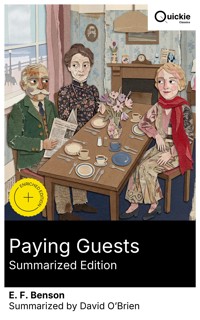
Paying Guests distills E. F. Benson's comedy of manners into a provincial boarding house where transient residents—retired officers, widows of slender means, aspirant bohemians—wage delicate campaigns of precedence across dining room and promenade. Minor slights swell into crises; thrift masquerades as taste; gossip circulates as currency. In quick, exact prose and deft free indirect style, Benson choreographs parlour set pieces with needlepoint dialogue. Written in the uneasy calm of interwar Britain, the novel charts loosening class boundaries and the rise of commercial leisure, conversing with Austen's social microcosms while keeping the brittle sparkle of late‑1920s comedy. Benson, educated at Cambridge and long resident in the Sussex town that inspired his Mapp and Lucia novels, brought a lifetime's observation of small communities and clubland sociability to this book. The son of an Archbishop and a prolific writer across genres—from ghost tales to satire—he understood how public performance masks private precarity; that insight animates the boarding‑house theatrics of Paying Guests. Readers of social comedy will find both laughter and diagnosis here: an ideal entry to Benson beyond Mapp and Lucia, and a keen portrait of interwar everyday ambition. Quickie Classics summarizes timeless works with precision, preserving the author's voice and keeping the prose clear, fast, and readable—distilled, never diluted. Enriched Edition extras: Introduction · Synopsis · Historical Context · Brief Analysis · 4 Reflection Q&As · Editorial Footnotes.
Das E-Book können Sie in Legimi-Apps oder einer beliebigen App lesen, die das folgende Format unterstützen:
Veröffentlichungsjahr: 2026
Ähnliche



















Paying Guests (Summarized Edition)
Table of Contents
Introduction
In Paying Guests, E. F. Benson turns the fragile pact between respectability and necessity into high comedy, revealing how a houseful of politely self-dramatizing people donate their manners to one another as currency while quietly calculating rent, status, affection, and advantage beneath the lace of afternoon tea, and how the pressures of living together—so close that privacy becomes a rumor and selfhood a performance—transform trivial gestures into decisive moves in a social game whose stakes are comfort, belonging, and the saving of face, even as kindness and vanity jostle for room on the same crowded mantelpiece of daily life.
First appearing in the late 1920s, during Britain’s interwar years, Paying Guests belongs to Benson’s distinguished line of comic novels of manners, and it unfolds within the circumscribed world of an English boarding house where residents live semi-public lives under one roof. Benson, an English novelist best known for the Mapp and Lucia sequence, brings the same keen eye for ritual, rivalry, and small-town theatrics to this standalone setting. The book is not a farce of broad caricature but a cultivated social comedy, observant and urbane, attentive to the nuances of class performance and the delicate economies that tether independence to community.
The premise is disarmingly simple: a respectable proprietor keeps a boarding establishment marketed to the genteel, and a circle of long- and short-term lodgers share meals, public rooms, and the wary intimacies of proximity; in this concentrated arena, minor mishaps, chance remarks, and shifting alliances acquire the scale of grand events. Benson guides the reader through breakfasts, promenades, visits, and evening entertainments with a voice that is poised, witty, and lightly ironic, favoring precise observation over slapstick. The comedy arises from character and situation rather than plot contortions, yielding a reading experience that is brisk, companionable, and quietly shrewd.
At its centre lie questions of class and cash: what it costs, materially and psychologically, to appear respectable when one depends on others for income or approval. The title signals this tension, for the characters are both guests and customers, both at ease and on probation. Benson traces the etiquette of small obligations—favours, seats, confidences—and how these weave a net of expectation that can feel like belonging or constraint. The book also studies domestic economies of care and management, the labor that makes comfort seem effortless, and the porous boundary between kindness and control in communities built on mutual surveillance.
Benson’s style combines clarity with slyness, moving between bright surface detail and understated implication so that a lifted eyebrow or rearranged cushion can carry narrative weight. His narrator attends to rhythm and timing, arranging conversational duets and ensemble scenes with the precision of chamber music, then letting a single misplaced emphasis ripple through the group. Although the tone is light, the prose is exact and paced, with sentences that balance decorum against a mischievous urge to puncture pretension. The result is comedy that flatters the reader’s intelligence, inviting us to notice what characters cannot admit and to relish tact as action.
Contemporary readers will recognize these dynamics in today’s economies of space and attention: shared housing arrangements, precarious budgets, curated self-presentation, and the uneasy negotiations of common areas, time, and noise. In Benson’s boarding house one sees prototypes of modern social media etiquette, office politics, and neighborhood associations, where civility masks bargaining and visibility is a resource. The novel also speaks to ongoing debates about class performance and the price of belonging, asking how communities welcome difference while policing norms. Its humor softens but does not dilute these questions, offering an artful mirror for the choreography of manners we still perform.
To read Paying Guests now is to encounter a meticulously scaled social laboratory, humane as well as incisive, where foibles are exposed without cruelty and resilience is celebrated without sentimentality. It demonstrates why Benson endures: he preserves the textures of ordinary life while making them scintillate, and he understands that dignity is often negotiated, not granted. The book offers a graceful entry point to his broader oeuvre and a reminder that comedy can be both consoling and diagnostic. In its measured hilarity and ethical tact, it rewards attention, leaving the reader amused, a little wiser, and newly alert to the theatre of daily coexistence.
Synopsis
Paying Guests, a comic novel by E. F. Benson, turns its amused scrutiny on a genteel English boarding house whose livelihood depends on the steady custom of transient residents. Within this contained world, the economy of rooms, meals, and small privileges shapes every encounter. Benson establishes the routines of breakfast discussions, town promenades, and drawing-room entertainments that give the house its pulse. The proprietor manages comfort and appearance while guarding solvency, conscious that one misstep can empty the ledger. The stage is set for a social comedy in which status is measured by table placement, syllables of address, and access to the best views.
An ensemble of long-staying residents supplies the comedy’s texture: retired officers with exact habits, widows clinging to dignity, unmarried ladies fierce about precedence, and modest professionals eager to be noticed. Their days are organized around fixed hours and sanctioned topics, and any disruption to these rails suggests moral peril. Benson delineates a delicate pecking order in the dining room and salon, where a seat by the fire or the window can validate months of careful maneuvering. Gossip is the house’s true currency, passed with smiles that conceal calculations, and the proprietor’s tact must continually reconcile temperaments that are both fragile and immovable.
Into this stability comes a newcomer whose manner and resources subtly unsettle the arrangement that has seemed permanent. The guest’s readiness to pay for extras, to demand adjustments, and to introduce new amusements draws attention and envy in equal measure. Kindnesses are interpreted as tactics, reserve as superiority, and the ordinary arrangements of the house begin to look negotiable. The proprietor, mindful that a vacancy is more dangerous than offense, courts the fresh income without losing the loyalty of regulars. Benson uses this arrival to expose how quickly settled hierarchies depend on perception, and how swiftly perception can be turned.
The boarding house grows busier and more performative. Musical evenings are revived, excursions proposed, and charitable committees invented to anchor new coalitions. Each initiative carries rules about precedence and participation, and each offers a chance to snub or include. Minor mishaps—lost invitations, misconstrued compliments, awkward pairings—take on the proportions of crises because they hint at shifting rank. Benson tracks these turns with a light touch, balancing affectionate observation with exact satire. The rhythms of the town outside—the promenade, the seasonal visitors, the weather—mirror the internal barometer, and small changes in the air leave the residents reinterpreting their own stories.
At the centre of the season, a misunderstanding threatens to unsettle the house more severely than anyone intended. An indiscretion that might be innocent in another setting here acquires consequences, as reputations appear negotiable and financial arrangements reveal their edges. Some guests try to monopolize influence, while others withdraw, hoping silence will preserve standing. The newcomer’s presence continues to complicate loyalties, testing whether generosity is kindness or control. The proprietor must calculate not only what is right for the establishment, but what is survivable, balancing an instinct for fairness against the uncompromising arithmetic of vacancies, rates, and whispered reputational harm.
The consequences converge during a public occasion that obliges everyone to act in full view, where performance and sincerity can no longer be kept apart. Small boastings and careful myths run into facts, and alliances formed in private are tested by crowd and rumor. Benson lets tension rise without cruelty, keeping the comic surface intact while suggesting the costs behind it. In the aftermath, some ties fray and others strengthen, and the house must decide what kind of community it will be. The results alter the internal map of precedence, yet leave room for routine to reclaim its place.
In presenting the intricacies of a boarding house, Paying Guests distils Benson’s enduring interest in social display, financial insecurity, and the inventive ways people defend fragile dignity. The novel’s comedy arises from close observation rather than caricature, capturing how rituals can both comfort and imprison. It preserves a world of narrow margins and expansive pretensions without condescension, showing why companionship matters even when it irritates. Without leaning on melodrama, it offers a satisfying arc of disturbance and repair. Its portrait of communal living—dependent on tact, performance, and mutual need—retains resonance wherever people share space and status remains something to be negotiated.
Historical Context
Published in 1929, E. F. Benson’s Paying Guests belongs to Britain’s interwar comic fiction, set largely in an English seaside boarding house whose routines and hierarchies supply its humor. Benson, an acute observer of small-town manners, dramatizes the rituals of meals, promenades, and parlors that characterized such establishments. The boarding house was a recognizable institution in resorts around the south and east coasts, drawing retirees, widows, clerks, and seasonal visitors. Against this milieu, the novel turns to status anxiety, social surveillance, and the perpetual negotiation of precedence, offering a tightly focused portrait of everyday decorum in the late 1920s.
The social economy after the First World War frames the novel’s premise. Demobilization, a brief postwar boom, and the sharp slump of 1921 left many on fixed or modest incomes. The General Strike of 1926 symbolized industrial unrest, while persistent unemployment in heavy industry contrasted with expanding service work and consumer spending. In this climate, “taking in paying guests” became a respectable strategy for genteel householders to maintain standards. Rent controls from the 1915 Rent Act and slow postwar housebuilding under the 1919 Addison Act accentuated housing pressures. Benson’s scene of lodgers, landladies, and negotiated comforts flows directly from these economic adjustments.
Changes in domestic service further shaped the boarding-house world. In 1911, domestic service was Britain’s largest female occupation; by the late 1920s and into the 1930s, alternatives in shops, offices, and factories, plus better wages elsewhere, made servants harder to retain. Contemporary discussions of the “servant problem” noted shorter hours, rising expectations, and the spread of labor-saving devices. Many middle-class homes cut staff or reorganized work, while guesthouses ran with minimal servants and strict routines. Paying Guests mines comedy from those constraints—the timetables, dining-room choreography, and disputes over chores—mirroring how interwar households balanced pride, economy, and the practical limits of reduced help.




