


Erhalten Sie Zugang zu diesem und mehr als 300000 Büchern ab EUR 5,99 monatlich.
- Herausgeber: Allen & Unwin
- Kategorie: Abenteuer, Thriller, Horror
- Serie: Fiskardo's War
- Sprache: Englisch
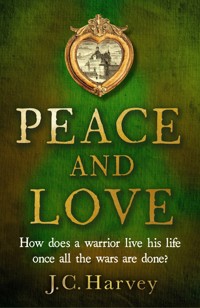
How is a warrior to live his life, once all the wars are done? Uppsala Province, Sweden, 1720: Magnus von Lindeborg, soldier, commander, champion; grandson of Jack Fiskardo's youthful high-born ensign, Karl-Christian von Lindeborg; a man of wealth, nobility, renown - - and a battered spirit, and a lonely heart. A man who finds himself without a place in the country of his birth, and without purpose to his life; a man who sees himself fading into nothingness much like the ghostly painted warriors upon his castle's walls. But Fate has other ideas . . . A wonderful tale of love and the power of human redemption, and a compelling treat for fans of The Silver Wolf and The Dead Men.
Sie lesen das E-Book in den Legimi-Apps auf:
Seitenzahl: 184
Veröffentlichungsjahr: 2023
Das E-Book (TTS) können Sie hören im Abo „Legimi Premium” in Legimi-Apps auf:
Ähnliche
















PEACE AND LOVE
J. C. Harvey is the fiction pen-name for Jacky Colliss Harvey. After studying English at Cambridge, and History of Art at the Courtauld Institute of Art, Jacky worked in museum publishing for twenty years, first at the National Portrait Gallery and then at the Royal Collection Trust, where she set up the Trust’s first commercial publishing programme. The extraordinary history of the Thirty Years War (1618–48) and of seventeenth-century Europe has been an obsession of hers for as long as she can remember, and was the inspiration behind the story of Jack Fiskardo’s adventures, which began with The Silver Wolf, continued with The Dead Men and will conclude in 2025 with The Wanton Road.
@JCollissHarvey
PEACE AND LOVE
J.C. Harvey
First published in Great Britain in 2023 by Allen & Unwin, an imprint of Atlantic Books Ltd.
Copyright © Jacky Colliss Harvey, 2023
The moral right of Jacky Colliss Harvey to be identified as the author of this work has been asserted by her in accordance with the Copyright, Designs and Patents Act of 1988.
All rights reserved. No part of this publication may be reproduced, stored in a retrieval system, or transmitted in any form or by any means, electronic, mechanical, photocopying, recording, or otherwise, without the prior permission of both the copyright owner and the above publisher of this book.
This novel is entirely a work of fiction. The names, characters and incidents portrayed in it are the work of the author’s imagination. Any resemblance to actual persons, living or dead, events or localities, is entirely coincidental.
10 9 8 7 6 5 4 3 2 1
A CIP catalogue record for this book is available from the British Library.
E-book ISBN: 978 1 80546 221 7
Printed in Great Britain
Allen & Unwin
An imprint of Atlantic Books Ltd
Ormond House
26–27 Boswell Street
London
WC1N 3JZ
www.atlantic-books.co.uk
This one is for Alice.
Author’s Note
Some years ago I found myself on holiday in Sweden. I had very little ownership of the arrangements for this; I was simply a part of them, and went along with them in the same spirit with which one might approach a buffet table that someone else has laid out and done all the hard work for, with an attitude of ‘I might like this, or I might not.’
Sweden is shamingly beautiful – clean and green and sharp and chill. And big. Its roads are long and empty; its forests run to the horizon. You understand very swiftly why there should be so many giants in Norse folklore. I remember in particular a lake so huge, I swear I could see the curve of the earth at the line of its offing. And its castles, correspondingly, are immense. After days gorging myself on a landscape that demanded physical effort to take it in, I found myself in Stockholm, where there was a visit to a museum. Its exhibits included a tricorn hat with a large bullet hole through the front of its brim, and a silvery masquerade costume bearing thick driblets of blood from the assassination of its royal wearer. Beside it, in a handsomely mounted glass vessel similar to a medieval reliquary, were the pathetic, maggot-white remains of the stomach of an assassin who had lost his nerve, and taken poison. It gave powerful inflection to the idea that some of Sweden’s many wars were fought out at home.
As is so often the way in a new place and after much travel, I couldn’t sleep. I had this line of words running through my head: Once upon another time, and in another place than this, there was a man… so I got up, and started writing. Insomnia: the writer’s friend. One pen ran out, then another; the sky began to lighten; I had used up my notepad, and was scribbling on paper napkins I found in a drawer. I heard my partner wake, and move around in the bedroom; outside, church bells began to ring. I had written right through the night and had 30,000 words in front of me.
This was the kind of concatenation of time and place and inspiration and wordage that writers beg and pray for, when they start off, and naively trust will be there for them when they sit down to write again more often than not. Not so. Not ever so. It took a long, long time learning that before I had any idea what I was going to do with my 30,000 words, or where they had come from, or what they were urging me toward. I kept turning the tale and the other tales I was working on round and around in my head, and then in that utterly maddening way that stories have, everything lined up and it all fell into place, like a writerly Rubik’s cube.
So, Peace and Love, which you have here, is a pendant to the story of Jack Fiskardo and The Dead Men, even if first scribbled down so long ago. It picks up, like a thread that has run all this time behind the tapestry, the story of Karl-Christian von Lindeborg, Jack Fiskardo’s high-born youthful Swedish ensign, and that of Karl-Christian’s grandson, Magnus von Lindeborg, a man indeed born in another time and in another place, and it ponders a question that must be there somewhere for every soldier: how is a warrior to live his life, once all the wars are done?
For Jack Fiskardo’s own answer to this, there will be the upcoming The Wanton Road. Although there are one or two small clues in this, as well….
I do hope you enjoy this. And I look forward very much to seeing you then.
PEACE AND LOVEUppsala Province, Sweden, 1720
Videre est facere: ‘To see is to do.’
Von Lindeborg family motto
Once upon another time, and in another land than this, there lived a nobleman, a count, who had spent all the most useful years of his life making war for his king. He had driven the pirates from his sovereign’s cold northern oceans, and beaten back those who looked with envious eyes upon her southern ports and their precious trade in timber, amber and furs. He had led an army in the dead of night across a frozen sea of ice, when no man believed it could be done, to lay waste a beautiful city that had dared defy him. He had troubled the dreams of a tsar, and thwarted the ambitions of an emperor, and had transformed maps and human lives with as much or as little thought as another man might give to the arrangement of the paintings on his walls. He had won for himself if not great riches (for few honest men make fortunes; and besides, he was plenty rich enough already), then great renown, and what price he paid for his valour was in the common human terms to be exacted from any man who follows such a course: a stiffness to his manner, a degree of rigidity in his thinking, and a hip that sang when the wind changed. In the cold and bitter weather, when the old hurts his body had sustained while it was young all chimed within him, they made him short-tempered with everyone.
In his youth, he had seen marvels. He had looked upon the stars at the top of the world from the deck of a towering galleon, stars so close and bright they filled the eyes with tears. He had seen the bronze coils of a sea-serpent disappear beneath his ship and felt the huge rise in the water as the creature dived below. He had watched a beaten army drag itself through the snow, leaving a trail of blood like a single wounded creature, and he held the knowledge of these things in his speech, which was brusque, and in his manner, which was that of a man more used to giving orders than to making conversation. Or, as his sister put it, ‘Most of the time he doesn’t bother looking at one at all, and when he does, it’s as uncomfortable as if one were a target.’ As the years passed, he found the company of men (and of women) who had not seen the same things as he less and less worth tolerating, although his soldiers loved him all the more for it, and aped his formidable glare until they had made it quite the fashion.
Then the old king died, and the Count returned to his country for the funeral ceremonies, and found that in his long absence it too had altered. He heard his royal master, whom he remembered as a golden monarch, full of wit and learning, openly spoken of as a doddering old man whose senses had all wandered off elsewhere, and who had lived far longer without them than he ought. He found his country had civilized itself in his absence, and although now secure and comfortable in itself, it seemed ill-at-ease with him, as with some grim reminder of a time when such had not been so. There was a history in the von Lindeborg family of effortless male beauty, but as these things so often like to do, this had skipped a generation with the Count, and while the fashion of the time was for the lean and the languid, topped by a little white-powdered wig, like a spoonful of whipped cream on top of the head, the Count was broad-shouldered and square of face, and more given to striding about than to the nonchalant stroll. The wide-skirted coats then so in favour at court the Count found ridiculous, with their pleats stiffened with horsehair, so that they must be spread out behind a man like the tail of a peacock when he went to sit down; their sparkling buttons and embroidered sprays of silken blooms unsettled him; and he would be damned if he would start his day with a valet undoing curl-papers from the hair over his ears. As he strode about the palace, he felt the courtiers’ eyes sneaking after him, and the new king seemed to have difficulty knowing what to say to him, and to prefer playing with his yapping pug-dogs and tinkling on spinets to the discussion of old wars and the planning of new conquests, which was how the Count felt a ruler ought to behave. Instead of campaigns and captives, this new king discussed the redecoration of the royal apartments, and the organisation of the winter masques and entertainments to take place upon the great snow-fields beyond the palace, in which the Count felt that the arts of war were being mocked, and the mighty cannon, mouthed one with a she-wolf and one with a lion, which he had pulled behind him across the ice, out of the wrecked and burning city, were being made toys of, that blew coloured smoke and paper flowers out their hot bronze mouths. And he was both unwise and impolite enough to let these feelings show; at which the new king was greatly insulted, for he too had aped the fashion for that soldierly glare and had greatly looked forward to having the original of it stand behind his throne as it had stood behind his father’s.
Then the Count began to think that the sneaking glances and the too-long silences when he entered a room betokened whisperings behind his back, and that his enemies (of which he certainly had a few) were moving against him, and that his authority and his past exploits alike were being traduced; and just as he had been wary of trusting himself to the delicate gilded chairs that now littered the exquisitely repainted state rooms, for fear they might crack apart beneath him, so he was unwilling to sleep in the festooned and curtained beds, with their corner coronets of ostrich feather, for the thought that some assassin’s knife might come stealing between the drapes, and one swift blow make the feathers tremble. So with great bitterness in his heart he left the court, and went home to his grey stone castle, not one whit less forbidding than the blocks of granite it had been raised upon, or the blank seas it faced; and he brooded in it on the falsity of man and the tinsel of fame until all his life was ashes to him, burned up in his anger; and his servants, had they not remembered him from the days when he was a younger and a happier and an easier man, would all have left him; and as it was they took to talking amongst themselves in whispers, and moving about him in silence. And his friends (for he had friends as well as enemies) grew exasperated at his rebuffs to their friendship, and shook their heads over him, and in the end left him to his anger and his castle, which in the winter months was so hellish cold that in the corridors the breath smoked about your face, and where you needed the strength of a giant even to move the chairs.
Left thus alone, he found himself drawn once again to the study of his youth, from before the time when the roll of the drums and the clatter of cavalry had claimed him. For when still little more than a boy, his great passion had been for astronomy: the course of the stars and planets, the eternal rhythms of the universe. For nights on end when he was young, from the highest tower on the castle walls, he had watched the stars and the moon and the night sky turn above him, turn as they had always done, untouched and unconcerned. So now he locked himself within his observatory within the tower, with its spiral stair and the narrow walk upon the roof, while his troubled servants left food by its heavy closed door, there to grow cold and be wasted, as he pored once more over his charts of the night skies, correcting his youthful observations with his later knowledge of the stars he had seen in those strange cold northern wastelands where he had wintered his armies and spent half his life: fiery comets and veils of fire hanging over land and sea, Venus with the green light of her moons, Jupiter’s mighty sunrise at midnight, and the red eye of Mars; and what comfort he had he took from the fact that the beginning and the end of his life would be the same, an orbit, with no more to show for it than the writings and rulings on his charts, for he was not a man who had neglected learning, and had even fought his wars as a science, and gained many of his victories as a result. Indeed, he might have made quite as able a scholar as a military man, only his country would have been the poorer as a result.
However. The stars do not care to be mocked. It is natural for human life to be both untidy and unexpected in its course. It does not do to claim for it the wholeness and perfection of the heavens.
In his youth, the Count had had a teacher whom he reverenced above all others, a learned doctor from the southern city of P-, hundreds of miles beyond the forests and the lakes. This great academic had come north at the request of the old king, to bring some learning into his kingdom, where it was sorely lacking. The doctor had stayed in this northern country for many years, teaching and lecturing at the new university the king had built, shaping its ways and patterns of thought into something the doctor hoped would be cleaner and sharper than the old academic befuddlements he had left behind him, and he had in part succeeded, as far as was possible, given the unchanging nature of man, no matter what country you may be in. The Count remembered him as a fine old gentleman, with a countenance full of kindness for his fellow-creatures, wearing a dark robe edged with fur. But the doctor’s years in the north had not been kind to him. His son had been incapable of grasping learning, even under his father’s patient tutelage, and had fallen into the bad habit, during the long winter nights, of drinking large and talking bigger, and had been found one snowy morning lying in the street, as bedraggled as a frozen sparrow, with a small neat hole in his forehead, for the nights were long and tempers quick to flare, and the country, as has been said, still most uncivilized. This, however, was not before he had wed a pale white northern lady, very thin and fine, and got her with child. When the child was born the doctor, with his face for once pressed blank by grief of all its kindly wrinkles, had taken the infant, and watched the mother die, and returned with it southward, as his grandchild, to his own people, for sorrow ever drives us home; and the Count, still a young man but already forgetting his books for the tug on the leash in his hands of the hounds of war, had never seen him again.
Now. As has been said, the Count had a sister, a good-hearted woman, who had a castle of her own but who much preferred her tall and splendid house in the city, where she lived with her husband and a tumbling pack of children, and who found life, for the most part, a jolly business; and like all those who are content, thought all that was needed for everyone else to be happy as she was for them to follow the same habits of life and of mind as she did herself. And she was troubled by the thought of her brother, brooding alone and embittered and forgotten – and besides, it did not look good for the family – and took it upon herself to break his loneliness from time to time with visits, though she dreaded the journey almost as much as the draughts and discomfort when she arrived, and thought the castle much in need of new carpets and curtains and a few fresh coats of paint. She would arrive in a coach and four, with her servants and baggage in a wagon-train behind her, cluttering the courtyard (much welcomed by the Count’s own household, who enjoyed the noise and gossip, and the way their own routine was turned upside down), and would insist on dragging her brother down from his tower, and saying the things to him that no-one else would. The sister, whose name was Margrit, would sit him down beside the great fire she always insisted should be built in the hall where she had shivered as a child, and berate him about the state of the roads and the dangers of her journey, then catalogue the health of his nephews and nieces, and make him feel guilty that he scarcely remembered their names, let alone their birthdays, and finally request his opinion on the doings of a pack of people he had never heard of, and leave him thoroughly vexed and out of sorts for days. He would settle himself in his chair by the fire, and restrict himself to the odd vague nod or frown, as he felt was required, for the weather had been stormy, and his hip ached, and his sister’s words went round and round his head like horseflies round a horse. ‘Now, Magnus, tell me,’ his sister said, coming to the end of her news, ‘do you remember good Dr Excelsior?’
The Count sat up in his chair, kneading his hip. How strange, when the same name had been running in his own thoughts, to hear it spoken by another. ‘I was thinking of him only yesterday. Is there news of him, after so long?’
‘There is, but only sadly what one might expect. It seems the poor old man has died in P-, you know, and left his fortune to his grandchild, but the creature has disappeared. It had been living all this time in a convent (some place no-one has ever heard of), and now it cannot be found. And there has been the greatest search for it, all over, for the talk is that it will be abducted for its fortune, and is either in hiding, or has been seized and married off already.’
‘Very likely,’ the Count said, frowning, in the manner of one who would close the subject, for the news of the old doctor’s death had saddened him, as one more link gone with a happier past, though he supposed that when he had thought of it, he had long presumed the old man dead; and perhaps his mood was darkened just a little further because he did not approve of this business of abducting children, and forcing them to wed, and what was the point of a man fighting for his country, and it civilizing itself, if this sort of thing still went on in it?
‘Oh, but to think of it’, his sister said, with a generous shudder, unready to give up the subject – which had been the talk of all she knew for weeks – quite yet. ‘Do you know, I myself despaired of my safety a dozen times on my journey here. Such people we passed on the roads, and so far from lights, or anywhere of any consequence, and the only estate before yours to be Drago’s – I declare, things are as bad out here as they ever were.’
‘Lord Drago is too old to frighten anyone,’ the Count said, with a laugh, for while in his childhood, accounts of the confrontations between his family and that of Lord Drago had given lurid colouring to many a nurse’s tale, he had found as he grew older that most of his nurses’ tales had been simply that, a means of keeping children in their beds, and that his feelings for Lord Drago, senescent and wizened head of a family that seemed to have all but forgotten his existence, were almost comradely. The times had changed, and left both men marooned.




