



0,49 €
Mehr erfahren.
- Herausgeber: DigiCat
- Kategorie: Sachliteratur, Reportagen, Biografien
- Sprache: Englisch
In "Pinkerton National Detective Agency: True Crime Stories & P.I. Cases," Allan Pinkerton weaves a gripping narrative that chronicles the fascinating and often perilous exploits of his renowned detective agency. Through meticulous case studies presented in a vivid, episodic style, Pinkerton immerses readers in the world of 19th-century crime and detective work, employing keen observations that reflect both the gritty realities of his time and the burgeoning field of criminal investigation. The book stands as a testament to the agency's innovation in forensic science and investigative techniques, contributing significantly to the literary context of true crime and detective fiction. Allan Pinkerton, a Scottish immigrant and visionary founder of the Pinkerton National Detective Agency, drew from his own rich background in law enforcement and intelligence work. His experiences during the Civil War, where he served as a spy for the Union, informed his understanding of crime and security, ultimately shaping his approach to private investigation. Pinkerton's dedication to justice and his pioneering organizational methods laid foundational elements for modern private detective work, making this book more than just a collection of stories—it is a historical document that emerged from a life devoted to solving mysteries. For readers interested in crime, history, and the evolution of detective work, "Pinkerton National Detective Agency: True Crime Stories & P.I. Cases" is an essential read. Pinkerton's firsthand accounts not only entertain but also educate, offering a unique glimpse into the challenges of law enforcement in a rapidly changing society. Engaging and informative, this book will appeal to true crime aficionados and history buffs alike. In this enriched edition, we have carefully created added value for your reading experience: - A comprehensive Introduction outlines these selected works' unifying features, themes, or stylistic evolutions. - The Author Biography highlights personal milestones and literary influences that shape the entire body of writing. - A Historical Context section situates the works in their broader era—social currents, cultural trends, and key events that underpin their creation. - A concise Synopsis (Selection) offers an accessible overview of the included texts, helping readers navigate plotlines and main ideas without revealing critical twists. - A unified Analysis examines recurring motifs and stylistic hallmarks across the collection, tying the stories together while spotlighting the different work's strengths. - Reflection questions inspire deeper contemplation of the author's overarching message, inviting readers to draw connections among different texts and relate them to modern contexts. - Lastly, our hand‐picked Memorable Quotes distill pivotal lines and turning points, serving as touchstones for the collection's central themes.
Das E-Book können Sie in Legimi-Apps oder einer beliebigen App lesen, die das folgende Format unterstützen:
Veröffentlichungsjahr: 2023
Ähnliche

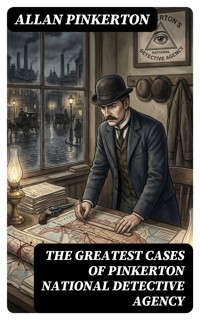











Pinkerton National Detective Agency: True Crime Stories & P.I. Cases
Table of Contents
Introduction
This single-author collection brings together nine book-length case narratives written by Allan Pinkerton, founder of the Pinkerton National Detective Agency. Drawn from investigations conducted under his direction, these works present extended accounts of detection as it was practiced in the United States during the late nineteenth century. Gathered here in one volume, they allow readers to follow recurring methods, ethical commitments, and practical constraints across varied crimes and settings. From The Expressman and the Detective to The Burglar’s Fate and the Detectives, the selection illustrates how Pinkerton fashioned a public record of professional practice, and how those records shaped ideas about private investigation in an era before modern forensic routines.
The texts are presented as narrative nonfiction: sustained true-crime case histories rather than invented puzzles or literary embellishments. They read like long-form reportage, organized with the pacing and character focus of nineteenth-century storytelling. While published separately, each volume shares an investigative structure, foregrounding surveillance, interviews, and the careful accumulation of corroborated fact. They are not plays, poems, or epistolary compilations, but prose accounts in which investigative steps are described, scenes are reconstructed from testimony, and strategic decisions are explained for a general audience. Read together, they form a coherent archive of private-detective procedure from a formative period in American print culture.
Across the books, several unifying themes emerge. Pinkerton emphasizes discipline, patience, and the systematic testing of claims against observable evidence. The narratives show detectives moving between cities and small towns, working with common carriers and local officials, and adapting to changing circumstances with discretion. They highlight the practical use of disguise, decoy operations, and long hours of quiet observation. Ethical reflection is integral: the case histories continually return to the social harm of crime and the public value of persistent, lawful inquiry. These themes link investigations that otherwise differ widely in setting and offense, forming a composite portrait of professional detection in action.
Stylistically, the volumes share a firm, instructive authorial voice. Exposition proceeds step by step, with clear accounts of what was known, what was inferred, and what remained uncertain at each stage. Dialogue is summarized to preserve clarity, while pivotal scenes are rendered with enough detail to show the craft of eliciting information without grand theatrics. The tone resists sensationalism, relying instead on procedural texture—routes traveled, schedules kept, messages sent and received—to build momentum. Narrative suspense comes from the measured disclosure of facts rather than surprise twists, reinforcing a view of detection as the patient conversion of conjecture into substantiated conclusion.
The Expressman and the Detective begins with irregularities in the transport of valuables by an express company, raising questions about whether losses originate from within or from opportunistic theft along the route. The investigation’s premise places detectives at the intersection of corporate trust, chain-of-custody protocols, and the vulnerabilities of overland transit. Pinkerton’s account showcases how controlled tests, discreet surveillance, and coordination across multiple depots can narrow possibilities without prematurely accusing any one party. The book models a tempered approach to insider risk and demonstrates the agency’s capacity to work within a business operation without interrupting its essential service.
The Somnambulist and the Detective opens on a case complicated by claims of sleepwalking, which, if true, might alter how witness statements and timelines are interpreted. The narrative premise highlights Pinkerton’s attentiveness to assertions that blur responsibility, including those couched in medical or quasi-medical terms. Rather than dismiss such claims outright, the investigation examines patterns, corroborates routines, and observes behaviors over time to separate verifiable fact from convenient explanation. The result is a study in how detectives assess extraordinary defenses while maintaining a focus on material links—motive, means, and opportunity—that can be demonstrated independently.
Two volumes address the entanglement of crime with superstition and organized deception. The Murderer and the Fortune Teller begins with a violent act shadowed by the influence of fortune-telling, where prophecy and rumor complicate the gathering of reliable testimony. The Spiritualists and the Detectives follows allegations of fraudulent practice that exploit grief and credulity, requiring agents to attend séances, map networks, and test purported phenomena. In both books, Pinkerton stresses the same investigative baseline: beliefs are noted, claims are tested, and only what survives evidentiary scrutiny guides the next step. The emphasis remains on patient verification in social environments prone to misdirection.
Mississippi Outlaws and the Detectives moves into the geography of pursuit, as agents track fugitives across county lines and through dispersed communities. The premise foregrounds the logistical demands of coordinating information where distance, local loyalties, and limited communication can shield offenders. Pinkerton presents the mechanics of travel, the scheduling of meetings, and the careful handling of informants as critical to success. The book becomes a primer on multi-jurisdictional work before standardized national databases, showing how diligence, record-keeping, and respectful collaboration with local authorities produce cumulative advantages in difficult terrain.
Don Pedro and the Detectives centers on a case involving a figure known as Don Pedro, leading agents into social settings that demand tact as well as persistence. The premise underscores an important dimension of the agency’s work: investigations sometimes unfold in public, among dignified company or unfamiliar customs, where discretion and decorum are as necessary as vigilance. Pinkerton outlines how agents balance visibility and privacy, keep detailed notes without causing alarm, and adapt standard methods to contexts in which a single misstep could jeopardize both the inquiry and relationships essential to its progress.
Poisoner and the Detectives begins with suspicions that a death may have resulted from deliberate poisoning, a crime that, by its nature, hides within ordinary routines. The narrative highlights the evidentiary burden of proving intent when the mechanism can be mistaken for illness. Pinkerton details how investigators reconstruct timetables, examine access to substances, and pursue patterns that convert suspicion into structured proof. Without relying on laboratory breakthroughs, the account shows how consistent testimony, controlled observation, and careful elimination of alternatives can establish a narrative of causation that meets the standard of responsible inference.
Bucholz and the Detectives and The Burglar’s Fate and the Detectives present contrasting challenges: in the first, a case identified by the name Bucholz requires careful sorting of personal history, financial context, and opportunity; in the second, a burglary inquiry tests the agency’s methods for tracing stolen goods and dismantling networks of receivers. Pinkerton uses both to demonstrate range. Homicide-focused work demands patience with motive and character; property cases reward swift coordination and attention to movement and resale. Together, they show investigators adapting the same core disciplines—vigilant observation, accurate records, and discreet interviews—to different ends.
As a group, these books matter because they codify a practice at the moment it was defining itself for the public. They helped establish the private detective as a recognizable figure and provided procedural models later echoed by police memoirs and crime fiction. Beyond their narrative interest, they preserve details of travel, communication, commerce, and law that make them valuable historical documents. Read consecutively, they reveal a consistent ethic of inquiry and a clear rhetorical aim: to demonstrate that careful, accountable work can replace rumor with fact and restore order without spectacle. That continuity is the rationale for uniting them here.
Author Biography
Allan Pinkerton (1819–1884) was a Scottish-born American detective whose name became synonymous with private investigation in the United States. Rising to prominence in the mid-nineteenth century, he founded a national agency that blended vigilance, organization, and publicity into a new model of security work. Beyond his operational exploits, he shaped public understanding of detection through bestselling case narratives that circulated widely. Volumes such as The Expressman and the Detective and The Somnambulist and the Detective presented investigations as moral dramas resolved by patience and method. Pinkerton’s dual identity—as practical spymaster and popular author—made him a defining figure in the history of policing, intelligence, and true-crime literature.
Pinkerton’s formative years were rooted in craft and reform. Trained as a cooper in Scotland, he belonged to a milieu that prized self-reliance and public speech more than formal schooling. He associated with Chartism, a working-class movement advocating political representation, experiences that sharpened his views on organization and civic duty. Emigrating to the United States in the early 1840s, he settled near Chicago and resumed his trade. The practical problem-solving of artisanal work, coupled with exposure to democratic activism, shaped his later investigative style: careful observation, reliance on networks, and an insistence that discipline and documentation could elevate ordinary vigilance into a principled profession.
In Illinois, Pinkerton’s reputation began with civic assignments and cooperation with local law enforcement against counterfeiters and bandits. By 1850 he established the Pinkerton National Detective Agency in Chicago, pioneering a private service for railroads, express companies, and businesses. The agency’s open eye emblem and the motto “We Never Sleep” conveyed ceaseless attention and helped brand detective work as a professional craft. Pinkerton emphasized undercover operations, surveillance logs, and centralized files—tools that anticipated later standard practices. He also organized teams for long-distance pursuits, coordinating communication across jurisdictions when public agencies were fragmented, a scale of effort that made his firm a national byword for hired detection.
Pinkerton’s wartime service cemented his fame. In 1861 agents helped uncover a plot to attack President-elect Abraham Lincoln during his journey to Washington, and the firm provided protective arrangements around the trip. During the early Civil War, Pinkerton led intelligence work supporting Union forces, collecting reports on enemy dispositions and movements. His methods favored informant networks and cautious estimates, which generated both praise for thoroughness and criticism for perceived overstatement. Nonetheless, the war confirmed the value of organized intelligence and protective detail. The experience deepened his conviction that information—diligently gathered, cross-checked, and archived—was the essential currency of security.
After the war, Pinkerton published a stream of case narratives under his name, translating agency files into accessible stories. The Expressman and the Detective and The Somnambulist and the Detective exemplify his blend of reportage and melodrama, tracing how patient surveillance and discreet interviews assembled a prosecutable picture. The Spiritualists and the Detectives and The Murderer and the Fortune Teller address deception and credulity, framing detection as a remedy against fraud as well as violence. These books popularized techniques such as decoy operations and careful chain-of-evidence building, while casting detectives as citizen-guardians whose success derived from stamina, discretion, and the steady accumulation of fact.
Further volumes widened his canvas. Mississippi Outlaws and the Detectives and Don Pedro and the Detectives stretched the agency’s geography, following suspects across regions and borders. Poisoner and the Detectives, Bucholz and the Detectives, and The Burglar’s Fate and the Detectives showcased methodical case-building against crimes ranging from clandestine poisoning to property offenses. The series cultivated a large readership, shaping expectations about how investigations unfold and what constitutes credible proof. Though dramatized, the narratives consistently promoted record-keeping, teamwork, and undercover tradecraft. They also reinforced Pinkerton’s public image as both practitioner and chronicler of a distinctly American form of professional policing.
In later years Pinkerton continued to direct his agency, advocate procedural rigor, and expand client services for transportation and finance. He supported antislavery causes earlier in his career and employed women as detectives, most notably in the mid-1850s, reflecting a pragmatic view of talent in fieldwork. He died in 1884, leaving an organization that would grow in size and controversy, especially in labor disputes after his lifetime. His legacy endures in modern corporate security, private investigations, and the literature of true crime. The enduring circulation of his casebooks ensures that Pinkerton remains a reference point for both the practice and the mythology of detective work.
Historical Context
Allan Pinkerton’s case narratives emerged from the rapid social and economic transformations of mid-nineteenth-century America. A Scottish immigrant who founded the Pinkerton National Detective Agency in 1850 in Chicago, he built a business at the nexus of rail expansion, urban growth, and weak interjurisdictional policing. The period encompassed antebellum commerce, the U.S. Civil War, and the volatile postwar decades now labeled the Gilded Age. These books present “true crime” accounts inflected by the era’s faith in progress and order, while revealing anxieties about mobility, anonymity, and fraud—conditions intensified by railroads, the telegraph, and expanding markets that connected distant towns to national flows of cash and goods.
Pinkerton’s firm was hired by express companies, railroads, banks, and insurers that faced losses in a legal landscape with limited federal criminal authority. Before the rise of coordinated state and federal policing, interstate crimes often demanded private pursuit. The agency’s narratives reflect that quasi-public role. Written in the 1870s and 1880s, they present detectives as disciplined technicians who supplement local sheriffs and marshals. The collection thus documents a privatized system of risk management: corporations contracted mobile investigators who used surveillance, informants, and undercover work to protect commerce at a time when municipal forces were uneven and jurisdictional boundaries hindered swift enforcement.
Technological and bureaucratic innovations shape these stories. The telegraph enabled rapid alerts, coordinated stakeouts, and the tracing of money orders and wire transfers. Rail timetables governed suspect pursuit and escape routes. Safes and locks improved, prompting corresponding advances in burglary methods and safe-breaking. Pinkerton popularized centralized record-keeping—“rogues’ galleries,” dossiers, and alias indexes—that complemented photography’s growing evidentiary role. These casebooks echo a pre-fingerprint era when identification hinged on memory, description, and paperwork. They also show detectives negotiating a world of counterfeit currency, express shipments, and standardized parcels, where clerks, conductors, and telegraph operators became crucial partners in intelligence gathering.
Civil War experience profoundly shaped Pinkerton’s methods and public profile. As an intelligence organizer for the Union—often under the alias E. J. Allen—he advocated systematic surveillance, codebooks, and counterintelligence during 1861–1862. Though historians debate his assessments of Confederate strength, the war placed the agency within national security concerns and trained operatives in clandestine work. Postwar, those practices migrated to civilian cases: cover identities, staged meetings, and monitored correspondence. The war also widened transportation networks and weapon familiarity, increasing both opportunities for crime and the perceived need for professionalized, mobile investigators who could operate beyond local political constraints.
The Expressman and the Detective draws on the era’s shipping economy, when companies like Adams Express and American Express transported coin, banknotes, and securities by rail and wagon. Express agents, messengers, and clerks—trusted intermediaries in a cash-based system—were vulnerable to theft and collusion. Pinkerton’s narrative illustrates how routine handling of sealed packages, waybills, and depot transfers created both audit trails and opportunities for misdirection. Without revealing outcomes, the case underscores reliance on clandestine observation, decoy consignments, and ledger analysis, reflecting how corporate bookkeeping and the telegraph furnished detectives with both evidence and pretexts for monitoring suspected diversions.
The Somnambulist and the Detective sits at the intersection of popular fascination with altered states and emerging forensic psychology. Nineteenth-century periodicals frequently discussed somnambulism, mesmerism, and trance phenomena as medical curiosities. Courts wrestled with witness reliability, memory, and intent when defendants or witnesses invoked sleepwalking or hypnotic influence. Pinkerton’s treatment reflects this milieu: detectives test narratives against physical evidence, timekeeping, and corroborating testimony. The case showcases a broader cultural shift from supernatural explanations to empirical scrutiny, while revealing how juries and readers alike were drawn to scientific-sounding frames that could either excuse or implicate behavior under conditions of impaired consciousness.
The Murderer and the Fortune Teller reflects a period when fortune-telling, clairvoyance, and palmistry flourished in American cities. Municipal ordinances frequently targeted such practices as fraud, yet clients sought occult counsel for business, romance, and grief. Pinkerton presents fortune tellers as nodes in urban information networks, attracting diverse clientele and rumor. Detectives observed how these circles could be exploited for deception and cover. The narrative mirrors ongoing debates about credulity, the commodification of advice, and the policing of vice districts, where gambling, drinking, and pseudoscientific services overlapped with boardinghouses, saloons, and pawnshops that formed the everyday geography of nineteenth-century crime control.
The Spiritualists and the Detectives engages directly with the spiritualist movement that surged from the late 1840s, widely dated to the Fox sisters’ Rochester raps. Civil War bereavement amplified demand for mediums who promised messages from the dead. Skeptics—including some journalists and stage magicians—exposed fraud through controlled tests. Pinkerton’s account aligns with that skeptical tradition, using surveillance, informants, and physical inspection of séance spaces. The narrative reflects conflicts over religious freedom, scientific authority, and consumer protection. It also records the practical policing challenge of activities that skirted criminal codes yet harmed clients through deception, blackmail, or financial exploitation.
Mississippi Outlaws and the Detectives is rooted in the post–Civil War Mississippi Valley, a region transformed by steamboats, rail spurs, and disrupted legal authority. Reconstruction (approximately 1865–1877) saw uneven policing, racial violence, and a proliferation of banditry along river and rail corridors. Pinkerton’s agency pursued train robbers and highwaymen who exploited county lines and state borders. While details vary, such cases highlight federalism’s constraints and the need to coordinate sheriffs, railroad guards, and private agents. The narrative aligns with contemporary efforts to secure freight and passengers, anticipating later reforms as states professionalized constabularies and legislatures updated extradition procedures.
Don Pedro and the Detectives signals the agency’s transnational posture during a period of expanding hemispheric ties. The 1870s saw increased travel between the United States and Latin America, with diplomats, investors, and tourists crossing regularly by steamship and rail. High-profile visits—such as Brazil’s Emperor Dom Pedro II attending the 1876 Centennial Exposition—illustrated the era’s global pageantry. Pinkerton’s narrative draws on that world of multilingual correspondence, consular contacts, and cross-border identity play. It reflects practical obstacles to international cooperation before formalized extradition treaties became widespread, and it demonstrates how private agencies brokered security in a marketplace for protection and intelligence.
Poisoner and the Detectives mirrors advances in forensic toxicology that had matured by the mid-nineteenth century. The Marsh (1836) and Reinsch (1841) tests enabled chemists to detect arsenic with new reliability, and medical jurisprudence texts circulated among prosecutors and defense attorneys. Pinkerton’s narrative relies on laboratory corroboration, chain-of-custody concerns, and the social contexts—domestic spaces, insurance policies, inheritance disputes—where poisoning accusations often arose. The case records the interplay between expert testimony and circumstantial evidence, illustrating how jurors increasingly weighed chemical assays alongside motive and opportunity in an age when “inheritance powder” occupied both popular imagination and courtrooms.
Bucholz and the Detectives unfolds amid mass immigration and the social tensions it produced. German, Irish, Scandinavian, and later Eastern and Southern European newcomers transformed American towns, bringing language barriers and cultural unfamiliarity that sometimes colored suspicion and reportage. Pinkerton’s narrative attends to translation, ethnic newspapers, and the role of consular officials or community leaders as intermediaries. It also reflects fears of itinerant workers and boardinghouse anonymity. Without divulging resolutions, the case captures how identity verification, property disputes, and witness credibility could be entangled with nativist sentiment, underscoring the importance—and limits—of documentary proof and neutral fact-finding.
The Burglar’s Fate and the Detectives addresses urban burglary during a period of rising commercial wealth and evolving security hardware. Banks and merchants installed improved safes, reinforced vaults, and alarm bells, while insurers surveyed risks and encouraged standardized protections. Burglars responded with specialized tools, forged keys, and knowledge of watchmen routines. Pinkerton’s narrative emphasizes nighttime surveillance, decoys, and cooperation with locksmiths and safe manufacturers. It documents how store layouts, street lighting, and adjacent alleys informed both criminal tactics and detective countermeasures, capturing an arms race between mechanical defenses and the craft traditions of the nineteenth-century professional thief.
Across these books, Pinkerton publicizes methods—undercover infiltration, staged confidences, and the cultivation of informants—that aligned with contemporary debates about entrapment and ethical deception. The absence of nationwide procedural standards left wide discretion in surveillance and pretextual contacts. Courts gradually refined evidentiary rules for confessions, accomplice testimony, and chain of custody. These narratives helped normalize such tactics in the public mind, framing them as disciplined professionalism. They also reveal a faith in moral suasion: by dramatizing the consequences of crime and the certainty of detection, the texts sought to deter wrongdoing and bolster confidence in privatized law enforcement.
Gender is a recurrent subtext. Pinkerton famously employed Kate Warne—widely regarded as the first American woman detective—beginning in 1856. Female operatives appear in agency lore as adept at social engineering, gaining access to domestic spaces and conversational circles closed to men. The collection reflects Victorian anxieties about women’s propriety while acknowledging their investigative utility. It also presents female suspects and victims within frameworks of reputation, dependency, and marital law. These dynamics help explain narrative emphasis on chaperoned meetings, coded notes, and domestic servants’ testimony—domains where gender norms structured both opportunities for inquiry and the credibility of witnesses.
The books’ moral tone is firmly Victorian, combining sensational description with didactic commentary about thrift, sobriety, and duty. This rhetoric resonated with contemporaneous movements for temperance and urban reform. At the same time, the texts belong to a marketplace crowded with dime novels and sensational journalism. Pinkerton positioned his accounts as factual correctives to lurid fiction, yet he adopted many melodramatic devices—cliffhangers, archetypal villains, disguised agents. Readers encountered a blend of documentary detail and narrative polish, reflecting the period’s porous boundary between reportage, advertising for the agency’s services, and the entertainment value of crime literature.
Labor and class tensions form a broader backdrop. The postwar decades produced strikes, lockouts, and confrontations as corporations consolidated. While Allan Pinkerton died in 1884, his agency later became notorious for strikebreaking, especially in the 1890s. That later reputation retroactively colors readings of these earlier casebooks: corporate clients, property protection, and suspicion of itinerant or organized groups all prefigure conflicts between capital and labor. The narratives thus document a business-centered vision of public order that many Gilded Age readers endorsed, and that later critics scrutinized for its blind spots regarding poverty, working conditions, and community autonomy in law enforcement priorities and practices.」「The collection also captures the legal geography of federalism. Extradition among states, the issuance of warrants, and the patchwork of municipal ordinances required deft navigation by detectives. Pinkerton’s agents often liaised with local officials, sought deputization, or arranged safe custody across county lines. Courts were formalizing rules of evidence and recognizing expert witnesses, but standard police protocols and forensic laboratories emerged unevenly. By dramatizing these hurdles, the books illuminate why businesses turned to private agencies capable of sustained, coordinated pursuit—a capacity most town constables lacked—while exposing the frictions that arose when private interests and public authority overlapped.」「For all their claims to literal truth, the texts are shaped by narrative selectivity: names are altered, timelines compressed, and the agency’s role emphasized. Contemporary reviewers often accepted them as authentic, while later historians treat them as semi-documentary sources requiring corroboration with court records and newspapers. That boundary between fact and promotion is historically significant in itself, revealing how professional authority was built through print. The casebooks helped forge the detective as a cultural figure—methodical, vigilant, tireless—while instructing readers in the practicalities of rail tickets, express receipts, aliases, and other mundane artifacts that knit together nineteenth-century investigation.」「Today, the collection serves as both historical evidence and cultural commentary. It chronicles technologies, legal norms, and social beliefs that structured crime and detection in an expanding nation. Readers also encounter the period’s prejudices and hierarchies: skepticism directed at immigrants and spiritualists, moralizing about vice districts, and confidence in corporate guardianship of order. Modern scholarship reinterprets the volumes as windows onto state formation by private means, the commodification of security, and the storytelling that legitimized both. As a whole, these books memorialize a formative moment when American policing, commerce, and print culture converged to define “true crime” for generations.
Synopsis (Selection)
Urban Crimes and Professional Thieves (The Expressman and the Detective; The Burglar's Fate and the Detectives)
These paired narratives track the agency through a theft from an express company and a determined pursuit of a burglar and his circle. Pinkerton foregrounds decoys, shadowing, and the patient accumulation of small facts to tighten a net around professional criminals. The tone is brisk and instructional, stressing practical craft over sensationalism and casting urban crime as a solvable problem of discipline and organization.
Mind, Belief, and the Unseen (The Somnambulist and the Detective; The Murderer and the Fortune Teller; The Spiritualists and the Detectives)
Here the agency confronts alibis and deceptions grounded in sleepwalking, fortune-telling, and purported spiritual communications. Investigators test claims, stage controlled encounters, and contrast testimony until superstition yields to verifiable sequence and motive. The tone is skeptical and exposé-driven, developing a recurring Pinkerton theme: reasoned inquiry dismantles the theatrical appeals of the occult and the manipulative.
Poison and Domestic Plots (Poisoner and the Detectives; Bucholz and the Detectives)
These cases probe suspicious deaths and tangled finances close to home, where a poisoner’s stealth and a surname-centered investigation entangle household loyalties. The detectives follow money trails, routines, purchases, and opportunity, using forensic-style reasoning to map means and motive without relying on confession. The mood is patient and methodical, emphasizing how ordinary details—times, receipts, habits—become decisive when carefully compared.
Outlaws and Frontier Pursuits (Mississippi Outlaws and the Detectives)
Pinkerton turns to river towns and backcountry hideouts as the agency tracks outlaws associated with the Mississippi corridor. The narrative highlights cooperation with local contacts, disguises, and extended surveillance to penetrate shifting alliances and geography. Its energy comes from pursuit across distance, reinforcing the collection’s broader arc from city rooms to rough terrain while keeping the focus on systematized detection.
Cosmopolitan Chase (Don Pedro and the Detectives)
This story follows a figure known as Don Pedro whose movements draw the detectives into a socially fluid, cross-regional chase. False identities, social performance, and quick travel test the agency’s ability to coordinate intelligence beyond familiar circuits. The tone is cat-and-mouse and worldly, suggesting the elasticity of Pinkerton methods when crime wears a polished face.
Pinkerton National Detective Agency: True Crime Stories & P.I. Cases
The Expressman and the Detective
PREFACE.
During the greater portion of a very busy life, I have been actively engaged in the profession of a Detective, and hence have been brought in contact with many men, and have been an interested participant in many exciting occurrences.
The narration of some of the most interesting of these events, happening in connection with my professional labors, is the realization of a pleasure I have long anticipated, and is the fulfillment of promises repeatedly made to numerous friends in by gone days.
"The Expressman and the Detective,"
and the other works announced by my publishers, are all true stories, transcribed from the Records in my offices. If there be any incidental embellishment, it is so slight that the actors in these scenes from the drama of life would never themselves detect it; and if the incidents seem to the reader at all marvelous or improbable, I can but remind him, in the words of the old adage, that "Truth is stranger than fiction."
ALLAN PINKERTON.
Chicago, October, 1874.
CHAPTER I.
Montgomery, Alabama, is beautifully situated on the Alabama river, near the centre of the State. Its situation at the head of navigation, on the Alabama river, its connection by rail with important points, and the rich agricultural country with which it is surrounded, make it a great commercial centre, and the second city in the State as regards wealth and population. It is the capital, and consequently learned men and great politicians flock to it, giving it a society of the highest rank, and making it the social centre of the State.
From 1858 to 1860, the time of which I treat in the present work, the South was in a most prosperous condition. "Cotton was king," and millions of dollars were poured into the country for its purchase, and a fair share of this money found its way to Montgomery.
When the Alabama planters had gathered their crops of cotton, tobacco, rice, etc., they sent them to Montgomery to be sold, and placed the proceeds on deposit in its banks. During their busy season, while overseeing the labor of their slaves, they were almost entirely debarred from the society of any but their own families; but when the crops were gathered they went with their families to Montgomery, where they gave themselves up to enjoyment, spending their money in a most lavish manner.
There were several good hotels in the city and they were always filled to overflowing with the wealth and beauty of the South.
The Adams Express Company had a monopoly of the express business of the South, and had established its agencies at all points with which there was communication by rail, steam or stage. They handled all the money sent to the South for the purchase of produce, or remitted to the North in payment of merchandise. Moreover, as they did all the express business for the banks, besides moving an immense amount of freight, it is evident that their business was enormous.
At all points of importance, where there were diverging routes of communication, the company had established principal agencies, at which all through freight and the money pouches were delivered by the messengers. The agents at these points were selected with the greatest care, and were always considered men above reproach. Montgomery being a great centre of trade was made the western terminus of one of the express routes, Atlanta being the eastern. The messengers who had charge of the express matter between these two points were each provided with a safe and with a pouch. The latter was to contain only such packages as were to go over the whole route, consisting of money or other valuables. The messenger was not furnished with a key to the pouch, but it was handed to him locked by the agent at one end of the route to be delivered in the same condition to the agent at the other end.
The safe was intended for way packages, and of it the messenger of course had a key. The pouch was carried in the safe, each being protected by a lock of peculiar construction.
The Montgomery office in 1858, and for some years previous, had been in charge of Nathan Maroney, and he had made himself one of the most popular agents in the company's employ.
He was married, and with his wife and one daughter, had pleasant quarters at the Exchange Hotel, one of the best houses in the city. He possessed all the qualifications which make a popular man. He had a genial, hearty manner, which endeared him to the open, hospitable inhabitants of Montgomery, so that he was "hail fellow, well met," with most of its populace. He possessed great executive ability and hence managed the affairs of his office in a very satisfactory manner. The promptness with which he discharged his duties had won for him the well-merited esteem of the officers of the company, and he was in a fair way of attaining a still higher position. His greatest weakness—if it may be so called—was a love for fast horses, which often threw him into the company of betting men.
On the morning of the twenty-sixth of April, 1858, the messenger from Atlanta arrived in Montgomery, placed his safe in the office as usual, and when Maroney came in, turned over to him the through pouch.
Maroney unlocked the pouch and compared it with the way-bill, when he discovered a package of four thousand seven hundred and fifty dollars for a party in Montgomery which was not down on the way-bill. About a week after this occurrence, advice was received that a package containing ten thousand dollars in bills of the Planters' and Mechanics' Bank of Charleston, S. C., had been sent to Columbus, Ga., via the Adams Express, but the person to whom it was directed had not received it. Inquiries were at once instituted, when it was discovered that it had been missent, and forwarded to Atlanta, instead of Macon. At Atlanta it was recollected that this package, together with one for Montgomery, for four thousand seven hundred and fifty dollars, had been received on Sunday, the twenty-fifth of April, and had been sent on to Montgomery, whence the Columbus package could be forwarded the next day. Here all trace of the missing package was lost. Maroney stated positively that he had not received it, and the messenger was equally positive that the pouch had been delivered to Maroney in the same order in which he received it from the Atlanta agent.
The officers of the company were completely at a loss. It was discovered beyond a doubt that the package had been sent from Atlanta. The messenger who received it bore an excellent character, and the company could not believe him guilty of the theft. The lock of the pouch was examined and found in perfect order, so that it evidently had not been tampered with. The messenger was positive that he had not left the safe open when he went out of the car, and there was no sign of the lock's having been forced.
The more the case was investigated, the more directly did suspicion point to Maroney, but as his integrity had always been unquestioned, no one now was willing to admit the possibility of his guilt. However, as no decided action in the matter could be taken, it was determined to say nothing, but to have the movements of Maroney and other suspected parties closely watched.
For this purpose various detectives were employed; one a local detective of Montgomery, named McGibony; others from New Orleans, Philadelphia, Mobile, and New York. After a long investigation these parties had to give up the case as hopeless, all concluding that Maroney was an innocent man. Among the detectives, however was one from New York, Robert Boyer, by name, an old and favorite officer of Mr. Matsell when he was chief of the New York police. He had made a long and tedious examination and finding nothing definite as to what had become of the money, had turned his attention to discovering the antecedents of Maroney, but found nothing positively suspicious in his life previous to his entering the employ of the company. He discovered that Maroney was the son of a physician, and that he was born in the town of Rome, Ga.
Here I would remark that the number of titled men one meets in the South is astonishing. Every man, if he is not a doctor, a lawyer, or a clergyman, has some military title—nothing lower than captain being admissible. Of these self-imposed titles they are very jealous, and woe be to the man who neglects to address them in the proper form. Captain is the general title, and is applied indiscriminately to the captain of a steamer, or to the deck hand on his vessel.
Maroney remained in Rome until he became a young man, when he emigrated to Texas. On the breaking out of the Mexican war he joined a company of Texan Rangers, and distinguished himself in a number of battles. At the close of the war he settled in Montgomery, in the year 1851, or 1852, and was employed by Hampton & Co., owners of a line of stages, to act as their agent. On leaving this position, he was made treasurer of Johnson & May's circus, remaining with the company until it was disbanded in consequence of the pecuniary difficulties of the proprietors—caused, it was alleged, through Maroney's embezzlement of the funds, though this allegation proved false, and he remained for many years on terms of intimacy with one of the partners, a resident of Montgomery. When the company disbanded he obtained a situation as conductor on a railroad in Tennessee, and was afterwards made Assistant Superintendent, which position he resigned to take the agency of the Adams Express Company, in Montgomery. His whole life seemed spotless up to the time of the mysterious disappearance of the ten thousand dollars.
In the fall of the year, Maroney obtained leave of absence, and made a trip to the North, visiting the principal cities of the East, and also of the Northwest. He was followed on this trip, but nothing was discovered, with the single exception that his associates were not always such as were desirable in an employé, to whose keeping very heavy interests were from time to time necessarily committed. He was lost sight of at Richmond, Va., for a few days, and was supposed by the man who was following him, to have passed the time in Charleston.
The company now gave up all hope of recovering the money; but as Maroney's habits were expensive, and they had lost, somewhat, their confidence in him, they determined to remove him and place some less objectionable person in his place.
Maroney's passion for fine horses has already been alluded to. It was stated about this time that he owned several fast horses; among others, "Yankee Mary," a horse for which he was said to have paid two thousand five hundred dollars; but as he had brought seven thousand five hundred dollars with him when he entered the employ of the company, this could not be considered a suspicious circumstance.
It having been determined to remove Maroney, the Vice-President of the company wrote to the Superintendent of the Southern Division of the steps he wished taken. The Superintendent of the Southern Division visited Montgomery on the twentieth of January, 1859, but was anticipated in the matter of carrying out his instructions, by Maroney's tendering his resignation. The resignation was accepted, but the superintendent requested him to continue in charge of the office until his successor should arrive.
This he consented to do.
CHAPTER II.
Previous to Maroney's trip to the North, Mr. Boyer held a consultation with the Vice-President and General Superintendent of the company. He freely admitted his inability to fathom the mystery surrounding the loss of the money, and thought the officers of the company did Maroney a great injustice in supposing him guilty of the theft. He said he knew of only one man who could bring out the robbery, and he was living in Chicago.
Pinkerton was the name of the man he referred to. He had established an agency in Chicago, and was doing a large business. He (Boyer) had every confidence in his integrity and ability, which was more than he could say of the majority of detectives, and recommended the Vice-President to have him come down and look into the case.
This ended the case for most of the detectives. One by one they had gone away, and nothing had been developed by them. The Vice-President, still anxious to see if anything could be done, wrote a long and full statement of the robbery and sent it to me, with the request that I would give my opinion on it.
I was much surprised when I received the letter, as I had not the slightest idea who the Vice-President was, and knew very little about the Adams Express, as, at that time, they had no office in the West.
I, however, sat down and read it over very carefully, and, on finishing it, determined to make a point in the case if I possibly could. I reviewed the whole of the Vice-President's letter, debating every circumstance connected with the robbery, and finally ended my consideration of the subject with the firm conviction that the robbery had been committed either by the agent, Maroney, or by the messenger, and I was rather inclined to give the blame to Maroney.
The letter was a very long one, but one of which I have always been proud. Having formed my opinion, I wrote to the Vice-President, explained to him the ground on which I based my conclusions, and recommended that they keep Maroney in their employ, and have a strict watch maintained over his actions.
After sending my letter, I could do nothing until the Vice-President replied, which I expected he would do in a few days; but I heard nothing more of the affair for a long time, and had almost entirely forgotten it, when I received a telegraphic dispatch from him, sent from Montgomery, and worded about as follows:
"Allan Pinkerton: Can you send me a man—half horse and half alligator? I have got 'bit' once more! When can you send him?"
The dispatch came late Saturday night, and I retired to my private office to think the matter over. The dispatch gave me no information from which I could draw any conclusions. No mention was made of how the robbery was committed, or of the amount stolen. I had not received any further information of the ten thousand dollar robbery. How had they settled that? It was hard to decide what kind of a man to send! I wanted to send the very best, and would gladly go myself, but did not know whether the robbery was important enough to demand my personal attention.
I did not know what kind of men the officers of the company were, or whether they would be willing to reward a person properly for his exertions in their behalf.
At that time I had no office in New York, and knew nothing of the ramifications of the company. Besides, I did not know how I would be received in the South. I had held my anti-slavery principles too long to give them up. They had been bred in my bones, and it was impossible to eradicate them. I was always stubborn, and in any circumstances would never abandon principles I had once adopted.
Slavery was in full blossom, and an anti-slavery man could do nothing in the South. As I had always been a man somewhat after the John Brown stamp, aiding slaves to escape, or keeping them employed, and running them into Canada when in danger, I did not think it would do for me to make a trip to Montgomery.
I did not know what steps had already been taken in the case, or whether the loss was a heavy one. From the Vice-President's saying he wanted a man "half horse, half alligator," I supposed he wanted a man who could at least affiliate readily with the inhabitants of the South.
But what class was he to mix with? Did he want a man to mix with the rough element, or to pass among gentlemen? I could select from my force any class of man he could wish. But what did he wish?
I was unaware of who had recommended me to the Vice-President, as at that time I had not been informed that my old friend Boyer had spoken so well of me. What answer should I make to the dispatch? It must be answered immediately!
These thoughts followed each other in rapid succession as I held the dispatch before me.
I finally settled on Porter as the proper man to send, and immediately telegraphed the Vice-President, informing him that Porter would start for Montgomery by the first train. I then sent for Porter and gave him what few instructions I could. I told him the little I knew of the case, and that I should have to rely greatly on his tact and discretion.
Up to that time I had never done any business for the Adams Express, and as their business was well worth having, I was determined to win.
He was to go to Montgomery and get thoroughly acquainted with the town and its surroundings; and as my suspicions had become aroused as to the integrity of the agent, Maroney, he was to form his acquaintance, and frequent the saloons and livery stables of the town, the Vice-President's letter having made me aware of Maroney's inclination for fast horses. He was to keep his own counsel, and, above all things, not let it become known that he was from the North, but to hail from Richmond, Va., thus securing for himself a good footing with the inhabitants. He was also to dress in the Southern style; to supply me with full reports describing the town and its surroundings, the manners and customs of its people, all he saw or heard about Maroney, the messengers and other employés of the company; whether Maroney was married, and, if so, any suspicious circumstances in regard to his wife as well as himself—in fact, to keep me fully informed of all that occurred. I should have to rely on his discretion until his reports were received; but then I could direct him how to act. I also instructed him to obey all orders from the Vice-President, and to be as obliging as possible.
Having given him his instructions, I started him off on the first train, giving him a letter of introduction to the Vice-President. On Porter's arriving in Montgomery he sent me particulars of the case, from which I learned that while Maroney was temporarily filling the position of agent, among other packages sent to the Montgomery office, on the twenty-seventh of January, 1859, were four containing, in the aggregate, forty thousand dollars, of which one, of two thousand five hundred dollars, was to be sent to Charleston, S. C., and the other three, of thirty thousand, five thousand, and two thousand five hundred respectively, were intended for Augusta. These were receipted for by Maroney, and placed in the vault to be sent off the next day. On the twenty-eighth the pouch was given to the messenger, Mr. Chase, and by him taken to Atlanta. When the pouch was opened, it was found that none of these packages were in it, although they were entered on the way-bill which accompanied the pouch, and were duly checked off. The poor messenger was thunder-struck, and for a time acted like an idiot, plunging his hand into the vacant pouch over and over again, and staring vacantly at the way-bill. The Assistant Superintendent of the Southern Division was in the Atlanta office when the loss was discovered, and at once telegraphed to Maroney for an explanation. Receiving no reply before the train started for Montgomery, he got aboard and went directly there. On his arrival he went to the office and saw Maroney, who said he knew nothing at all of the matter. He had delivered the packages to the messenger, had his receipt for them, and of course could not be expected to keep track of them when out of his possession.
Before Mr. Hall, the route agent, left Atlanta he had examined the pouch carefully, but could find no marks of its having been tampered with. He had immediately telegraphed to another officer of the company, who was at Augusta, and advised him of what had happened. The evening after the discovery of the loss the pouch was brought back by the messenger from Atlanta, who delivered it to Maroney.
Maroney took out the packages, compared them with the way-bill, and, finding them all right, he threw down the pouch and placed the packages in the vault.
In a few moments he came out, and going over to where Mr. Hall was standing, near where he had laid down the pouch, he picked it up and proceeded to examine it. He suddenly exclaimed, "Why, it's cut!" and handed it over to Mr. Hall. Mr. Hall, on examination, found two cuts at right angles to each other, made in the side of the pouch and under the pocket which is fastened on the outside, to contain the way-bill.
On Sunday the General Superintendent arrived in Montgomery, when a strict investigation was made, but nothing definite was discovered, and the affair seemed surrounded by an impenetrable veil of mystery. It was, however, discovered that on the day the missing packages were claimed to have been sent away, there were several rather unusual incidents in the conduct of Maroney.
After consultation with Mr. Hall and others, the General Superintendent determined that the affair should not be allowed to rest, as was the ten thousand dollar robbery, and had Maroney arrested, charged with stealing the forty thousand dollars.
The robbery of so large an amount caused great excitement in Montgomery. The legislature was in session, and the city was crowded with senators, representatives and visitors. Everywhere, on the streets, in the saloons, in private families, and at the hotels, the great robbery of the Express Company was the universal topic of conversation. Maroney had become such a favorite that nearly all the citizens sympathized with him, and in unmeasured terms censured the company for having him arrested. They claimed that it was another instance of the persecution of a poor man by a powerful corporation, to cover the carelessness of those high in authority, and thus turn the blame on some innocent person.
Maroney was taken before Justice Holtzclaw, and gave the bail which was required—forty thousand dollars—for his appearance for examination a few days later; prominent citizens of the town actually vieing with one another for an opportunity to sign his bail-bond.
At the examination the Company presented such a weak case that the bail was reduced to four thousand dollars, and Maroney was bound over in that amount to appear for trial at the next session of the circuit court, to be held in June. The evidence was such that there was little prospect of his conviction on the charge unless the company could procure additional evidence by the time the trial was to come off.
It was the desire of the company to make such inquiries, and generally pursue such a course as would demonstrate the guilt or the possible innocence of the accused. It was absolutely necessary for their own preservation to show that depredations upon them could not be committed with impunity. They offered a reward of ten thousand dollars for the recovery of the money, promptly made good the loss of the parties who had entrusted the several amounts to their charge, and looked around to select such persons to assist them as would be most likely to secure success. The amount was large enough to warrant the expenditure of a considerable sum in its recovery, and the beneficial influence following the conviction of the guilty party would be ample return for any outlay securing that object. The General Superintendent therefore telegraphed to me, as before related, requesting me to send a man to work up the case.
CHAPTER III.
Mr. Porter had a very rough journey to Montgomery, and was delayed some days on the road. It was in the depth of winter, and in the North the roads were blockaded with snow, while in the South there was constant rain. The rivers were flooded, carrying away the bridges and washing out the embankments of the railroads, very much impeding travel.
On his arrival in Montgomery he saw the General Superintendent and presented his letter. He received from him the particulars of the forty thousand dollar robbery, and immediately reported them to me.
The General Superintendent directed him to watch—"shadow" as we call it—the movements of Maroney, find out who were his companions, and what saloons he frequented.
Porter executed his duties faithfully, and reported to me that Montgomery was decidedly a fast town; that the Exchange Hotel, where Maroney boarded, was kept by Mr. Floyd, former proprietor of the Briggs House, Chicago, and, although not the leading house of the town, was very much liked, as it was well conducted.
From the meagre reports I had received I found I had to cope with no ordinary man, but one who was very popular, while I was a poor nameless individual, with a profession which most people were inclined to look down upon with contempt. I however did not flinch from the undertaking, but wrote to Porter to do all he could, and at the same time wrote to the General Superintendent, suggesting the propriety of sending another man, who should keep in the background and "spot" Maroney and his wife, or their friends, so that if any one of them should leave town he could follow him, leaving Porter in Montgomery, to keep track of the parties there.
There were, of course, a number of suspicious characters in a town of the size of Montgomery, and it was necessary to keep watch of many of them.
Maroney frequented a saloon kept by a man whom I will call Patterson. Patterson's saloon was the fashionable drinking resort of Montgomery, and was frequented by all the fast men in town. Although outwardly a very quiet, respectable place, inwardly, as Porter found, it was far from reputable. Up stairs were private rooms, in which gentlemen met to have a quiet game of poker; while down stairs could be found the greenhorn, just "roped in," and being swindled, at three card monte. There were, also, rooms where the "young bloods" of the town—as well as the old—could meet ladies of easy virtue. It was frequented by fast men from New Orleans, Mobile, and other places, who were continually arriving and departing.
I advised the General Superintendent that it would be best to have Porter get in with the "bloods" of the town, make himself acquainted with any ladies Maroney or his wife might be familiar with, and adopt generally the character of a fast man.
As soon as the General Superintendent received my letter he telegraphed to me to send the second man, and also requested me to meet him, at a certain date, in New York.
I now glanced over my force to see who was the best person to select for a "shadow". Porter had been promoted by me to be a sort of "roper".
Most people may suppose that nearly any one can perform the duties of a "shadow", and that it is the easiest thing in the world to follow up a man; but such is not the case. A "shadow" has a most difficult position to maintain. It will not do to follow a person on the opposite side of the street, or close behind him, and when he stops to speak to a friend stop also; or if a person goes into a saloon, or store, pop in after him, stand staring till he goes out, and then follow him again. Of course such a "shadow" would be detected in fifteen minutes. Such are not the actions of the real "shadow", or, at least, of the "shadow" furnished by my establishment.
I had just the man for the place, in Mr. Roch, who could follow a person for any length of time, and never be discovered.
Having settled on Roch as the proper man for the position, I summoned him to my private office. Roch was a German. He was about forty-five years old, of spare appearance and rather sallow or tanned complexion. His nose was long, thin and peaked, eyes clear but heavy looking, and hair dark. He was slightly bald, and though he stooped a little, was five feet ten inches in height. He had been in my employ for many years, and I knew him thoroughly, and could trust him.
I informed him of the duties he was to perform, and gave him minute instructions how he was to act. He was to keep out of sight as much as possible in Montgomery. Porter would manage to see him on his arrival, unknown to any one there, and would point out to him Maroney and his wife, and the messenger, Chase, who boarded at the Exchange; also Patterson, the saloon keeper, and all suspected parties. He was not to make himself known to Floyd, of the Exchange, or to McGibony, the local detective. I had also given Porter similar instructions. I suggested to him the propriety of lodging at some low boarding house where liquor was sold.
He was to keep me fully posted by letter of the movements of all suspected parties, and if any of them left town to follow them and immediately inform me by telegraph who they were and where they were going, so that I could fill his place in Montgomery.
Having given him his instructions, I selected for his disguise a German dress. This I readily procured from my extensive wardrobe, which I keep well supplied by frequent attendance at sales of old articles.
When he had rigged himself up in his long German coat, his German cap with the peak behind, and a most approved pair of emigrant boots, he presented himself to me with his long German pipe in his mouth, and I must say I was much pleased with his disguise, in which his own mother would not have recognized him. He was as fine a specimen of a Dutchman as could be found.
Having thoroughly impressed on his mind the importance of the case and my determination to win the esteem of the company by ferreting out the thief, if possible, I started him for Montgomery, where he arrived in due time.
At the date agreed upon I went to New York to meet the General Superintendent. I had never met the gentlemen of the company and I was a little puzzled how to act with them.
I met the Vice-President at the express office, in such a manner that none of the employés were the wiser as to my profession or business, and he made an appointment to meet me at the Astor House in the afternoon. At the Astor House he introduced me to the President, the General Superintendent of the company, and we immediately proceeded to business.
They gave me all the particulars of the case they could, though they were not much fuller than those I had already received from Porter's reports. They reviewed the life of Maroney, as already related, up to the time he became their agent, stating that he was married, although his marriage seemed somewhat "mixed".
As far as they could find out, Mrs. Maroney was a widow, with one daughter, Flora Irvin, who was about seven or eight years old. Mrs. Maroney was from a very respectable family, now living in Philadelphia or its environs. She was reported to have run away from home with a roué, whose acquaintance she had formed, but who soon deserted her. Afterwards she led the life of a fast woman at Charleston, New Orleans, Augusta, Ga., and Mobile, at which latter place she met Maroney, and was supposed to have been married to him.
After Maroney was appointed agent in Montgomery he brought her with him, took a suite of rooms at the Exchange, and introduced her as his wife.
On account of these circumstances the General Superintendent did not wish to meet her, and, when in Montgomery, always took rooms at another hotel.
The Vice-President said he had nearly come to the conclusion that Maroney was not guilty of the ten thousand dollar robbery; but when my letter reached him, with my comments on the robbery, he became convinced that he was the guilty party.
He was strengthened in this opinion by the actions of Maroney while on his Northern tour, and by the fact that immediately on his return the fast mare "Yankee Mary" made her appearance in Montgomery and that Maroney backed her heavily. It was not known that he was her owner, it being generally reported that Patterson and other fast men were her proprietors.




