


0,49 €
Mehr erfahren.
- Herausgeber: Quickie Classics
- Kategorie: Geisteswissenschaft
- Sprache: Englisch
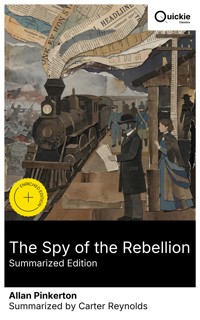
The Spy of the Rebellion (1883) recounts the Union's secret war, from foiling the 1861 Baltimore Plot against President-elect Lincoln to the Union Intelligence Service's operations during the Peninsula Campaign and beyond. Drawn from case files and dispatches, the book blends documentary detail with Victorian melodrama: episodic chapters, moral asides, and cliffhangers frame portraits of field operatives, notably Timothy Webster and pioneering agent Kate Warne. Situated in the postbellum marketplace of memory and emerging spy literature, Pinkerton's narrative offers a primary window—and a self-crafted myth—into wartime espionage and bureaucratic infighting. A Scottish immigrant and founder of the Pinkerton National Detective Agency, Allan Pinkerton brought abolitionist sympathies and industrial-era discipline to American policing. As McClellan's intelligence chief, he professionalized surveillance and undercover tradecraft. Writing later, he mined agency archives to defend his estimates of Confederate strength, honor fallen operatives, promote his firm, and justify the nascent craft of national intelligence. Recommended for students of Civil War command, intelligence history, and the cultural politics of memory, this volume rewards critical reading. Pair it with modern assessments to correct exaggerations while appreciating its granular vignettes, gendered breakthroughs, and procedural innovations. It remains a seminal, teachable artifact of American espionage. Quickie Classics summarizes timeless works with precision, preserving the author's voice and keeping the prose clear, fast, and readable—distilled, never diluted. Enriched Edition extras: Introduction · Synopsis · Historical Context · Author Biography · Brief Analysis · 4 Reflection Q&As · Editorial Footnotes.
Das E-Book können Sie in Legimi-Apps oder einer beliebigen App lesen, die das folgende Format unterstützen:
Veröffentlichungsjahr: 2026
Ähnliche













The Spy of the Rebellion (Summarized Edition)
Table of Contents
Introduction
In a nation fighting itself, secrecy becomes both weapon and shield. The Spy of the Rebellion by Allan Pinkerton is a nonfiction account of espionage and counterintelligence set during the American Civil War, written by the famed founder of the Pinkerton National Detective Agency and published in the late nineteenth century. Drawing on his experiences overseeing intelligence activities for Union forces, Pinkerton narrates how clandestine work unfolded amid divided loyalties and contested borders. The book belongs to an early tradition of American spy literature, combining reportage with narrative momentum. Its pages situate readers in camps, cities, and rail lines where information moved as decisively as armies.
Pinkerton opens with the fraught emergence of wartime intelligence and proceeds through episodes that map the creation of networks, the recruitment of operatives, and the perils of moving unnoticed through hostile territory. He writes in a confident first-person voice, alternately methodical and dramatic, attentive to routine detail and sudden reversals. The style reflects nineteenth-century prose: expansive, moralizing at times, yet focused on practical steps, disguises, and logistics. Readers encounter brief sketches of personalities and places rather than exhaustive portraits, which keeps the pace brisk while preserving the secrecy central to the narrative. The result is a chronicle that reads like both casebook and adventure.
Central to the book is the patient work of gathering, testing, and moving information—watching rail depots, tracing rumors to sources, and establishing cover stories sturdy enough to withstand suspicion. Pinkerton emphasizes coordination as much as daring, showing how couriers, safe meeting points, and disciplined reporting can decide whether intelligence reaches commanders in time. Scenes often unfold in crowded public spaces as well as along back roads, where small details carry outsized meaning. Because the narrative privileges process over surprise, readers witness the mechanics without needing the resolution of every mission, a choice that underscores the theme that invisible labor underwrites visible outcomes.
Running throughout is a meditation on loyalty—personal, political, and institutional—and the price of protecting a government tested by insurrection. The book weighs the ethics of deception in a republic that depends on truth, asking when secrecy preserves liberty and when it threatens it. Risk is constant yet uneven, borne by operatives who must act convincingly while denying themselves recognition. Trust becomes a commodity earned by patience and discipline rather than bravado, and mistakes, even minor ones, carry cascading consequences. Pinkerton’s emphasis on organization and duty frames espionage not as romantic escapade but as civic labor carried out under relentless uncertainty.
As a late-nineteenth-century publication, The Spy of the Rebellion stands at the junction of history and self-portrait, offering one prominent participant’s view of early U.S. military intelligence. It helped shape popular images of detectives and spies before professionalized federal agencies emerged, and it preserves period assumptions about class, region, and patriotism. Its perspective is necessarily partial, drawn from the author’s role and responsibilities, which makes the book valuable as both testimony and artifact. Reading it alongside other Civil War sources can illuminate how narratives of security take form, how successes are framed, and how omissions, whether deliberate or practical, contour public memory.
For contemporary readers, the book resonates in debates over surveillance, disinformation, and the balance between safety and civil liberty. Pinkerton’s emphasis on human judgment—cultivating sources, vetting reports, avoiding hasty conclusions—mirrors challenges that persist despite modern technologies. It illustrates how institutions manage uncertainty, how leaders act with incomplete data, and how failure to question assumptions can distort strategy. By foregrounding process and responsibility, the narrative invites comparisons to current discussions about accountability in security work, from municipal policing to national intelligence. Its enduring value lies not only in what it recounts but in how it models the careful, skeptical reading that complex events demand.
Approached with attention to context, The Spy of the Rebellion offers both a gripping sequence of clandestine episodes and a study in how a democracy fights while trying to remain itself. Its voice bears the stamp of its era, yet its concerns—credibility, coordination, and the human limits of foresight—feel immediate. Pinkerton invites readers into the tension between secrecy and public trust without resolving it, encouraging reflection rather than simple judgment. As an introduction to American espionage writing and a window on Civil War realities beyond the battlefield, the book rewards patience, curiosity, and care. It endures because it asks how truth survives under pressure.
Synopsis
The Spy of the Rebellion (1883) is Allan Pinkerton’s expansive chronicle of the intelligence work he organized for the United States during the opening years of the Civil War. Writing as the founder of a private detective agency who was drawn into national service, Pinkerton describes how a civilian network of operatives, scouts, and informants emerged to meet wartime needs. The narrative combines first-person recollection with reproduced reports, sketches, and case narratives. Across its chapters, the book traces the rise of an organized, centrally directed effort to collect information, protect vital infrastructure, and counter clandestine threats as the Union mobilized under unprecedented pressure.
The account begins in the tense months surrounding the 1861 inauguration, when unrest threatened rail corridors and political gatherings. Assigned to safeguard railroad interests and public officials along the route to Washington, Pinkerton’s inquiries in Maryland reveal organized secessionist activity centered on Baltimore. He methodically presents meetings, surveillance, and informant testimony that point to a danger facing the president-elect’s journey. Acting through trusted aides and sympathetic railroad executives, he outlines protective measures and alternative travel arrangements. Pinkerton emphasizes coordination, cover identities, and tight control of information, establishing themes—discretion, speed, and layered deception—that will govern his approach throughout the ensuing wartime narrative.
With Washington secured, the book turns to the formation of a permanent intelligence apparatus operating between the capital, Baltimore, and contested border regions. Using the alias E. J. Allen, Pinkerton builds a headquarters, recruits field operatives, and establishes courier lines, safe houses, and cipher routines. He assigns specialized roles, noting the contributions of experienced detectives and pioneering women operatives such as Kate Warne, whose ability to adopt convincing social personas expands the service’s reach. The organization’s priorities include assessing loyalty in key cities, mapping threats to railways and telegraphs, and cultivating local sources whose observations can be aggregated into timely strategic assessments.
Case studies then carry the reader into neighborhoods, depots, and taverns where allegiances are tested and intelligence is traded. Operatives penetrate secessionist circles to learn about planned movements, supply lines, and intentions, while countermeasures aim to deter sabotage against bridges and trains. Pinkerton highlights patient cover-building, staged meetings, and plausible business fronts that enable agents to pass. Figures such as Timothy Webster appear repeatedly as emissaries who shuttle between hostile locales and the Washington office, transmitting observations by coded message or trusted courier. The narrative underscores the constant calibration of risk, and the need to corroborate fragmentary reports before advising commanders.
Parallel chapters address counterespionage in the nation’s capital, where social salons, boardinghouses, and government offices become arenas of quiet contest. Pinkerton describes surveillance of suspected couriers and socialites who cultivate access to officers and legislators, along with efforts to intercept communications or shadow meetings that hint at organized espionage. He depicts painstaking documentation—names, schedules, and mapped routes—used to brief military authorities and justify arrests or restrictions. Railroad security remains central: guarding workshops, telegraph relays, and vital junctions to ensure troops and supplies move unimpeded. Through these episodes, the book frames intelligence as both shield and lens for a besieged government.
As major armies take the field, Pinkerton’s service attaches to Union commands in Virginia, supplying the Army of the Potomac with reconnaissance from across rivers and roads leading toward Confederate positions. Scouts sketch terrain, count encampments, track wagon traffic, and question refugees and prisoners, turning observations into formal estimates of strength and intention. Pinkerton emphasizes secure communications with headquarters and the need to guard sources. He situates intelligence within the rhythm of campaign planning, where weather, geography, and rumors complicate analysis. The book portrays a feedback loop: reports shape strategy, and operational choices, in turn, redefine what information can be safely gathered.
Throughout, the hazards facing undercover work remain palpable. Agents operate under assumed names, improvise alibis, and travel through zones where a misplaced word can prove fatal. Pinkerton reflects on the ethical boundaries of deception in wartime, the treatment of civilians who may aid either side, and the duty to minimize collateral harm while denying adversaries advantage. He stresses discipline in handling funds, credentials, and passwords, and the importance of rotating routes to avoid detection. Episodes of suspicion, betrayal, and sudden violence convey the human costs of clandestine service without overshadowing the central objective: timely, actionable intelligence for commanders and civil leaders.
Methodologically, the book doubles as a manual of practice. Pinkerton details recruitment standards, compartmentalization, and verification routines that compare independent sources before drawing conclusions. He discusses codes and secret writing, the use of sketches and passphrases, and the discipline of nightly debriefings that turn raw notes into coherent narratives. A documentary thread runs throughout, with reproduced affidavits, letters, and field reports used to corroborate scenes and timelines. Although intensely narrative, the emphasis falls on process: how information is collected, sifted, and delivered with protective redactions to preserve lives and channels. The portrayal suggests an emerging professional ethos for American intelligence work.
By closing, The Spy of the Rebellion presents intelligence as a decisive but imperfect instrument, forged under pressure and reliant on the courage of individuals working in secrecy. Pinkerton’s orderly, document-based storytelling elevates clandestine labor from rumor and legend to a discipline bound by procedure and accountability. Without disclosing every outcome of the missions it recounts, the book frames the Union’s survival as intertwined with the protection of infrastructure, the disruption of enemy networks, and steady flows of verified information. Its enduring significance lies in portraying how a modern intelligence service could be built in a democracy at war.
Historical Context
The Spy of the Rebellion, published in 1883 by Allan Pinkerton, situates readers in the United States during the Civil War, 1861–1865. Pinkerton, a Scottish-born detective who founded the Pinkerton National Detective Agency in Chicago in 1850, served as a civilian intelligence organizer for the Union. He worked most closely with Major General George B. McClellan and the Army of the Potomac. The book recounts operations centered on Washington, Maryland, and Virginia, with forays behind Confederate lines. Drawing on his memoranda and agency files, Pinkerton presents a first-person account of building networks, gathering information, and advising military leaders when formal federal intelligence structures were still nascent.
Pinkerton’s narrative opens in the secession crisis that followed Abraham Lincoln’s election in November 1860. Southern states left the Union, and the rail junction of Baltimore, Maryland, became a flashpoint as the president-elect traveled to Washington in February 1861. Contracted by railroad executive Samuel M. Felton to investigate threats to lines and bridges, Pinkerton extended his inquiry to political violence. He later asserted that his operatives uncovered a plan to attack Lincoln during the Baltimore transfer; historians have debated aspects of this claim, but Lincoln did pass through the city at night under heightened security. These tensions frame Pinkerton’s emphasis on clandestine danger and loyal service.
At the war’s outset, the Union lacked a permanent, centralized intelligence bureau. Commanders relied on scouts, local informants, and ad hoc detective work. In 1861 McClellan engaged Pinkerton, who operated under the alias E. J. Allen, to organize a secret service for the Army of the Potomac. Pinkerton recruited field agents, debriefed deserters and refugees, and compiled written estimates for headquarters. His reports moved through military channels alongside provost-marshal investigations and signal and engineer reconnaissance. This improvisational system predated the U.S. Army’s Bureau of Military Information, created in 1863 under George H. Sharpe, and illustrates how civilian expertise supplemented government capacity during rapid mobilization.
Campaign geography shapes the book’s middle sections. Pinkerton followed McClellan through the defense of Washington and into the 1862 Peninsula Campaign toward Richmond, where muddy roads, limited maps, and unreliable guides complicated reconnaissance. He produced order-of-battle estimates that, historians have shown, often overstated Confederate strength. Those numbers reinforced McClellan’s caution and requests for reinforcements, affecting the tempo of operations around the Chickahominy and the approaches to Richmond. While battlefield outcomes lie beyond Pinkerton’s narrative focus, his vantage underscores how intelligence assessments—formed from interrogations, intercepted conversations, and prisoner reports—could frame strategic choices in a theater where rumor and deception were constant features.
Pinkerton details methods typical of nineteenth-century espionage. Operatives assumed aliases, traveled on railways and coastal steamers, and frequented boardinghouses, taverns, and courthouses to collect information. The agency employed some women as investigators, notably Kate Warne, whose participation in undercover work during the war is documented in Pinkerton’s papers. Reports moved by courier and telegraph, sometimes in code, and were collated into narrative summaries for generals. Work concentrated in border cities and occupied towns, where loyalties were divided and civil officials cooperated unevenly with the army. Pinkerton emphasizes the hazards of arrest, imprisonment, and exposure, reflecting the legal penalties that both sides imposed on captured spies.
The wartime legal environment informs the book’s atmosphere. Lincoln authorized limited suspension of habeas corpus along key rail corridors in 1861 and broadened it in September 1862, enabling military arrests of suspected saboteurs, recruiters, and disloyal public officials. The U.S. Military Telegraph controlled government communications, and censorship of military intelligence appeared in orders governing the press and mails. Provost marshals investigated subversion and enforced conscription after 1863. Pinkerton’s operations intersected with these institutions, as detectives shared leads with commanders and federal authorities detained suspects for questioning. The narrative highlights how emergency measures, especially in Maryland and the capital region, shaped daily assumptions about surveillance and risk.
By the time The Spy of the Rebellion appeared in 1883, readers were immersed in postwar reminiscences and the Gilded Age’s booming market for detective literature. Pinkerton had already published popular casebooks that blended reportage with advocacy for professional policing. This volume promoted his agency’s contributions and offered a dramatic chronicle of Union espionage before the Bureau of Military Information systematized military intelligence. Subsequent scholars have criticized inaccuracies and self-aggrandizing elements, and have re-evaluated Pinkerton’s estimates and claims using wartime records. Nevertheless, the book preserves names, procedures, and viewpoints that shaped the public memory of clandestine service during the nation’s most studied conflict.
Viewed historically, the work reflects a formative moment in American security culture. It records how railroads, telegraphs, and mass mobilization created vulnerabilities that civilian detectives tried to manage for the state. Pinkerton’s emphasis on loyalty oaths, undercover surveillance, and preventive action mirrors Union anxieties about internal revolt and sabotage in 1861–1862. At the same time, its confident tone and marketing anticipate debates over the reliability of private intelligence and the boundary between history and promotion. The Spy of the Rebellion thus both documents and defends an early model of wartime espionage, inviting later readers to weigh narrative authority against archival corroboration.
Author Biography
Allan Pinkerton (1819–1884) was a Scottish-born American detective, private security pioneer, and bestselling author whose career spanned the mid- to late nineteenth century. As founder of the agency that bore his name, he helped formalize investigative techniques in the United States, from organized surveillance to systematic recordkeeping. During the Civil War he directed intelligence operations for the Union under a widely used alias and earlier assisted in safeguarding President-elect Abraham Lincoln. Parallel to his operational work, Pinkerton published vivid case narratives that blurred lines among memoir, reportage, and didactic fiction, shaping popular understandings of crime, policing, and national security in an era of rapid urban and industrial change.
Born near Glasgow, Pinkerton trained as a cooper and received limited formal schooling, a common trajectory for working-class youths of his era. In Scotland he engaged with Chartist reform politics, an experience that sharpened his interest in civic order and public debate. He emigrated to the United States in the early 1840s and settled in the Midwest, continuing his trade while educating himself through reading and participation in local committees. His practical craft background, exposure to mass meetings, and admiration for empiricism informed the disciplined, methodical habits he later brought to detection. Rather than citing literary mentors, Pinkerton consistently credited observation, persistence, and documentation as his chief guides.
In Illinois he gained public attention after uncovering a counterfeiting ring while working along the Fox River, a discovery that led to assignments as a lawman and, soon, as a special agent for the U.S. Post Office. By around 1850 he organized what became the Pinkerton National Detective Agency, headquartered in Chicago and later active across multiple states. The firm emphasized undercover work, informant networks, and detailed files, adopting the all-seeing eye emblem and the motto We Never Sleep. Pinkerton is widely credited with hiring Kate Warne in the 1850s, regarded as the first female detective in the United States. In the same period he publicly supported antislavery efforts in the Chicago area.
In early 1861 Pinkerton and his operatives investigated threats to the president-elect as he traveled east, assisting in Lincoln’s discreet nighttime passage through Baltimore amid reports of a conspiracy. During the Civil War he headed intelligence for the Army of the Potomac under the alias E. J. Allen, managing scouts, debriefings, and counterespionage. His estimates of Confederate strength, prepared for General George B. McClellan, were influential yet later criticized as excessively high. Pinkerton nevertheless helped establish procedures—such as standardized reports and coded communications—that linked field observation to command. This wartime service made him a national figure and strengthened his agency’s postwar standing.
After the war, Pinkerton’s firm pursued train robbers and bandits, including the Reno gang and associates of the James-Younger circle, operations that mixed successes with costly setbacks and public controversy after civilians were harmed during a failed raid. The agency also contracted with railroads and industrial firms for security and strikebreaking, positioning Pinkerton at the intersection of crime control and labor conflict during the tumultuous 1870s. He refined methods such as shadowing, disguise, and centralized rogues’ galleries, and promoted inter-jurisdictional cooperation at a time when policing remained fragmented. Admirers praised efficiency and reach; detractors accused the company of overstepping legal and ethical bounds.
Pinkerton turned his cases into popular books that gave readers dramatic access to investigations while promoting professional standards. Notable titles include The Expressman and the Detective (1874), The Somnambulist and the Detective (1874), Bank Robbers and the Detectives (1875), The Molly Maguires and the Detectives (1877), Strikers, Communists, Tramps, and Detectives (1878), and The Spy of the Rebellion (1883). These narratives mixed reconstructed dialogues with documentary claims, presenting detection as both civic duty and moral theater. They sold widely and influenced public perceptions of crime and political violence, though historians have debated their accuracy and the degree to which cases were simplified or embellished.
Pinkerton continued to manage and write into the early 1880s, mentoring operatives and promoting a national network of field offices. He died in the mid-1880s, leaving an organization that endured well beyond his lifetime. The Pinkerton name became synonymous with private security—admired for investigative innovation and criticized for its role in anti-labor campaigns. His use of meticulous dossiers, undercover techniques, and female operatives left a durable imprint on modern policing and corporate security practices. His books bridged true-crime reportage and proto-detective fiction, shaping genre conventions and inspiring later popular culture. The agency’s iconic eye symbol remains a fixture in narratives about surveillance and secrecy.




