


Erhalten Sie Zugang zu diesem und mehr als 300000 Büchern ab EUR 5,99 monatlich.
- Herausgeber: Bitter Lemon Press
- Kategorie: Abenteuer, Thriller, Horror
- Sprache: Englisch
Tokyo, 1958. Teiko marries Kenichi Uhara, ten years her senior, an advertising man recommended by a go-between. After a four-day honeymoon, Kenichi vanishes. Teiko travels to the coastal and snow-bound city of Kanazawa, where Kenichi was last seen, to investigate his disappearance. When Kenichi's brother comes to help her, he is murdered, poisoned in his hotel room. Soon, Teiko discovers that her husband's disappearance is tied up with the so-called "pan-pan girls", women who worked as prostitutes catering to American GIs after the war. Now, ten years later, as the country is recovering, there are those who are willing to take extreme measures to hide that past.
Sie lesen das E-Book in den Legimi-Apps auf:
Seitenzahl: 400
Veröffentlichungsjahr: 2024
Das E-Book (TTS) können Sie hören im Abo „Legimi Premium” in Legimi-Apps auf:
Ähnliche



















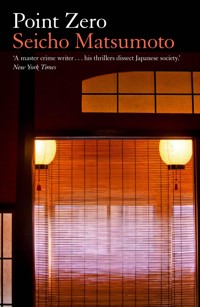
POINT ZERO
Seichō Matsumoto
Translated by Louise Heal Kawai
Contents
1 A Husband
That autumn, Teiko Itane got married. Her husband, Kenichi Uhara, had come highly recommended by a go-between. Teiko was twenty-six: her new husband, ten years older. There was nothing inappropriate about the age difference, but in the eyes of society, it was a little late in life for a man to be marrying.
“Still single at thirty-six. It makes you think something’s going on there…”
That was Teiko’s mother’s reaction to the news of his proposal. To be fair, she was probably on the right track. It would have been strange for a man to reach that age without having had any involvement with women, and Kenichi would surely have been lying had he attempted to deny it. Besides, Teiko felt it made a man look weak if he hadn’t.
She was a professional herself, and well used to a male working environment. She reflected that she couldn’t respect a man who had stayed completely celibate. Rather than admiring him for staying pure, she would have seen him as lacking strength, both in person and in the workplace. In conclusion, she decided she was fine with any past liaisons that her new husband might have had. She would never have asked him outright if he had lived with a woman, but as long as everything was in the past, and there was no possibility of future problems, she’d have nothing to reproach him for.
For sure, if Teiko had been younger, she’d have felt differently. But she’d had several romances herself already and had developed a far less rigid stance towards marriage. Age and experience had mellowed her.
Teiko had discovered that people at work considered her an attractive woman; she’d learnt this from the rather explicit compliments her male colleagues made, as well as from the many more acerbic comments made by the women.
She’d never really fallen in love, always being the one to pull back, partly because she had been disappointed by a lack of manliness in her partners, but also a little because of her own cowardice. Each time her previous relationships had advanced to the point of a marriage proposal, she had always refused. And if she ever developed romantic feelings for a man, she would somehow manage to convince herself that he wasn’t worth waiting for.
And then she received a marriage proposal from Kenichi Uhara.
He was manager of the Hokuriku regional branch office of A—advertising agency. The matchmaker, a man by the name of Saeki, was a friend of Teiko’s late father and had a connection with this advertising agency. Saeki explained that A—agency was one of the top in its field in the Tokyo area, but neither Teiko nor her mother had much idea of what an advertising agency did.
Mr Saeki brought along a newspaper to show them.
“See, newspapers are full of advertisements like these. The low subscription costs paid by the readers aren’t enough to cover the production costs of a newspaper, so the income from adverts like these keeps the paper running. Now the newspaper companies don’t deal directly with the different companies that advertise here. There are agents that work as intermediaries between the two. The biggest of these is D—agency. They make contracts for their client companies with newspapers, magazines, radio and television. A—generally deals only with newspapers, but they offer probably the second or third best service in the country. They have a total of around three hundred employees at branches throughout Japan. Anyway, they’re a top-level operation. Mr Uhara is the manager of the Hokuriku branch. He’s got very good prospects.”
This gave Teiko a clearer picture of Kenichi Uhara’s business. She still didn’t quite get the world of electric-appliance sales or drug-manufacturing, but she’d got some idea of what he did.
He’d quit university without graduating, but Mr Saeki assured them that it was due to the outbreak of the Second World War. He’d returned to Japan from China two years after the end of the war and had tried his hand at a couple of different jobs, before being taken on by A—, where he’d been for the past six years.
“He must be a hard worker to be branch manager after only six years with them.”
The matchmaker was full of compliments about his protégé.
“The branch office is up in Kanazawa City.”
Teiko’s mother interrupted to ask a question.
“So will Teiko need to move to Kanazawa after she’s married?”
“No, not at all. Mr Uhara spends a period of ten days a month in Tokyo. Most of the businesses that have factories up in the Hokuriku region are based here in the city, so he has to come here to work out the contracts anyway. He’s told me that he’d like his family base to be here in Tokyo.”
But Teiko’s mother was still concerned.
“That still means that twenty days of every month he’ll be away from home.”
“I hear that in the near future Mr Uhara will be moving back from Kanazawa permanently. He’s been up there for about two years, and the head office has tried to get him to move back a few times already. Every time he’s asked them for a little more time.”
“And why is that?”
“Well, I shouldn’t really say this, but it’s a pretty rural area and there’s not all that much work up there. Mr Uhara was saying he wanted to see if he could increase business in the area. He wanted to make more of an impact as branch manager. It’s human nature to try to make a success of things, isn’t it? Anyway, since he’s been the chief there, business has been improving.”
Saeki turned to Teiko with a smile.
“Anyway, Mr Uhara says that if he’s finally going to heed the call of the head office to come back to Tokyo, then he’s going to take the opportunity to get married. So, if your husband is going to be absent on business trips, then it’s only going to be for a short time.”
As was traditional, the first meeting took place at the Kabuki Theatre. Next to the short figure of Saeki, Kenichi Uhara was tall and well-proportioned. Teiko had imagined a young, boyish type, but in fact he looked older than she’d expected. Maybe it was because of his high cheekbones, she mused, but looking again from a purely objective viewpoint, she concluded that with his darkish complexion he looked neither older nor younger than his thirty-six years.
It was clear right away that Kenichi was not at all the lively, vivacious type. He was calm-mannered, but more than that, he was rather quiet. However, from time to time, Teiko observed a flash of amusement, something more light-hearted in his expression. She could tell there was more complexity to this man.
As they ate, Teiko’s mother addressed Kenichi.
“Kanazawa must be a really lovely place. I’ve never had the chance to visit.”
“No, actually it’s quite dull,” the young man replied. “The weather is rather dark all year round. It gives the place a gloomy feel.”
He seemed to be saying that he was simply putting up with the area because of his work obligations. As he looked down at his plate, concentrating on the movements of his knife and fork, there was something of that gloom in the way he knitted his eyebrows.
As soon as she accepted his marriage proposal, Teiko quit her own company.
The wedding was held in mid-November.
Kenichi Uhara was given a week off work, and the advertising agency sent a member of the top management of the sales department to give a congratulatory speech at the wedding reception.
“…Our company is expecting great things of this talented young man. Now, I know this is sounding like a stereotypical congratulatory address, but please bear with me. I’m Mr Uhara’s senior. And when your superior praises you in front of everyone this way, you’re guaranteed a raise. Mrs Uhara, you can be assured of that. You’ll get no boilerplate speech from me.”
The guests all smiled at this.
“I only met Mr Uhara’s bride for the first time today, but I can tell you that I was struck by both her intellect and her beauty. After all the temptations of his thirty-six years – well, I don’t know the details of that part of his life, of course – today I finally understood why he waited so long. As you know, our agency’s business is to persuade companies to sponsor newspapers with their advertisements. It’s a job that requires perseverance and endurance. And because Uhara was able to persuade this beautiful woman to become his wife, he no longer has to endure the life of a single man. I will allow myself to brag quietly that the practice he had in our company helped to give him the skills to achieve this.”
Teiko, her eyes respectfully lowered, heard the wedding guests laughing along to the speech. At the time, she was just listening vaguely to the polished speech of a company boss who’d had plenty of experience making wedding speeches. Later, however, she would recall these words in a completely different light.
Kenichi Uhara’s parents had already passed away, and his only family was a married older brother living in the Aoyama area of Tokyo. His brother, Sotaro, didn’t resemble Kenichi at all. He was rather overweight, with a chubby face that gave the impression of someone in the habit of drinking too much. He was a junior manager at a big company. His wife was thin with high cheekbones, like Kenichi, and consequently was often mistaken for his sister.
Kenichi had been living in Aoyama with his brother and sister-in-law, but now, in preparation for his marriage, he’d rented an apartment in Shibuya. It was up on a hill, and, viewed from the window, Tokyo opened out like a great shimmering sea below.
Perhaps it was because so little time had elapsed between the marriage proposal and the ceremony, but by the time they were married, Teiko had not spent a single day alone with her fiancé. Even if they’d wanted to, it would have been difficult with Kenichi away in Kanazawa for most of that period. Unlike her previous romantic escapades Teiko wasn’t particularly expecting to have much contact before marriage, and her fiancé didn’t express any particular desire to meet either. Teiko was satisfied with what she had glimpsed of her future husband at their formal omiai meetings.
It wasn’t that she had fallen in love at first sight. In reality, she was far from that feeling, since she knew little about him except the name of his agency, the kind of work he did, and the fact that he lived with his brother. But wasn’t this normal? When you married someone, wasn’t it often on the basis of a rather vague understanding? A woman can be afraid of the unknown part of her partner but at the same time feel a fascination to learn more. After the marriage, as they get to know each other, the fear vanishes, and the fascination gives way to everyday life. At least, that was what Teiko believed.
She had expressed a desire to go on her honeymoon to Hokuriku, hoping to learn more about her future husband as soon as possible. Besides the fact that he worked there, she’d sensed that he was strongly attached to the region; he would talk to her about its gloomy skies and wild waves. She imagined them rising and crashing deep in his consciousness.
But the matchmaker, Saeki, communicated to her Kenichi’s wish to go to Atami or Hakone instead, or even a more distant destination, such as the Kansai region.
“He told me that he didn’t feel like going to Hokuriku. Probably because he already spends so much time there. As it’s a special occasion, he said a livelier destination would be better.”
Teiko remembered a moment when she had seen an expression of melancholy in his eyes. She imagined it as a reflection of Hokuriku’s scenery. She pushed back and declared that she didn’t want to go to Hakone or Kansai. She suggested the Shinshu region and the Kiso valley before returning to Tokyo via Nagoya. November would be the perfect season to enjoy the autumn leaves.
Thus, there’d been a little friction between them, but eventually, following the wedding reception, they boarded the second-class compartment of a train departing from Tokyo’s Shinjuku station.
Night had fallen by the time they arrived in Kofu. At the station, they were greeted by the manager of the ryokan inn they had reserved, a paper lantern in his hand. He ushered them into a waiting car and closed the door behind them, bowing. Teiko was seized by the feeling that she was at a crossroads in her life and was being pushed in a particular direction.
The inn was in the Yumura quarter of Kofu City. It was supposed to overlook a traditional garden with a view of Mount Fuji, but in the dark only a bit of lawn and some ornamental stones were visible. As soon as they were alone in their room, Kenichi approached Teiko, took her in his arms for the first time and kissed her. Up to that very moment, even on the train, he had been completely reserved, every bit the mature adult. Now he was acting with the passion of a younger man.
“The maid will be back soon,” she said, trying to escape his embrace, but he didn’t seem inclined to let her go. When the maid returned to tell them the bath was ready, he calmed his ragged breathing by walking over to the sofa by the window.
Teiko insisted that they bathe separately.
“Why?” he asked.
He sounded almost fearful.
“Just this once,” she replied softly, in order to avoid being overheard by the employee who was waiting in the shadow of the sliding door. Teiko had often been complimented on her eyes, and now she played up the habit she had developed of peering upwards flirtatiously.
Late that evening there was the sound of music coming from the ryokan’s main hall. A group of young twentysomethings, probably on a company trip, were dancing to an up-tempo rhythm. Teiko encouraged her rather reluctant husband to go and check it out. Teiko leant against the wall, watching for a while, but then flashed her new husband a smile.
“Do you want to dance?” she asked him.
Kenichi turned out to be a rather better dancer than she’d imagined. As the tunes changed and they kept dancing, she realized that the time was flying by.
Teiko felt tears of happiness for the first time.
The following morning, they took a car up to Shosenkyo Gorge. The road was narrow and the car had trouble getting through the crowds of people admiring the maple foliage.
Kenichi was no different from the day before. His thirty-six-year-old face was expressionless, his movements calm. And yet, Teiko had learnt a new side of him that she had never known before. In one night, a tiny corner of his mysterious character had been revealed. And, she supposed, her husband must feel the same way about her. That said, she suspected that men, even more than women, fell into the trap of thinking they’d learnt all they needed to know about women. She took as proof that look of relief that men have on their faces after their wedding night.
Kenichi also seemed relieved. But what kind of relief? Was he happy to have confirmed that his new wife hadn’t previously had physical relations with another man? His face seemed unchanged from the day before, but underneath there was a sense of pride at having become somebody’s husband.
“Is this your first time at Shosenkyo?”
“Yes,” she replied with a nod.
“That’s good, isn’t it?” he said, smiling broadly.
It sounded to Teiko as if he were talking to a child. In the past, she’d have hated it, but now… well, she didn’t exactly like being spoken to that way, but, as it was her husband, she suppressed the feeling. Was this what becoming a wife was all about? To acknowledge that a relationship of mutual dependence had been established, and to begin the journey towards adapting to each other’s feelings?
That afternoon they left Kofu. From the window on the right side of the train, they could see the wide plain that spread out from the foot of Mount Yatsugatake. Kenichi rested his elbow on the window frame and stared out at the landscape. Up here in Nagano Prefecture the grass was already brown and dry, and the trees were shedding their leaves. Teiko examined her husband’s profile, his prominent cheekbone and the fine crow’s feet in the corner of his eye, and thought how tired he looked. He was already thirty-six years old, after all.
No matter how long or intimate the relationship, the eyes of a lover are not the same as the eyes of a wife. She wondered what expression was in her own eyes as she observed her husband. Then she thought of how her body had been changed for ever by this man she barely knew yet, and the realization scared her a little.
Kenichi turned his head, meeting her eyes.
“Is something wrong?”
He knew that she’d been watching him. She blushed, feeling a suggestion of their past night’s activity in his question.
The train had crossed the border of Nagano Prefecture and picked up speed as it approached Fujimi. White-walled houses with roofs of red or blue lined the slopes of the plateau.
“It’s beautiful,” said Teiko in a low voice.
Kenichi glanced at the scenery, then picked up the magazine from his lap and absent-mindedly flicked through it. After a short while he closed it again, and, as if he’d made his mind up about something, turned purposefully towards Teiko.
“You’d have preferred this trip to be to Hokuriku, wouldn’t you?”
He lit a cigarette, the smoke making him blink.
Teiko nodded.
“Maybe it was selfish of me, but I wanted to see that region just once,” she said.
“But it’s not as beautiful as this part of the country.”
He was comparing Hokuriku to Teiko’s reaction to the Fujimi Plateau. He drew deeply on his cigarette. Perhaps he was tired of the Hokuriku region. He probably knew the area inside out and didn’t want to spend any more time there. The smoke from his cigarette collided with the window and began to crawl its way up the glass pane, clouding the landscape beyond.
Teiko wondered about the reason behind his distaste for Hokuriku. It was understandable that he wouldn’t want to spend his honeymoon at his place of work. He’d been there for two years, spending twenty days of every month in Kanazawa and ten in Tokyo. He’d become a Kanazawa local. Even if Hakone, Atami or Kansai had become mediocre, run-of-the-mill locations for a honeymoon, perhaps they were at least a respite from the miserable Hokuriku landscape.
And yet, why was he not delighted by his wife’s perfectly natural desire to see where her new husband worked? Why had he worked so hard to discourage her?
“It’s because you were raised in a big city,” he told her. “You’ve probably got some kind of romantic notion in your head of the wild landscape of Hokuriku.”
He must have seen that she was not happy with his reply, and flashed her a charming smile.
“There’s so much more poetry in these mountains of Shinano and Kiso. We can go to Hokuriku anytime. There’ll be plenty of time in the future. Let’s make it our next trip.”
Teiko was reminded of when she was a child and how her mother used to console her when she didn’t get what she wanted – by offering her a substitute gift.
When Lake Suwa appeared to their left, Kenichi stood up and began to get their luggage down from the overhead netting. Teiko reached out to help.
“It’s fine,” he said, taking a case in each hand.
“Sorry.”
Her apology was intended to encompass her pushiness on the subject of Hokuriku, but she wasn’t sure whether Kenichi had taken it that way. In fact, although she knew she was being a little self-centred, she also couldn’t help feeling a little bit hard done by.
At Kamisuwa station, the manager of the ryokan had once again come to pick them up.
“Would you like to take the car, or perhaps you’d prefer to walk? It’s only seven or eight minutes on foot.”
“It’s not too far, but we’ve got a lot of luggage, so I think we’ll take the car,” Kenichi replied.
It sounded to Teiko as if he’d been there before.
The ryokan was a little removed from the lake. When they slid open the shoji screens on the window, there was only a tiny garden with a fence separating it from the next inn. Teiko was rather disappointed not to have the expected view of the lake.
“Yes, everyone says the same thing,” said the maid, pouring their tea. “It really would be nice if we could see the lake from here.”
At least the room was a good one.
“We’ll go for a walk to see it later,” said Kenichi.
As soon as the maid left, he moved over to where Teiko sat on the tatami floor and leant in to kiss her. His thick lips were quite rough, and the kiss intense, just as it had been the night before. Teiko was forced to put one hand down on the tatami to stop herself from falling, but this failed to stop Kenichi.
Of course, Teiko already had some experience of kissing, but this was the first time that she’d felt such strong physical pressure from a man. She was quite thrown by the contrast between the calm, reserved nature that Kenichi showed to the outside world and his behaviour behind closed doors. She had no idea that physical love could be so intense. She could only put it down to the fact that he was already thirty-six. But then again, there was no reason not to be happy about it.
It was dusk as they approached the lake, and the water was dark. Waves bobbed across its surface, and at the water’s edge the leafless willow trees swayed in the wind.
Tourist boats were still out in the middle of the lake and the voices of the guides shouting through their megaphones carried on the wind. Heavy clouds stretched across the sky and the setting sun sent bright threads through the gaps between. Daylight was quickly fading. Beneath the clouds, the ridge of the low hills rolled away into a blur of midnight blue.
Kenichi pointed out a break in the ridge directly ahead.
“That’s where the Tenryu River flows through, and see that high mountain over there? That’s the Shiojiri Pass. Usually between the two you can see Mount Hodaka and Mount Yari, but today is too overcast.”
The Shiojiri Pass was also capped by a band of low cloud. Teiko concentrated her gaze on the thick layer that had gathered over Lake Suwa, seeming to weigh down on the very surface of the water.
She imagined the cloud stretching all the way north to Hokuriku. The colourless cloud seemed to her a symbol of the gloomy northern country. Miles away – how far, she was not sure – were towns with low-roofed houses, vast plains and a turbulent ocean of crashing waves. She pictured each landscape and imagined her husband spending twenty days there every month.
“What are you staring at?” that husband said to her. It felt as if he could see straight into her thoughts. “If we stand around here any longer, we’re going to catch cold. Let’s get back to the hotel and take a hot bath.”
He turned and set off without waiting for a reply.
The bath house was rather small and brightly lit. Beneath the overhead lights, you could see right down to the tiles at the bottom of the bath. Teiko shielded her body against the harshness of those lights. Kenichi tipped a bucket of water over his head and from under his dripping hair looked playfully across at his wife.
“You have such a young body,” he said with obvious relish.
“I don’t like it when you say things like that,” she retorted, retreating to a corner of the tub.
“No, I mean it. You’re really beautiful.”
She hid her face and wondered if her husband was comparing her body to his own. Perhaps he was bothered by the ten-year age gap, she thought. Then again, there was no hint of envy in his tone or his look. Then it struck her that he was comparing her to some woman from his past. It certainly sounded that way from the way he’d said it. Teiko knew nothing of her husband’s past affairs. She reflected how she was slowly beginning to learn more about Kenichi, but that part of his past would probably remain a secret for the longest time.
After dinner, as they sat drinking tea, Teiko decided to confess something.
“When we were looking at the lake just now, I was thinking about Hokuriku.”
“So that’s why you were staring in that direction,” he replied with a smile. “If you’re that set on seeing it, then I’ll take you sometime… When I’m not going there on business.”
He shifted his position on the tatami.
“Now they’ve decided to move me back to Tokyo, I don’t need to go up to Kanazawa any more.”
“Mr Saeki said that might be the case. Is it happening so soon?”
“Yes, I expect I’ll get my new assignment as soon as we get back from this trip. I guess my next visit to Kanazawa will be my last job up there.”
“But you were there for quite a long time, weren’t you?”
“Just about two years. But the time went by quickly.”
Kenichi lit a cigarette and took a deep puff. His eyes glazed over. It was the same expression that Teiko had seen back in the train on their way to Lake Suwa. It was clear that his mind was elsewhere.
Teiko could hear someone playing the shamisen and singing. There must have been a party somewhere in the hotel.
“I’m tired,” said Kenichi, getting to his feet.
Teiko stayed where she was, seated on the tatami, but he came over and threw his arms around her.
“You’re lovely. So lovely,” he repeated as he held her in his arms. “Your lips are as soft as marshmallows.”
He sounded passionate, but Teiko couldn’t help feeling she was being compared to another.
Around ten days after their return to Tokyo, Teiko saw Kenichi off at Ueno station for his last trip to Kanazawa. It was evening and the station was crowded. For his final business trip to the region, he was accompanied by the man who was to take over his post, a younger man than Kenichi with big eyes and heavy eyebrows.
“My name’s Yoshio Honda,” he said. “Congratulations.”
Teiko thought he was congratulating her on their recent marriage, but later realized he was referring to her husband’s promotion.
The previous evening, Kenichi had explained to Teiko that the passing-over of the job to his successor and other parts of the process of finishing up his assignment would take about a week.
Right before passing through the ticket gate, he slipped into one of the station souvenir shops to load up on gifts of nori seaweed and castella cake.
“As it’s the last time, I’m going to have to visit all our clients in the area,” he explained.
Teiko smiled and nodded, but couldn’t help thinking that if he’d let her know beforehand, she could have got everything in advance from a department store.
The three stood talking on the platform until it was almost time for the train to depart, but then Honda, as if trying to add a thoughtful touch, got on with a mini bottle of whisky and some other items in hand. The interior of the carriage was lit brightly enough for a young woman to fix her make-up before heading off on a trip.
“Take care getting home,” said Kenichi. “It’s late, so you’d better take a taxi.”
“I will,” Teiko assured him. “And you hurry back safely, too.”
Then she added:
“Promise it’ll be me taking this train with you next time?”
“Of course.”
Kenichi’s mouth was smiling but his forehead wore the hint of a frown.
“Next summer, when I get some days off.”
The train bell rang, and Kenichi turned to get on.
She waited for the faces of Honda and her husband to appear at the window. They both smiled and waved at her until they’d disappeared into the distance.
Teiko stood on the platform until the crowd had thinned out, watching darkness fall over the train tracks. She could see the red and green lights of the signals blinking in the gloom, and felt a sudden void inside. Ah, she thought, so this is what married couples feel.
That was the last time Teiko ever saw her husband.
2 Missing
In their Shibuya apartment, Teiko waited for her husband’s return. The days felt monotonous. It was only supposed to be a week, but she was impatient to see him again.
Inside the apartment, her husband’s belongings and her own were still in two separate piles, just as they’d been delivered. They’d not yet had the time to merge their belongings and call them theirs. It was as if a line had been drawn between the two, and each had their side. For Teiko, it underlined in her mind that she and Kenichi had not yet achieved the intimacy of a married couple.
What it meant was that she had not yet made Kenichi Uhara her own. She still needed to know everything about him, and she was not even halfway to that goal. Tender feelings had begun to grow between them, but her husband was still mostly a mystery.
On his return, everything would become clear. They’d begin their daily life together, and all of his mysteries would be revealed. He would also learn more about her. Ten years, twenty years, together they would be a strong couple.
One day she decided to pay a visit to her brother-in-law’s family. They lived just down the hill from Aoyama, in a house enclosed by a low fence.
“Welcome!”
It was Sunday, and Sotaro was home. Sitting cross-legged on the tatami next to his wife, his childlike face broke into a grin.
“How’s it going? Have you settled into married life yet?”
He was holding their five-year-old on his knee.
“No, not really. I just haven’t been able to sort out the house properly yet.”
Teiko observed her brother- and sister-in-law. As they sat there with their children beside them, Teiko thought them a perfect couple. A couple who had shared with each other every secret.
“Of course,” said the sister-in-law, watching Teiko’s expression. “You won’t be able to start your new life until Kenichi gets back from his trip. You’ve been all on your own ever since the honeymoon, haven’t you?”
“When does Kenichi get back from Kanazawa?” Sotaro asked.
“He said a week, so three more days.”
“It’s great that they’ve moved him back to Tokyo,” said the sister-in-law, offering Teiko some tea that the maid had just brought in. “The company kept asking him to come back, but he kept refusing.”
“Even Tokyo must be boring for you, stuck alone like this,” said Sotaro. “It can’t have been half bad for Kenichi, spending two-thirds of the time in Kanazawa and a third in Tokyo.”
“You say that as if you’re jealous, but it’s only fun if you’re single,” the sister-in-law retorted, giving her husband a sideways glance.
“Of course. Once you’re married, you want to settle in one place,” he agreed.
The sister-in-law wasn’t giving up that easily.
“And you, my love, are you still wishing you could live like Kenichi? You’d never have to find another excuse to play mah-jong all night.”
“Don’t say such weird things in front of Teiko!”
Her brother-in-law pulled a face, which made Teiko laugh.
“Be that as it may, men have to keep up professional relationships,” he continued. “But when it comes to family… Well, there are some men who, after living the family life for a while, find themselves in a rut. They approach old age, they’ve saved money and amassed a fortune, their kids are all grown up and no longer a source of stress, and then they abandon their families to set out in search of a new way of life. I can see their point of view. But of course, that’s all just something I’ve read about in foreign novels.”
“And it’s a good thing it’s only in foreign novels,” said the sister-in-law. “Because if that happened, the poor deserted wife would be utterly devastated.”
“No, well, that’s one of men’s desires. They dream about it, but none of them has the guts to actually do it.”
“Men truly have a demon in their hearts,” said the sister-in-law, looking at Teiko. “But you don’t have to worry about Kenichi, though. He’s very responsible.”
“Yeah, you’re right. He’s a bit strange, that one,” said his brother with a big grin. “Even when he was single, he never had any woman trouble. That’s pretty unusual for guys these days.”
“You’ll be fine with him, Teiko,” said the sister-in-law with a smile. “We can guarantee it. While he was living with us you could tell he was the kind of man who would really cherish his wife.”
After Teiko left her in-laws’ place, she dropped in on her mother.
“So, just another three days? Come and visit, the both of you, when he’s back. Has he been in touch?”
“No, not yet.”
Teiko’s mother pondered this for a moment, then pulled herself a little closer to her daughter.
“Tell me, what’s he like, this Kenichi?”
She was apparently still suspicious of a man who’d stayed single until thirty-six.
“He seems like a really decent man.”
In reality, there was still an awful lot she didn’t know about him. She could only talk about the bits she was already familiar with.
“Good. I’m glad to hear it. Anyway, make sure you bring him by to see me. And take care of yourself until he gets back.”
It sounded as if her mother was preparing to give Kenichi the third degree.
When Teiko got home, there was a postcard waiting for her. It had a colour photo of the traditional okesa dance from Sado Island.
I’ve been making the rounds of my clients with Mr Honda, to introduce him to them before passing over the reins. It’s taking a little longer than I thought, but I should be home on the twelfth. I’m sure it’s all still a mess in there, but please wait until I get back.
The characters, written with a fountain pen, were rather neat. It was the first time that Teiko had seen her husband’s handwriting. The postmark read Kanazawa City.
She presumed that the comment about the mess was referring to sorting out all his stuff in the apartment. He knew it would be too much for her to manage alone, so he was asking her to leave it until he was able to help. But Teiko suspected there was more to it than that. She might have been overthinking it, but it came from her not knowing her husband well enough yet.
She went over to the window. As always, Tokyo stretched out like a great ocean far below, but up above, occupying most of the frame, was the sky, dominating the landscape as if wanting the city below to disappear under its might. She suddenly wished her husband could be with her right now. If only he were physically there, she could stop her mind wandering to strange places.
Already the memories she had of him on their honeymoon were beginning to fade. His words, and his affectionate touch, were already disappearing into a void that she felt surround her.
The day before he was due to return, Teiko decided to open a box of her husband’s books and take a look inside. The box contained about a dozen books, mostly on economics, including a few in their original language. Teiko was rather disappointed not to find a single literary work among them. She picked up one of the foreign-language books, vaguely thinking she might practise her English a little, and discovered that it wasn’t an economics textbook after all, but a law book on the subject of prison sentences. It seemed out of place next to the others. Moreover, the economics books were all in pristine condition, as if they’d barely been read, whereas the four or so law volumes looked like something you’d find on the shelves of a second-hand bookshop, well-thumbed and a little grimy. There were even sections underlined in red pencil.
Teiko couldn’t imagine what Kenichi had been studying. Perhaps there was a time he had hoped to become a lawyer of some kind, or perhaps even a magistrate. She really didn’t know anything of his past. He’d mentioned holding several different jobs before becoming an ad salesman, but she’d never been told what they were. “Been told” was doubtless a strange way of putting it; it was perhaps more accurate to say that he hadn’t said anything because she’d never asked him. After all, they really hadn’t been married long.
But wasn’t it fairly normal among married couples for the wife to be unconcerned about her husband’s previous occupations? The thing to focus on was the present and the future. As long as his past activities had no negative effect on the present, it really didn’t matter, surely? A wife could feel secure.
Unable to really follow all the difficult words in the book, Teiko made to close it, but, as she did, her attention was caught by what seemed to be a couple of postcards slipped in between the last page and back cover. On closer inspection, she saw that they were photographs.
Both photos were of houses, but very different in appearance. The first was an elegant-looking Western-style house, but the other was a much more modest traditional Japanese home. The first was surrounded by a concrete-block wall and sheltered by several trees, behind which the two-storey Western-style home was visible. There were no neighbouring houses, nor was the ridge of any mountain visible. It looked just like the kind of house you’d see in a residential area of Tokyo. The second was obviously a house from the Hokuriku region: small, with a narrow entrance, a deep roof with low eaves, and latticed windows. Since the persimmon tree next to the house was laden with fruit, the photo appeared to have been taken in autumn. The photographer had not been standing straight in front of the house, but slightly at an angle, possibly in order to capture the line of the mountains far in the distance. There were no living beings in either photo. The Hokuriku house photo appeared to have been taken a long time ago, while the richer house was a much newer photo.
If these photos were meant to be art, then they were rather bleak and empty. Perhaps the architecture of the houses themselves was of interest. But if that were the case, compared to the house in the older photo, the newer house was nothing special. It was just the average residential home found anywhere in Tokyo. Teiko wondered whether the photographer was her husband.
Turning the photos over, she found that the printer had marked something in pencil on the back. The fancy house had the number 35 and the traditional old Japanese house a 21.
Teiko replaced the photos inside the cover of the book and put the book onto the bookshelf. But she couldn’t shake a strange feeling she had about the two photographs.
Her husband didn’t return the next day. She’d gone to the market to get food and had a meal prepared and waiting for him, but there was no sign of him. He should have taken the night train from Kanazawa, arriving in Ueno early in the morning. She’d thought he’d at least drop by the apartment, but he must have gone straight to the office. She waited up late into the evening, but he never appeared. That night she slept alone.
On the morning of the fourteenth, she went out to a public phone to call her husband’s company. When she asked if Kenichi Uhara had come into work, the receptionist put her on hold for a moment then came back on the line.
“Who’s calling, please?”
“I’m a family member of Kenichi Uhara’s.”
“I’m afraid Mr Uhara hasn’t returned from his business trip.”
Teiko went home, thinking over the facts. Her husband hadn’t returned from his business trip. He was already two days behind schedule, but perhaps this was perfectly normal. She probably shouldn’t have called his company.
The whole day she was on edge, waiting for news. In the evening, she heard footsteps outside the neighbouring apartment and lots of noise on the stairs. Teiko checked the clock: six p.m. The time of day when families joyfully welcomed their husbands and fathers home from work.
A doorbell rang. Teiko assumed it was next door, but then it rang again, and she realized it was inside her apartment. She ran to open the door.
But it wasn’t her husband. It was a thin, middle-aged man she hadn’t seen before, his hat in his hand and his clothes expensively made.
“Are you the lady of the house?” he said.
“Er… yes,” Teiko replied, rather breathlessly.
The middle-aged man held out a business card that introduced him as Hideo Yokota, section manager at her husband’s company.
Teiko removed her apron and bowed to the visitor, then invited him into the apartment. Her heart was beating fast, and her fingers trembled.
Yokota was courteous and made all the correct small talk as he smoked a cigarette. Teiko smiled politely as she responded. Finally, extinguishing his cigarette, Yokota came to the reason for his visit.
“I was wondering whether you had any news from your husband?”
His tone was even, but Teiko had a sense of foreboding. She fetched the postcard she’d received from Kenichi. Her hand trembled so much she almost dropped it.
“Would you mind if I had a look?” said Yokota.
Teiko watched his eyes follow the handwriting, and then as he took out a pocketbook and wrote something down. She guessed that he had noted the return date of 12 December. Yokota then turned the postcard over and examined the postmark, making another note in his pocketbook.
“Thank you very much,” he said, handing back the postcard.
“Will my husband’s business trip be much longer?” Teiko asked.
“Well, I… er…”
The section chief blinked. His eyes were a little dazed and Teiko noticed his knee twitch.
“Just as he wrote on that postcard, Mr Uhara was scheduled to return from Kanazawa on the twelfth.”
Teiko’s breath seemed to stick in her throat.
“However, today is the fourteenth and he hasn’t put in an appearance at the office. We called the Kanazawa office, but Mr Honda – that’s Mr Uhara’s successor – says that your husband was supposed to have left the city on the evening of the eleventh.”
Supposed to have left? That meant that it wasn’t certain that he ever left. Those were Teiko’s thoughts, but she didn’t express them aloud.
“So, we assumed,” Yokota continued, “that Mr Uhara had arrived at Ueno station and gone straight home from there. And when he didn’t turn up at work, we thought he was busy with his new apartment, perhaps had some organizing to do, and had decided to take a couple of extra days off.”
The section chief’s expression relaxed slightly. He had no doubt been implying Kenichi was busy with his new wife rather than with his new apartment.
“But then we did think it rather strange that there was no contact from him for two whole days. And I was just thinking about paying a visit when you called the office. Of course, I immediately called Kanazawa to check on the situation. However, Honda’s reply was the same as before: that Mr Uhara wasn’t there. I called around our various business contacts in the region, but he wasn’t with any of them. I’m afraid I have no clue… I don’t suppose you have any idea of where he might be?”
Yokota peered hopefully at Teiko.
“I’m sorry. I’m at a loss too.”
She looked down as she spoke, but her mind was furiously running through all the possibilities. He might have dropped in at his brother’s house, she thought, but then she decided it was unlikely.
“Might he be with a relative, or an acquaintance?”
Unfortunately, she knew nothing yet of his friends or acquaintances. But even if he was with someone, he would surely have contacted the company by now.
“I really can’t think of anyone. But…”
She decided she ought to mention her brother-in-law. Yokota seized on this information and asked Teiko to call him right away.
She had to go down to the concierge’s office to make the call. She was in a daze as she descended the stairs.
It was her sister-in-law who picked up the telephone.
“Kenichi should have been back from his business trip two days ago. His section chief is here asking after him.”
Teiko shielded her mouth as she spoke so that the concierge wouldn’t hear the conversation.
“I wondered if he happened to be with you.”
“No, we haven’t seen him. That’s strange. He must have stopped by an acquaintance’s place.”
It was the same thing that the section chief had said.
“I can’t think of anywhere he might have gone,” said Teiko. “I wonder if his brother might have an idea.”
“He might. I’ll give him a call at work. But you know, I shouldn’t worry too much. He may just show up tomorrow morning.”
Despite the optimism, her sister-in-law’s voice was a little shaky.
After Yokota had left, there was a call from Kenichi’s brother to say he hadn’t been able to locate him.
Teiko left the concierge’s office, and, on her way back up the stairs, apropos of nothing, she thought of the two photos inside the law book.
Around midday the next day, Teiko got a call from Kenichi’s office.
“Has your husband come home yet?”
It was the section chief, Yokota.
“No, not yet.”
“I see. In that case I propose sending someone to Kanazawa to investigate. Would you care to accompany him? If you take the night train, you could be there by tomorrow morning.”
“Has Kenichi got involved in something?” Teiko asked.
“What do you mean?”
“A financial irregularity, for example…”
“No, nothing like that. We’re just worried that we haven’t heard from him for several days. We’re getting nowhere by phone and feel it’s better to send someone to investigate in person. I’m sure you’d agree, and that’s why we’re offering to send you along with one of my colleagues.”
“Yes, I’ll go,” she answered without hesitation.
If she hadn’t had that postcard from her husband announcing his return on the twelfth, she wouldn’t have made up her mind so quickly. But she had begun to suspect that he wasn’t staying away of his own free will. Someone else was surely involved.
Yokota told her the departure time of the train and hung up.




