


2,99 €
Mehr erfahren.
- Herausgeber: 22 Lions Bookstore
- Kategorie: Bildung
- Sprache: Englisch
This book is a compilation of texts, exercises, and a vast amount resources as used in the best universities to teach Portuguese to Foreigners. It includes the most effective methods to learn the Portuguese Language, either alone or with the help of a partner. It’s also an excellent manual to help Portuguese Language Teachers and Lecturers in the Classroom.
This book is based on an extensive experience teaching Portuguese to foreign students, creating the first Portuguese Departments for several Chinese Universities, and most importantly, based on the insights acquired through cooperations with the Universities of Guangdong, Harbin, Jilin and Shanghai, in China.
During these years, the author researched everything that exists in the market to teach the Portuguese Language, and that’s why he knows that you won’t ever find a manual for the teaching of the Portuguese Language that can guarantee you faster and better results, but also more motivating and interesting than what is presented here.
Moreover, during his experience as a lecturer, the author was considered one of the most efficient Language Teachers in China, recommended by the Portuguese Embassy as one of their best lecturers ever, and his students were known for winning multiple national awards related to speech, translation, interpretation and writing competitions, and also known for being the fastest at language learning. Many of them became fluent Portuguese speakers in just one month.
Today, these formers students are managers, entrepreneurs, translators, interpreters, and employees of some of the best and most popular companies around the world, including futebol teams, and in countries as diversified as Brazil, Portugal, Angola, Mozambique, Spain, Saudi Arabia, China, England and the USA, among many others.
Das E-Book können Sie in Legimi-Apps oder einer beliebigen App lesen, die das folgende Format unterstützen:
Veröffentlichungsjahr: 2017
Ähnliche








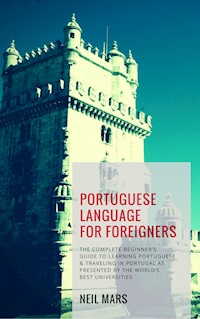
Portuguese Language for Foreigners: The Complete Beginner’s Guide to Learning Portuguese and Traveling in Portugal as Presented by the World’s Best Universities
Neil Mars
Published by 22 Lions Bookstore, 2017.
Table of Contents
Title Page
Copyright Page
Introduction
Accent & Pronunciation Training
Phonetic Training
Basic Vocabulary
Basic Questions
Numbers
Weekdays
Months
Colors
Presentation for Teachers
Presentation for Students
Conversation Exercise
Meals in Portugal
Vocabulary for Ingredients & Food
Vocabulary for Restaurants | Dishes
Salads
Condiments
Fastfood and Snaks
The Time
Vocabulary for the Classroom
Revisions Exercise
Translation & Interpretation
Vocabulary for Sports
Vocabulary for Professions
Advanced Conversation
Knowing People
Vocabulary About Human Anatomy
Understanding Meanings
Ordering Drinks
Portuguese Recipes
Vocabulary for Shopping
Adjectives
Vocabulary for Family
Vocabulary for Clothing & Footwear
Vocabulary for Jewelry & Accessories
Vocabulary for Cosmetics & Make-up
Vocabulary for Transportation
Portuguese Music - Level 1
Portuguese Music - Level 2
Traveling in Portugal
Knowing the Portuguese
Visiting Lisbon in 5 Days
Keeping Yourself Safe in Lisbon
Resources to Travel in Portugal
Resources to Study Portuguese
Recommended Bibliography
Copyright Page
Portuguese Language for Foreigners: The Complete Beginner’s Guide to Learning Portuguese and Traveling in Portugal as Presented by the World’s Best Universities
Copyright © Neil Mars, 2017 (1st Ed.) All Rights Reserved.
Cover Photo © Via Pixabay CC0.
Published by 22 Lions
Introduction
This book is a compilation of texts, exercises, and a vast amount resources as used in the best universities to teach Portuguese to Foreigners. It includes the most effective methods to learn the Portuguese Language, either alone or with the help of a partner. It’s also an excellent manual to help Portuguese Language Teachers and Lecturers in the Classroom.
This book is based on an extensive experience teaching Portuguese to foreign students, creating the first Portuguese Departments for several Chinese Universities, and most importantly, based on the insights acquired through cooperations with the Universities of Guangdong, Harbin, Jilin and Shanghai, in China.
During these years, the author researched everything that exists in the market to teach the Portuguese Language, and that’s why he knows that you won’t ever find a manual for the teaching of the Portuguese Language that can guarantee you faster and better results, but also more motivating and interesting than what is presented here.
Moreover, during his experience as a lecturer, the author was considered one of the most efficient Language Teachers in China, recommended by the Portuguese Embassy as one of their best lecturers ever, and his students were known for winning multiple national awards related to speech, translation, interpretation and writing competitions, and also known for being the fastest at language learning. Many of them became fluent Portuguese speakers in just one month.
Today, these formers students are managers, entrepreneurs, translators, interpreters, and employees of some of the best and most popular companies around the world, including futebol teams, and in countries as diversified as Brazil, Portugal, Angola, Mozambique, Spain, Saudi Arabia, China, England and the USA, among many others.
Accent & Pronunciation Training
Let us start by becoming familiar with the language and let it be part of our daily life. The following is a list of famous Portuguese singers and songs. Please find them, buy them, and download them. For now, I only require that you listen and choose the ones you like the most. You can start with one song only. Find the lyrics at the end of this book, translate them to English to understand the basic meaning behind the words, and practice singing your song while you cook and drive.
Adriana - Em contramão
Amália Rodrigues - Lisboa Antiga
Anjos - Eu estou aqui
Anjos - Faz-me acreditar no amor
António Variações - Canção do Engate
Boss AC - Que Deus?
Boss AC - Não Sou o Único
Carlos Paião - Cinderela
Carlos Paião - Playback
Cristina Branco - Ai Margarida
Daniela Mercury - Nobre Vagabundo
Daniela Mercury - Rapunzel
Daniela Mercury - Vide Gal
Da Vinci - Conquistador
Diana Lucas - Tu corres em mim
Diana Lucas - Pontas soltas
Dulce Pontes - Canção do Mar
Dulce Pontes - Lusitana Paixão
D’zrt - Enquanto não vencer
FF - O jogo recomeça
GNR - Efectivamente
Helena Caspurro - Se...
Heróis do Mar - Paixão
Humanos - Maria Albertina
João Pedro Pais - A palma e a mão
João Pedro Pais - Louco por ti
João Pedro Pais - Mentira
João Pedro Pais - Nada de nada
João Pedro Pais - Não há ninguém como tu
José Afonso - Comboio descendente
Just Girls - A vida te espera
Just Girls - Bye bye (vou-me divertir)
Just Girls - Há um lugar
Just Girls - Não te deixes vencer
Just Girls - O jogo já começou
Just Girls - Pensar em ti
Luís Represas - Perdidamente
Madredeus - O Pastor
Mafalda Veiga - Pássaros do Sul
Mariza - Fado Triste
Mickael Carreira - Não voltes agora
Moonspell - Os Senhores da Guerra
Paulo de Carvalho - E depois do adeus
Pedro Khima - Dá-me sede
Quinta do Bill - O homem do leme
Rita Guerra - A bela e o monstro
Rio Grande - Postal dos correios
Rui Veloso - Não há estrelas no céu
Salvador Sobral - Amar pelos dois
Santa Maria - Só uma noite contigo
Sara Tavares - Chamar a Música
Silence 4 - Eu não sei dizer
Silence 4 - Sextos Sentidos
Tiago Bettencourt - O jogo
Tony Carreira - A vida que eu escolhi
Tony Carreira - Se me vais deixar
Xutos & Pontapés - Contentores
Zeca Afonso - Grândola Vila Morena
Phonetic Training
Phonetic Training - Treino de Fonética
Exercise 1: Use the following board to practice your spelling. Simply combine the letters. Ex: AE, EE, IE, OE, UE,... EA, EE, EI, EO, EU,...
A
E
I
O
U
E
I
O
U
Exercise 2: Use the following board to practice your spelling as before. This time, using a combination of words as presented. Ex: Ola, ole, oli, olo and olu,...
OLA
E
I
O
U
OLE
OLI
OLO
OLU
Exercise 3: Continue the previous exercise, by using the two rows. Follow it until you reach letter “u”. Ex: Olala, olale, olali, olalo, olalu,... olela, olele, oleli, olelo, olulu.
Basic Vocabulary
Hello: Olá!
Good morning: Bom dia!
Good afternoon: Boa tarde!
Good evening: Boa noite!
What is your name?: Qual é o seu nome?
Where are you from?: De onde é?
Where do you live?: Onde vive?
See you next time: Até à próxima!
See you soon: Até logo!
See you tomorrow: Até amanhã!
See you next week: Até para a semana!
Have a nice weekend: Bom fim de semana!
Goodbye: Adeus! / Tchau!.
Yes: Sim.
No: Não.
That depends: Depende.
I don’t know: Não sei.
Maybe: Talvez.
True: Verdade.
Not true: Não é verdade.
With pleasure: Com prazer.
Please: Por favor.
Thank you: Obrigado.
Excuse me: Desculpe.
May I?: Posso?
Congratulations: Parabéns!
Good luck: Boa sorte!
Where?: Onde?
When?: Quando?
Why?: Porquê?
What?: Quê?
Who?: Quem?
How?: Como?
How many?: Quantos?
I feel unwell: Não me sinto bem.
I feel ill: Sinto-me doente.
I have a headache: Tenho uma dor de cabeça.
I have a stomach ache: Tenho dores de estômago
I feel dizzy: Sinto-me tonto.
I’m allergic: Sou alérgico.
It’s not serious: Não é grave.
I don’t understand: Não compreendo.
Please speak slower: Por favor fale mais devagar.
What does that mean?: Que quer isso dizer?
Can you repeat, please?: Pode repetir isso?
Basic Questions
Where is the reception, please?: Poderia dizer-me onde é a recepção?
Is there a car park?: Há um parque de automóveis?
Is there a restaurant in the hotel?: Há um restaurante no hotel?
Is there an elevator?: Há elevador?
How much is the room per night?: Quanto custa o quarto por noite?
What is the price?: Qual é o preço?
Do you have any rooms available for tonight?: Tem quartos para hoje?
What time does the hotel close in the evenings?: A que horas fecha o hotel à noite?
Is breakfast included?: O pequeno almoço está incluído?
When is dinner served?: Quando é servido o jantar?
Where’s the nearest railway station?: Onde fica a estação de comboios mais perto?
Which platform does the train leave from?: De que plataforma sai o comboio?
A single ticket to Faro, please: Um bilhete de ida para Faro, se faz favor.
A return ticket to Porto, please: Um bilhete de ida e volta para o Porto, se faz favor.
How long does the journey take?: Quanto tempo leva a viagem?
I would like to reserve a seat: Eu queria reservar um assento.
Is there a non-smoking seat?: Existe lugar para não-fumadores?
Which bus do I take to get to the airport?: Que autocarro devo tomar para o aeroporto?
When is the next bus?: Quando é o próximo autocarro?
When is the last bus?: A que horas sai o último autocarro?
Where can I get a taxi?: Onde posso encontrar um taxi?
Where can I change money?: Onde posso trocar dinheiro?
Is there a police station near here?: Há alguma esquadra de polícia perto daqui?
Numbers
Números
1 - um
2 - dois
3 - três
4 - quatro
5 - cinco
6 - seis
7 - sete
8 - oito
9 - nove
10 - dez
11 - onze
12 - doze
13 - treze
14 - catorze ou quatorze
15 - quinze
16 - dezasseis ou dezesseis
17 - dezassete ou dezessete
18 - dezoito
19 - dezanove ou dezenove
20 - vinte
21 - vinte e um
22 - vinte e dois
...
30 - trinta
40 - quarenta
50 - cinquenta - cinqüenta
60 - sessenta
70 - setenta
80 - oitenta
90 - noventa
100 - cem
101 - cento e um
102 - cento e dois
...
200 - duzentos
300 - trezentos
400 - quatrocentos
500 - quinhentos
600 - seiscentos
700 - setecentos
800 - oitocentos
900 - novecentos
1000 - mil
2000 - dois mil
3000 - três mil
Exercise: Get a partner and ask him to read random numbers. Practice by answering the next number following the one you listen.
Weekdays
Dias da Semana
Domingo - Sunday
Segunda-feira - Monday
Terça-feira - Tuesday
Quarta-feira - Wednesday
Quinta-feira - Thursday
Sexta-feira - Friday
Sábado - Saturday
Exercise: Get a partner and ask him to read random weekdays. Practice by answering the next weekday following the one you listen.
Months
Meses
Janeiro
Fevereiro
Março
Abril
Maio
Junho
Julho
Agosto
Setembro
Outubro
Novembro
Dezembro
Exercise: Get a partner and ask him to read random months. Practice by answering the next month following the one you listen.
Colors
Cores
Vermelho/ encarnado - Red
Verde - Green
Azul - Blue
Amarelo - Yellow
Castanho - Brown
Roxo - Purple
Preto/ negro – Black
Branco – White
Laranja – Orange
Cinzento - Grey
Cor de rosa - Pink
Creme - Cream
Dourado - Gold
Prateado - Silver
Moreno - Brown skin
Exercise: Get a partner and ask him to point at random objects. Practice by answering the color of the object you see. Let your partner confirm if you said it right, by using the translations above.
Presentation for Teachers
Full Text
Bom Dia! O meu nome é Neil Mars. Venho de Lisboa. Lisboa é a capital de Portugal. Estudei na Universidade de Lisboa. Tenho um Mestrado em Educação. Tenho também duas especialidades: Educação de adultos e dificuldades de aprendizagem. Tenho mais de vinte anos de experiência como professor. Já ensinei Português em Harbin, Guangdong e Changchun. Este ano irei ensinar Português aqui em Shanghai. Poderão contar comigo para vos ajudar como professor e amigo no que precisarem. Tenho a certeza que irão gostar muito de aprender português. A língua Portuguesa é considerada uma das línguas românticas, tal como o Francês, o Espanhol e o Italiano. A língua Portuguesa é muito bonita.
Presentation for Students
Questions
Answers
Bom Dia!
Exercise: Write a text presenting yourself. Don’t forget to mention your name, age, hometown, university and hobbies. For example:
Olá! Bom Dia! O meu nome é Joana. Tenho 18 anos. Tenho dois irmãos. Venho de Guangdong. Nos tempos livres gosto de jogar ping-pong, cartas, ténis e correr. Gosto muito da Universidade de Guangdong e de aprender Português. A lingual Portuguesa é muito bonita.




