


0,49 €
Niedrigster Preis in 30 Tagen: 1,99 €
Niedrigster Preis in 30 Tagen: 1,99 €
Mehr erfahren.
- Herausgeber: Booksell-Verlag
- Kategorie: Religion und Spiritualität
- Sprache: Englisch
In "Post-Medi√¶val Preachers," S. Baring-Gould embarks on an insightful exploration of the evolution of Christian preaching following the medieval era. This scholarly work intricately examines the stylistic shifts in homiletics, illustrating the transition from rigid exegesis to more personal and accessible forms of preaching. Through a careful analysis of historical texts and rhetorical techniques, Baring-Gould illuminates the cultural and theological contexts that shaped these preachers, revealing how they engaged with contemporary issues such as reform, morality, and social justice. His erudite prose is both rich and approachable, making this examination a critical addition to homiletic literature. S. Baring-Gould, a distinguished writer, folklorist, and theologian, possesses an extensive background in church history, which profoundly informs his analysis in this volume. His comprehensive understanding of the socio-religious dynamics of his time gave him a unique lens through which to investigate the post-medieval preaching tradition. Baring-Gould's own experiences as a preacher serve to enrich this narrative, infusing it with both personal reflection and academic rigor. "Post-Medi√¶val Preachers" is a must-read for scholars, theologians, and anyone with an interest in the history of Christian thought. Baring-Gould's meticulous research not only uncovers the intricate tapestry of preaching's evolution but also invites readers to appreciate the significant role these preachers played in shaping modern faith practices. This book is an invaluable resource that encourages deeper reflection on the power of preaching in a rapidly changing world. In this enriched edition, we have carefully created added value for your reading experience: - A succinct Introduction situates the work's timeless appeal and themes. - The Synopsis outlines the central plot, highlighting key developments without spoiling critical twists. - A detailed Historical Context immerses you in the era's events and influences that shaped the writing. - A thorough Analysis dissects symbols, motifs, and character arcs to unearth underlying meanings. - Reflection questions prompt you to engage personally with the work's messages, connecting them to modern life. - Hand‐picked Memorable Quotes shine a spotlight on moments of literary brilliance. - Interactive footnotes clarify unusual references, historical allusions, and archaic phrases for an effortless, more informed read.
Das E-Book können Sie in Legimi-Apps oder einer beliebigen App lesen, die das folgende Format unterstützen:
Veröffentlichungsjahr: 2019
Ähnliche
















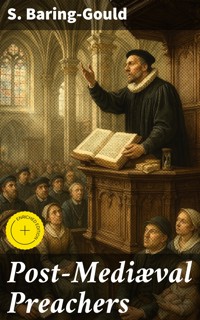
Post-Mediæval Preachers
Table of Contents
Introduction
At the fraught crossroads between inherited tradition and restless change, Post-Mediæval Preachers considers how voices from the pulpit sought to interpret, steady, and sometimes redirect a society moving beyond the Middle Ages.
Post-Mediæval Preachers is a work of historical and religious reflection by S. Baring-Gould, an English clergyman and author known for bringing scholarly inquiry to the study of Christian life and culture. The book’s focus, signaled by its title, is on preachers who came after the medieval period, situated within Western European contexts. As a nonfiction study, it belongs to the broad field of church history and homiletics, examining the public role of preaching and the character of those who embodied it. Readers encounter a historically attentive account rather than a theological treatise, attentive to people, places, and the conditions that shaped their ministry.
The premise is straightforward yet rich: by tracing notable preachers in the post-medieval era, the book explores how sermons functioned as instruments of instruction, conscience, and community formation. Instead of merely cataloging dates or doctrines, it considers the lived settings in which preaching occurred—parishes and cities, courts and marketplaces—and the audiences that gathered. The experience is one of historically informed narrative, drawing connections between a preacher’s formation, the needs of the time, and the resonance of spoken word. The voice remains measured and observant, inviting readers to weigh context alongside character and to consider influence without reducing it to easy causes.
Among the themes that emerge are the tension between continuity and reform, the negotiation between local custom and wider ecclesial standards, and the practical art of translating learning into pastoral care. The book treats preaching as an ethical act as much as a rhetorical one, asking what makes speech credible when addressed to communities in motion. It highlights the interplay of education, temperament, and circumstance in shaping a preacher’s reach, and it underscores how the pulpit both responds to and shapes public feeling. Attention to audience, tone, and occasion consistently frames the moral and cultural significance of sermons.
Baring-Gould situates these figures within the social and religious currents that followed the medieval period, when institutions, devotions, and patterns of authority were being reassessed. Such a frame allows readers to see preaching not as a timeless monologue, but as a dialogue with its age—sometimes conciliatory, sometimes corrective, always aware of the pressures that attend public speech. The book observes how preachers navigated changing expectations of learning, propriety, and accountability. It also notes the practical demands of ministry: teaching, consoling, admonishing, and organizing communal life, work that drew upon both personal conviction and inherited wisdom.
For contemporary readers, the relevance is clear. In an era saturated with messages, Post-Mediæval Preachers returns attention to the ethics of persuasion, the patience of instruction, and the responsibility of leadership. It invites reflection on how authority is constituted—by office, character, or service—and on the ways public words can heal or harden communal bonds. The book also offers perspective on intellectual humility: how complex questions are broached with care, and how tradition can be revisited without either nostalgia or amnesia. In tracing earlier models, it opens space to consider our own practices of listening and speaking.
Ultimately, this is a study of how faith meets history through the embodied craft of preaching, attentive to the concrete realities that make words matter. Readers inclined toward church history, literature, or cultural studies will find a work that prizes clarity of observation over polemic, preferring cumulative insight to sweeping verdicts. By focusing on post-medieval figures, it illuminates the formative role of the pulpit in shaping habits of thought and habits of heart that have endured into modernity. In doing so, Baring-Gould offers a patient, humane introduction to lives whose significance rests not only in what they said, but in how and why they said it.
Synopsis (Selection)
Post-Medival Preachers by S. Baring-Gould surveys notable pulpit orators from the Reformation to the eighteenth century, presenting brief biographical sketches alongside observations on their styles, audiences, and cultural settings. The book balances Protestant and Catholic figures, drawing on sermons, memoirs, and anecdotes to illustrate method and influence rather than to debate doctrine. Arranged broadly by period and national school, it traces how preaching evolved from scholastic disputation to vernacular persuasion, public ceremony, and revivalist appeal. Throughout, Baring-Gould keeps attention on the preacher as communicator: voice, structure, imagery, and moral purpose, and how these interacted with courts, universities, parishes, and the street.
The opening chapters situate the pulpit at the Reformation as a principal medium of instruction and controversy. Early Protestant leadersMartin Luther, Huldrych Zwingli, John Calvin, and English reformers like Hugh Latimerare presented as exemplars of direct, scriptural preaching addressed to lay understanding. Their homiletic plainness and urgency contrast with late medieval scholastic habits. In response, Catholic reform revived the sermon through pastoral renewal and orders devoted to teaching. Figures such as Luis de Granada represent this constructive turn, emphasizing clear exposition and moral guidance. The book highlights how public preaching shaped opinion, established confessional identities, and became a tool of governance and community discipline.
Turning to Southern Europe, Baring-Gould outlines the Baroque Catholic tradition in Italy and the Iberian world. Paolo Segneri exemplifies Jesuit method: structured argument, vivid exempla, and devotional appeal aimed at conscience. Spanish and Portuguese preachers, notably Luis de Granada and Ant62nio Vieira, show a range from meditative guides to forceful court and mission orators. Vieiras rhetorical ingenuity and public interventions illustrate the sermons reach beyond church walls into political and colonial debates. Across these figures, the author underscores the use of classical devices, emblematic imagery, and carefully graduated persuasion designed to reform conduct while consoling and instructing diverse congregations.
France receives extended treatment for its "Grand Sicle" pulpit. Jacques-Be9nigne Bossuet, Louis Bourdaloue, Jean-Baptiste Massillon, and Frane7ois Fe9nelon are profiled through their Lenten courses and funeral orations. Bossuets architecture of thought and historical amplitude, Bourdaloues tight logic, Massillons moral penetration, and Fe9nelons pastoral gentleness illustrate complementary ideals of eloquence. Their audiences ranged from court to capital, shaping taste in French prose and notions of decorum. Baring-Gould notes how thematic sequencing, ethical analysis, and controlled pathos served to admonish power, comfort the afflicted, and define a national homiletic model widely imitated across Europe.
In German-speaking lands and Central Europe, the book contrasts confessional currents. Post-Lutheran preaching developed through devotional renewal with Johann Arndt, while Pietism under Philipp Jakob Spener and August Hermann Francke emphasized conversion, practical godliness, and small-group nurture. Alongside them stands the Austrian Capuchin Abraham a Sancta Clara, whose satiric vigor and urban immediacy addressed social mores with memorable imagery. These strands demonstrate how sermons mediated reform within city life, courts, and schools, combining doctrinal instruction with appeals to conduct. Baring-Gould registers the variety of tonefrom catechetical simplicity to biting witand the shared concern to reach ordinary hearers in changing civic environments.
English preaching from the late Tudor to Restoration periods is presented as a spectrum of styles and occasions. Lancelot Andrewess learned cadence, John Donnes metaphysical intensity, Jeremy Taylors imagination, Isaac Barrows reasoned amplitude, Robert Souths point, and John Tillotsons plain persuasion illustrate Anglican eloquence. Political and ecclesial contextsfrom Pauls Cross to royal chapelsframe sermons as both devotion and state ceremony. Puritan and Nonconformist voices widen the range toward practical application and experimental piety. Selections and anecdotes show the preacher balancing scholarship, rhetoric, and pastoral duty, while university pulpits and parish cures shaped expectations of clarity, order, and moral exhortation.
The narrative then moves to eighteenth-century revival and transatlantic expansion. John Wesley and George Whitefield exemplify itinerant method and open-air proclamation, adapting voice and structure for crowds outside church buildings. In Wales, Griffith Jones and Howell Harris show organized catechesis and fervor; in New England, Jonathan Edwards unites doctrinal depth with arresting imagery. Baring-Gould outlines how these preachers formed societies, used lay assistance, and emphasized conversion, assurance, and disciplined life. He records practical techniquesfrom extemporaneous delivery to vivid metaphorand the measurable effects on attendance, conduct, and philanthropy, marking a shift from courtly occasions to popular, mobile, and missionary settings.
Other national scenes and special figures broaden the panorama. The Dutch Reformed tradition is treated for its sober exposition and doctrinal clarity within civic republics; Polish court preaching, notably Piotr Skarga, shows admonition addressed to political assemblies. Scandinavian pastors illustrate catechetical steadiness and parish organization. Missionary eloquence abroad appears in sketches of colonial pulpits and court chapels, where preachers negotiated language, law, and custom. Across these settings, Baring-Gould notes the interplay of local institutions, censorship, and education in shaping sermon form. The result is a comparative view of how national character and circumstance molded homiletic purpose and reception.
The concluding reflections synthesize themes across centuries and countries. The book presents the pulpit as a major instrument of education, moral suasion, and public discourse before the rise of modern media. By juxtaposing stylescourtly, academic, parochial, and revivalistit shows recurring concerns: clarity of doctrine, fitness of illustration, authority tempered by charity, and attention to audience. Without adjudicating theological disputes, Baring-Gould emphasizes practice: the craft of arrangement, voice, and example. The closing note underscores continuity amid change, inviting readers to recognize in varied preachers a common aimto instruct, warn, and consolewhile tracing the historical conditions that made their influence possible.
Historical Context
Post-Medival Preachers, composed by Anglican priest and antiquarian S. Baring-Gould in Victorian Britain (mid-1860s, London), surveys Christian pulpit oratory in the centuries after the Middle Ages. The work arises from a climate shaped by the Oxford Movement (c. 1833 31845), renewed ecclesiastical scholarship, and the expansion of print culture that made historical sermons widely accessible. Baring-Gould writes from an English parish perspective yet ranges across Europe, from Reformation Germany and Switzerland to Stuart England and Bourbon France. His canvas primarily spans the sixteenth to eighteenth centuries, when sermons functioned as public pedagogy and political argument. The book thus frames post-medieval preaching as a lens on confessional conflict, state formation, and the moral anxieties of early modern societies.
The Protestant Reformation (1517 onward) redefined the sermon as the central instrument of reform. Martin Luthers 95 Theses at Wittenberg (1517) and his defense at the Diet of Worms (1521) were paired with vernacular preaching and catechesis that spread through the press (Gutenbergs movable type c.1450 onwards). In Zurich and Geneva, Huldrych Zwingli and John Calvin made exposition of Scripture the core of public worship, producing models of pastoral discipline and civic religion. Lutheran territories institutionalized preaching offices and visitation articles (e.g., Saxony, 1528 3153). In England and Scotland, reforming preachers such as Hugh Latimer (c.1487 31555) and John Knox (1514 31572) fused pulpit rhetoric with national policy. Baring-Gould presents these figures as architects of a public sphere in which doctrine, governance, and moral order were hammered out weekly before urban and rural congregations.
The English Reformation and its Tudor settlements embedded the sermon in statecraft. Henry VIIIs Act of Supremacy (1534) and the Dissolution of the Monasteries (1536 31541) reoriented ecclesiastical authority; under Edward VI, evangelical preaching accompanied the 1549 and 1552 Books of Common Prayer. Mary Is restoration of papal allegiance (1553 31558) culminated in the burnings of bishops Hugh Latimer and Nicholas Ridley at Oxford (1555), events memorialized through martyrological homiletics. Elizabeth Is Acts of Supremacy and Uniformity (1559) promoted an authorized homily tradition while permitting powerful court and university preaching. Later, Lancelot Andrewes (1555 31626) and John Donne (1572 31631) exemplified learned Anglican oratory. Baring-Gould reads these careers to show how the pulpit mediated between royal policy, confessional identity, and communal conscience.
The Catholic Reformation and the Council of Trent (1545 31563) professionalized Catholic preaching as a tool of catechesis and reform. The Society of Jesus (founded 1540) trained persuasive orators for urban missions and court chapels. In Frances Wars of Religion (1562 31598), preaching helped mobilize Huguenot and Catholic partisans until the Edict of Nantes (1598) imposed limited peace. St. Francis de Sales (1567 31622), bishop of Geneva in exile at Annecy, led the Chablais missions (1594 31598) with gentle apologetic sermons. Under Louis XIV, Jacques-Be9nigne Bossuet (1627 31704), Louis Bourdaloue (1632 31704), and Jean-Baptiste Massillon (1663 31742; Petit Careabme, 1718) crafted moral and political eloquence for court and city. Baring-Gould uses these orators to illustrate how Catholic homiletics negotiated absolutism, conversion, and conscience within post-Tridentine discipline.
Continental war and confessionalization intensified the political pulpit. The Thirty Years War (1618 31648), sparked by the Defenestration of Prague, devastated German lands until the Peace of Westphalia (1648) recognized confessional pluralism (cuius regio, eius religio, with Calvinists included). Preachers framed suffering, providence, and civic duty across Lutheran and Reformed territories. In England, the Civil Wars (1642 31651) and Interregnum (1649 31660) elevated Puritan fast sermons before Parliament; figures like Richard Baxter (1615 31691; The Reformed Pastor, 1656) tied pastoral rigor to moral reform. After the Restoration (1660), Anglican sermons by Jeremy Taylor (1613 31667) and others articulated reconciliation and order. Baring-Gould reads these traditions comparatively, tracing how rival homiletic styles embodied state formation, conscience, and the ethics of obedience and resistance.
The Revocation of the Edict of Nantes (1685) under Louis XIV spurred Huguenot exile to London (Spitalfields), the Dutch Republic, Brandenburg-Prussia, and Geneva, reshaping Protestant preaching with refugee networks and polemical urgency. Meanwhile, Jansenist controversies at Port-Royal (mid-seventeenth century) and its suppression (1709 31710) generated a rigorous Catholic moral theology that colored French sermons and provoked royal-court reactions. Funeral orations (e.g., Bossuet on the Prince de Conde9, 1687) and diocesan preaching wrestled with sin, grace, and royal virtue. Baring-Gould treats court and diaspora pulpits as mirror opposites: one ornamental yet morally incisive, the other ascetic, communal, and embattled. He uses their rhetoric to illuminate the social consequences of intolerance, centralization, and displaced religious communities.
The eighteenth-century Evangelical Revival in Britain and the First Great Awakening in the Atlantic world transformed preaching into mass, itinerant persuasion. John Wesley (1703 31791) and George Whitefield (1714 31770) pioneered open-air sermons at Kingswood (1739) and Moorfields, organized societies and class meetings, and convened the first Methodist Conference (1744). In Wales, Howell Harris (1714 31773) and Daniel Rowland catalyzed Calvinistic Methodist networks; in New England, Jonathan Edwardss Sinners in the Hands of an Angry God (Enfield, 1741) exemplified affective theology. These campaigns addressed industrializing towns, enclosure-disrupted villages, and emergent print publics through tracts and journals. Baring-Gould, attentive to social reach and discipline, interprets revivalist oratory as both pastoral innovation and a critique of complacent establishments. He links their methodsfield preaching, lay exhortation, data-keepingto a new religious sociology that reshaped British parishes and imperial Protestantism.
By juxtaposing court orations, parish sermons, and revivalist appeals, the book functions as a social and political critique of early modern and Georgian society. It exposes how confessional states policed conscience (from Marian burnings in 1555 to the 1685 Revocation), how absolutism instrumentalized piety, and how economic change produced religious neglect answered by itinerant ministries. Baring-Gould highlights inequities of access to instruction, the coercive entanglement of throne and altar, and the volatility of populist zeal. His treatment of Puritan and Methodist discipline implicitly queries class governance and moral reform, while his portraits of French court preachers scrutinize elite hypocrisy, showing the pulpit as a forum where power was admonished and the poor remembered.




